BIS 245 Quizzes.
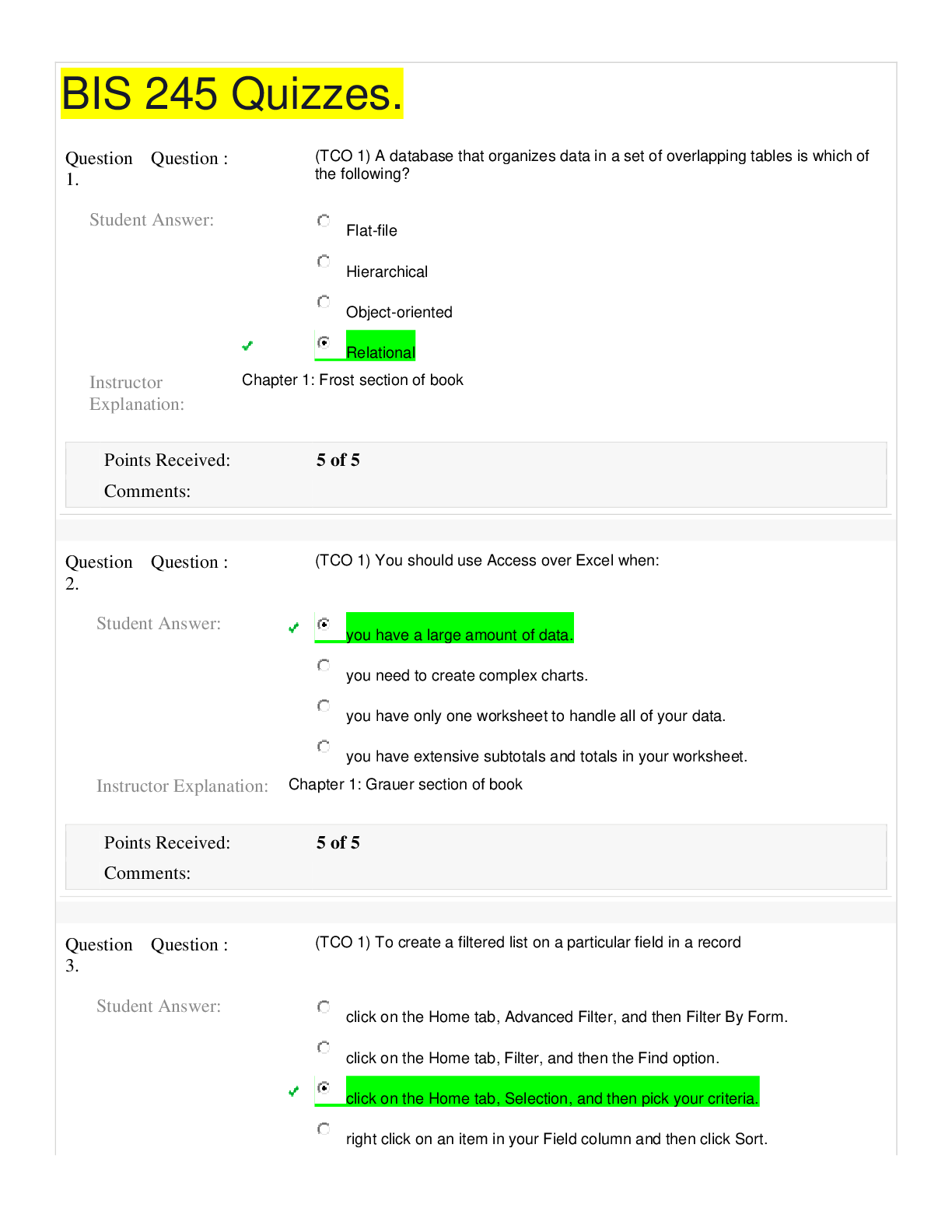
Question 1. Question : (TCO 1) A database that organizes data in a set of overlapping tables is which of the following?
Flat-file
Hierarchical
Object-oriented
Relational
...
BIS 245 Quizzes.
Question 1. Question : (TCO 1) A database that organizes data in a set of overlapping tables is which of the following?
Flat-file
Hierarchical
Object-oriented
Relational
Question 2. Question : (TCO 1) You should use Access over Excel when:
you have a large amount of data.
you need to create complex charts.
you have only one worksheet to handle all of your data.
you have extensive subtotals and totals in your worksheet.
Question 3. Question : (TCO 1) To create a filtered list on a particular field in a record
click on the Home tab, Advanced Filter, and then Filter By Form.
click on the Home tab, Filter, and then the Find option.
click on the Home tab, Selection, and then pick your criteria.
right click on an item in your Field column and then click Sort.
Question 4. Question : (TCO 1) To locate the tool to compact an Access database, click on the
File tab, Options, Current Database, and select Compact and Repair Database Tools.
Home tab, Advanced, and select Compact and Repair Database Tools.
Database Tools tab, and select Compact and Repair Database Tools.
External Data tab, and select Compact and Repair Database Tools.
Question 5. Question : (TCO 1) Which view best describes the image below?
Datasheet
Design
Form
Report
Question 6. Question : (TCO 2) In using a web search engine, typing the web site address in the proper place in the brower and then hitting enter is called
server setup.
presentation task.
client browsing.
systems application.
Question 7. Question : (TCO 2) Types of relationships between tables do NOT include
one-to-one
many-to-many
primary-to-foreign
many-to-one
5 of 5
Question 8. Question : (TCO 1) You should use Excel over Access when:
you have a large amount of data.
you need to group, sort, and total data based on various parameters.
you need multiple related tables to store data.
you require a series of what if scenarios on your data.
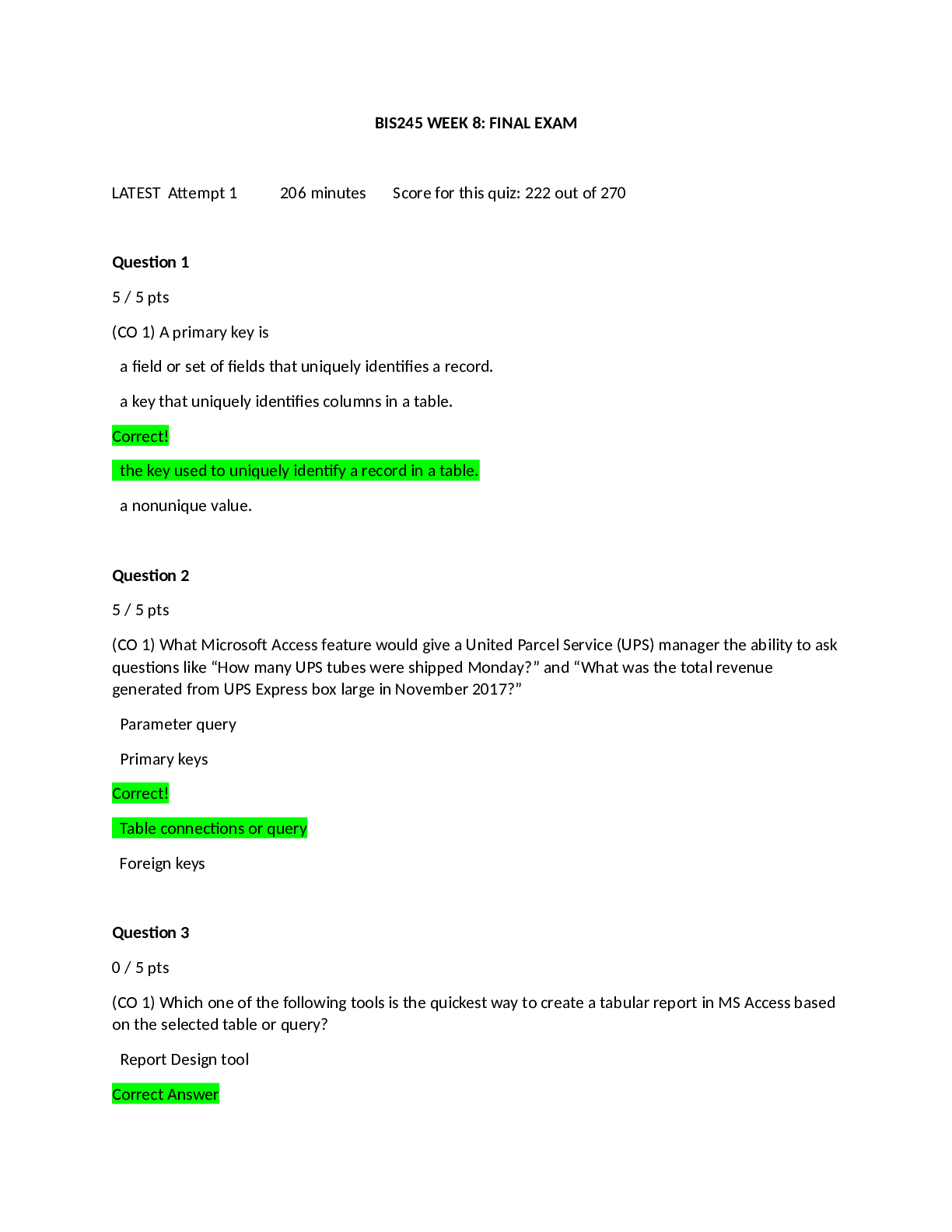
Question 1. Question : (TCO 2) When building a database, you should first
create and input the design of the table and reports at the same time.
determine the input and then design the tables.
determine the output and then design the tables.
input the data and then design the reports.
Question 2. Question : (TCO 2) Which of the following is used as a symbol for an entity?
Box
Diamond
Line
Triangle
Question 3. Question : (TCO 2) Columns in an Access table are called
fields.
records.
relation.
tuples.
Question 4. Question : (TCO 3) A relational table includes the following conditions EXCEPT
column entries and attributes must be the same data type.
rows must be in order.
cells contain a single data value.
columns or attributes have a well defined range of values.
Question 5. Question : (TCO 3) In Access, a query result that contained the date November 12, 2011 could have had which of the following query criteria?
11/12/2011
12/11/2011
#12/11/2011#
#11/12/2011#
Question 6. Question : (TCO 3) The field property that ensures that the field is not empty is
Format.
Required.
Validation.
Validation Rule.
Instructor Explanation: Chapter 2: Grauer section of book
Question 7. Question : (TCO 3) Which data type will increment automatically each time a new record is entered into a table?
AutoNumber
Currency
Date/Time
Number
Question 8. Question : (TCO 4) All of the following make good candidates for a single field in an employee table EXCEPT
Employee ID.
Hire date.
Last name.
Name.
Question 9. Question : (TCO 4) To ensure that a VALUE of 15 or greater was entered into a field, you would use a
field size.
field type.
Sarbanes-Oxley Act.
validation rule.
Question 10. Question : (TCO 2) In Access, which item below is NOT considered a logical operator?
Equal
And
Not
Or
Question 1. Question : (TCO 2) In a relational database, entities are
events.
persons.
things.
All of the above
Question 2. Question : (TCO 2) Which of the following is NOT a step in the Database Life Cycle (See Lecture)?
Database Design
Maintenance and Redevelopment
Throughput
Testing
Question 3. Question : (TCO 3) Database design refers to
developing a database model that will support company operations.
selecting the specific hardware characteristics based on data storage and data access requirements.
the process of converting your ERD into tables, and defining your rows and columns based your entities and attributes.
Instructor Explanation: Week 3 Lecture
Question 4. Question : (TCO 2) A crow's foot
is a Boolean field.
points to the child table.
points to the parent table.
Question 5. Question : (TCO 2) A one-to-many relationship is
a relationship that guarantees that a record is unique.
an association between a record and its own fields.
used to describe attributes.
when a row in one table is matched to multiple rows in a second table and a row in the second table is matched back to one row in the first table.
Question 6. Question : (TCO 2) A primary key
can be computer generated.
consists of one field only.
is a relationship between two or more tables.
All of the above.
Question 7. Question : (TCO 3) Which of the following does NOT describe data redundancy?
The same data exists in multiple tables.
The data is always in linked tables.
Data updating must be done in multiple table locations.
Data redundancy can result in data anomalies.
Question 8. Question : (TCO 4) Entity attributes are represented as
fields.
files.
records.
tables.
Question 9. Question : (TCO 4) You can reserve space for a field using the
PNPI regulations.
Sarbanes-Oxley Act.
field size property.
validation rule.
Question 10. Question : (TCO 4) All of the following are examples of good primary keys EXCEPT
employee ID.
social security number.
ISBN number on a textbook.
last name.
Question 1. Question : (TCO 1) Which object, by definition, allows you to ask questions about the data stored in a database, such as which customers live in New Orleans and Seattle?
Form
Query
Table
Question 2. Question : (TCO 2) When constructing criteria for a query, you should use
no delimiters for number data types.
quotes to enclose Date/Time data types.
single quotes for number data types.
the pound sign to enclose text data.
Question 3. Question : (TCO 2) In Access, query results are displayed in which view?
datasheet.
form.
design.
report.
Question 4. Question : (TCO 2) Which of the following is NOT a recommended practice for designing multi-table queries?
Include only related tables in your query.
Remove join lines in Query Design to speed up query processing.
Related tables should be established before you design a multitable query.
Print a Relationship Report to guide you in selecting related tables.
Question 5. Question : (TCO 2) The command language used with relational databases is
PNPI.
RDBMS.
SQL.
tuple.
Question 6. Question : (TCO 2) Another term for an expression is
formula.
function.
parameter.
query.
Instructor Explanation: Chapter 3: Grauer section of book
Question 7. Question : (TCO 2) A function used to isolate a specific portion of a date such as year, month, or day in a date field is
Date.
DateDiff.
DateParse.
DatePart.
Question 8. Question : (TCO 2) You can add records (data) through the
DataSheet View of a table.
Design View of a table.
Report View.
All of the above
Question 9. Question : (TCO 6) Which of the following does NOT describe data redundancy?
The same data exists in multiple tables.
The data is always in linked tables.
Data updating must be done in multiple table locations.
Data redundancy can result in data anomalies.
Question 10. Question : (TCO 6) Which of the following is true about a crosstab query?
It is an action query.
It is used to retrieve parameter data.
It summarizes a data source into rows and columns with aggregate data displayed at the intersection of the rows and columns.
It summarizes unmatched records from a data source.
Question 1. Question : (TCO 2) A validation rule
can prohibit values from being entered that may not meet a criterion.
compares a field to a table.
is an error message that appears when a value is incorrectly entered into a field.
makes a value entered into a field appear in a particular format.
Question 2. Question : (TCO 2) The process of checking the reliability of data is called
data validation.
input mask.
primary key.
Question 3. Question : (TCO 2) When entering data into a field, which of the following would require the user to input a value that is higher than a zero?
0
>0
=>0
>=0>
Question 4. Question : (TCO 2) Validation text is
an error message that provides instruction on what to fix when an incorrect value is entered into a field.
a list of predefined values that can be entered in a field.
a comparison of values entered in two fields.
a field that requires a value of characters or text only.
Question 5. Question : (TCO 2) An input mask
allows one record to have more than two field values.
allows the user to type a social security number as 111223333 and it would display as 111-22-3333.
confirms that a value greater than 100 is a valid value.
is a list of values that are previously defined from which the user can select one item.
Question 6. Question : (TCO 2) An input mask that will only allow for digits from 0 to 9 and the + or - sign is
AA.
99.
##.
00.
Question 7. Question : (TCO 2) An input mask that will NOT accept a letter (A to Z) in a field value is
?.
A.
L.
#.
Question 8. Question : (TCO 5) To edit a form, use the
design view.
datasheet view.
layout view.
layout view or design view.
Question 9. Question : (TCO 5) Which statement below best describes how designers and users work with forms?
The designer of a form will make it perfectly functional and easy to use the first time.
The designer of a form should keep revising a form as suggested by the users.
The designer and users will never need to edit a well designed form.
Question 10. Question : (TCO 5) All of the following are aggregate functions EXCEPT
average.
count.
minimum.
subtract.
1. Question : (TCO 1) Which of the following is not a step in DESIGNING a report?
Create a sketch of your report.
Identify the record source and fields for your report.
Input the data for your report.
Determine sorts, groups, and summaries for your report.
Question 2. Question : (TCO 1) Which of the following is NOT a Report Wizard Layout type?
Block
Outline
Stepped
Paved
Question 3. Question : (TCO 1) Which of the following statements best describes the image below?
Datasheet view of the Employees report
Design view of the Employees report
Layout view of the Employees report
Question 4. Question : (TCO 1) The selected image below shows
Report View.
Layout View.
Design View.
Print View.
Comments:
Question 5. Question : (TCO 1) A report can be created from
queries and tables.
forms.
Instructor Explanation: Chapter 4: Grauer section of book
Question 6. Question : (TCO 1) Modifications to a report can be done in
Detail View.
Layout View.
Print View.
All of the above
Question 7. Question : (TCO 1) By default, Print Preview will
print the first record in a report.
allow you to modify the report design.
display all the pages in a report.
display only summary data.
Comments:
Question 8. Question : (TCO 1) When designing a report, make sure that your report
does not have grouped data.
is clear and easy to understand.
uses all report sections.
Question 9. Question : (TCO 7) Data mining refers to
analyzing volumes of data to identify trends and patterns.
conducting what if analyses.
analyzing minute differences in field data.
the least squares regression technique.
Question 10. Question : (TCO 7) All of the following are Aggregate Functions EXCEPT
average.
count.
pick.
sum.
[Show More]