The child with seizure disorder is being treated with Dilantin
(phenytoin). Which of the following statements by the patient’s mother
indicates to the nurse that the patient is experiencing a side effect of Dilantin
t
...
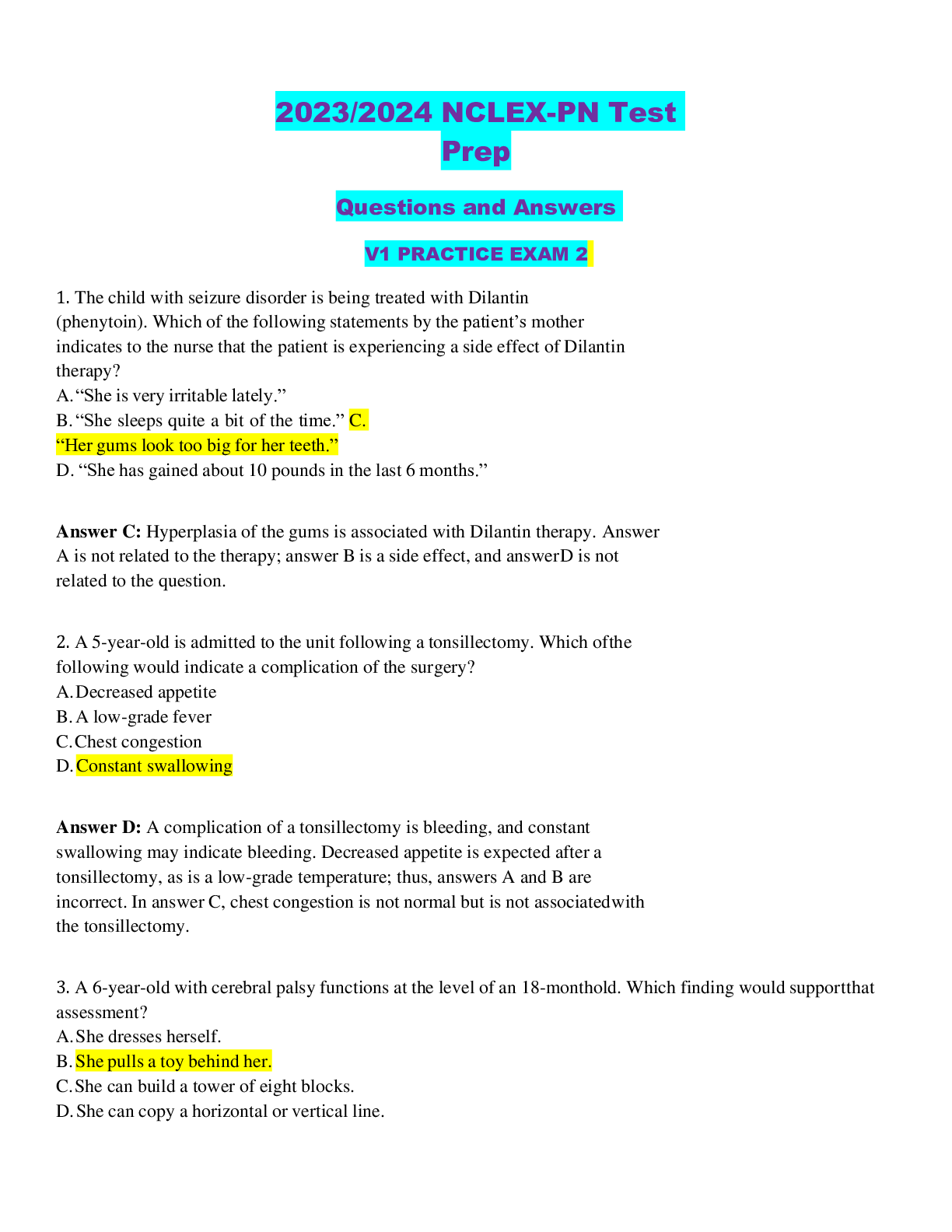
The child with seizure disorder is being treated with Dilantin
(phenytoin). Which of the following statements by the patient’s mother
indicates to the nurse that the patient is experiencing a side effect of Dilantin
therapy?
A. “She is very irritable lately.”
B. “She sleeps quite a bit of the time.”
C. “Her gums look too big for her teeth.”
D. “She has gained about 10 pounds in the last 6 months.”
Answer C: Hyperplasia of the gums is associated with Dilantin therapy.
Answer A is not related to the therapy; answer B is a side effect, and answer
D is not related to the question.
2. A 5-year-old is admitted to the unit following a tonsillectomy. Which of
the following would indicate a complication of the surgery?
A. Decreased appetite
B. A low-grade fever
C. Chest congestion
D. Constant swallowing
Answer D: A complication of a tonsillectomy is bleeding, and constant
swallowing may indicate bleeding. Decreased appetite is expected after a
tonsillectomy, as is a low-grade temperature; thus, answers A and B are
incorrect. In answer C, chest congestion is not normal but is not associated
with the tonsillectomy.
3. A 6-year-old with cerebral palsy functions at the level of an 18-monthold. Which finding would support
that assessment?
A. She dresses herself.
B. She pulls a toy behind her.
C. She can build a tower of eight blocks.
D. She can copy a horizontal or vertical line.
Answer B: Children at 18 months of age like push-pull toys. Children at
approximately 3 years of age begin to dress themselves and build a tower of
eight blocks. At age four, children can copy a horizontal or vertical line.
Therefore, answers A, C, and D are incorrect.
4. Which information obtained from the mother of a child with cerebral
palsy most likely correlates to the diagnosis?
A. She was born at 42 weeks gestation.
B. She had meningitis when she was 6 months old.
C. She had physiologic jaundice after delivery.
D. She has frequent sore throats.
Answer B: The diagnosis of meningitis at age 6 months correlates to a
diagnosis of cerebral palsy. Cerebral palsy, a neurological disorder, is often
associated with birth trauma or infections of the brain or spinal column.
Answers A, C, and D are not related to the question.
5. A 10-year-old is being treated for asthma. Before administering
Theodur, the nurse should check the:
A. Urinary output
B. Blood pressure
C. Pulse
D. Temperature
Answer C: Theodur is a bronchodilator, and a side effect of bronchodilators
is tachycardia, so checking the pulse is important. Extreme tachycardia
should be reported to the doctor. Answers A, B, and D are not necessary.
106. An elderly client is diagnosed with ovarian cancer. She has surgery
followed by chemotherapy with a fluorouracil (Adrucil) IV. What should the
nurse do if she notices crystals and cloudiness in the IV medication?
A. Discard the solution and order a new bag
B. Warm the solution
C. Continue the infusion and document the finding
D. Discontinue the medication
Answer A: Crystals in the solution are not normal and should not be
administered to the client. Discard the bad solution immediately. Answer B is
incorrect because warming the solution will not help. Answer C is incorrect,
and answer D requires a doctor’s order.
7. The client is diagnosed with multiple myoloma. The doctor has ordered
cyclophosphamide (Cytoxan). Which instruction should be given to the
client?
A. “Walk about a mile a day to prevent calcium loss.”
B. “Increase the fiber in your diet.”
C. “Report nausea to the doctor immediately.”
D. “Drink at least eight large glasses of water a day.”
Answer D: Cytoxan can cause hemorrhagic cystitis, so the client should
drink at least eight glasses of water a day. Answers A and B are not necessary
and, so, are incorrect. Nausea often occurs with chemotherapy, so answer C
is incorrect.
[Show More]