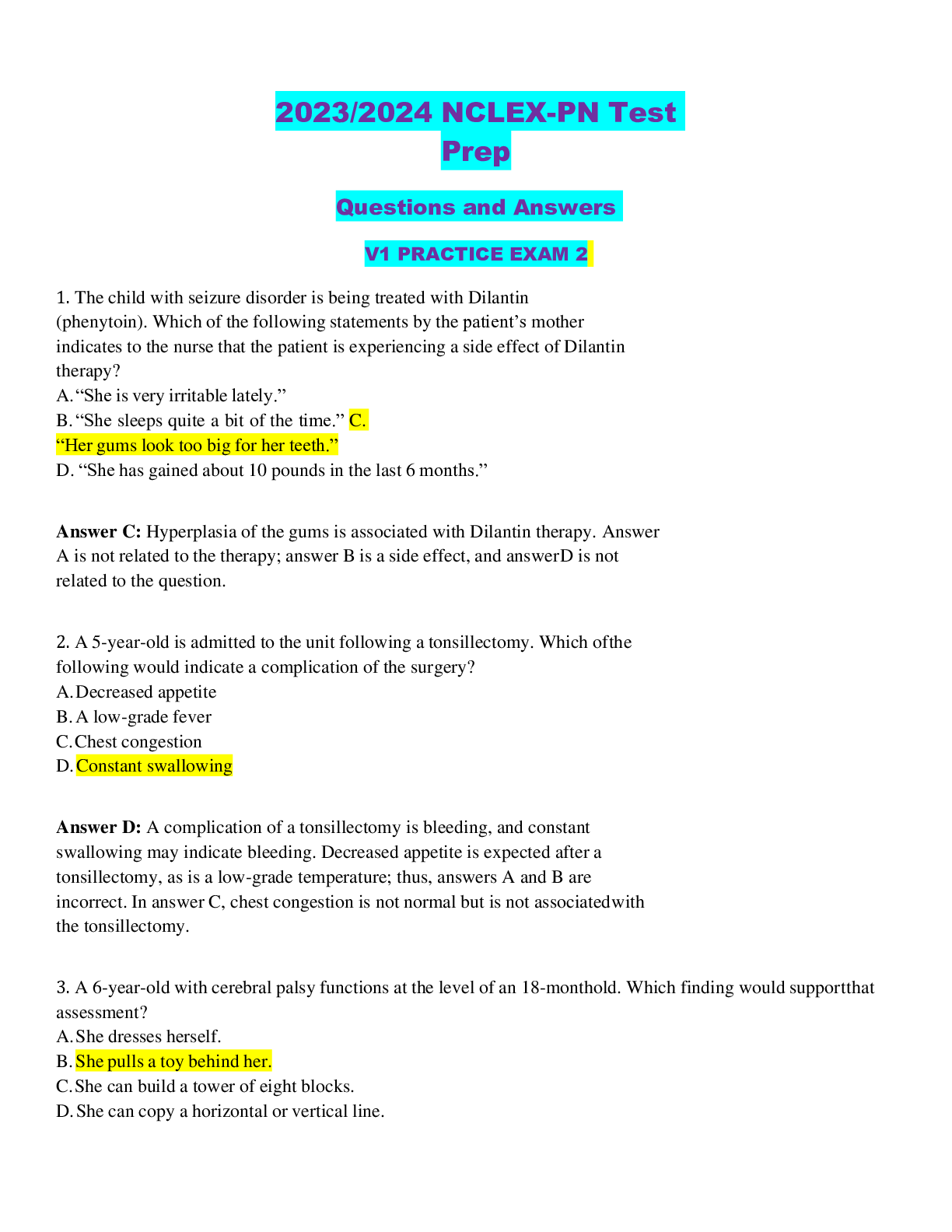
2020/2021 NCLEX-PN Test Prep
Questions and Answers with Explanations
V1 PRACTICE EXAM 1 (STUDY MODE)
1. The nurse is caring for a client scheduled for removal of a pituitary tumor
using the transsphenoidal approac
...
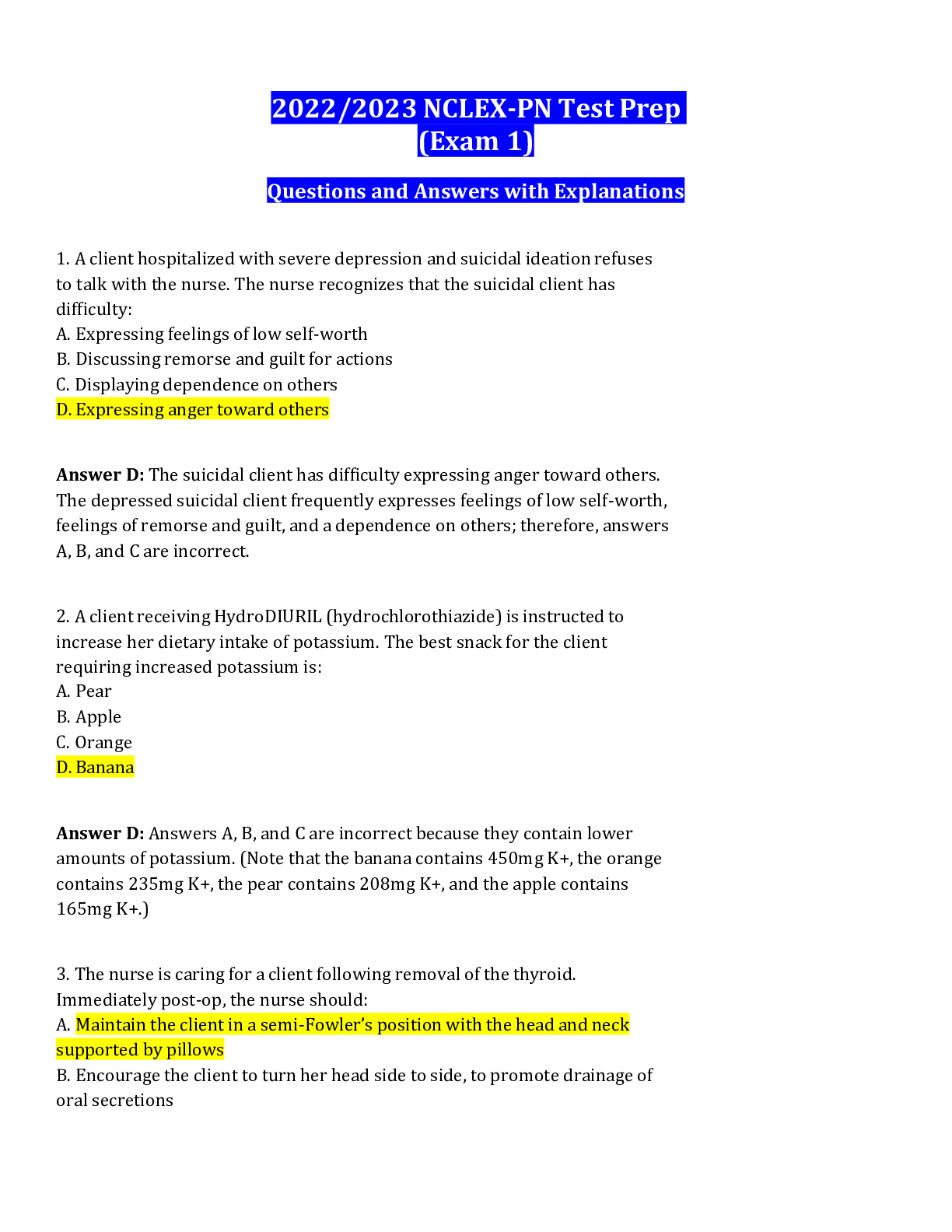
2020/2021 NCLEX-PN Test Prep
Questions and Answers with Explanations
V1 PRACTICE EXAM 1 (STUDY MODE)
1. The nurse is caring for a client scheduled for removal of a pituitary tumor
using the transsphenoidal approach. The nurse should be particularly alert
for:
A. Nasal congestion
B. Abdominal tenderness
C. Muscle tetanic
D. Oliguria
Answer A: Removal of the pituitary gland is usually done by a
transsphenoidal approach, through the nose. Nasal congestion further
interferes with the airway. Answers B, C, and D are not correct because they
are not directly associated with the pituitary gland.
2. A client with cancer is admitted to the oncology unit. Stat lab values reveal
Hgb 12.6, WBC 6500, K+ 1.9, uric acid 7.0, Na+ 136, and platelets 178,000.
The nurse evaluates that the client is experiencing which of the following?
A. Hypernatremia
B. Hypokalemia
C. Myelosuppression
D. Leukocytosis
Answer B: Hypokalemia is evident from the lab values listed. The other
laboratory findings are within normal limits, making answers A, C, and D
incorrect.
3. A 24-year-old female client is scheduled for surgery in the morning.
Which of the following is the primary responsibility of the nurse?
A. Taking the vital signs
B. Obtaining the permit
C. Explaining the procedure
D. Checking the lab work
Answer A: The primary responsibility of the nurse is to take the vital signs
before any surgery. The actions in answers B, C, and D are the responsibility
of the doctor and, therefore, are incorrect for this question.
4. The nurse is working in the emergency room when a client arrives with
severe burns of the left arm, hands, face, and neck. Which action should
receive priority?
A. Starting an IV
B. Applying oxygen
C. Obtaining blood gases
D. Medicating the client for pain
Answer B: The client with burns to the neck needs airway assessment and
supplemental oxygen, so applying oxygen is the priority. The next action
should be to start an IV and medicate for pain, making answers A and C
incorrect. Answer D, obtaining blood gases, is ordered by the doctor.
5. The nurse is visiting a home health client with osteoporosis. The client has
a new prescription for alendronate (Fosamax). Which instruction should be
given to the client?
A. Rest in bed after taking the medication for at least 30 minutes
B. Avoid rapid movements after taking the medication
C. Take the medication with water only
D. Allow at least 1 hour between taking the medicine and taking other
medications
Answer B: The client with burns to the neck needs airway assessment and
supplemental oxygen, so applying oxygen is the priority. The next action
should be to start an IV and medicate for pain, making answers A and C
incorrect. Answer D, obtaining blood gases, is ordered by the doctor.
6. The nurse is making initial rounds on a client with a C5 fracture and
crutchfield tongs. Which equipment should be kept at the bedside?
A. A pair of forceps
B. A torque wrench
C. A pair of wire cutters
D. A screwdriver
Answer B: A torque wrench is kept at the bedside to tighten and loosen the
screws of crutchfield tongs. This wrench controls the amount of pressure that
is placed on the screws. A pair of forceps, wire cutters, and a screwdriver, in
answers A, C, and D, would not be used and, thus, are incorrect.
7. An infant weighs 7 pounds at birth. The expected weight by 1 year should
be:
A. 10 pounds
B. 12 pounds
C. 18 pounds
D. 21 pounds
Answer D: A birth weight of 7 pounds would indicate 21 pounds in 1 year,
or triple his birth weight. Answers A, B, and C therefore are incorrect.
8. A client is admitted with a Ewing’s sarcoma. Which symptoms would be
expected due to this tumor’s location?
A. Hemiplegia
B. Aphasia
C. Nausea
D. Bone pain
Answer D: Sarcoma is a type of bone cancer; therefore, bone pain would be
expected. Answers A, B, and C are not specific to this type of cancer and are
incorrect.
9. The nurse is caring for a client with epilepsy who is being treated with
carbamazepine (Tegretol). Which laboratory value might indicate a serious
side effect of this drug?
A. Uric acid of 5mg/dL
B. Hematocrit of 33%
C. WBC 2,000 per cubic millimeter
D. Platelets 150,000 per cubic millimeter
Answer C: Tegretol can suppress the bone marrow and decrease the white
blood cell count; thus, a lab value of WBC 2,000 per cubic millimeter
indicates side effects of the drug. Answers A and D are within normal limits,
and answer B is a lower limit of normal; therefore, answers A, B, and D are
incorrect.
10. A 6-month-old client is admitted with possible intussuception. Which
question during the nursing history is least helpful in obtaining information
regarding this diagnosis?
A. “Tell me about his pain.”
B. “What does his vomit look like?”
C. “Describe his usual diet.”
D. “Have you noticed changes in his abdominal size?”
Answer C: The least-helpful questions are those describing his usual diet. A,
B, and D are useful in determining the extent of disease process and, thus, are
incorrect.
11. The nurse is assisting a client with diverticulosis to select appropriate
foods. Which food should be avoided?
A. Bran
B. Fresh peaches
C. Cucumber salad
D. Yeast rolls
Answer C: The client with diverticulitis should avoid foods with seeds. The
foods in answers A, B, and D are allowed; in fact, bran cereal and fruit will
help prevent constipation.
12. A client has rectal cancer and is scheduled for an abdominal perineal
resection. What should be the priority nursing care during the post-op period?
A. Teaching how to irrigate the illeostomy
B. Stopping electrolyte loss in the incisional area
C. Encouraging a high-fiber diet
D. Facilitating perineal wound drainage
Answer D: The client with a perineal resection will have a perineal incision.
Drains will be used to facilitate wound drainage. This will help prevent
infection of the surgical site. The client will not have an illeostomy, as in
answer A; he will have some electrolyte loss, but treatment is not focused on
preventing the loss, so answer B is incorrect. A high-fiber diet, in answer C,
is not ordered at this time.
13. The nurse is performing discharge teaching on a client with diverticulitis
who has been placed on a low-roughage diet. Which food would have to be
eliminated from this client’s diet?
A. Roasted chicken
B. Noodles
C. Cooked broccoli
D. Custard
Answer C: The client with diverticulitis should avoid eating foods that are
gas forming and that increase abdominal discomfort, such as cooked broccoli.
Foods such as those listed in answers A, B, and D are allowed.
14. The nurse is caring for a new mother. The mother asks why her baby has
lost weight since he was born. The best explanation of the weight loss is:
A. The baby is dehydrated due to polyuria.
B. The baby is hypoglycemic due to lack of glucose.
C. The baby is allergic to the formula the mother is giving him.
D. The baby can lose up to 10% of weight due to meconium stool, loss of
extracellular fluid, and initiation of breast-feeding.
Answer D: After birth, meconium stool, loss of extracellular fluid, and
initiation of breastfeeding cause the infant to lose body mass. There is no
evidence to indicate dehydration, hypoglycemia, or allergy to the infant
formula; thus, answers A, B, and C are incorrect.
15. The nurse is caring for a client with laryngeal cancer. Which finding
ascertained in the health history would not be common for this diagnosis?
A. Foul breath
B. Dysphagia
C. Diarrhea
D. Chronic hiccups
Answer C: Diarrhea is not common in clients with mouth and throat cancer.
All the findings in answers A, B, and D are expected findings.
16. A removal of the left lower lobe of the lung is performed on a client with
lung cancer. Which post-operative measure would usually be included in the
plan?
A. Closed chest drainage
B. A tracheostomy
C. A mediastinal tube
D. Percussion vibration and drainage
Answer A: The client with a lung resection will have chest tubes and a
drainage-collection device. He probably will not have a tracheostomy or
mediastinal tube, and he will not have an order for percussion, vibration, or
drainage. Therefore, answers B, C, and D are incorrect.
17. Six hours after birth, the infant is found to have an area of swelling over
the right parietal area that does not cross the suture line. The nurse should
chart this finding as:
A. A cephalohematoma
B. Molding
C. Subdural hematoma
D. Caput succedaneum
Answer A: A swelling over the right parietal area is a cephalohematoma, an
area of bleeding outside the cranium. This type of hematoma does not cross
the suture line because it is outside the cranium but beneath the periosteum.
Answer B, molding, is overlapping of the bones of the cranium and, thus,
incorrect. In answer C, a subdural hematoma, or intracranial bleeding, is
ominous and can be seen only on a CAT scan or x-ray. A caput
succedaneum, in answer D, crosses the suture line and is edema.
18. The nurse is assisting the RN with discharge instructions for a client with
an implantable defibrillator. What discharge instruction is essential?
A. “You cannot eat food prepared in a microwave.”
B. “You should avoid moving the shoulder on the side of the pacemaker site
for 6 weeks.”
C. “You should use your cellphone on your right side.”
D. “You will not be able to fly on a commercial airliner with the defibrillator
in place.”
Answer C: The client with an internal defibrillator should learn to use any
battery-operated machinery on the opposite side. He should also take his
pulse rate and report dizziness or fainting. Answers A, B, and D are incorrect
because the client can eat food prepared in the microwave, move his shoulder
on the affected side, and fly in an airplane.
19. A client in the cardiac step-down unit requires suctioning for excess
mucous secretions. The nurse should be most careful to monitor the client for
which dysrhythmia during this procedure?
A. Bradycardia
B. Tachycardia
C. Premature ventricular beats
D. Heart block
Answer A: Suctioning can cause a vagal response and bradycardia. Answer
B is unlikely and, therefore, not most important, although it can occur.
Answers C and D can occur as well, but they are less likely.
20. The nurse is caring for a client scheduled for a surgical repair of a sacular
abdominal aortic aneurysm. Which assessment is most crucial during the
preoperative period?
A. Assessment of the client’s level of anxiety
B. Evaluation of the client’s exercise tolerance
C. Identification of peripheral pulses
D. Assessment of bowel sounds and activity
Answer C: The assessment that is most crucial to the client is the
identification of peripheral pulses because the aorta is clamped during
surgery. This decreases blood circulation to the kidneys and lower
extremities. The nurse must also assess for the return of circulation to the
lower extremities. Answer A is of lesser concern, answer B is not advised at
this time, and answer D is of lesser concern than answer A.
21. A client with suspected renal disease is to undergo a renal biopsy. The
nurse plans to include which statement in the teaching session?
A. “You will be sitting for the examination procedure.”
B. “Portions of the procedure will cause pain or discomfort.”
C. “You will be given some medication to anesthetize the area.”
D. “You will not be able to drink fluids for 24 hours before the study.”
Answer B: Portions of the exam are painful, especially when the sample is
being withdrawn, so this should be included in the session with the client.
Answer A is incorrect because the client will be positioned prone, not in a
sitting position, for the exam. Anesthesia is not commonly given before this
test, making answer C incorrect. Answer D is incorrect because the client can
eat and drink following the test.
22. The nurse is performing an assessment on a client with possible
pernicious anemia. Which data would support this diagnosis?
A. A weight loss of 10 pounds in 2 weeks
B. Complaints of numbness and tingling in the extremities
C. A red, beefy tongue
D. A hemoglobin level of 12.0gm/dL
Answer C: A red, beefy tongue is characteristic of the client with pernicious
anemia. Answer A, a weight loss of 10 pounds in 2 weeks, is abnormal but is
not seen in pernicious anemia. Numbness and tingling, in answer B, can be
associated with anemia but are not particular to pernicious anemia. This is
more likely associated with peripheral vascular diseases involving
vasculature. In answer D, the hemoglobin is low normal.
23. A client arrives in the emergency room with a possible fractured femur.
The nurse should anticipate an order for:
A. Trendelenburg position
B. Ice to the entire extremity
C. Buck’s traction
D. An abduction pillow
Answer C: The client with a fractured femur will be placed in Buck’s
traction to realign the leg and to decrease spasms and pain. The
Trendelenburg position is the wrong position for this client, so answer A is
incorrect. Ice might be ordered after repair, but not for the entire extremity, so
answer B is incorrect. An abduction pillow is ordered after a total hip
replacement, not for a fractured femur; therefore, answer D is incorrect.
24. A client with cancer is to undergo an intravenous pyelogram. The nurse
should:
A. Force fluids 24 hours before the procedure
B. Ask the client to void immediately before the study
C. Hold medication that affects the central nervous system for 12 hours preand post-test
D. Cover the client’s reproductive organs with an x-ray shield
Answer B: The client having an intravenous pyelogram will have orders for
laxatives or enemas, so asking the client to void before the test is in order. A
full bladder or bowel can obscure the visualization of the kidney ureters and
urethra. In answers A, C, and D, there is no need to force fluids before the
procedure, to withhold medications, or to cover the reproductive organs.
25. The nurse is caring for a client with a malignancy. The classification of
the primary tumor is Tis. The nurse should plan care for a tumor:
A. That cannot be assessed
B. That is in situ
C. With increasing lymph node involvement
D. With distant metastasis
Answer B: Cancer in situ means that the cancer is still localized to the
primary site. Cancer is graded in terms of tumor, grade, node involvement,
and mestatasis. Answer A is incorrect because it is an untrue statement.
Answer C is incorrect because T indicates tumor, not node involvement.
Answer D is incorrect because a tumor that is in situ is not metastasized.
26. A client is 2 days post-operative colon resection. After a coughing
episode, the client’s wound eviscerates. Which nursing action is most
appropriate?
A. Reinsert the protruding organ and cover with 4×4s
B. Cover the wound with a sterile 4×4 and ABD dressing
C. Cover the wound with a sterile saline-soaked dressing
D. Apply an abdominal binder and manual pressure to the wound
Answer C: If the client eviscerates, the abdominal content should be covered
with a sterile saline-soaked dressing. Reinserting the content should not be
the action and will require that the client return to surgery; thus, answer A is
incorrect. Answers B and D are incorrect because they are not appropriate to
this case.
27. The nurse is preparing a client for surgery. Which item is most important
to remove before sending the client to surgery?
A. Hearing aid
B. Contact lenses
C. Wedding ring
D. Artificial eye
Answer B: It is most important to remove the contact lenses because leaving
them in can lead to corneal drying, particularly with contact lenses that are
not extended-wear lenses. Leaving in the hearing aid or artificial eye will not
harm the client. Leaving the wedding ring on is also allowed; usually, the
ring is covered with tape. Therefore, answers A, C, and D are incorrect.
28. The nurse on the 3–11 shift is assessing the chart of a client with an
abdominal aneurysm scheduled for surgery in the morning and finds that the
consent form has been signed, but the client is unclear about the surgery and
possible complications. Which is the most appropriate action?
A. Call the surgeon and ask him or her to see the client to clarify the
information
B. Explain the procedure and complications to the client
C. Check in the physician’s progress notes to see if understanding has been
documented
D. Check with the client’s family to see if they understand the procedure
fully
Answer A: It is the responsibility of the physician to explain and clarify the
procedure to the client. Answers B, C, and D are incorrect because they are
not within the nurse’s purview.
29. When assessing a client for risk of hyperphosphatemia, which piece of
information is most important for the nurse to obtain?
A. A history of radiation treatment in the neck region
B. A history of recent orthopedic surgery
C. A history of minimal physical activity
D. A history of the client’s food intake
Answer A: Previous radiation to the neck might have damaged the
parathyroid glands, which are located on the thyroid gland, and interfered
with calcium and phosphorus regulation. Answer B has no significance to
this case; answers C and D are more related to calcium only, not to
phosphorus regulation.
30. A client is admitted to the acute care unit. Initial laboratory values reveal
serum sodium of 170meq/L. What behavior changes would be most common
for this client?
A. Anger
B. Mania
C. Depression
D. Psychosis
Answer B: The client with serum sodium of 170meq/L has hypernatremia
and might exhibit manic behavior. Answers A, C, and D are not associated
with hypernatremia and are, therefore, incorrect.
31. The nurse is obtaining a history of an 80-year-old client. Which statement
made by the client might indicate a possible fluid and electrolyte imbalance?
A. “My skin is always so dry.”
B. “I often use a laxative for constipation.”
C. “I have always liked to drink a lot of ice tea.”
D. “I sometimes have a problem with dribbling urine.”
Answer B: Frequent use of laxatives can lead to diarrhea and electrolyte loss.
Answers A, C, and D are not of particular significance in this case and,
therefore, are incorrect.
32. A client visits the clinic after the death of a parent. Which statement made
by the client’s sister signifies abnormal grieving?
A. “My sister still has episodes of crying, and it’s been 3 months since Daddy
died.”
B. “Sally seems to have forgotten the bad things that Daddy did in his
lifetime.”
C. “She really had a hard time after Daddy’s funeral. She said that she had a
sense of longing.”
D. “Sally has not been sad at all by Daddy’s death. She acts like nothing has
happened.”
Answer D: Abnormal grieving is exhibited by a lack of feeling sad; if the
client’s sister appears not to grieve, it might be abnormal grieving. This
family member might be suppressing feelings of grief. Answers A, B, and C
are all normal expressions of grief and, therefore, incorrect.
33. The nurse recognizes that which of the following would be most
appropriate to wear when providing direct care to a client with a cough?
A. Mask
B. Gown
C. Gloves
D. Shoe covers
Answer A: If the nurse is exposed to the client with a cough, the best item to
wear is a mask. If the answer had included a mask, gloves, and a gown, all
would be appropriate, but in this case, only one item is listed; therefore,
answers B and C are incorrect. Shoe covers are not necessary, so answer D is
incorrect.
34. The nurse is caring for a client with a diagnosis of hepatitis who is
experiencing pruritis. Which would be the most appropriate nursing
intervention?
A. Suggest that the client take warm showers B.I.D.
B. Add baby oil to the client’s bath water
C. Apply powder to the client’s skin
D. Suggest a hot-water rinse after bathing
Answer B: Oils can be applied to help with the dry skin and to decrease
itching, so adding baby oil to bath water is soothing to the skin. Answer A is
incorrect because bathing twice a day is too frequent and can cause more
dryness. Answer C is incorrect because powder is also drying. Rinsing with
hot water, as stated in answer D, dries out the skin as well.
35. A client with pancreatitis has been transferred to the intensive care unit.
Which order would the nurse anticipate?
A. Blood pressure every 15 minutes
B. Insertion of a Levine tube
C. Cardiac monitoring
D. Dressing changes two times per day
Answer B: The client with pancreatitis frequently has nausea and vomiting.
Lavage is often used to decompress the stomach and rest the bowel, so the
insertion of a Levine tube should be anticipated. Answers A and C are
incorrect because blood pressures are not required every 15 minutes, and
cardiac monitoring might be needed, but this is individualized to the client.
Answer D is incorrect because there are no dressings to change on this client.
36. The client is admitted to the unit after a cholescystectomy. Montgomery
straps are utilized with this client. The nurse is aware that Montgomery straps
are utilized on this client because:
A. The client is at risk for evisceration.
B. The client will require frequent dressing changes.
C. The straps provide support for drains that are inserted in the incision.
D. No sutures or clips are used to secure the incision.
Answer B: Montgomery straps are used to secure dressings that require
frequent dressing changes because the client with a cholecystectomy usually
has a large amount of drainage on the dressing. Montgomery straps are also
used for clients who are allergic to several types of tape. This client is not at
higher risk of evisceration than other clients, so answer A is incorrect.
Montgomery straps are not used to secure the drains, so answer C is
incorrect. Sutures or clips are used to secure the wound of the client who has
had gallbladder surgery, so answer D is incorrect.
37. The physician has ordered that the client’s medication be administered
intrathecally. The nurse is aware that medications will be administered by
which method?
A. Intravenously
B. Rectally
C. Intramuscularly
D. Into the cerebrospinal fluid
Answer D: Intrathecal medications are administered into the cerebrospinal
fluid. This method of administering medications is reserved for the client
with metastases, the client with chronic pain, or the client with cerebrospinal
infections. Answers A, B, and C are incorrect because intravenous, rectal,
and intramuscular injections are entirely different procedures.
38. Which client can best be assigned to the newly licensed practical nurse?
A. The client receiving chemotherapy
B. The client post–coronary bypass
C. The client with a TURP
D. The client with diverticulitis
Answer D: The best client to assign to the newly licensed nurse is the most
stable client; in this case, it is the client with diverticulitis. The client
receiving chemotherapy and the client with a coronary bypass both need
nurses experienced in these areas, so answers A and B are incorrect. Answer
D is incorrect because the client with a transurethral prostatectomy might
bleed, so this client should be assigned to a nurse who knows how much
bleeding is within normal limits.
39. The nurse notes the patient care assistant looking through the personal
items of the client with cancer. Which action should be taken by the
registered nurse?
A. Notify the police department as a robbery
B. Report this behavior to the charge nurse
C. Monitor the situation and note whether any items are missing
D. Ignore the situation until items are reported missing
Answer B: The best action at this time is to report the incident to the charge
nurse. Further action might be needed, but it should be determined by the
charge nurse. Answers A, C, and D are incorrect because notifying the police
is overreacting at this time, and monitoring or ignoring the situation is an
inadequate response.
40. The nurse overhears the patient care assistant speaking harshly to the
client with dementia. The charge nurse should:
A. Change the nursing assistant’s assignment
B. Explore the interaction with the nursing assistant
C. Discuss the matter with the client’s family
D. Initiate a group session with the nursing assistant
Answer B: The best action for the nurse to take is to explore the interaction
with the nursing assistant. This will allow for clarification of the situation.
Changing the assignment in answer A might need to be done, but talking to
the nursing assistant is the first step. Answer C is incorrect because
discussing the incident with the family is not necessary at this time; it might
cause more problems. Answer C is not a first step, even though initiating a
group session might be a plan for the future.
41. A home health nurse is planning for her daily visits. Which client should
the home health nurse visit first?
A. A client with AIDS being treated with Foscarnet
B. A client with a fractured femur in a long leg cast
C. A client with laryngeal cancer with a laryngetomy
D. A client with diabetic ulcers to the left foot
Answer C: The client with laryngeal cancer has a potential airway alteration
and should be seen first. The clients in answers A, B, and D are not in
immediate danger and can be seen later in the day.
42. The nurse is assigned to care for an infant with physiologic jaundice.
Which action by the nurse would facilitate elimination of the bilirubin?
A. Increasing the infant’s fluid intake
B. Maintaining the infant’s body temperature at 98.6°F
C. Minimizing tactile stimulation
D. Decreasing caloric intake
Answer A: Bilirubin is excreted through the kidneys, thus the need for
increased fluids. Maintaining the body temperature is important but will not
assist in eliminating bilirubin; therefore, answer B is incorrect. Answers C
and D are incorrect because they do not relate to the question.
43. The graduate licensed practical nurse is assigned to care for the client on
ventilator support, pending organ donation. Which goal should receive
priority?
A. Maintain the client’s systolic blood pressure at 70mmHg or greater
B. Maintain the client’s urinary output greater than 300cc per hour
C. Maintain the client’s body temperature of greater than 33°F rectal
D. Maintain the client’s hematocrit less than 30%
Answer A: When the cadaver client is being prepared to donate an organ, the
systolic blood pressure should be maintained at 70mmHg or greater to ensure
a blood supply to the donor organ. Answers B, C, and D are incorrect because
they are unnecessary actions for organ donation.
44. Which action by the novice nurse indicates a need for further teaching?
A. The nurse fails to wear gloves to remove a dressing.
B. The nurse applies an oxygen saturation monitor to the ear lobe.
C. The nurse elevates the head of the bed to check the blood pressure.
D. The nurse places the extremity in a dependent position to acquire a
peripheral blood sample.
Answer A: The nurse who fails to wear gloves to remove a contaminated
dressing needs further instruction. Answers B, C, and D are incorrect because
they indicate an understanding of the correct method of completing these
tasks.
45. The nurse is preparing a client for mammography. To prepare the client
for a mammogram, the nurse should tell the client:
A. To restrict her fat intake for 1 week before the test
B. To omit creams, powders, or deodorants before the exam
C. That mammography replaces the need for self-breast exams
D. That mammography requires a higher dose of radiation than an x-ray
Answer B: The client having a mammogram should be instructed to omit
deodorants or powders beforehand because powders and deodorants can be
interpreted as abnormal. Answer A is incorrect because there is no need for
dietary restrictions before a mammogram. Answer C is incorrect because the
mammogram does not replace the need for self-breast exams. Answer D is
incorrect because a mammogram does not require higher doses of radiation
than an x-ray.
46. Which of the following roommates would be best for the client newly
admitted with gastric resection?
A. A client with Crohn’s disease
B. A client with pneumonia
C. A client with gastritis
D. A client with phlebitis
Answer D: The most suitable roommate for the client with gastric resection
is the client with phlebitis because phlebitis is an inflammation of the blood
vessel and is not infectious. Crohn’s disease clients, in answer A, have
frequent stools that might spread infections to the surgical client. The client
in answer B with pneumonia is coughing and will disturb the gastric client.
The client with gastritis, in answer C, is vomiting and has diarrhea, which
also will disturb the gastric client.
47. The licensed practical nurse is working with a registered nurse and a
patient care assistant. Which of the following clients should be cared for by
the registered nurse?
A. A client 2 days post-appendectomy
B. A client 1 week post-thyroidectomy
C. A client 3 days post-splenectomy
D. A client 2 days post-thoracotomy
Answer D: The most critical client should be assigned to the registered
nurse; in this case, that is the client 2 days post-thoracotomy. The clients in
answers A and B are ready for discharge, and the client in answer C who had
a splenectomy 3 days ago is stable enough to be assigned to an LPN.
48. The licensed practical nurse is observing a graduate nurse as she assesses
the central venous pressure. Which observation would indicate that the
graduate needs further teaching?
A. The graduate places the client in a supine position to read the manometer.
B. The graduate turns the stop-cock to the off position from the IV fluid to
the client.
C. The graduate instructs the client to perform the Valsalva maneuver during
the CVP reading.
D. The graduate notes the level at the top of the meniscus.
Answer C: The client should breathe normally during a central venous
pressure monitor reading. Answer A indicates understanding because the
client should be placed supine if he can tolerate being in that position.
Answers B and D indicate understanding because the stop-cock should be
turned off to the IV fluid, and the reading should be done at the top of the
meniscus.
49. Which of the following roommates would be most suitable for the client
with myasthenia gravis?
A. A client with hypothyroidism
B. A client with Crohn’s disease
C. A client with pylonephritis
D. A client with bronchitis
Answer A: The most suitable roommate for the client with myasthenia gravis
is the client with hypothyroidism because he is quiet. The client with Crohn’s
disease in answer B will be up to the bathroom frequently; the client with
pylonephritis in answer C has a kidney infection and will be up to urinate
frequently. The client in answer D with bronchitis will be coughing and will
disturb any roommate.
50. The nurse employed in the emergency room is responsible for triage of
four clients injured in a motor vehicle accident. Which of the following
clients should receive priority in care?
A. A 10-year-old with lacerations of the face
B. A 15-year-old with sternal bruises
C. A 34-year-old with a fractured femur
D. A 50-year-old with dislocation of the elbow
Answer B: The teenager with sternal bruising might be experiencing airway
and oxygenation problems and, thus, should be seen first. In answer A, the
10-year-old with lacerations might look bad but is not in distress. The client
in answer C with a fractured femur should be immobilized but can be seen
after the client with sternal bruising. The client in answer D with the
dislocated elbow can be seen later as well.
51. The client is receiving peritoneal dialysis. If the dialysate returns cloudy,
the nurse should:
A. Document the finding
B. Send a specimen to the lab
C. Strain the urine
D. Obtain a complete blood count
Answer B: If the dialysate returns cloudy, infection might be present and
must be evaluated. Documenting the finding, as stated in answer A, is not
enough; straining the urine, in answer C, is incorrect; and dialysate, in answer
D, is not urine at all. However, the physician might order a white blood cell
count.
52. The client with cirrhosis of the liver is receiving Lactulose. The nurse is
aware that the rationale for the order for Lactulose is:
A. To lower the blood glucose level
B. To lower the uric acid level
C. To lower the ammonia level
D. To lower the cretonne level
Answer C: Lactulose is administered to the client with cirrhosis to lower
ammonia levels. Answers A, B, and D are incorrect because this does not
have an effect on the other lab values.
53. The client with diabetes is preparing for discharge. During discharge
teaching, the nurse assesses the client’s ability to care for himself. Which
statement made by the client would indicate a need for follow-up after
discharge?
A. “I live by myself”
B. “I have trouble seeing.”
C. “I have a cat in the house with me.”
D. “I usually drive myself to the doctor.”
Answer B: A client with diabetes who has trouble seeing would require
follow-up after discharge. The lack of visual acuity for the client preparing
and injecting insulin might require help. Answers A, C, and D will not
prevent the client from being able to care for himself and, thus, are incorrect.
54. The client is receiving total parenteral nutrition (TPN). Which lab test
should be evaluated while the client is receiving TPN?
A. Hemoglobin
B. Creatinine
C. Blood glucose
D. White blood cell count
Answer C: When the client is receiving TPN, the blood glucose level should
be drawn. TPN is a solution that contains large amounts of glucose. Answers
A, B, and D are not directly related to the question and are incorrect.
55. The client with a myocardial infarction comes to the nurse’s station
stating that he is ready to go home because there is nothing wrong with him.
Which defense mechanism is the client using?
A. Rationalization
B. Denial
C. Projection
D. Conversion reaction
Answer B: The client who says he has nothing wrong is in denial about his
myocardial infarction. Rationalization is making excuses for what happened,
projection is projecting feeling or thoughts onto others, and conversion
reaction is converting a psychological trauma into a physical illness; thus,
answers A, C, and D are incorrect.
56. Which laboratory test would be the least effective in making the diagnosis
of a myocardial infarction?
A. AST
B. Troponin
C. CK-MB
D. Myoglobin
Answer A: Answer A, AST, is not specific for myocardial infarction.
Troponin, CK-MB, and myoglobin, in answers B, C, and D, are more
specific, although myoglobin is also elevated in burns and trauma to muscles.
57. The licensed practical nurse assigned to the post-partal unit is preparing
to administer Rhogam to a postpartum client. Which woman is not a
candidate for RhoGam?
A. A gravida IV para 3 that is Rh negative with an Rh-positive baby
B. A gravida I para 1 that is Rh negative with an Rh-positive baby
C. A gravida II para 0 that is Rh negative admitted after a stillbirth delivery
D. A gravida IV para 2 that is Rh negative with an Rh-negative baby
Answer D: The mothers in answers A, B, and C all require RhoGam and,
thus, are incorrect. The mother in answer D is the only one who does not
require a RhoGam injection.
58. The first exercise that should be performed by the client who had a
mastectomy is:
A. Walking the hand up the wall
B. Sweeping the floor
C. Combing her hair
D. Squeezing a ball
Answer D: The first exercise that should be done by the client with a
mastectomy is squeezing the ball. Answers A, B, and C are incorrect as the
first step; they are implemented later.
59. The client is scheduled for a Tensilon test to check for Myasthenia
Gravis. Which medication should be kept available during the test?
A. Atropine sulfate
B. Furosemide
C. Prostigmin
D. Promethazine
Answer A: Atropine sulfate is the antidote for Tensilon and is given to treat
cholenergic crises. Furosemide (answer B) is a diuretic, Prostigmin (answer
C) is the treatment for myasthenia gravis, and Promethazine (answer D) is an
antiemetic, antianxiety medication. Thus, answers B, C, and D are incorrect.
60. The client is scheduled for a pericentesis. Which instruction should be
given to the client before the exam?
A. “You will need to lay flat during the exam.”
B. “You need to empty your bladder before the procedure.”
C. “You will be asleep during the procedure.”
D. “The doctor will inject a medication to treat your illness during the
procedure.”
Answer B: The client scheduled for a pericentesis should be told to empty
the bladder, to prevent the risk of puncturing the bladder when the needle is
inserted. A pericentesis is done to remove fluid from the peritoneal cavity.
The client will be positioned sitting up or leaning over a table, making
answer A incorrect. The client is usually awake during the procedure, and
medications are not commonly inserted into the peritoneal cavity during this
procedure; thus, answers C and D are incorrect (although this could depend
on the circumstances).
61. To ensure safety while administering a nitroglycerine patch, the nurse
should:
A. Wear gloves
B. Shave the area where the patch will be applied
C. Wash the area thoroughly with soap and rinse with hot water
D. Apply the patch to the buttocks
Answer A: To protect herself, the nurse should wear gloves when applying a
nitroglycerine patch or cream. Answer B is incorrect because shaving the
shin might abrade the area. Answer C is incorrect because washing with hot
water will vasodilate and increase absorption. The patches should be applied
to areas above the waist, making answer D incorrect.
62. A 25-year-old male is brought to the emergency room with a piece of
metal in his eye. Which action by the nurse is correct?
A. Use a magnet to remove the object.
B. Rinse the eye thoroughly with saline.
C. Cover both eyes with paper cups.
D. Patch the affected eye only.
Answer C: Covering both eyes prevents consensual movement of the
affected eye. The nurse should not attempt to remove the object from the eye
because this might cause trauma, as stated in answer A. Rinsing the eye, as
stated in answer B, might be ordered by the doctor, but this is not the first
step for the nurse. Answer D is not correct because often when one eye
moves, the other also does.
63. The physician has ordered sodium warfarin (Coumadin) for the client
with thrombophlebitis. The order should be entered to administer the
medication at:
A. 0900
B. 1200
C. 1700
D. 2100
Answer C: Sodium warfarin is administered in the late afternoon, at
approximately 1700 hours. This allows for accurate bleeding times to be
drawn in the morning. Therefore, answers A, B, and D are incorrect.
64. The schizophrenic client has become disruptive and requires seclusion.
Which staff member can institute seclusion?
A. The security guard
B. The registered nurse
C. The licensed practical nurse
D. The nursing assistant
Answer B: The registered nurse is the only one of these who can legally put
the client in seclusion. The only other healthcare worker who is allowed to
initiate seclusion is the doctor; therefore, answers A, C, and D are incorrect.
65. The client is admitted with chronic obstructive pulmonary disease. Blood
gases reveal pH 7.36, CO2 45, O2 84, HCO3 28. The nurse would assess the
client to be in:
A. Uncompensated acidosis
B. Compensated alkalosis
C. Compensated respiratory acidosis
D. Uncompensated metabolic acidosis
Answer C: The client is experiencing compensated respiratory acidosis. The
pH is within the normal range but is lower than 7.40, so it is on the acidic
side. The CO2 level is elevated, the oxygen level is below normal, and the
bicarb level is slightly elevated. In respiratory disorders, the pH will be the
inverse of the CO2 and bicarb levels. This means that if the pH is low, the
CO2 and bicarb levels will be elevated. Answers A, B, and D are incorrect
because they do not fall into the range of symptoms.
66. The nurse is assessing the client recently returned from surgery. The
nurse is aware that the best way to assess pain is to:
A. Take the blood pressure, pulse, and temperature
B. Ask the client to rate his pain on a scale of 0–5
C. Watch the client’s facial expression
D. Ask the client if he is in pain
Answer B: The best way to evaluate pain levels is to ask the client to rate his
pain on a scale. In answer A, the blood pressure, pulse, and temperature can
alter for other reasons than pain. Answers C and D are not as effective in
determining pain levels.
67. The nursing is participating in discharge teaching for the post-partal
client. The nurse is aware that an effective means of managing discomfort
associated with an episiotomy after discharge is:
A. Promethazine
B. Aspirin
C. Sitz baths
D. Ice packs
Answer C: A sitz bath will help with swelling and improve healing. Ice
packs, in answer D, can be used immediately after delivery. Answers A and
B are not used in this instance.
68. Which of the following post-operative diets is most appropriate for the
client who has had a hemorroidectomy?
A. High-fiber
B. Low-residue
C. Bland
D. Clear-liquid
Answer D: After surgery, the client will be placed on a clear-liquid diet and
progressed to a regular diet. Stool softeners will be included in the plan of
care, to avoid constipation. Later, a high-fiber diet, in answer A, is
encouraged, but this is not the first diet after surgery. Answers B and C are
not diets for this type of surgery.
69. The physician has ordered a culture for the client with suspected
gonorrhea. The nurse should obtain which type of culture?
A. Blood
B. Nasopharyngeal secretions
C. Stool
D. Genital secretions
Answer D: A culture for gonorrhea is taken from the genital secretions. The
culture is placed in a warm environment, where it can grow nisseria
gonorrhea. Answers A, B, and C are incorrect because these cultures do not
test for gonorrhea.
70. The nurse is caring for a client with cerebral palsy. The nurse should
provide frequent rest periods because:
A. Grimacing and writhing movements decrease with relaxation and rest.
B. Hypoactive deep tendon reflexes become more active with rest.
C. Stretch reflexes are increased with rest.
D. Fine motor movements are improved.
Answer A: Frequent rest periods help to relax tense muscles and preserve
energy. Answers B, C, and D are incorrect because they are untrue
statements.
71. The nurse is making assignments for the day. Which client should be
assigned to the nursing assistant?
A. A client with Alzheimer’s disease
B. A client with pneumonia
C. A client with appendicitis
D. A client with thrombophlebitis
Answer A: The client with Alzheimer’s disease is the most stable of these
clients and can be assigned to the nursing assistant, who can perform duties
such as feeding and assisting the client with activities of daily living. The
clients in answers B, C, and D are less stable and should be attended by a
registered nurse.
72. A client with cancer develops xerostomia. The nurse can help alleviate
the discomfort associated with xerostomia by:
A. Offering hard candy
B. Administering analgesic medications
C. Splinting swollen joints
D. Providing saliva substitute
Answer D: Xerostomia is dry mouth, and offering the client a saliva
substitute will help the most. Eating hard candy in answer A can further
irritate the mucosa and cut the tongue and lips. Administering an analgesic
might not be necessary; thus, answer B is incorrect. Splinting swollen joints,
in answer C, is not associated with xerostomia.
73. A home health nurse is making preparations for morning visits. Which
one of the following clients should the nurse visit first?
A. A client with brain attack (stroke) with tube feedings
B. A client with congestive heart failure complaining of nighttime dyspnea
C. A client with a thoracotomy 6 months ago
D. A client with Parkinson’s disease
Answer B: The client with congestive heart failure who is complaining of
nighttime dyspnea should be seen first because airway is number one in
nursing care. In answers A, C, and D, the clients are more stable.
74. A client with glomerulonephritis is placed on a low-sodium diet. Which
of the following snacks is suitable for the client with sodium restriction?
A. Peanut butter cookies
B. Grilled cheese sandwich
C. Cottage cheese and fruit
D. Fresh peach
Answer D: The fresh peach is the lowest in sodium of these choices.
Answers A, B, and C have much higher amounts of sodium.
75. Due to a high census, it has been necessary for a number of clients to be
transferred to other units within the hospital. Which client should be
transferred to the postpartum unit?
A. A 66-year-old female with a gastroenteritis
B. A 40-year-old female with a hysterectomy
C. A 27-year-old male with severe depression
D. A 28-year-old male with ulcerative colitis
Answer B: The best client to transport to the postpartum unit is the 40-yearold female with a hysterectomy. The nurses on the postpartum unit will be
aware of normal amounts of bleeding and will be equipped to care for this
client. The clients in answers A and D will be best cared for on a medicalsurgical unit. The client with depression in answer C should be transported to
the psychiatric unit.
76. During the change of shift, the oncoming nurse notes a discrepancy in the
number of Percocet (Oxycodone) listed and the number present in the
narcotic drawer. The nurse’s first action should be to:
A. Notify the hospital pharmacist
B. Notify the nursing supervisor
C. Notify the Board of Nursing
D. Notify the director of nursing
Answer B: The first action the nurse should take is to report the finding to
the nurse supervisor and follow the chain of command. If it is found that the
pharmacy is in error, it should be notified, as stated in answer A. Answers C
and D, notifying the director of nursing and the Board of Nursing, might be
necessary if theft is found, but not as a first step; thus, these are incorrect
answers.
77. The nurse is assigning staff for the day. Which assignment should be
given to the nursing assistant?
A. Taking the vital signs of the 5-month-old with bronchiolitis
B. Taking the vital signs of the 10-year-old with a 2-day post-appendectomy
C. Administering medication to the 2-year-old with periorbital cellulites
D. Adjusting the traction of the 1-year-old with a fractured tibia
Answer B: The client with the appendectomy is the most stable of these
clients and can be assigned to a nursing assistant. The client with
bronchiolitis has an alteration in the airway, the client with periorbital
cellulitis has an infection, and the client with a fracture might be an abused
child. Therefore, answers A, C, and D are incorrect.
78. A new nursing graduate indicates in charting entries that he is a licensed
practical nurse, although he has not yet received the results of the licensing
exam. The graduate’s action can result in what type of charge:
A. Fraud
B. Tort
C. Malpractice
D. Negligence
Answer A: Identifying oneself as a nurse without a license defrauds the
public and can be prosecuted. A tort is a wrongful act; malpractice is failing
to act appropriately as a nurse or acting in a way that harm comes to the
client; and negligence is failing to perform care. Therefore, answers B, C, and
D are incorrect.
79. A client with acute leukemia develops a low white blood cell count. In
addition to the institution of isolation, the nurse should:
A. Request that foods be served with disposable utensils
B. Ask the client to wear a mask when visitors are present
C. Prep IV sites with mild soap and water and alcohol
D. Provide foods in sealed single-serving packages
Answer D: Because the client is immune-suppressed, foods should be served
in sealed containers, to avoid food contaminants. Answer B is incorrect
because of possible infection from visitors. Answer A is not necessary, but
the utensils should be cleaned thoroughly and rinsed in hot water. Answer C
might be a good idea, but alcohol can be drying and can cause the skin to
break down.
80. A 70-year-old male who is recovering from a strike exhibits signs of
unilateral neglect. Which behavior is suggestive of unilateral neglect?
A. The client is observed shaving only one side of his face.
B. The client is unable to distinguish between two tactile stimuli presented
simultaneously.
C. The client is unable to complete a range of vision without turning his head
side to side.
D. The client is unable to carry out cognitive and motor activity at the same
time.
Answer A: The client with unilateral neglect will neglect one side of the
body. Answers B, C, and D are not associated with unilateral neglect.
81. The nurse is providing discharge teaching for a client taking dissulfiram
(Antabuse). The nurse should instruct the client to avoid eating:
A. Peanuts, dates, raisins
B. Figs, chocolate, eggplant
C. Pickles, salad with vinaigrette dressing, beef
D. Milk, cottage cheese, ice cream
Answer C: The client taking antabuse should not eat or drink anything
containing alcohol or vinegar. The other foods in answers A, B, and D are
allowed.
82. A client has been receiving cyanocobalamine (B12) injections for the past
6 weeks. Which laboratory finding indicates that the medication is having the
desired effect?
A. Neutrophil count of 60%
B. Basophil count of 0.5%
C. Monocyte count of 2%
D. Reticulocyte count of 1%
Answer D: Cyanocolamine is a B12 medication that is used for pernicious
anemia, and a reticulocyte count of 1% indicates that it is having the desired
effect. Answers A, B, and C are white blood cells and have nothing to do
with this medication.
83. The nurse has just received a change-of-shift report. Which client should
the nurse assess first?
A. A client 2 hours post-lobectomy with 150ccs drainage
B. A client 2 days post-gastrectomy with scant drainage
C. A client with pneumonia with an oral temperature of 102°F
D. A client with a fractured hip in Buck’s traction
Answer A: The first client to be seen is the one who recently returned from
surgery. The other clients in answers B, C, and D are more stable and can be
seen later.
84. Several clients are admitted to the emergency room following a three-car
vehicle accident. Which clients can be assigned to share a room in the
emergency department during the disaster?
A. The schizophrenic client having visual and auditory hallucinations and the
client with ulcerative colitis
B. The client who is 6 months pregnant with abdominal pain and the client
with facial lacerations and a broken arm
C. A child whose pupils are fixed and dilated and his parents, and the client
with a frontal head injury
D. The client who arrives with a large puncture wound to the abdomen and
the client with chest pain
Answer B: Out of all of these clients, it is best to hold the pregnant client and
the client with a broken arm and facial lacerations in the same room. The
clients in answer A need to be placed in separate rooms because these clients
are disruptive or have infections. In the case of answer C, the child is terminal
and should be in a private room with his parents.
85. The home health nurse is planning for the day’s visits. Which client
should be seen first?
A. The 78-year-old who had a gastrectomy 3 weeks ago with a PEG tube
B. The 5-month-old discharged 1 week ago with pneumonia who is being
treated with amoxicillin liquid suspension
C. The 50-year-old with MRSA being treated with Vancomycin via a PICC
line
D. The 30-year-old with an exacerbation of multiple sclerosis being treated
with cortisone via a centrally placed venous catheter
Answer D: The priority client is the one with multiple sclerosis who is being
treated with cortisone via the central line. This client is at highest risk for
complications. MRSA, in answer C, is methicillin-resistant staphylococcus
aureas. Vancomycin is the drug of choice and can be administered later, but
its use must be scheduled at specific times of the day to maintain a
therapeutic level. Answers A and B are incorrect because these clients are
more stable.
86. The nurse is found to be guilty of charting blood glucose results without
actually performing the procedure. After talking to the nurse, the charge
nurse should:
A. Call the Board of Nursing
B. File a formal reprimand
C. Terminate the nurse
D. Charge the nurse with a tort
Answer B: The action after discussing the problem with the nurse is to
document the incident and file a formal reprimand. If the behavior continues
or if harm has resulted to the client, the nurse may be terminated and reported
to the Board of Nursing, but this is not the first step. A tort is a wrongful act
committed against a client or his belongings. Answers A, C, and D are
incorrect. .
87. Which information should be reported to the state Board of Nursing?
A. The facility fails to provide literature in both Spanish and English.
B. The narcotic count has been incorrect on the unit for the past 3 days.
C. The client fails to receive an itemized account of his bills and services
received during his hospital stay
D. The nursing assistant assigned to the client with hepatitis fails to feed the
client and give the bath.
Answer B: The Joint Commission on Accreditation of Hospitals will
probably be interested in the problems in answers A and C. The failure of the
nursing assistant to assist the client with hepatitis should be reported to the
charge nurse. If the behavior continues, termination may result. Answer D is
incorrect because failure to feed and bathe the client should be reported to the
superior, not the Board of Nursing.
88. Which nurse should be assigned to care for the postpartal client with
preeclampsia?
A. The nurse with 2 weeks of experience on postpartum
B. The nurse with 3 years of experience in labor and delivery
C. The nurse with 10 years of experience in surgery
D. The nurse with 1 year of experience in the neonatal intensive care unit
Answer B: The nurse in answer B has the most experience with possible
complications involved with preeclampsia. The nurse in answer A is a new
nurse to this unit and should not be assigned to this client; the nurses in
answers C and D have no experience with the postpartal client and also
should not be assigned to this client.
89. The client returns to the unit from surgery with a blood pressure of 90/50,
pulse 132, respirations 30. Which action by the nurse should receive priority?
A. Continue to monitor the vital signs
B. Contact the physician
C. Ask the client how he feels
D. Ask the LPN to continue the post-op care
Answer B: The vital signs are abnormal and should be reported to the doctor
immediately. Answer A, continuing to monitor the vital signs, can result in
deterioration of the client’s condition. Answer C, asking the client how he
feels, would supply only subjective data. Involving the LPN, in answer D, is
not the best solution to help this client because he is unstable.
90. Which assignment should not be performed by the licensed practical
nurse?
A. Inserting a Foley catheter
B. Discontinuing a nasogastric tube
C. Obtaining a sputum specimen
D. Initiating a blood transfusion
Answer D: A licensed practical nurse should not be assigned to initiate a
blood transfusion. The LPN can assist with the transfusion and check ID
numbers for the RN. The licensed practical nurse can be assigned to insert
Foley and French urinary catheters, discontinue Levine and Gavage gastric
tubes, and obtain all types of specimens, so answers A, B, and C are
incorrect.
91. The nurse witnesses the nursing assistant hitting the client in the longterm care facility. The nursing assistant can be charged with:
A. Negligence
B. Tort
C. Assault
D. Malpractice
Answer C: Assault is defined as striking or touching the client
inappropriately, so a nurse assistant striking a client could be charged with
assault. Answer A, negligence, is failing to perform care for the client.
Answer B, a tort, is a wrongful act committed on the client or their
belongings. Answer D, malpractice, is failure to perform an act that the
nursing assistant knows should be done, or the act of doing something wrong
that results in harm to the client.
92. The nurse is planning room assignments for the day. Which client should
be assigned to a private room if only one is available?
A. The client with Cushing’s disease
B. The client with diabetes
C. The client with acromegaly
D. The client with myxedema
Answer A: The client with Cushing’s disease has adrenocortical
hypersecretion. This increase in the level of cortisone causes the client to be
immune suppressed. In answer B, the client with diabetes poses no risk to
other clients. The client in answer C has an increase in growth hormone and
poses no risk to himself or others. The client in answer D has
hyperthyroidism or myxedema, and poses no risk to others or himself.
93. The nurse is making assignments for the day. Which client should be
assigned to the pregnant nurse?
A. The client receiving linear accelerator radiation therapy for lung cancer
B. The client with a radium implant for cervical cancer
C. The client who has just been administered soluble brachytherapy for
thyroid cancer
D. The client who returned from placement of iridium seeds for prostate
cancer
Answer A: The pregnant nurse should not be assigned to any client with
radioactivity present. Therefore, the client receiving linear accelerator therapy
is correct because this client travels to the radium department for therapy, and
the radiation stays in the department; the client is not radioactive. The client
in answer B does pose a risk to the pregnant client. The client in answer C is
radioactive in very small doses. For approximately 72 hours, the client should
dispose of urine and feces in special containers and use plastic spoons and
forks. The client in answer D is also radioactive in small amounts, especially
upon return from the procedure.
94. The client is receiving heparin for thrombophlebitis of the left lower
extremity. Which of the following drugs reverses the effects of heparin?
A. Cyanocobalamine
B. Protamine sulfate
C. Streptokinase
D. Sodium warfarin
Answer B: The antidote for heparin is protamine sulfate. Cyanocobalamine
is B12, Streptokinase is a thrombolytic, and sodium warfarin is an
anticoagulant. Therefore, answers A, C, and D are incorrect.
95. The client is admitted with a BP of 210/120. Her doctor orders
furosemide (Lasix) 40mg IV stat. How should the nurse administer the
prescribed furosemide to this client?
A. By giving it over 1–2 minutes
B. By hanging it IV piggyback
C. With normal saline only
D. By administering it through a venous access device
Answer A: Lasix should be given approximately 1mL per minute to prevent
hypotension. Answers B, C, and D are incorrect because it is not necessary to
be given in an IV piggyback, with saline, or through a venous access device
(VAD).
96. The physician prescribes captopril (Capoten) 25mg po tid for the client
with hypertension. Which of the following adverse reactions can occur with
administration of Capoten?
A. Tinnitus
B. Persistent cough
C. Muscle weakness
D. Diarrhea
Answer B: A persistent cough might be related to an adverse reaction to
Captoten. Answers A and D are incorrect because tinnitus and diarrhea are
not associated with the medication. Muscle weakness might occur when
beginning the treatment but is not an adverse effect; thus, answer C is
incorrect.
97. The doctor orders 2% nitroglycerin ointment in a 1-inch dose every 12
hours. Proper application of nitroglycerin ointment includes:
A. Rotating application sites
B. Limiting applications to the chest
C. Rubbing it into the skin
D. Covering it with a gauze dressing
Answer A: Sites for the application of nitroglycerin should be rotated, to
prevent skin irritation. It can be applied to the back and upper arms, not to the
lower extremities, making answer B incorrect. Answer C is contraindicated to
the question, and answer D is incorrect because the medication should be
covered with a prepared dressing made of a thin paper substance, not gauze.
98. Lidocaine is a medication frequently ordered for the client experiencing:
A. Atrial tachycardia
B. Ventricular tachycardia
C. Heart block
D. Ventricular brachycardia
Answer B: Lidocaine is used to treat ventricular tachycardia. This
medication slowly exerts an antiarrhythmic effect by increasing the electric
stimulation threshold of the ventricles without depressing the force of
ventricular contractions. It is not used for atrial arrhythmias; thus, answer A
is incorrect. Answers C and D are incorrect because it slows the heart rate, so
it is not used for heart block or brachycardia.
99. The client is admitted to the emergency room with shortness of breath,
anxiety, and tachycardia. His ECG reveals atrial fibrillation with a ventricular
response rate of 130 beats per minute. The doctor orders quinidine sulfate.
While he is receiving quinidine, the nurse should monitor his ECG for:
A. Peaked P wave
B. Elevated ST segment
C. Inverted T wave
D. Prolonged QT interval
Answer D: Quinidine can cause widened Q-T intervals and heart block.
Other signs of myocardial toxicity are notched P waves and widened QRS
complexes. The most common side effects are diarrhea, nausea, and
vomiting. The client might experience tinnitus, vertigo, headache, visual
disturbances, and confusion. Answers A, B, and C are not related to the use
of quinidine.
100. The physician has prescribed tranylcypromine sulfate (Parnate) 10mg
bid. The nurse should teach the client to refrain from eating foods containing
tyramine because it may cause:
A. Hypertension
B. Hyperthermia
C. Melanoma
D. Urinary retention
Answer A: If the client eats foods high in tyramine, he might experience
malignant hypertension. Tyramine is found in cheese, sour cream, Chianti
wine, sherry, beer, pickled herring, liver, canned figs, raisins, bananas,
avocados, chocolate, soy sauce, fava beans, and yeast. These episodes are
treated with Regitine, an alpha-adrenergic blocking agent. Answers B, C, and
D are not related to the question.
[Show More]






.png)




 5th Edition.png)


