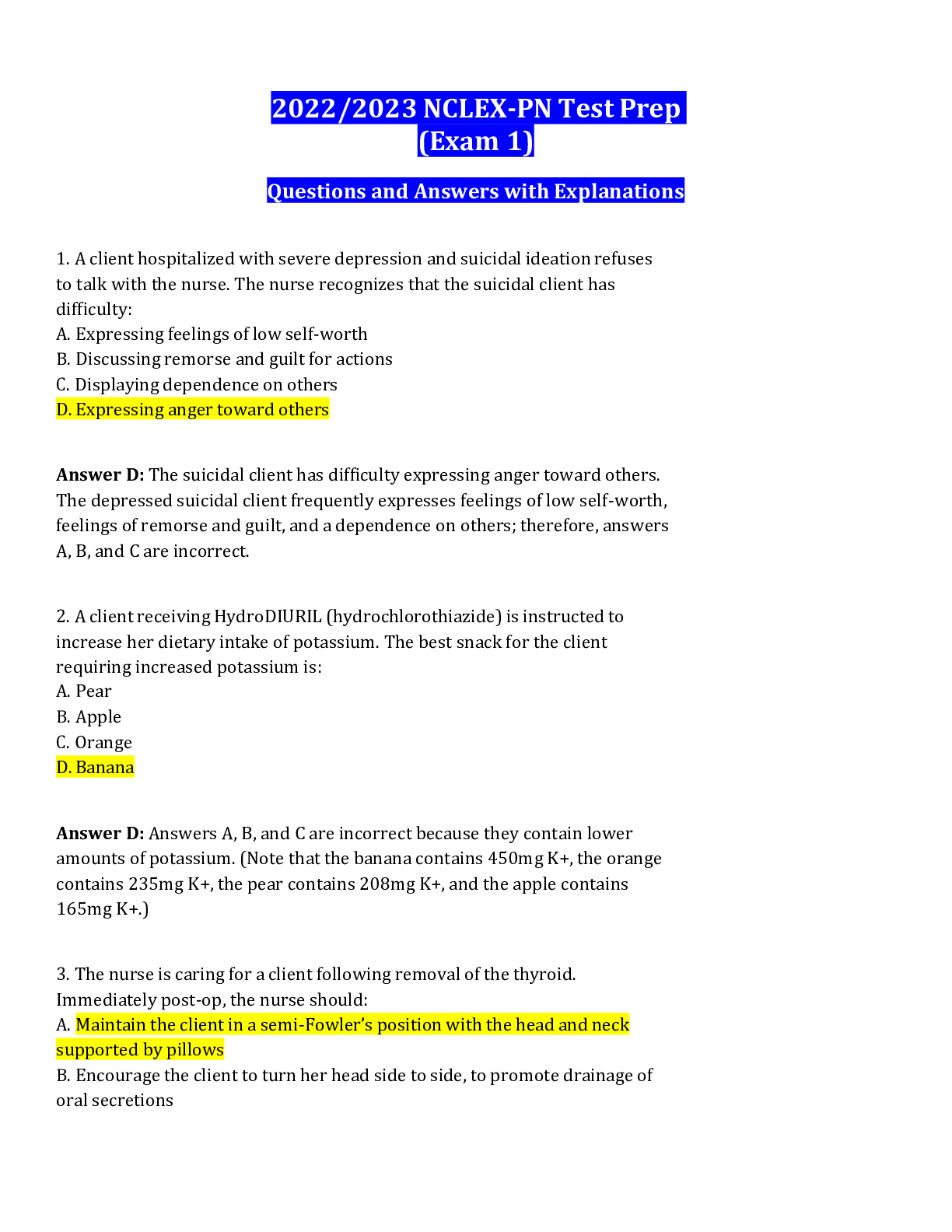
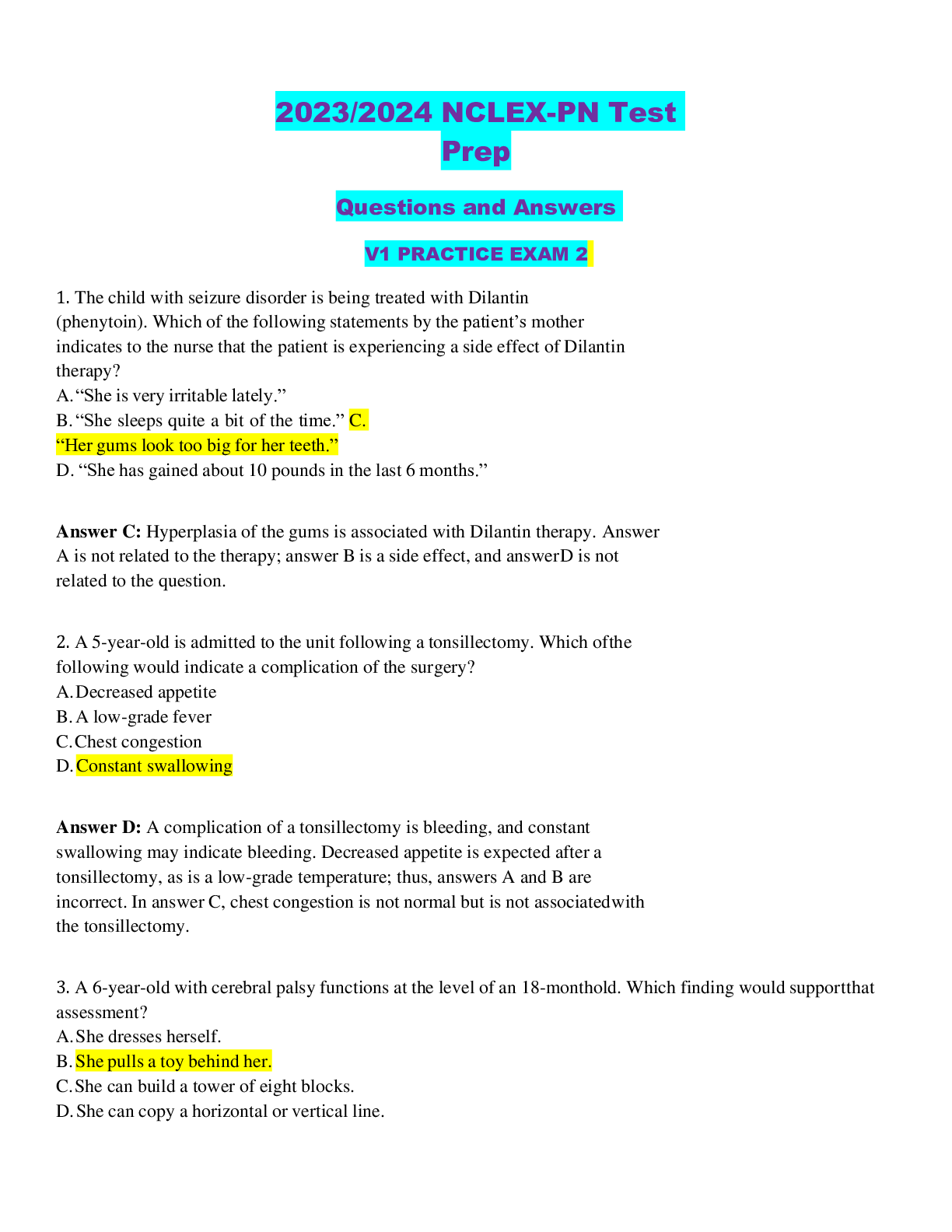
2020/2021 NCLEX-PN Test Prep
Questions and Answers with Explanations
V2 PRACTICE EXAM 1 (STUDY MODE)
1. A papular lesion is noted on the perineum of the laboring client. Which
initial action is most appropriate?
A
...
2020/2021 NCLEX-PN Test Prep
Questions and Answers with Explanations
V2 PRACTICE EXAM 1 (STUDY MODE)
1. A papular lesion is noted on the perineum of the laboring client. Which
initial action is most appropriate?
A. Document the finding
B. Report the finding to the doctor
C. Prepare the client for a C-section
D. Continue primary care as prescribed
Answer B: Any lesion should be reported to the doctor. This can indicate a
herpes lesion. Clients with open lesions related to herpes are delivered by
Cesarean section because there is a possibility of transmission of the infection
to the fetus with direct contact to lesions. It is not enough to document the
finding, so answer A is incorrect. The physician must make the decision to
perform a C-section, making answer C incorrect. It is not enough to continue
primary care, so answer D is incorrect.
2. A client with a diagnosis of human papillomavirus (HPV) is at risk for
which of the following?
A. Lymphoma
B. Cervical and vaginal cancer
C. Leukemia
D. Systemic lupus
Answer B: The client with HPV is at higher risk for cervical and vaginal
cancer related to this STI. She is not at higher risk for the other cancers
mentioned in answers A, C, and D, so those are incorrect.
3. The client seen in the family planning clinic tells the nurse that she has a
painful lesion on the perineum. The nurse is aware that the most likely source
of the lesion is:
A. Syphilis
B. Herpes
C. Candidiasis
D. Condylomata
Answer B: A lesion that is painful is most likely a herpetic lesion. A chancre
lesion associated with syphilis is not painful, so answer A is incorrect. In
answer C, candidiasis is a yeast infection and does not present with a lesion,
but it is exhibited by a white, cheesy discharge. Condylomata lesions are
painless warts, so answer D is incorrect.
4. A client visiting a family planning clinic is suspected of having an STI.
The most diagnostic test for treponema pallidum is:
A. Venereal Disease Research Lab (VDRL)
B. Rapid plasma reagin (RPR)
C. Florescent treponemal antibody (FTA)
D. Thayer-Martin culture (TMC)
Answer C: FTA is the only answer choice for treponema pallidum. Answers
A and B are incorrect because VDRL and RPR are screening tests for syphilis
but are not conclusive of the disease; they only indicate exposure to the
disease. The Thayer-Martin culture is a test for gonorrhea, so answer D is
incorrect.
5. Which laboratory finding is associated with HELLP syndrome in the
obstetric client?
A. Elevated blood glucose
B. Elevated platelet count
C. Elevated creatinine clearance
D. Elevated hepatic enzymes
Answer D: The criteria for HELLP is hemolysis, elevated liver enzymes, and
low platelet count. In answer A, an elevated blood glucose level is not
associated with HELLP. Platelets are decreased in HELLP syndrome, not
elevated, as stated in answer B. The creatinine levels are elevated in renal
disease and are not associated with HELLP syndrome, as stated in answer C.
6. The nurse is assessing the deep tendon reflexes of the client with
hypomagnesemia. Which method is used to elicit the biceps reflex?
A. The nurse places her thumb on the muscle inset in the antecubital space
and taps the thumb briskly with the reflex hammer.
B. The nurse loosely suspends the client’s arm in an open hand while tapping
the back of the client’s elbow.
C. The nurse instructs the client to dangle her legs as the nurse strikes the
area below the patella with the blunt side of the reflex hammer.
D. The nurse instructs the client to place her arms loosely at her side as the
nurse strikes the muscle insert just above the wrist.
Answer A: The answer can only be A because the other methods elicit
different reflexes. Answer B elicits the triceps reflex, answer C elicits the
patella reflex, and answer D elicits the radial nerve.
7. Which medication should be used with caution in the obstetric client with
diabetes?
A. Magnesium sulfate
B. Brethine
C. Stadol
D. Ancef
Answer B: Brethine is used cautiously because it raises the blood glucose
levels. Answers A, C, and D are all medications that are commonly used in
the diabetic client, so there is no need to question the order for these
medications.
8. A multigravida is scheduled for an amniocentesis at 32 weeks gestation to
determine the L/S ratio and phosphatidyl glycerol level. The L/S ratio is 1:1.
The nurse’s assessment of this data is:
A. The infant is at low risk for congenital anomalies.
B. The infant is at high risk for intrauterine growth retardation.
C. The infant is at high risk for respiratory distress syndrome.
D. The infant is at high risk for birth trauma.
Answer C: When the L/S ratio reaches 2:1, the lungs are considered to be
mature. The infant will most likely be small for gestational age and will not
be at risk for birth trauma, so answer B is incorrect. The L/S ratio does not
indicate congenital anomalies, as stated in answer A, and the infant is not at
risk for intrauterine growth retardation, as stated in answer D.
9. Which observation in the newborn of a mother who is alcohol dependent
would require immediate nursing intervention?
A. Crying
B. Wakefulness
C. Jitteriness
D. Yawning
Answer C: Jitteriness is a sign of seizure in the neonate. Answers A, B, and
D are incorrect because crying, wakefulness, and yawning are expected in the
newborn.
10. The nurse caring for a client receiving magnesium sulfate must closely
observe for side effects associated with drug therapy. An expected side effect
of magnesium sulfate is:
A. Decreased urinary output
B. Hypersomnolence
C. Absence of knee jerk reflex
D. Decreased respiratory rate
Answer B: The client is expected to become sleepy, have hot flashes, and
experience lethargy. A decreasing urinary output, absence of the knee jerk
reflex, and decreased respirations are signs of toxicity and are not expected
side effects of magnesium sulfate. Therefore, answers A, C, and D are
incorrect.
11. The 57-year-old male client has elected to have epidural anesthesia as the
anesthetic during a hernia repair. If the client experiences hypotension, the
nurse would:
A. Place him in the Trendelenburg position
B. Obtain an order for Benedryl
C. Administer oxygen per nasal cannula
D. Speed the IV infusion of normal saline
Answer D: If the client experiences hypotension after an injection of epidural
anesthetic, the nurse should turn him to the left side if possible, apply oxygen
by mask, and speed the IV infusion. Epinephrine, not Benedryl, in answer B,
should be kept for emergency administration. A is incorrect because placing
the client in Trendelenburg position (head down) will allow the anesthesia to
move up above the respiratory center, thereby decreasing the diaphragm’s
ability to move up and down, ventilating the client. Answer C is incorrect
because the oxygen should be applied by mask, not cannula.
12. A client has cancer of the pancreas. The nurse should be most concerned
with which nursing diagnosis?
A. Alteration in nutrition
B. Alteration in bowel elimination
C. Alteration in skin integrity
D. Ineffective individual coping
Answer A: Cancer of the pancreas frequently leads to severe nausea and
vomiting. Answers B, C, and D are incorrect because although they are a
concern to the client, they are not the priority nursing diagnosis.
13. The nurse is caring for a client with ascites. Which is the best method to
use for determining early ascites?
A. Inspection of the abdomen for enlargement
B. Bimanual palpation for hepatomegaly
C. Daily measurement of abdominal girth
D. Assessment for a fluid wave
Answer C: Measuring the girth daily with a paper tape measure and marking
the area that is measured is the most objective method of estimating ascites.
Inspection, in answer A, and checking for fluid waves, in answer D, are more
subjective and not correct. Palpation of the liver will not tell the amount of
ascites, so answer B is incorrect.
14. The client arrives in the emergency department after a motor vehicle
accident. Nursing assessment findings include BP 80/34, pulse rate 120, and
respirations 20. Which is the client’s most appropriate priority nursing
diagnosis?
A. Alteration in cerebral tissue perfusion
B. Fluid volume deficit
C. Ineffective airway clearance
D. Alteration in sensory perception
Answer B: The vital signs indicate hypovolemic shock, so checking for fluid
volume deficit is the appropriate action. Answers A, C, and D do not indicate
cerebral tissue perfusion, airway clearance, or sensory perception alterations,
and are incorrect.
15. Which information obtained from the visit to a client with hemophilia
would cause the most concern? The client:
A. Likes to play football
B. Drinks several carbonated drinks per day
C. Has two sisters with sickle cell tract
D. Is taking acetaminophen to control pain
Answer A: The client with hemophilia is likely to experience bleeding
episodes if he participates in contact sports. Drinking several carbonated
drinks per day, as in answer B, has no bearing on the hemophiliac’s
condition. Having two sisters with sickle cell, as in answer C, is not
information that would cause concern. Taking acetaminophen for pain, as in
answer D, is an accepted practice and does not cause concern.
16. The nurse on oncology is caring for a client with a white blood count of
800, a platelet count of 150,000, and a red blood cell count of 250,000.
During evening visitation, a visitor is noted to be coughing and sneezing.
What action should the nurse take?
A. Ask the visitor to wash his hands
B. Document the visitor’s condition in the chart
C. Ask the visitor to leave and not return until the client’s white blood cell
count is 1,000
D. Provide the visitor with a mask and gown
Answer D: The client with neutropenia should not have visitors with any
type of infection, so the best action by the nurse is to give the visitor a mask
and a gown. Asking the visitor to wash his hands is good but will not help
prevent the infection from spreading by droplets; therefore, answer A is
incorrect. Answer B is incorrect because documenting the visitor’s condition
is not enough action for the nurse to take. Answer C is incorrect because
asking the visitor to leave and not return until the client’s white blood cell
count is 1,000 is an insuffient intervention. The normal WBC is 5,000–
10,000, so a WBC of 1,000 is not high enough to prevent the client from
contracting infections.
17. The nurse is caring for the client admitted after trauma to the neck in an
automobile accident. The client suddenly becomes unresponsive and pale,
with a BP of 60 systolic. The initial nurse’s action should be to:
A. Place the client in Trendelenburg position
B. Increase the infusion of normal saline
C. Administer atropine IM
D. Obtain a crash cart
Answer B: For some clients with trauma to the neck, the answer would be A;
however, in this situation, it is incorrect because lowering the head of the bed
could further interfere with the airway. Increasing the infusion and placing
the client in supine position is better. If atropine is administered to the client,
it should be given IV, not IM, and there is no need for this action at present,
as stated in answer C. Answer D is not necessary at this time.
18. Immediately following the removal of a chest tube, the nurse would:
A. Order a chest x-ray
B. Take the blood pressure
C. Cover the insertion site with a Vaseline gauze
D. Ask the client to perform the Valsalva maneuver
Answer C: When a chest tube is removed, the hole should be immediately
covered with a Vaseline gauze to prevent air from rushing into the chest and
causing the lung to collapse. The doctor, not the nurse, will order a chest xray; therefore, answer A is incorrect. Taking the BP in answer B is good but
is not the priority action. Answer D is incorrect because the Valsalva
maneuver is done during removal of the tube, not afterward.
19. A client being treated with sodium warfarin has an INR of 9.0. Which
intervention would be most important to include in the nursing care plan?
A. Assess for signs of abnormal bleeding
B. Anticipate an increase in the dosage
C. Instruct the client regarding the drug therapy
D. Increase the frequency of neurological assessments
Answer A: The normal international normalizing ratio (INR) is 2–3. A 9
might indicate spontaneous bleeding. Answer B is an incorrect action at this
time. Answer C is incorrect because just instructing the client regarding his
medication is not enough. Answer D is incorrect because increasing the
frequency of neurological assessment will not prevent bleeding caused by the
prolonged INR.
20. Which snack selection by a client with osteoporosis indicates that the
client understands the dietary management of the disease?
A. A glass of orange juice
B. A blueberry muffin
C. A cup of yogurt
D. A banana
Answer C: The food with the most calcium is the yogurt. The others are
good choices, but not as good as the yogurt, which has approximately 400mg
of calcium. Therefore, answers A, B, and D are incorrect.
21. The elderly client with hypomagnesemia is admitted to the unit with an
order for magnesium sulfate. Which action by the nurse indicates
understanding of magnesium sulfate?
A. The nurse places a sign over the bed not to check blood pressures in the
left arm.
B. The nurse places a padded tongue blade at the bedside.
C. The nurse measures the urinary output hourly.
D. The nurse darkens the room.
Answer C: The client receiving magnesium sulfate should have a Foley
catheter in place, and the hourly intake and output should be checked because
a sign of toxicity to magnesium sulfate is oliguria. There is no need to refrain
from checking the blood pressure in the left arm, as stated in answer A. A
padded tongue blade should be kept in the room at the bedside, just in case of
a seizure, but this is not related to the magnesium sulfate infusion, so this
makes answer B incorrect. Answer D is incorrect because just darkening the
room will not prevent toxicity, although it might help with the headache
associated with preeclampsia.
22. The nurse is caring for a 10-year-old client scheduled for surgery. The
client’s mother tells the nurse that her religion forbids blood transfusions.
What nursing action is most appropriate?
A. Document the mother’s statement in the chart
B. Encourage the mother to reconsider
C. Explain the consequences of no treatment
D. Notify the physician of the mother’s refusal
Answer D: If the client’s mother refuses to sign for the child’s treatment, the
doctor should be notified. Because the client is a minor, the court might order
treatment. Answer A is incorrect because simply documenting the statement
is not enough. Answer B is incorrect because it is not the nurse’s
responsibility to try to persuade the mother to allow the blood transfusion.
Answer C is incorrect because the consequences of the denial of a blood
transfusion are not known.
23. A client is admitted to the unit 3 hours after an injury with second-degree
burns to the face, neck, and head. The nurse would be most concerned with
the client developing which of the following?
A. Hypovolemia
B. Laryngeal edema
C. Hypernatremia
D. Hyperkalemia
Answer B: The nurse should be most concerned with laryngeal edema
because of the area of burn. The next priority should be answer A,
hypovolemia. Hypernatremia and hyperkalemia, as stated in answers C and
D, are incorrect because the client will most likely experience hyponatremia
and hypokalemia.
24. The nurse is evaluating nutritional outcomes for an elderly client with
anorexia. Which data best indicates that the plan of care is effective?
A. The client selects a balanced diet from the menu.
B. The client’s hematocrit improves.
C. The client’s tissue turgor improves.
D. The client gains weight.
Answer D: The client with anorexia shows the most improvement by weight
gain. Selecting a balanced diet, as in answer A, is of little use if the client
does not eat the diet. The hematocrit in answer B is incorrect because
although it might improve by several means, such as blood transfusion, it
does not indicate improvement in the anorexic condition. The tissue turgor
indicates fluid stasis, not improvement of anorexia; therefore, answer C is
incorrect.
25. The client is admitted following repair of a fractured femur with cast
application. Which nursing assessment should be reported to the doctor?
A. Pain
B. Warm toes
C. Pedal pulses rapid
D. Paresthesia of the toes
Answer D: Paresthesia, in answer D, is not normal and might indicate
compartment syndrome. At this time, pain beneath the cast is normal, so
answer A is incorrect. The client’s toes should be warm to the touch and
pulses should be present. Because answers B and C are normal findings,
these answers are incorrect.
26. Which would be an expected finding during injection of dye with a
cardiac catheterization?
A. Cold extremity distant to the injection site
B. Warmth in the extremity
C. Extreme chest pain
D. Itching in the extremities
Answer B: It is normal for the client to have a warm sensation when dye is
injected. Answer A is incorrect because the client should not have a cold
extremity. This indicates peripheral vascular disease. Answer C is incorrect
because extreme chest pain can be related to a myocardial infarction. The
pain is not normal. Answer D is incorrect because itching is a sign of an
allergic reaction. Also, the itching will most likely be on the chest and skin
folds.
27. Which action by the healthcare worker indicates a need for further
teaching?
A. The nursing assistant wears gloves while giving the client a bath.
B. The nurse wears goggles while drawing blood from the client.
C. The doctor washes his hands before examining the client.
D. The nurse wears gloves to take the client’s vital signs.
Answer D: It is not necessary to wear gloves to take the vital signs of the
client under normal circumstances. If the client has active infection with
methicillin-resistant staphylococcus aureus, gloves should be worn. The other
answer choices indicate knowledge of infection control by the actions, so
answers A, B, and C are incorrect.
28. The client is having electroconvulsive therapy for treatment of severe
depression. Which of the following indicates that the client’s ECT has been
effective?
A. The client loses consciousness.
B. The client vomits.
C. The client’s ECG indicates tachycardia.
D. The client has a grand mal seizure.
Answer D: During ECT, the client will have a grand mal seizure. This
indicates completion of the electroconvulsive therapy. Answer A is incorrect
because clients are frequently given medication that will cause drowsiness or
sleep. Answer B is incorrect because vomiting is not a sign that the ECT has
been effective. Answer C is incorrect because tachycardia might be present,
but it is not a sign that the ECT has been effective.
29. A 5-year-old is being tested for pinworms. To collect a specimen for
assessment of pinworms, the nurse should teach the mother to:
A. Examine the perianal area with a flashlight 2–3 hours after the child is
asleep and to collect any eggs on a clear tape
B. Scrape the skin with a piece of cardboard and bring it to the clinic
C. Obtain a stool specimen in the afternoon
D. Bring a hair sample to the clinic for evaluation
Answer A: Infection with pinworms begins when the eggs are ingested or
inhaled. The eggs hatch in the upper intestine and mature in 2–8 weeks. The
females then mate and migrate out the anus, where they lay up to 17,000
eggs. This causes intense itching. The mother should be told to use a
flashlight to examine the rectal area about 2–3 hours after the child is asleep.
Placing clear tape on a tongue blade will allow the eggs to adhere to the tape.
The specimen should then be brought in to be evaluated. There is no need to
scrape the skin, as stated in answer B. Collecting a stool specimen in the
afternoon will probably not reveal the eggs because the worms often are not
detected during the day; therefore, answer C is incorrect. Answer D is
incorrect because eggs are not located in the hair.
30. Which instruction should be given regarding the medication used to treat
enterobiasis (pinworms)?
A. Treatment is not recommended for children less than 10 years of age.
B. The entire family should be treated.
C. Medication therapy will continue for 1 year.
D. Intravenous antibiotic therapy will be ordered.
Answer B: Erterobiasis, or pinworms, is treated with Vermox (mebendazole)
or Antiminth (pyrantel pamoate). The entire family should be treated to
ensure that no eggs remain. The family should then be tested again in 2
weeks to ensure that no eggs remain. Answer A is incorrect because children
less than 10 can be treated with Vermox. Answer C is incorrect because a
single treatment is usually sufficient. Answer D is incorrect because there is
no need for IV antibiotics for the client with pinworms.
31. Which client should be assigned to the pregnant licensed practical nurse?
A. The client who just returned after receiving linear accelerator radiation
therapy for lung cancer
B. The client with a radium implant for cervical cancer
C. The client who has just been administered soluble brachytherapy for
thyroid cancer
D. The client who has returned from placement of iridium seeds for prostate
cancer
Answer A: The pregnant nurse should not be assigned to any client with
radioactivity present. The client receiving linear accelerator therapy in answer
A travels to the radium department for therapy; thus, the radiation stays in the
department. The client himself is not radioactive. The client in answer B
poses a risk to the pregnant client because the implant stays with the patient.
The client in answer C is radioactive in very small doses. For approximately
72 hours, the client should dispose of urine and feces in special containers
and use plastic spoons and forks. The client in answer D is also radioactive in
small amounts, especially upon return from the procedure. Thus, answers B,
C, and D are all incorrect.
32. Which client should be assigned to a private room if only one is
available?
A. The client with Cushing’s syndrome
B. The client with diabetes
C. The client with acromegaly
D. The client with myxedema
Answer A: The client with Cushing’s syndrome has adrenocortical
hypersecretion. This increase in the level of cortisone causes the client to be
immune suppressed, and he should not have a roommate because of the
possibility of infection. In answer B, the client with diabetes poses no risk to
other clients. The client in answer C has an increase in growth hormone and
poses no risk to himself or others. The client in answer D has
hyperthyroidism or myxedema and so poses no risk to others or himself.
33. The nurse caring for a client on the pediatric unit administers adultstrength Digitalis to the 3-pound infant. As a result of her actions, the baby
suffers permanent heart and brain damage. The nurse can be charged with:
A. Negligence
B. Tort
C. Assault
D. Malpractice
Answer D: Malpractice is failing to perform or performing an act that causes
harm to the client, making answer D correct. In answer A, negligence is
failing to perform care for the client. In answer B, a tort is a wrongful act
committed to the client or his belongings. Answer C is incorrect because
assault is willfully hitting or restraining the client.
34. Which assignment should not be performed by the licensed practical
nurse?
A. Inserting a Foley catheter
B. Discontinuing a nasogastric tube
C. Obtaining a sputum specimen
D. Initiating a blood transfusion
Answer D: The licensed practical nurse should not be assigned to begin a
blood transfusion. The licensed practical nurse can insert a Foley catheter, as
stated in answer A; discontinue a nasogastric tube, as stated in answer B; and
collect sputum specimen, as stated in answer C. Thus, answers A, B, and C
are all incorrect.
35. The client returns to the unit from surgery with a blood pressure of 90/50,
pulse 132, and respirations 30. Which action by the nurse should receive
priority?
A. Continuing to monitor the vital signs
B. Contacting the physician
C. Asking the client how he feels
D. Asking the LPN to continue the post-op care
Answer B: The vital signs are abnormal and should be reported to the doctor
immediately. To continue to monitor the vital signs, as in answer A, could
result in deterioration of the client’s condition. Asking the client how he feels
in answer C will provide only subjective data. The nurse in answer D is not
the best nurse to assign because this client is unstable.
36. Which nurse should be assigned to care for the postpartal client with
preeclampsia? The nurse with:
A. 2 weeks of experience in postpartum
B. 3 years of experience in labor and delivery
C. 10 years of experience in surgery
D. 1 year of experience in the neonatal intensive care unit
Answer B: The nurse in answer B has the most experience in knowing
possible complications involving preeclampsia. The nurse in answer A is a
new nurse to the unit and so should not be assigned to this client; the nurses
in answers C and D have no experience with the postpartum client, so neither
should be assigned to this client.
37. Which information should be reported to the state Board of Nursing?
A. The facility fails to provide literature in both Spanish and English.
B. The narcotic count has been incorrect on the unit for the past 3 days.
C. The client fails to receive an itemized account of his bills and services
received during his hospital stay.
D. The nursing assistant assigned to the client with hepatitis fails to feed the
client and give the bath.
Answer B: An inaccurate narcotic count on the unit should be reported to the
state Board of Nursing because narcotics are controlled substances. Answers
A, C, and D are incorrect because they are of little concern to the state board.
Although they are important functions, these actions would be resolved
within the hospital.
38. The nurse is suspected of charting the administration of a medication that
he did not give. After talking to the nurse, the charge nurse should:
A. Call the Board of Nursing
B. File a formal reprimand
C. Terminate the nurse
D. Charge the nurse with a tort
Answer B: After discussing with the nurse and documenting the incident,
filing a formal reprimand is the first action for the charge nurse to take. If the
nurse continues following an incorrect procedure that causes, or could cause,
harm to the client, termination might be needed. The Joint Commission on
Accreditation of Hospitals will probably be interested in the actions in
answers A and C, but this is not the immediate action to take. The failure of
the nursing assistant to care for the client with hepatitis might result in
termination, but this is not of interest to the Joint Commission; therefore,
answer D is incorrect.
39. The nurse is making rounds. Which client should be seen first?
A. The 78-year-old who had a gastrectomy 3 weeks ago and has a PEG tube
B. The 5-month-old discharged 1 week ago with pneumonia who is being
treated with amoxicillin liquid suspension
C. The 50-year-old with MRSA (methcillin-resistant staphylococcus aurea)
D. The 30-year-old with an exacerbation of multiple sclerosis being treated
with cortisone intravenously
Answer D: The client with multiple sclerosis should receive priority because
of the IV cortisone treatment. This client is at highest risk for complications.
The clients in answers A and B are more stable and are not the priority. The
client with MRSA (methicillin-resistant staphylococcus aureus) is being
treated with antibiotics, but there is no data to indicate that the nurse should
see this client first, so answer C is incorrect.
40. The emergency room is flooded with clients injured in a tornado. Which
clients can be assigned to share a room in the emergency department during
the disaster?
A. A schizophrenic client having visual and auditory hallucinations and the
client with ulcerative colitis
B. The client who is 6 months pregnant with abdominal pain and the client
with facial lacerations and a broken arm
C. A child whose pupils are fixed and dilated and his parents, and a client
with a frontal head injury
D. The client who arrives with a large puncture wound to the abdomen and
the client with chest pain
Answer B: The two clients who can share a room are the pregnant client and
the client with a broken arm and facial lacerations because these clients are
stable. The other clients in answers A needs to be placed in separate rooms
because the schizophrenic will further upset the client with an ulcerative
colitis. Answer C is incorrect because this child is terminal and he should not
be placed in the room with the client with a frontal head injury. Answer D is
incorrect because the chest pain may be related to a myocardial infarction.
41. The nurse is caring for a 6-year-old client admitted with the diagnosis of
conjunctivitis. Before administering eyedrops, the nurse should recognize
that it is essential to consider which of the following?
A. The eye should be cleansed with warm water, removing any exudate,
before instilling the eyedrops.
B. The child should be allowed to instill his own eyedrops.
C. The mother should be allowed to instill the eyedrops.
D. If the eye is clear of any redness or edema, the eyedrops should be held.
Answer A: Before instilling eyedrops, the nurse should cleanse the area with
water. A 6-year-old child is not developmentally ready to instill his own
eyedrops, so answer B is incorrect. Although the mother of the child may
instill the eyedrops, the area must be cleansed before administration, so
answer C is incorrect. The eye might appear to be clear, but the nurse should
instill the eyedrops, as ordered, so answer D is incorrect.
42. The nurse is discussing meal planning with the mother of a 2-year-old
toddler. Which of the following statements, if made by the mother, would
require a need for further instruction?
A. “It is okay to give my child white grape juice for breakfast.”
B. “My child can have a grilled cheese sandwich for lunch.”
C. “We are going on a trip, and I have bought hot dogs to grill for his lunch.”
D. “For a snack, my child can have ice cream.”
Answer C: The comment of most concern is answer C because hot dogs are
commonly the cause of choking in children. There is no reason for concern in
the comments in answers A, B, or D; therefore, these are incorrect.
43. A 2-year-old toddler is seen in the pediatrician’s office. During physical
assessment, the nurse would anticipate the need for which intervention?
A. Ask the parent/guardian to leave the room when assessments are being
performed
B. Ask the parent/guardian to remove the child’s toys during examination
C. Ask the parent/guardian to stay with the child during the examination
D. If the child is screaming, tell him this is inappropriate behavior
Answer C: There is no reason to tell the parents to leave because this might
cause the child to become more agitated, making answer A incorrect.
Removing his toys may also cause him to fret and make the examination
more difficult, so answer B is incorrect. Answer D is incorrect because telling
him that the behavior is inappropriate will not help because the child is too
young to understand.
44. Which instruction should be given to the client who is fitted for a behindthe-ear hearing aid?
A. Remove the mold and clean every week
B. Store the hearing aid in a cool place
C. Clean the lint from the hearing aide with a toothpick
D. Change the batteries weekly
Answer B: Hearing aids should be stored in a cool place in order to preserve
the life of the battery. Answer A is incorrect because the mold should be
cleaned daily. Answer C is incorrect because the hearing aid should not be
cleaned with a toothpick. Answer D is incorrect because changing the
batteries weekly is not necessary.
45. A priority nursing diagnosis for a child being admitted from surgery
following a tonsillectomy is:
A. Body image disturbance
B. Impaired verbal communication
C. Risk for aspiration
D. Pain
Answer C: A risk for aspiration is the best answer because aspiration of
blood can lead to airway obstruction. Answer A does not apply to a child who
has undergone a tonsillectomy because there is no alteration in body image.
Answer B is incorrect because impaired verbal communication might be true
but is not the highest priority. Pain is an issue, but not the highest priority, so
answer D is incorrect.
46. A client with bacterial pneumonia is admitted to the pediatric unit. What
would the nurse expect the admitting assessment to reveal?
A. High fever
B. Nonproductive cough
C. Rhinitis
D. Vomiting and diarrhea
Answer A: If the child has bacterial pneumonia, a high fever is usually
present. Bacterial pneumonia usually presents with a productive cough, not a
nonproductive cough, so answer B is incorrect. Rhinitis is often seen with
viral pneumonia, not bacterial pneumonia, so answer C is incorrect. Vomiting
and diarrhea are usually not seen with pneumonia, so answer D is incorrect.
47. The nurse is caring for a client admitted with acute
laryngotracheobronchitis (LTB). Because of the possibility of complete
obstruction of the airway, which of the following should the nurse have
available?
A. Intravenous access supplies
B. Emergency intubation equipment
C. Intravenous fluid administration pump
D. Supplemental oxygen
Answer B: For a child with LTB and the possibility of complete obstruction
of the airway, emergency intubation equipment should always be kept at the
bedside. Intravenous supplies and fluid will not treat an obstruction, so
answers A and C are incorrect. Answer D is incorrect because although
supplemental oxygen is needed, the child will need to be intubated for it to
help.
48. The 45-year-old client is seen in the clinic with hyperthyroidism. What
would the nurse expect the admitting assessment to reveal?
A. Bradycardia
B. Decreased appetite
C. Exophthalmos
D. Weight gain
Answer C: Exophthalmos (protrusion of eyeballs) often occurs with
hyperthyroidism. The client with hyperthyroidism will often exhibit
tachycardia, increased appetite, and weight loss, not bradycardia, decreased
appetite, or weight gain, so answers A, B, and D are incorrect.
49. The nurse is providing dietary instructions to the mother of an 8-year-old
child diagnosed with celiac disease. Which of the following foods, if selected
by the mother, would indicate her understanding of the dietary instructions?
A. Whole-wheat bread
B. Spaghetti and meatballs
C. Hamburger on white bread with ketchup
D. Cheese omelet
Answer D: The child with celiac disease should be on a gluten-free diet.
Answer D is the only choice of foods that do not contain gluten, so answers
A, B, and C are incorrect.
50. The nurse is caring for a 9-year-old child admitted with asthma. During
the morning rounds, the nurse finds an O2 sat of 78%. Which of the
following actions should the nurse take first?
A. Check the arterial blood gases.
B. Do nothing; this is a normal O2 sat for this client.
C. Apply oxygen.
D. Assess the child’s pulse.
Answer C: The child with an oxygen saturation level of 78% is hypoxic. He
will require oxygen therapy. Checking the arterial blood gases in answer A is
good but is not the highest priority and will not correct the problem. If the
nurse does nothing, as in answer B, the client’s condition will most likely
continue to decline. Answer D is incorrect because assessing the pulse will
probably reveal tachycardia, but this is not the highest priority.
51. A gravida II para 0 is admitted to the labor and delivery unit. The doctor
performs an amniotomy. Which observation would the nurse expect to make
after the amniotomy?
A. Fetal heart tones 160bpm
B. A moderate amount of straw-colored fluid
C. A small amount of greenish fluid
D. A small segment of the umbilical cord
Answer B: Normal amniotic fluid is straw colored and odorless. An
amniotomy is an artificial rupture of membranes. Fetal heart tones of 160
indicate tachycardia, so answer A is incorrect. Greenish fluid is indicative of
meconium, so answer C is incorrect. If the nurse notes the umbilical cord, the
client is experiencing a prolapsed cord. This would need to be reported
immediately; therefore, answer D is incorrect.
52. The client is admitted to the unit. Vaginal exam reveals that she is 3cm
dilated. Which of the following statements would the nurse expect her to
make?
A. “I can’t decide what to name the baby.”
B. “It feels good to push with each contraction.”
C. “Don’t touch me. I’m trying to concentrate.”
D. “When can I get my epidural?”
Answer D: Dilation of 3cm is the end of the latent phase of labor, so a
request for an epidural would be expected. Answer A is a vague answer, and
answer B would indicate the end of the first stage of labor, or complete
dilation. Answer C indicates the transition phase and, thus, is incorrect.
53. The client is having fetal heart rates of 100–110bpm during the
contractions. The first action the nurse should take is:
A. Reassess the fetal heart tones in 15 minutes
B. Turn the client to her left side
C. Get the client up and walk her in the hall
D. Move the client to the delivery room
Answer B: The normal fetal heart rate is 120–160bpm; 100–110bpm is
bradycardia. The first action would be to turn the client to the left side and
apply oxygen. Answer A is not indicated at this time. Answer C is not the
best action for clients experiencing bradycardia. There is no data to indicate
the need to move the client to the delivery room at this time, so answer D is
incorrect.
54. The nurse is monitoring the client admitted for induction of labor. The
nurse knows that Pitocin has been effective when:
A. The client has a rapid, painless delivery.
B. The client’s cervix is effaced.
C. The client has infrequent contractions.
D. The client has progressive cervical dilation.
Answer D: The expected effect of Pitocin is cervical dilation. Pitocin causes
more intense contractions, which can increase the pain, so answer A is
incorrect. Cervical effacement is caused by pressure on the presenting part, so
answer B is incorrect. Answer C is incorrect because the word infrequent
indicates irregular contractions.
55. A vaginal exam reveals a breech presentation. The nurse should take
which of the following actions at this time?
A. Prepare the client for a Caesarean section
B. Apply the fetal heart monitor
C. Place the client in Trendelenburg position
D. Perform an ultrasound exam
Answer B: A breach presentation calls for applying a fetal heart monitor.
Answer A is incorrect because there is no need to prepare for a Caesarean
section at this time. Answer C is incorrect because placing the client in
Trendelenburg position is also not an indicated action. Answer D is incorrect
because there is no need for an ultrasound based on the finding.
56. The nurse is caring for a gravida 1 admitted in labor. Which finding
would suggest the need for an internal fetal monitor?
A. The cervix is dilated 5cm.
B. The fetal heart tones are difficult to assess using the external toco monitor.
C. The fetus is at station 0.
D. Contractions are every 3 minutes.
Answer B: There are only a few reasons to apply an internal monitor: if the
fetus is in distress or if the fetal heart tones cannot be assessed using the
external monitor. Answer A is incorrect because cervical dilation is not a
reason to apply an internal monitor. Answer C is incorrect because the fact
that the fetus is at 0 station is not a reason to apply an internal monitor.
Answer D is also incorrect because noting contractions every 3 minutes is not
a reason to apply an internal monitor. It is not necessary for a scalp electrode
placement, as long as the membranes are still intact.
57. Which nursing diagnoses is most appropriate for the client as she
completes the latent phase of labor?
A. Impaired gas exchange related to hyperventilation
B. Alteration in oxygen perfusion related to maternal position
C. Impaired physical mobility related to fetal-monitoring equipment
D. Potential fluid volume deficit related to decreased fluid intake
Answer D: Clients admitted in labor are told not to eat during labor, to avoid
nausea and vomiting. Ice chips may be allowed, but this amount of fluid is
not sufficient to prevent dehydration. Answer A is incorrect because impaired
gas exchange related to hyperventilation is not a risk to the client. Answer B
is incorrect because alteration in oxygen perfusion related to maternal
position is not a problem encountered by the client at the end of the early
phase of labor. Answer C is incorrect because not all clients have fetal
monitoring.
58. As the client reaches 8cm dilation, the nurse notes a pattern on the fetal
monitor that shows a drop in the fetal heart rate of 30bpm beginning at the
peak of the contraction and ending at the end of the contraction. The FHR
baseline is 165–175bpm with variability of 0–2bpm. What is the most likely
explanation of this pattern?
A. The baby is asleep.
B. The umbilical cord is compressed.
C. There is a vagal response.
D. There is uteroplacental insufficiency.
Answer D: This information indicates a late deceleration. This type of
deceleration is caused by uteroplacental lack of oxygen. Answer A is
incorrect because decelerations are not caused by fetal sleep, answer B results
in a variable deceleration, and answer C is indicative of an early deceleration.
59. The nurse notes variable decelerations on the fetal monitor strip. The
most appropriate initial action would be to:
A. Notify her doctor
B. Document the finding
C. Reposition the client
D. Readjust the monitor
Answer C: The initial action by the nurse observing a variable deceleration
should be to turn the client to the side, preferably the left side. Administering
oxygen is also indicated. Answer A is incorrect because the question asks for
the initial action. The initial action should be to turn the client to her side. If
this does not resolve the problem, call the doctor. Answers B and D are
incorrect because there is no data to indicate that the monitor is applied
incorrectly
60. Which of the following is a characteristic of a reassuring fetal heart rate
pattern?
A. A fetal heart rate of 170–180bpm
B. A baseline variability of 25–35bpm
C. Ominous periodic changes
D. Acceleration of FHR with fetal movements
Answer D: Accelerations with movement are normal. Answers A, B, and C
indicate ominous findings on the fetal heart monitor.
61. The nurse asks the client with an epidural anesthesia to void every hour
during the labor. The rationale for this intervention is:
A. The bladder fills more rapidly because of the medication used for the
epidural.
B. Her level of consciousness is such that she is in a trancelike state.
C. The sensation of the bladder filling is diminished or lost.
D. She is embarrassed to ask for the bedpan that frequently.
Answer C: Epidural anesthesia decreases the urge to void and sensation of a
full bladder. A full bladder will decrease the progression of labor. Answer A
is incorrect because the bladder does not fill more rapidly in the client with
epidural anesthesia. Answer B is incorrect because the client’s level of
consciousness is not altered. Answer D is incorrect because there is no data to
indicate that the client is embarrassed to ask for the bedpan.
62. A client in the family planning clinic asks the nurse about the most likely
time for her to conceive. The nurse explains that conception is most likely to
occur when:
A. Estrogen levels are low.
B. Lutenizing hormone is high.
C. The endometrial lining is thin.
D. The progesterone level is low.
Answer B: Lutenizing hormone released by the pituitary is responsible for
ovulation. At about day 14, the continued increase in estrogen stimulates the
release of lutenizing hormone from the anterior pituitary. The LH surge is
responsible for ovulation, or the release of the dominant follicle in reparation
from conception, which occurs within the next 10–12 hours after the LH
levels peak. Answer A is incorrect because estrogen levels are high at the
beginning of ovulation. Answer C is incorrect because the endometrial lining
is thick, not thin. Answer D is incorrect because the progesterone levels are
high, not low.
63. A client tells the nurse that she plans to use the rhythm method of birth
control. The nurse is aware that the success of the rhythm method depends on
the:
A. Age of the client
B. Frequency of intercourse
C. Regularity of the menses
D. Range of the client’s temperature
Answer C: The success of the rhythm method of birth control is dependent
on the client’s menses being regular. It is not dependent on the age of the
client, as stated in answer A; the frequency of intercourse, as stated in answer
B; or the range of the client’s temperature, as stated in answer D.
64. A client with diabetes asks the nurse for advice regarding methods of
birth control. Which method of birth control is most suitable for the client
with diabetes?
A. Intrauterine device
B. Oral contraceptives
C. Diaphragm
D. Contraceptive sponge
Answer C: The best method of birth control for the client with diabetes is the
diaphragm. The intrauterine device in answer A prevents implantation by
producing an inflammatory response. Clients with diabetes have an increased
response to inflammation. Oral contraceptives, in answer B, are not the best
method because they tend to elevate blood glucose levels. Contraceptive
sponges alone are not best at preventing pregnancy, so answer D is incorrect.
65. The doctor suspects that the client has an ectopic pregnancy. Which
symptom is consistent with a diagnosis of ectopic pregnancy?
A. Painless vaginal bleeding
B. Abdominal cramping
C. Throbbing pain in the upper quadrant
D. Sudden, stabbing pain in the lower quadrant
Answer D: The signs of an ectopic pregnancy are vague until the fallopian
tube ruptures. The client will complain of sudden, stabbing pain in the lower
quadrant that radiates down the leg or up into the chest. Painless vaginal
bleeding is a sign of placenta previa, so answer A is incorrect. Abdominal
cramping is a sign of labor, so answer B is incorrect. Throbbing pain in the
upper quadrant, in answer C, is nonspecific and is not a sign of an ectopic
pregnancy.
66. The nurse is teaching a pregnant client about nutritional needs during
pregnancy. Which menu selection will best meet the nutritional needs of the
pregnant client?
A. Hamburger pattie, green beans, French fries, and iced tea
B. Roast beef sandwich, potato chips, baked beans, and cola
C. Baked chicken, fruit cup, potato salad, coleslaw, yogurt, and iced tea
D. Fish sandwich, gelatin with fruit, and coffee
Answer C: All of the choices are tasty, but the pregnant client needs a diet
that is balanced and has increased amounts of calcium, such as is included in
answer C: meat, fruit, potato salad, and yogurt, with about 360mg of calcium.
Answer A is lacking in fruits and milk. Answer B contains the potato chips,
which contain a large amount of sodium. Answer D is not the best diet
because it lacks vegetables and milk products.
67. The client with hyperemesis gravidarum is at risk for developing:
A. Respiratory alkalosis without dehydration
B. Metabolic acidosis with dehydration
C. Respiratory acidosis without dehydration
D. Metabolic alkalosis with dehydration
Answer B: The client with hyperemesis has persistent nausea and vomiting.
With vomiting comes dehydration. When the client is dehydrated, she will
have metabolic acidosis. Answers A and C are incorrect because they are
respiratory in nature, and answer D is incorrect because the client will not be
in alkalosis with persistent vomiting.
68. A client tells the doctor that she is about 20 weeks pregnant. The most
definitive sign of pregnancy is:
A. Elevated human chorionic gonadatropin
B. The presence of fetal heart tones
C. Uterine enlargement
D. Breast enlargement and tenderness
Answer B: The most definitive diagnosis of pregnancy is the presence of
fetal heart tones. The other signs are subjective and can be related to other
medical conditions. Answers A and C can be related to a hydatidiform mole.
Answer D is very subjective and is often present before menses or with use of
oral contraceptives.
69. The nurse is caring for a neonate whose mother is diabetic. The nurse will
expect the neonate to be:
A. Hypoglycemic, small for gestational age
B. Hyperglycemic, large for gestational age
C. Hypoglycemic, large for gestational age
D. Hyperglycemic, small for gestational age
Answer C: The infant of a diabetic mother is usually large for gestational
age. After birth, glucose levels fall rapidly due to the absence of glucose from
the mother. Answer A is incorrect because the infant will not be small for
gestational age. Answer B is incorrect because the infant will not be
hyperglycemic. Answer D is incorrect because the infant will have
hypoglycemia and will be large for gestational age.
70. Which of the following instructions should be included in the nurse’s
teaching regarding oral contraceptives?
A. Weight gain should be reported to the physician.
B. An alternate method of birth control is needed when taking antibiotics.
C. If the client misses one or more pills, two pills should be taken per day for
1 week.
D. Changes in the menstrual flow should be reported to the physician.
Answer B: When the client is taking oral contraceptives and begins
antibiotics, another method of birth control should be used. Antibiotics
decrease the effectiveness of oral contraceptives. Approximately 5–10
pounds of weight gain is not unusual in clients taking oral contraceptives, so
answer A is incorrect. If the client misses a birth control pill, she should be
instructed to take the pill as soon as she remembers the pill. If she missed
two, she should take two; if she missed more than two, she should take the
missed pills but use another method of birth control for the remainder of the
cycle, so answer C is incorrect. Changes in menstrual flow are expected in
clients using oral contraceptive. Often these clients have lighter menses and
this need not be reported, so answer D is incorrect.
71. The nurse is discussing breastfeeding with a postpartum client.
Breastfeeding is contraindicated in the postpartum client with:
A. Diabetes
B. Positive HIV
C. Hypertension
D. Thyroid disease
Answer B: Clients with HIV should not breastfeed because the infection can
be transmitted to the baby through breast milk. The clients mentioned in
answers A, C, and D—those with diabetes, hypertension, and thyroid disease
—can be allowed to breastfeed.
72. A client is admitted to the labor and delivery unit complaining of vaginal
bleeding with very little discomfort. The nurse’s first action should be to:
A. Assess the fetal heart tones
B. Check for cervical dilation
C. Check for firmness of the uterus
D. Obtain a detailed history
Answer A: The symptoms of painless vaginal bleeding are consistent with
placenta previa, so assessing the fetal heart tones is indicated. Cervical check
for dilation is contraindicated because this can increase the bleeding; thus,
answer B is incorrect. Checking for firmness of the uterus can be done, but
the first action should be to check the fetal heart tones, so answer C is
incorrect. A detailed history can be done later, so answer D is incorrect.
73. A client telephones the emergency room stating that she thinks that she is
in labor. The nurse should tell the client that labor has probably begun when:
A. Her contractions are 2 minutes apart.
B. She has back pain and a bloody discharge.
C. She experiences abdominal pain and frequent urination.
D. Her contractions are 5 minutes apart.
Answer D: The client should be advised to come to the labor and delivery
unit when the contractions are every 5 minutes and consistent. She should
also be told to report to the hospital if she experiences rupture of membranes
or extreme bleeding. Answer A is incorrect because she should not wait until
the contractions are every 2 minutes. Answer B is incorrect because she
should not wait until she has bloody discharge. Answer C is incorrect because
this is a vague answer and can be related to a urinary tract infection.
74. The nurse is teaching a group of prenatal clients about the effects of
cigarette smoke on fetal development. Which characteristic is associated with
babies born to mothers who smoked during pregnancy?
A. Low birth weight
B. Large for gestational age
C. Preterm birth, but appropriate size for gestation
D. Growth retardation in weight and length
Answer A: Infants of mothers who smoke are often of low birth weight.
Answer B is incorrect because an infant who is large for gestational age is
associated with diabetic mothers. Preterm births are associated with smoking
but not with appropriate size for gestation, so answer C is incorrect. Growth
retardation is associated with smoking, but this does not affect the infant
length, making answer D incorrect.
75. The physician has ordered an injection of RhoGam for the postpartum
client whose blood type is A negative but whose baby is O positive. To
provide postpartum prophylaxis, RhoGam should be administered:
A. Within 72 hours of delivery
B. Within 1 week of delivery
C. Within 2 weeks of delivery
D. Within 1 month of delivery
Answer A: To provide protection against antibody production, RhoGam
should be given within 72 hours. Answers B, C, and D are incorrect because
they would be given too late to provide antibody protection. RhoGam can
also be given during pregnancy.
76. After the physician performs an amniotomy, the nurse’s first action
should be to assess the:
A. Degree of cervical dilation
B. Fetal heart tones
C. Client’s vital signs
D. Client’s level of discomfort
Answer B: When the membranes rupture, there is often a transient drop in
the fetal heart tones. The heart tones should return to baseline quickly. Any
alteration in fetal heart tones, such as bradycardia or tachycardia, should be
reported. After the fetal heart tones are assessed, the nurse should evaluate
the cervical dilation, as stated in answer A; vital signs, as stated in answer C;
and level of discomfort, as stated in answer D.
77. A client is admitted to the labor and delivery unit. The nurse performs a
vaginal exam and determines that the client’s cervix is 5cm dilated with 75%
effacement. Based on the nurse’s assessment, the client is in which phase of
labor?
A. Active
B. Latent
C. Transition
D. Early
Answer A: The active phase of labor begins when the client is dilated 4–
7cm. Answer B refers to the latent or early phase of labor, from 1cm to 3cm
dilation. Answer C refers to the transition phase of labor, from 8cm to 10cm
dilation. Answer D refers to the early phase of labor, from 1cm to 3cm
dilation.
78. A newborn with narcotic abstinence syndrome is admitted to the nursery.
Nursing care of the newborn should include:
A. Teaching the mother to provide tactile stimulation
B. Wrapping the newborn snugly in a blanket
C. Placing the newborn in the infant seat
D. Initiating an early infant-stimulation program
Answer B: The infant of a mother with narcotic addiction will undergo
withdrawal. Snugly wrapping the infant in a blanket will help prevent the
muscle irritability that these babies often experience. Teaching the mother to
provide tactile stimulation or provide for early infant stimulation, in answers
A and C, is incorrect because he is irritable and needs quiet and little
stimulation at this time. Placing the infant in an infant seat is incorrect
because this will also cause movement that can increase muscle irritability;
thus, answer D is incorrect.
79. A client elects to have epidural anesthesia to relieve the discomfort of
labor. Following the initiation of epidural anesthesia, the nurse should give
priority to:
A. Checking for cervical dilation
B. Placing the client in a supine position
C. Checking the client’s blood pressure
D. Obtaining a fetal heart rate
Answer C: Following epidural anesthesia, the client should be checked for
hypotension and signs of shock every 5 minutes for 15 minutes. The client
can be checked for cervical dilation later, after she is stable, so answer A is
incorrect. The client should not be positioned supine because the anesthesia
can move above the respiratory center and the client can stop breathing,
making answer B incorrect. Fetal heart tones should be assessed after the
blood pressure is checked, so answer D is incorrect.
80. The nurse is aware that the best way to prevent post-operative wound
infection in the surgical client is to:
A. Administer a prescribed antibiotic
B. Wash her hands for 2 minutes before care
C. Wear a mask when providing care
D. Ask the client to cover her mouth when she coughs
Answer B: The best way to prevent post-operative wound infection is
handwashing. Use of prescribed antibiotics will treat infection, not prevent
infections, so answer A is incorrect. Wearing a mask and asking the client to
cover her mouth are good practices but will not prevent wound infections;
thus, answers C and D are incorrect.
81. The elderly client is admitted to the emergency room. Which symptom is
the client with a fractured hip most likely to exhibit?
A. Pain
B. Disalignment
C. Cool extremity
D. Absence of pedal pulses
Answer B: The client with a hip fracture will most likely have disalignment.
Answer A is incorrect because all fractures experience pain. Coolness of the
extremity and the absence of pulses are indicative of compartment syndrome
or peripheral vascular disease, not a fractured hip, so answers C and D are
incorrect.
82. The nurse knows that the 60-year-old female client’s susceptibility to
osteoporosis is most likely related to:
A. Lack of exercise
B. Hormonal disturbances
C. Lack of calcium
D. Genetic predisposition
Answer B: After menopause, women lack hormones necessary to absorb and
utilize calcium. Doing weight-bearing exercises and taking calcium
supplements can help prevent osteoporosis, but these are not the most likely
causes, so answers A and C are incorrect. Body types that frequently
experience osteoporosis are thin Caucasian females, but they are not most
likely to cause osteoporosis, so answer D is incorrect.
83. A 2-year-old is admitted for repair of a fractured femur and is placed in
Bryant’s traction. Which finding by the nurse indicates that the traction is
working properly?
A. The infant no longer complains of pain.
B. The buttocks are 15° off the bed.
C. The legs are suspended in the traction.
D. The pins are secured within the pulley.
Answer B: The infant’s hips should be off the bed approximately 15° in
Bryant’s traction. Answers A and C are incorrect because they do not indicate
that the traction is working correctly. Answer D is incorrect because Bryant’s
traction is skin traction, not skeletal traction.
84. A client with a fractured hip has been placed in traction. Which statement
is true regarding balanced skeletal traction? Balanced skeletal traction:
A. Utilizes a pin through bones
B. Requires that both legs be secured
C. Utilizes Kirschner wires
D. Is used primarily to heal the fractured hips
Answer A: Balanced skeletal traction uses pins and screws. A Steinman pin
goes through large bones and is used to stabilize large bones such as the
femur. Answer B is incorrect because only the affected leg is in traction.
Kirschner wires are used to stabilize small bones, such as fingers and toes, so
answer C is incorrect. Answer D is incorrect because this type of traction is
not used for fractured hips.
85. The client is admitted for an open reduction internal fixation of a
fractured hip. Immediately following surgery, the nurse should give priority
to assessing the client for:
A. Hypovolemia
B. Pain
C. Nutritional status
D. Immobilizer
Answer A: Bleeding is a common complication of orthopedic surgery. The
blood-collection device should be checked frequently to ensure that the client
is not hemorrhaging. Answer B is incorrect because the client’s pain should
be assessed, but this is not life-threatening. Answer C is incorrect because the
nutritional status should be assessed later. An immobilizer is not used, so
answer D is incorrect.
86. Which statement made by the family member caring for the client with a
percutaneous gastrotomy tube indicates understanding of the nurse’s
teaching?
A. “I must flush the tube with water after feedings and clamp the tube.”
B. “I must check placement four times per day.”
C. “I will report to the doctor any signs of indigestion.”
D. “If my father is unable to swallow, I will discontinue the feeding and call
the clinic.”
Answer A: The client’s family member should be taught to flush the tube
after each feeding and clamp the tube. The placement should be checked
before feedings, so answer B is incorrect. Indigestion can occur with the PEG
tube just as it can occur with any client, so there is no need to call the doctor,
as suggested in answer C. Medications can be ordered for this, but it is not a
reason for alarm. A percutaneous endoscopy gastrotomy tube is used for
clients who have experienced difficulty swallowing. The tube is inserted
directly into the stomach and does not require swallowing, so answer D is
incorrect.
87. The nurse is assessing the client with a total knee replacement 2 hours
post-operative. Which information requires notification of the doctor?
A. Bleeding on the dressing is 2cm in diameter.
B. The client has a low-grade temperature.
C. The client’s hemoglobin is 6g/dL.
D. The client voids after surgery.
Answer C: The client with a total knee replacement should be assessed for
anemia. A hemaglobin of 6g/dL is extremely low and might require a blood
transfusion (the normal is 14–18g/dL). Bleeding on the dressing of 2cm is not
extreme, so answer A is incorrect. Circle the bleeding, write the date and time
on the dressing, and chart the finding. If the drainage continues to enlarge,
notify the doctor. A low-grade temperature is not unusual after surgery, so
answer B is incorrect. Recheck the temperature in 1 hour. If the temperature
rises above 101°F, report this finding to the doctor. Tylenol will probably be
ordered. Voiding after surgery is not uncommon and is not a sign of
immediate danger, so answer D is incorrect. Ensure that the client is well
hydrated and monitored.
88. The nurse is caring for the client with a 5-year-old diagnosed with
plumbism. Which information in the health history is most likely related to
the development of plumbism?
A. The client has traveled out of the country in the last 6 months.
B. The client’s parents are skilled stained-glass artists.
C. The client lives in a house built in 1990.
D. The client has several brothers and sisters.
Answer B: Plumbism is lead poisoning. If the parents have stained glass as a
hobby, there is a danger that the lead used to adhere stained glass can drop in
the work area where the child can consume the lead beads. Other factors
associated with the consumption of lead are eating from pottery made in
Central America or Mexico that is unfired. In answer A, there is no data to
suggest that the child is drinking from pottery bought in Central America.
Answer C is incorrect because the child in this situation lives in a house built
in 1990. Lead was taken out of paint in 1976. Answer D is unrelated to
plumbism.
89. A client with a total hip replacement requires special equipment. Which
equipment would assist the client with a total hip replacement with
prevention of dislocation of the prosthesis?
A. An abduction pillow
B. A straight chair
C. A pair of crutches
D. A soft mattress
Answer A: An abduction pillow will help to prevent adduction of the hip
joint. The client should be taught to avoid crossing the legs. Answer B is
incorrect because the client should not flex the hip more than 90°; the straight
chair would potentiate the flexion of the hip more than 90°. Answer C is
incorrect because the client should use a walker, not crutches, to ambulate.
Answer D is incorrect because a hard mattress is best, not a soft one.
90. The client with a joint replacement is scheduled to receive Lovenox
(enoxaparin). Which lab value should be reported to the doctor?
A. PT of 20 seconds
B. PTT of 300 seconds
C. Protime of 30 seconds
D. INR 3
Answer B: A PTT of 300 is extremely prolonged and can indicate bleeding.
Answers A, C, and D are incorrect because there is no need to report a PT of
20, a Protime of 30 seconds, or an INR of 3 because these are within normal
findings.
91. An elderly client with abdominal surgery is admitted to the unit following
surgery. In anticipation of complications of anesthesia and narcotic
administration, the nurse should:
A. Administer oxygen via nasal cannula
B. Have Narcan (naloxane) available
C. Prepare to administer blood products
D. Prepare to do cardioresuscitation
Answer B: Narcan is the antidote for narcotic overdose. If hypoxia occurs,
the client should have oxygen administered by mask, not cannula, so answer
A is incorrect. There is no data to support administering blood products or
cardioresuscitation, so answers C and D are incorrect.
92. Which roommate would be most suitable for the 6-year-old male with a
fractured femur in Russell’s traction?
A. 16-year-old female with scoliosis
B. 12-year-old male with a fractured femur
C. 10-year-old male with sarcoma
D. 6-year-old male with osteomyelitis
Answer B: The 6-year-old should have a roommate as close to the same age
as possible. The client in answer A is 16 and a female. The client in answer C
is closest to the client’s age, but the 10-year-old with sarcoma has cancer and
will be treated with chemotherapy that makes him immune suppressed. The
6-year-old with osteomylitis is infected, so answer D is incorrect.
93. A client with rheumatoid arthritis has a prescription for
hydroxychloroquine (Plaquenil). Which instruction should be included in the
discharge teaching?
A. Take the medication with milk
B. Report joint pain
C. Allow 6 weeks for optimal effects
D. Have eye exams every six months
Answer D: Plaquenil can cause color blindness, and therefore requires that
the client’s vision be evaluated every six months. Answer A is incorrect
because there is no need to take the medication with milk. Answers B and C
are incorrect because these actions are unnecessary. Answer C is incorrect
because there is no need to remain upright for 30 minutes after taking the
medication.
94. A client with a fractured tibia has a plaster-of-Paris cast applied to
immobilize the fracture. Which action by the nurse indicates understanding of
a plaster-of-Paris cast? The nurse:
A. Handles the cast with the fingertips
B. Bivalves the cast
C. Dries the cast with a hair dryer
D. Allows 24 hours before bearing weight
Answer D: A plaster-of-Paris cast takes 24 hours to dry, and the client
should not bear weight for 24 hours. The cast should be handled with the
palms, not the fingertips, so answer A is incorrect. Answer B is incorrect
because bivalving a cast is done for compartment syndrome and is not
routine. The client should be told not to dry the cast with a hair dryer because
this causes hot spots and could burn the client, so answer C is incorrect.
95. The teenager with a fiberglass cast asks the nurse if it will be okay to
allow his friends to autograph his cast. Which response would be best?
A. “It will be alright for your friends to autograph the cast.”
B. “Because the cast is made of plaster, autographing can weaken the cast.”
C. “If they don’t use chalk to autograph, it is okay.”
D. “Autographing or writing on the cast in any form will harm the cast.”
Answer A: There is no reason that the client’s friends should not be allowed
to autograph the cast; it will not harm the cast in any way. This makes
answers B, C, and D incorrect.
96. The nurse is assigned to care for the client with a Steinmen pin. During
pin care, she notes that the LPN uses sterile gloves and Q-tips to clean the
pin. Which action should the nurse take at this time?
A. Assist the LPN with opening sterile packages and peroxide
B. Tell the LPN that clean gloves are allowed
C. Tell the LPN that the registered nurse should perform pin care
D. Ask the LPN to clean the weights and pulleys with peroxide
Answer A: The nurse is performing the pin care correctly when she uses
sterile gloves and Q-tips. The nurse can assist her co-worker by opening any
packages of sterile dressings that are needed. Answers B, C, and D are
incorrect. The nurse should use sterile gloves, not clean gloves, for pin care, a
licensed practical nurse can perform pin care, and there is no need to clean
the weights.
97. A child with scoliosis has a spica cast applied. Which action specific to
the spica cast should be taken?
A. Checking the bowel sounds
B. Assessing the blood pressure
C. Offering pain medication
D. Checking for swelling
Answer A: A body cast or spica cast extends from the upper abdomen to the
knees or below. Bowel sounds should be checked to ensure that the client is
not experiencing a paralytic illeus. Checking the blood pressure is a treatment
for any client but is not specific to a spica cast, so answer B is incorrect.
Answers C and D are incorrect because they are not concerns associated with
a body cast or spica cast.
98. The client with a cervical fracture is placed in traction. Which type of
traction will be utilized at the time of discharge?
A. Russell’s traction
B. Buck’s traction
C. Halo traction
D. Crutchfield tong traction
Answer C: Halo traction will be ordered for the client with a cervical
fracture. Russell’s traction is used for bones of the lower extremities, as is
Buck’s traction, so answers A and B are incorrect. Cruchfield tongs are used
while in the hospital and the client is immobile, so answer D is incorrect.
99. A client with a total knee replacement has a CPM applied during the postoperative period. Which statement made by the nurse indicates understanding
of the CPM machine?
A. “Use of the CPM will permit the client to ambulate during the therapy.”
B. “The CPM machine controls should be positioned distal to the site.”
C. “If the client complains of pain during the therapy, I will turn off the
machine and call the doctor.
D. “Use of the CPM machine will alleviate the need for physical therapy after
the client is discharged.”
Answer B: The controller for the continuous passive-motion device should
be placed distal to the site to prevent the client from being able to turn off the
machine. If the client is allowed to have the control close by, he might be
tempted to turn off the machine and stop the passive motion. This treatment
is often painful, so the nurse should offer pain medication before the
treatment. Answer A is incorrect because the client cannot ambulate during
the therapy. Answer C is incorrect because pain is expected and is not a
reason to turn off the machine. Answer D is incorrect because the continuous
passive-motion machine does not alleviate the need for physical therapy.
100. A client with a fractured hip is being taught correct use of the walker.
The nurse is aware that the correct use of the walker is achieved if the:
A. Palms rest lightly on the handles
B. Elbows are flexed 0°
C. Client walks to the front of the walker
D. Client carries the walker
Answer A: The client’s palms should rest lightly on the handles. The elbows
should be flexed no more than 30° but should not be extended, so answer B is
incorrect. The client should walk to the middle of the walker, not to the front
of the walker, so answer C is incorrect. The client should be taught not to
carry the walker, so answer D is incorrect.
[Show More]




.png)





 5th Edition.png)


