NUR 141 Final Exam - Questions and Answers (Complete Solutions) The nurse is responsible for preoperative teaching for a patient who is mildly anxious about receiving pain medication postoperatively. The nurse recogniz
...
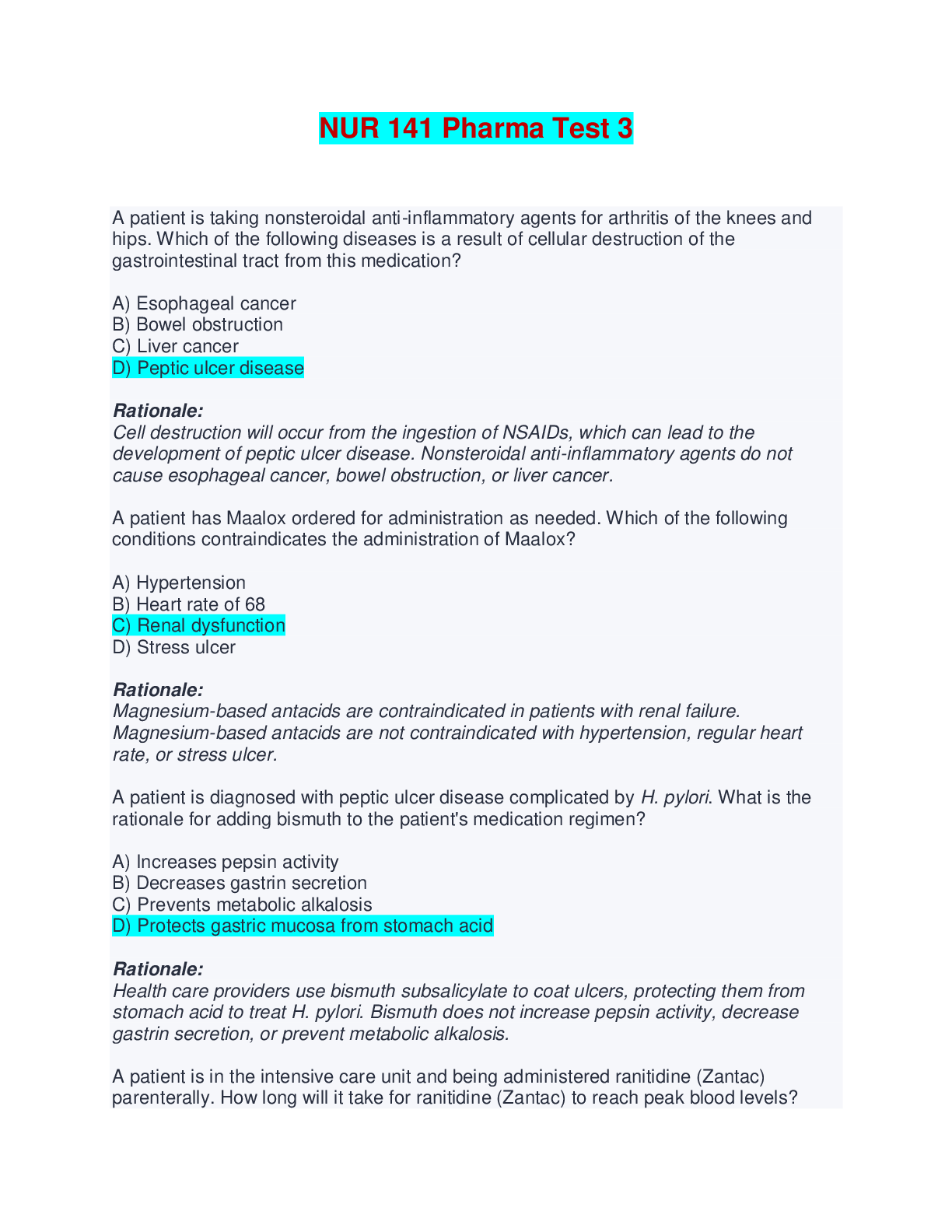
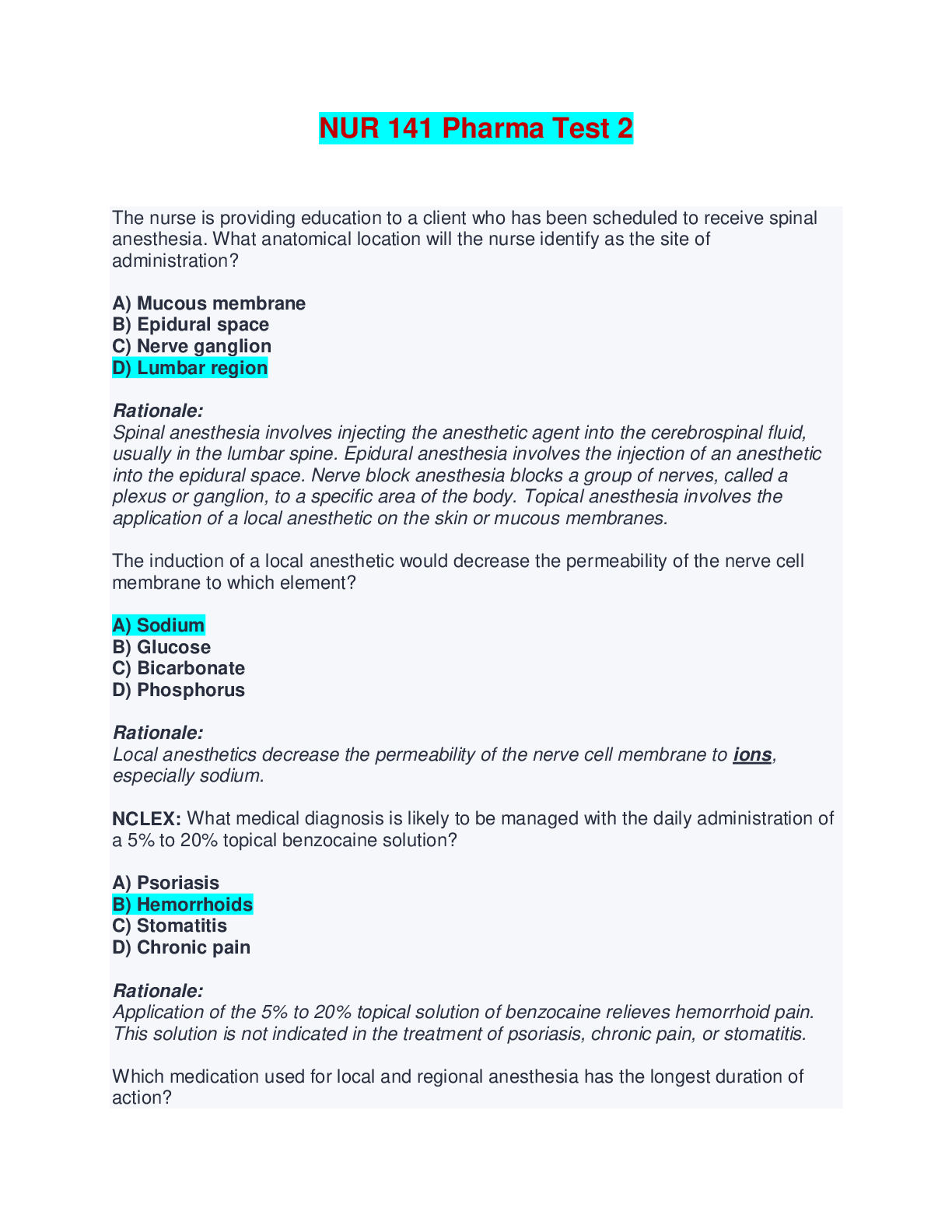
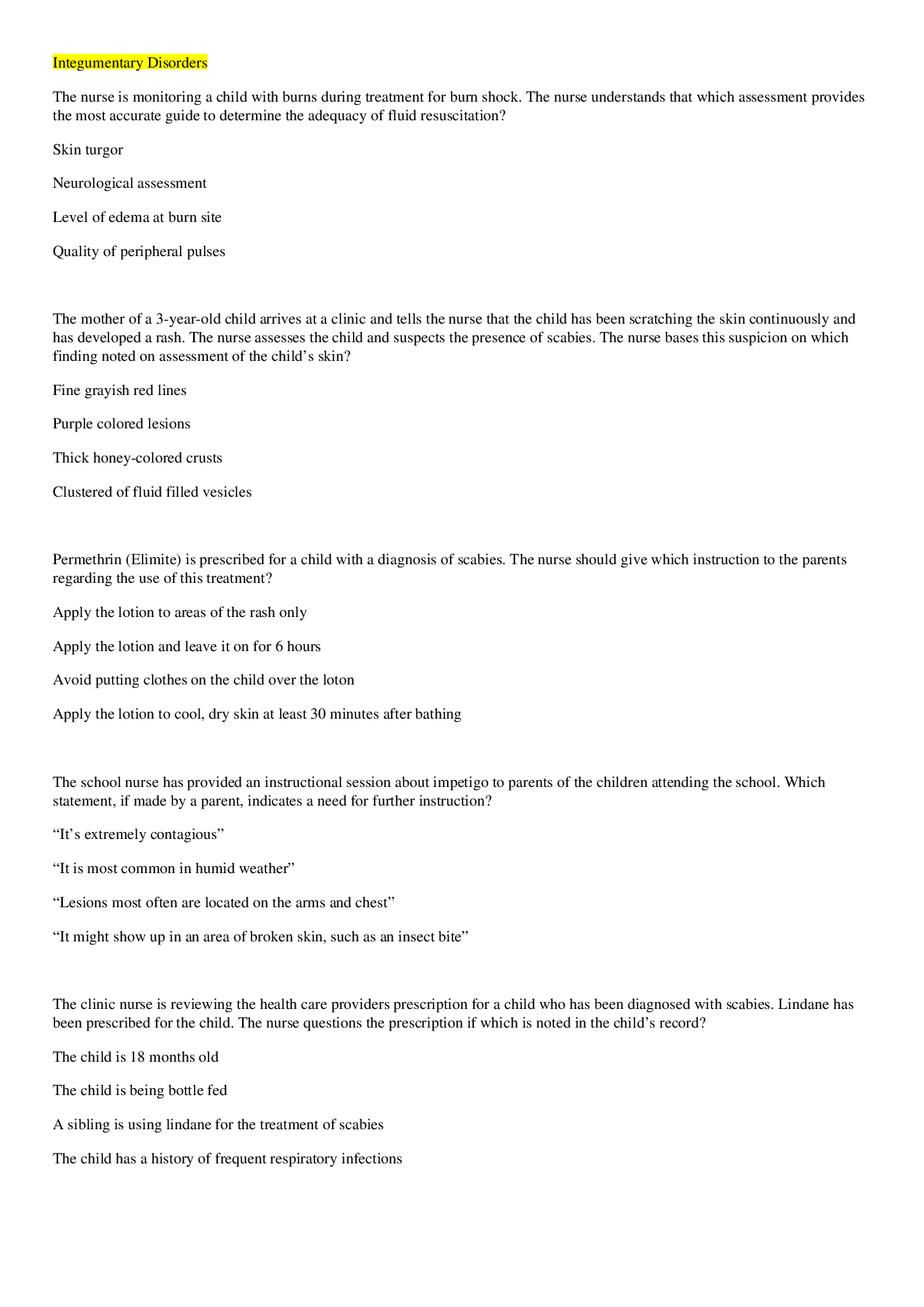
NUR 141 Final Exam - Questions and Answers (Complete Solutions) The nurse is responsible for preoperative teaching for a patient who is mildly anxious about receiving pain medication postoperatively. The nurse recognizes that this level of anxiety may: a. result in learning by increasing patient's motivation to learn. b. lead to major emotional unsteadiness. c. impede learning because anxiety is always a barrier to learning. d. reorganize the patient's thoughts and lead to inadequate potential for learning. A conversion between different systems of measurement is required in all of the following situations EXCEPT: a. Physician orders a medication in micrograms and tablets supplied by the pharmacy are in milligrams b. Temperature is taken in Fahrenheit but is required to be documented in Celcius. c. Physician orders a medication using a different system of measurement than how the medication is supplied d. Patient reports his/her weight in pounds when kilograms is required to determine an appropriate dosage of an ordered medication. Which system of measure is most widely used for dispensing medications? a. Metric. b. Household. c. Apothecary. d. Avoidupois. A dosage calculation is performed in order to find the: a. quantity or volume of medication. b. dose of medication. c. administration time of medication. d. frequency of medication. Which of the following information is pertinent when performing a dosage calculation? Select all that apply. a. Patient receiving medication b. Unit of measure in which medication is supplied. c. Unit of measure in which medication is ordered. d. Ordered dose of medication. e. Time of administration. A patient receives an inappropriate dosage of a medication as prescribed. Who is responsible for this medication error? a. All of the above. b. The prescriber who prescribed the medication. c. The pharmacist who dispensed the medication. d. The nurse who administered the medication. A drug (Drug X 40 mg by mouth daily) has been ordered for your client. Each tablet contains 0.02 grams. How many tablets of this drug will you prepare? a. 2 tabs b. 1.2 tabs c. 1 tab d. 0.5 tabs A woman weighs 165 pounds. What is her weight in kilograms? a. 75 kg b. 363 kg c. 3.6 kg d. 7.5 kg Which of the following is the part of the Nursing Process that has the nurse assess the effectiveness of the medication? a. Evaluation b. Assessment c. Diagnosis d. Implementation If a medication is omitted for any reason, what must the nurse do? a. Record the omission and the reason why it wasn't given. b. Record the omission. c. Cross the space out on the MAR with an X. d. Leave the space blank on the MAR. The nurse holds a bottle of liquid medication with the label next to the palm of the hand when pouring a dose in order to: a. prevent soiling of the label by spilling the liquid. b. conceal the label from the curiosity of others. c. ensure the accuracy of the measurement of the dose. d. guarantee that the label is read before pouring the liquid. When a medication error is made, the nurse should: a. assess the patient, report it immediately to the charge nurse, call the physician, and initiate an Incident report. b. complete a variance report. c. report it to the charge nurse, complete an Incident report and notify the physician if injury/harm has occurred. d. assess the patient, report it to the charge nurse and complete and Incident report. A drug is ordered to be given STAT. The nurse should administer this drug: a. immediately. b. in the subcutaneous tissue. c. at hour of sleep. d. in a suspension. While preparing to give morning medication, it is most important for the nurse to: a. compare the MAR to the physicians orders. b. explain actions and side effects of meds. c. plan to stay with the patient until medications are taken. d. crush medications that may be difficult to swallow. When the nurse has a problem reading the doctor's order, the most appropriate action is to: a. call the ordering physician. b. call the pharmacy. c. ask the charge nurse. d. check the patient's admission medication list. The client ask the nurse to leave his sleeping pill at the bedside because he wants to read for a few more minutes before going to sleep. The most appropriate action for the nurse to take is to: a. tell the client to call the nurse when he is ready for his medication. b. leave the pill as requested. c. tell the client he can take it now or not at all as this is when it is ordered. d. leave the pill as requested and check back in half an hour to be sure the client took the medication. When should tablets be removed from the individual dosage package a. At the bedside. b. After the first check. c. After the second check. d. Before leaving the med cart. The patient tells the nurse, "This pill is a different color than the one I usually take at home". The nurse's response is based on the understanding that: a. accountability demands the nurse follow-up. b. many patients are confused in the hospital. c. checking the MAR with the physician orders is sufficient. d. a generic form of the medication may have been substituted. When preparing a medication, it is important to check all EXCEPT: a. The name of the person who gave it last. b. Check the expiration date. c. Check the dosage. d. Check the name of the medication. When giving eye drops the nurse should perform all of the following EXCEPT: a. place the drops on the cornea of the eye. b. use a separate bottle for each client. c. warm the eye drop solution before instilling in the clients lower conjunctival sac. d. discard the dropper if the tip is accidentally contaminated. If a client is having difficulty swallowing, which of the following would be contraindicated during administration of oral meds? a. place the med on the tip of the tongue. b. place the head of bed to 90 degrees. c. use liquid form. d. crush pill and put in applesauce. A medication is in a sustained-release tablet. The nurse should avoid: a. crushing the tablet before administration. b. administering the tablet with another medication. c. giving the drug with an antacid. d. administering the tablet with water A nurse is caring for a patient who has received an order to administer several drugs at the same time. What would be the nurse's priority action? a. Consult a drug guide for possible drug interactions. b. Wash her hands before handling the medications. c. Question the patient concerning drug allergies. d. Call the physician to get clarification on the medication order. Drugs do not metabolize the same in all people. In which of the following patients would a nurse expect to see an alteration in drug metabolism? a. A 50 year old patient with liver disease. b. A 35 year old female with cervical cancer. c. A 41 year old male with kidney disease. d. A 70 year old patient with heart disease. One reason it is important for your physician to know what drugs you are taking is that during a phase of pharmacokinetics a significant drug-drug interaction can occur resulting in one drug stimulating or blocking the metabolism of the other drug. What phase can this occur in? a. Metabolism. b. Absorption. c. Excretion. d. Distribution. Your patient is taking low dose aspirin daily for his/her heart. You know that the patient is not receiving all the dosage of the aspirin that is being ingested. This occurs because of what? a. First-pass effect b. Biotransformation c. Liver metabolism d. A nurse is administering digoxin to one of her patients. When administering a drug the nurse needs to consider the phases of what so that the drug she is administering can be made as effective as possible? a. Pharmacokinetics b. Pharmacotherapeutics c. Pharmacoeconomics d. Pramcodynamics The nurse is explaining first pass effect to the client. Which of the following have the most influence on drug absorption considering first pass effect? a. Route of administration b. Age of the patient c. Route of excretion d. Amount of fluid the drug is taken with The nurse administers a medication to the client that has a known side effect of dizziness. The nurse informs the client not to get up without help and raises the side rails. These interventions are examples of" a. anticipating complications and initiating preventive measures. b. making the client physically comfortable. c. arranging the environment to reduce distractions. d. identifying situations in which the nurse needs assistance. A nurse is teaching her patient about the use of over-the-counter (OTC) drugs. Which of the following statements best informs the patient about their safe use? a. "OTC drugs need to be taken with caution; they can mask the signs and symptoms of an actual disease." b. "OTC drugs are products that are available without prescription for self-treatment of minor complaints." c. "OTC drugs are considered medications and should be reported in a drug history." d. "OTC drugs were approved as prescription drugs but later were found to be safe without the need of a prescription." A nurse is administering a medication that is formulated as an enteric-coated tablet. What is the rationale for not crushing or chewing an enteric-coated tablet? a. To prevent gastric irritation. b. To prevent absorption in the mouth. c. To prevent absorption in the stomach. d. To prevent absorption in the esophagus. To prevent gastric irritation. The following would be an appropriate outcome for clients receiving medications. The client will: a. state the reasons for taking the medication. b. understand the disease process. c. know how the medication works. d. understand what causes the side effects. What is the primary role of the nurse in medication administration? a. ensure medications are administered and delivered in a safe manner. b. be certain that the physician orders are accurate. c. inform the client that prescribed medications need to be taken only if the client agrees with the treatment plan. d. assure client compliance by watching the client swallow all prescribed medications. What technique is used to help otic medications drain better into the ear canal of an adult patient? a. press gently several times on the tragus of the ear. b. roll the patient from the side-lying to the supine position. c. pull the pinna of the ear backward and downward. d. instill the drops into the center of the auditory canal. A doctor has ordered that Mrs. Smith receive Lasix 20 mg by mouth. What essential elements of the medication order is missing? a. Frequency b. Patient's name c. Route d. Drug name A nurse is preparing to administer a drug to a client for the first time. What questions should the nurse consider before actually administering the drug? Select all that apply a. Is this the right patient? b. Is this the right drug? c. Is this the right route for this patient? d. Is this the right dose, as ordered? e. Did I record this properly? When preparing liquid medications that are in suspension form, what is important for the nurse to do when preparing the medication for administration? a. Shake the bottle before pouring. b. Measure the liquid into the bottle cap. c. Mix liquid medications together. d. Measure medication while holding the cup in hand. What is most important when applying transdermal patches? a. Remove the old patch. b. Cleaning the area. c. Use fingertips to apply patch. d. Initial, date, and time on the patch. When establishing the nursing interventions appropriate for a specific patient: a. an evaluation of all the data accumulated should be incorporated to achieve an effective care plan. b. the patient should not be actively involved. c. the patient support systems should be included only at discharge. d. teaching should be done when the patient states he or she is ready to learn. The nurse is reviewing drug therapy with OTC (over-the-counter) medications. Which of the following is an advantage of OTC drugs? a. Many OTC drugs have fewer drug interactions with an established history of safety. b. The OTC drugs are usually inexpensive with no side effects to be concerned with. c. Patients can feel better much faster compared to a complicated prescribed drug regimen. d. Patient can eliminate the need for all physician visits while saving money. The prescriber orders valsartan 120 mg by mouth daily for a patient with hypertension. The pharmacist has dispensed 40 mg tablets, how any tablets would you give to the client? a. 3 tabs b. 2 tabs c. 4 tabs d. 1 tab An older adult patient is eating breakfast. The nurse knows this patient is taking a variety of different types of medications. Which item on the patient's tray would most concern the nurse about possible effects on drug metabolism?
[Show More]