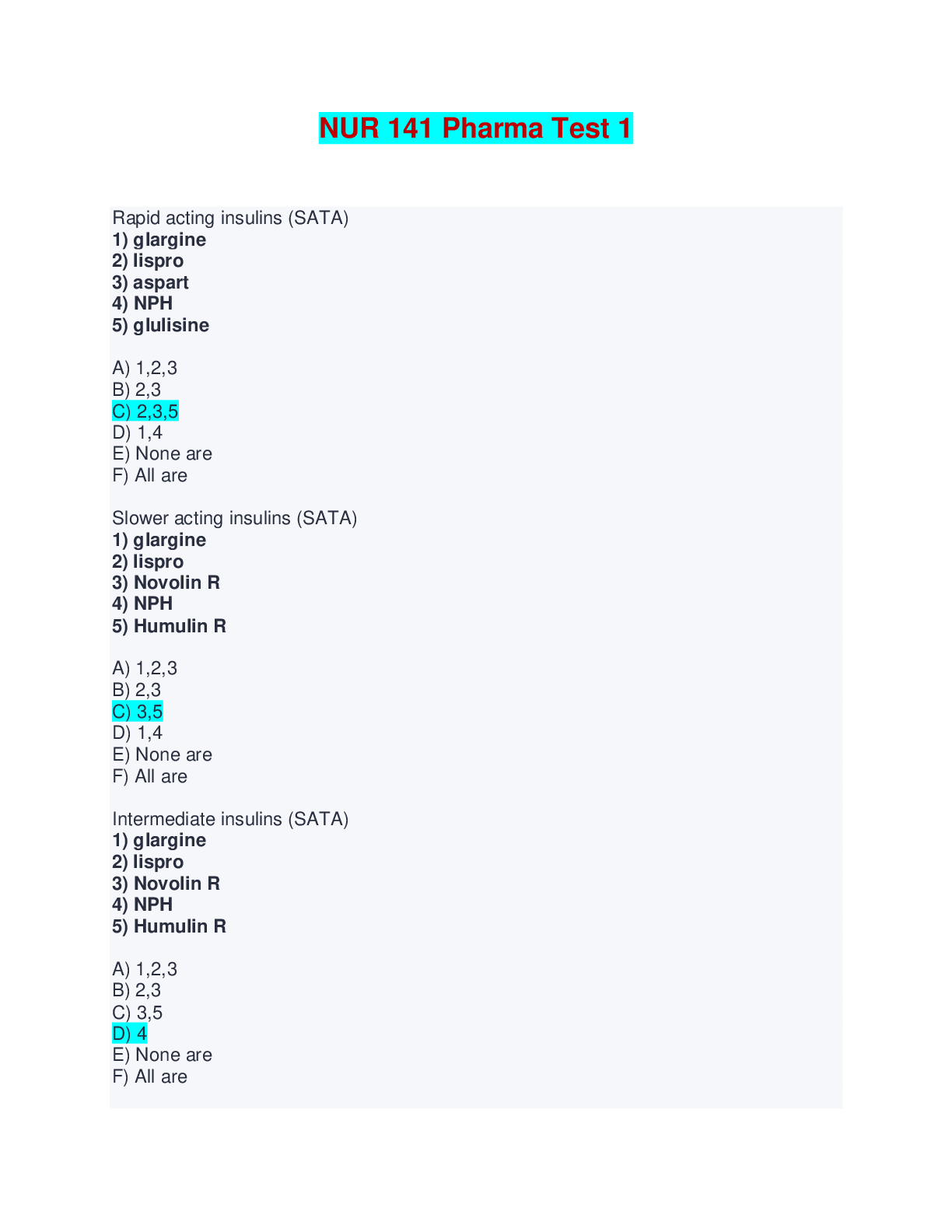
NUR 141 Pharma Test 3 - Answered with Rationales (Complete Solutions) A patient is taking nonsteroidal anti-inflammatory agents for arthritis of the knees and hips. Which of the following diseases is a result of cellul
...
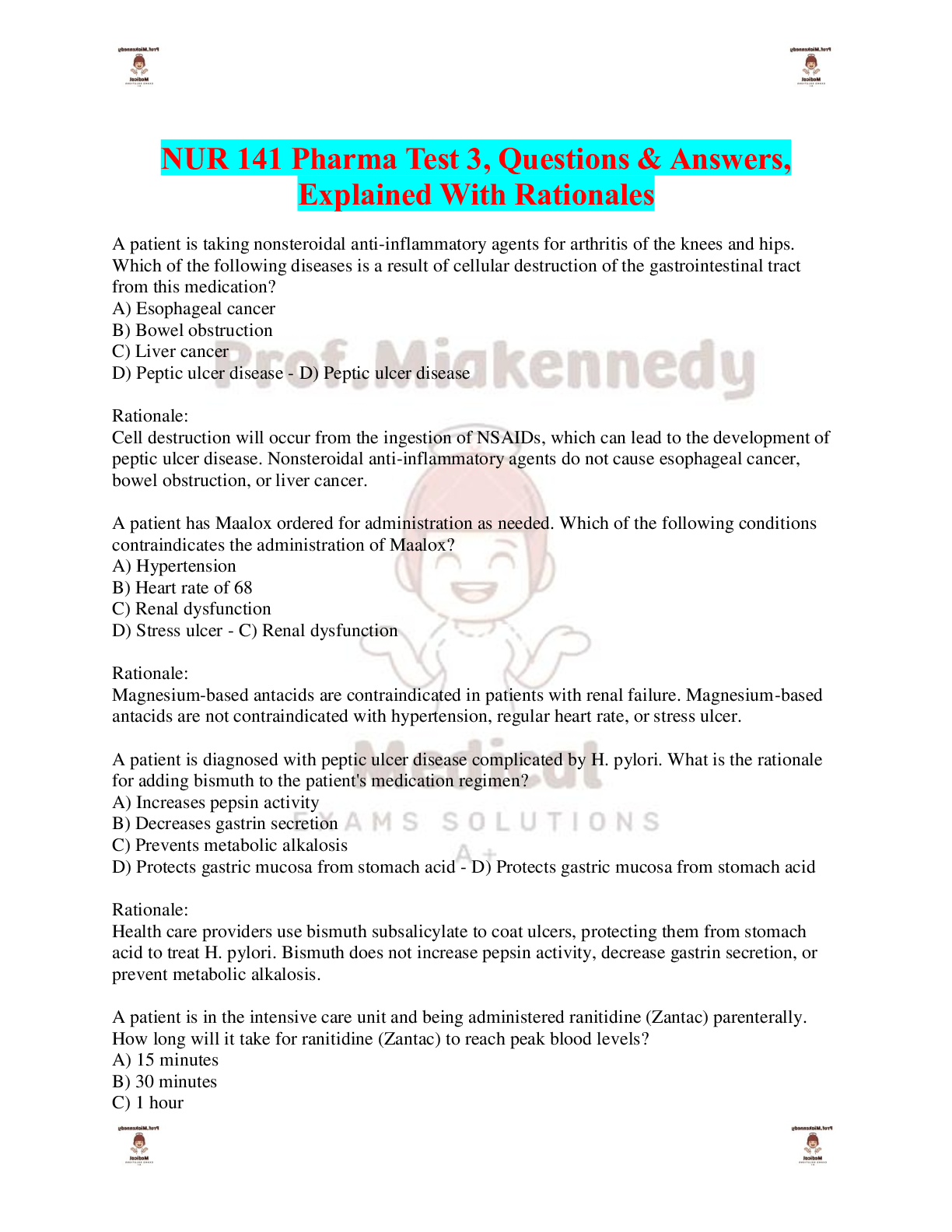
NUR 141 Pharma Test 3 - Answered with Rationales (Complete Solutions) A patient is taking nonsteroidal anti-inflammatory agents for arthritis of the knees and hips. Which of the following diseases is a result of cellular destruction of the gastrointestinal tract from this medication? A) Esophageal cancer B) Bowel obstruction C) Liver cancer D) Peptic ulcer disease Rationale: Cell destruction will occur from the ingestion of NSAIDs, which can lead to the development of peptic ulcer disease. Nonsteroidal anti-inflammatory agents do not cause esophageal cancer, bowel obstruction, or liver cancer. A patient has Maalox ordered for administration as needed. Which of the following conditions contraindicates the administration of Maalox? A) Hypertension B) Heart rate of 68 C) Renal dysfunction D) Stress ulcer Rationale: Magnesium-based antacids are contraindicated in patients with renal failure. Magnesium-based antacids are not contraindicated with hypertension, regular heart rate, or stress ulcer. A patient is diagnosed with peptic ulcer disease complicated by H. pylori. What is the rationale for adding bismuth to the patient's medication regimen? A) Increases pepsin activity B) Decreases gastrin secretion C) Prevents metabolic alkalosis D) Protects gastric mucosa from stomach acid Rationale: Health care providers use bismuth subsalicylate to coat ulcers, protecting them from stomach acid to treat H. pylori. Bismuth does not increase pepsin activity, decrease gastrin secretion, or prevent metabolic alkalosis. A patient is in the intensive care unit and being administered ranitidine (Zantac) parenterally. How long will it take for ranitidine (Zantac) to reach peak blood levels? A) 15 minutes B) 30 minutes C) 1 hour D) 2 hours Rationale: Parenteral ranitidine reaches peak blood level in 15 minutes. Parenteral ranitidine reaches its peak prior to 30 minutes, 1 hour, and 2 hours. The nurse practitioner instructs the patient to use over-the-counter ranitidine (Zantac) instead of cimetidine (Tagamet). What risk is decreased when using ranitidine rather than cimetidine? A) Headache B) Drug-to-drug interaction C) Diarrhea D) Bradycardia Rationale: Unlike cimetidine, ranitidine (Zantac), famotidine (Pepcid, Pepcid RPD), and nizatidine (Axid) do not affect the cytochrome P450 drug-metabolizing system in the liver and therefore do not interfere with the metabolism of other drugs. Use of these other drugs may be preferable in patients who are critically ill because they often require numerous other drugs with which cimetidine may interact. A patient is taking cimetidine (Tagamet) for increased gastric pain and hypersecretion. Nurses should use extreme caution when administering cimetidine to patients with which of the following conditions? A) Hepatic disease B) Cancer C) Hypertension D) Diabetes mellitus Rationale: No absolute contraindications exist, but cimetidine should be used cautiously in patients with impaired hepatic and renal function. The patient with cancer, hypertension, and diabetes mellitus can take cimetidine safely. A male patient is taking cimetidine (Tagamet). Which adverse effect is more likely to occur with cimetidine than with other histamine2 receptor antagonists? A) Hypoxia B) Hypertension C) Gynecomastia D) Seizures Rationale: Gynecomastia is an adverse effect that is more likely to occur with cimetidine than with other histamine-2 antagonists. Hypoxia, hypertension, and seizures are not adverse effects of cimetidine. A patient is prescribed a proton pump inhibitor to treat erosive gastritis. How soon will the patient's symptoms most likely be abolished? A) 1 to 2 weeks B) 4 weeks C) 1 month D) 6 weeks Rationale: The symptoms of gastroesophageal reflux disease will be abolished in 1 to 2 weeks after the start of the proton pump inhibitor medication regime. It will not take 4 weeks, 1 month, or 6 weeks to see a change with the proton pump inhibitor. A 23-year-old female patient is prescribed misoprostol (Cytotec). Which of the following patient teaching interventions is most important? A) Supplement therapy with magnesium antacids. B) Report postmenopausal bleeding. C) Use effective contraceptive measures. D) Administer the drug one time per day. Rationale: Misoprostol (Cytotec) is used to prevent NSAID gastric ulcer development. The medication can cause spontaneous abortion; thus, the medication should be administered with a good form of birth control. It should not be administered with magnesium antacids. It is not necessary for a patient aged 23 years to report postmenopausal bleeding. The medication should be administered two to four times per day. (SATA)A 62-year-old man is surprised to learn that his recurrent indigestion has been attributed to a new diagnosis of peptic ulcer disease. The patient states, “I've never been a really anxious type of person, so I never thought I'd develop ulcers.” The nurse has responded with health education addressing the etiology of peptic ulcer disease. What causative factors should the nurse cite? 1) Physiologic or psychological stress 2) Diabetes mellitus 3) Cigarette smoking 4) Infections 5) Nonsteroidal anti-inflammatory drugs A) 1, 3
B) 2, 3, 5 C) 1, 5 D) 1, 3, 4, 5 E) All of these F) None of these Rationale: There are multiple etiologic factors implicated in PUD. These include smoking, H. pylori infection, NSAID use, and stress. Diabetes is not an identified cause. A critically ill patient is being treated in a burn unit following a workplace accident. The patient's current treatment includes an intragastric drip of an antacid through a nasogastric tube. How should the critical care nurse most accurately titrate the dose and frequency of administration? A) By assessing the pH of a 24-hour urine sample B) By aspirating stomach contents and measuring the pH C) By measuring the pH of urine after each void D) By swabbing the patient's buccal mucosa and testing for pH daily Rationale: For patients with a nasogastric tube in place, antacid dosage may be titrated by aspirating stomach contents, determining pH, and then basing the dose on the pH. Accurate measurement of gastric pH cannot be determined from the buccal mucosa or urine. An adult patient has been taking Titralac (Tums) on an increasingly frequent basis. When teaching this patient, the nurse should include suggestions for the prevention of which of the following adverse effects? A) Constipation B) Urinary frequency C) Fatty stools D) Nausea Rationale: With the antacid Titralac (Tums), which contains calcium, it is important to observe for constipation. Combining this antacid with other antacids containing magnesium may prevent this effect. Frequency, fatty stools, and nausea are not noted adverse effects. A patient who has been experiencing heartburn has begun taking OTC ranitidine (Zantac). The nurse who is working with this patient should be aware that this drug achieves a therapeutic effect by which of the following means? A) Raising the pH of gastric secretions B) Inhibiting the secretion of gastric acid C) Binding to proton pumps D) Decreasing gastric motility Rationale: The histamine-2 receptor antagonists (H2RAs) inhibit both basal secretion of gastric acid and the secretion stimulated by histamine, acetylcholine, and gastrin. These drugs, such as ranitidine, do not change the pH of secretions, bind to the proton pumps, or decrease gastric motility. A patient has sought care for follow-up to his recent diagnosis of peptic ulcer disease. The patient states that he has achieved adequate symptom relief with the use of OTC antacids but has asked the nurse about the optimal schedule for taking these drugs. What should the nurse recommend? A) Taking the drugs at the earliest appearance of symptoms B) Immediately prior to each meal and at bedtime C) Every 4 hours during all waking hours D) One hour and three hours after each meal and at bedtime Rationale: For treatment of peptic ulcer disease, patients should take antacids 1 and 3 hours after meals and at bedtime (four to seven doses daily), 1 to 2 hours before or after other medications. A patient has been prescribed omeprazole by her primary care provider. When questioned by the nurse about her perceived effectiveness of the drug, the patient states, "I think it's working quite well, and I've gotten in the routine of taking it every morning before breakfast." How should the nurse respond? A) "That's good, but remember that you shouldn't take it on days when you're not having any symptoms." B) "I'm glad it's working for you, but you'll probably find it works even better if you take it after eating." C) "That's great. If you find later that it's not working as well, you might want to try taking it at bedtime." D) "I'm glad to hear that. It sounds like you're taking it exactly like it should be taken." Rationale: It is important that omeprazole be administered before food intake. Once-daily dosing is typical. The drug is not taken solely as a response to acute symptoms. A patient who has a diagnosis of peptic ulcer disease has begun taking sucralfate (Carafate). The nurse should caution the patient against the concurrent use of: A) antacids. B) NSAIDs. C) acetaminophen. D) probiotics. Rationale: Antacids decrease the effects of sucralfate, and people should not take them within 30 minutes before or after administration of sucralfate. A patient with ulcers has asked the nurse if it would be acceptable for him to take bismuth subsalicylate. Before recommending an OTC formulation of this drug, the nurse should assess the patient's: A) immunization history. B) allergy status. C) cognition. D) normal bowel pattern. Rationale: Because it is a salicylate, this drug can cause serious bleeding problems when used alone in patients with ulcers. People with an allergy to aspirin or other salicylates should not take bismuth subsalicylate. The patient's bowel pattern, immunization history, and cognition are not central considerations. A patient is experiencing nausea and vomiting as a response to radiation therapy. Which of the following antiemetic agents is a phenothiazine administered to control nausea and vomiting? A) Prochlorperazine (Compazine) B) Metoclopramide (Reglan) C) Mesna (Mesnex) D) Dexamethasone Rationale: Prochlorperazine (Compazine) is a commonly used phenothiazine administered for nausea and vomiting related to radiation therapy. Metoclopramide is a prokinetic agent that increases GI motility and the rate of gastric emptying by increasing the release of acetylcholine from nerve endings in the GI tract. Mesna is used for thrombocytopenia. Dexamethasone is a corticosteroid. A pregnant woman suffers from morning sickness. Which of the following should be considered a first-line treatment? A) Vitamin B6 B) Promethazine (Phenergan) C) Vitamin E D) Diphenhydramine (Benadryl) Rationale: For pregnant women, taking pyridoxine (vitamin B6) 30 to 75 mg daily in three divided doses with or without the antihistamine doxylamine 12.5 mg every 8 hours as needed is considered a first-line treatment option that is safe and effective. Phenergan is not a first-line treatment for morning sickness. Benadryl and vitamin E are not used to treat nausea. A patient with Parkinson's disease develops nausea and vomiting. Promethazine may be contraindicated because it depletes levels of what neurotransmitter? A) Acetylcholine B) Serotonin C) Dopamine D) Adenosine Rationale: Promethazine and other phenothiazines have widespread effects on the body. The therapeutic effects in nausea and vomiting are attributed to their ability to block dopamine from receptor sites in the brain and CTZ. This blockage of dopamine has the potential to exacerbate parkinsonian effects. What is a non-pharmacological measure that is effective in treating nausea and vomiting in pregnant women? A) Ginkgo biloba B) Ginger C) Garlic D) Ginseng Rationale: Clinical trials indicate that ginger can effectively reduce nausea and vomiting associated with motion sickness, pregnancy, and surgery. A patient is administered promethazine (Phenergan) for nausea and vomiting. Which of the following is an adverse effect of promethazine (Phenergan)? A) Urinary incontinence B) Tachycardia C) Taste alteration D) Extrapyramidal symptoms Rationale: Extrapyramidal symptoms are adverse effects of promethazine. Urinary retention is an adverse effect, not urinary incontinence. Tachycardia is not an adverse effect of promethazine. Taste alteration is not an adverse effect of promethazine. A patient is administered an antihistamine for nausea. Which of the following is an adverse effect of this classification of medication? A) Diarrhea B) Prolonged QRS complex C) Urinary retention D) Inverted T wave Rationale: Adverse anticholinergic effects of antihistamines are dizziness, confusion, dry mouth, and urinary retention. Diarrhea, prolonged QRS complex, and inverted T wave are not adverse effects of antihistamines. A patient is administered a phenothiazine for nausea and vomiting. What is the action of phenothiazine? A) Increases gastric motility B) Antagonizes dopamine receptors C) Blocks histamine receptors D) Antagonizes serotonin receptors Rationale: Phenothiazines act on the CTZ and vomiting center by blocking dopamine. They do not increase gastric motility. Phenothiazines do not block histamine receptors. Phenothiazines do not antagonize serotonin receptors. A patient has been administered hydroxyzine for the treatment of nausea. Which of the following statements indicates that she has understood the teaching provided by the nurse? A) "I will take repeated doses of this medication until my nausea resolves." B) "I may experience drowsiness with this medication." C) "I should eat before I take this medication." D) "I will need to take potassium with this medication." Rationale: Hydroxyzine will produce drowsiness in the patient. Repeated doses are unsafe. The patient should not eat with nausea. The patient does not need to take potassium with hydroxyzine. A pediatric patient is receiving chemotherapy. What is the recommended treatment of nausea and vomiting with pediatric chemotherapy agents? A) Corticosteroids and 5-HT3 receptor antagonists B) Phenothiazines and benzodiazepines C) Proton pump inhibitors and antacids D) Prokinetic agents and antihistamines Rationale: 5-HT3 receptor antagonists and corticosteroids are used to treat nausea and vomiting in pediatric oncology patients. A 1-year-old postoperative patient has been experiencing repeated vomiting. What antiemetic drug has a black box warning against use in a patient of this age? A) Promethazine (Phenergan) B) Benzquinamide (Emete-Con) C) Buclizine (Bucladin-S) D) Cyclizine (Marezine) Rationale: A black box warning alerts nurses that promethazine is contraindicated in children younger than 2 years of age because of the risk of potentially fatal respiratory depression. Benzquinamide, buclizine, and cyclizine do not have such warnings. An adult patient is administered hydroxyzine for nausea. What adverse effect is most likely with this medication? A) Thrombocytopenia B) Palpitations C) Hypertonic muscle tone D) Dry mouth Rationale: Anticholinergic effects, including dry mouth, can result from the use of hydroxyzine. This drug is not associated with thrombocytopenia, palpitations, or hypertonicity. An 85-year-old patient is administered dimenhydrinate (Dramamine). Which of the following is the priority nursing intervention? A) Encourage fluids with this patient. B) Have the patient void after administration. C) Maintain IV access. D) Protect from injury. Rationale: Dimenhydrinate (Dramamine) causes drowsiness, especially in older adults, and therefore should be used cautiously. The nurse should protect the patient from injury. The nurse should not force fluids. The patient will not require IV access unless fluid replacement is ordered. A patient is administered promethazine. The patient has an elevated creatinine level. Which of the following is important when administering promethazine to this patient? A) Administer the routine dose. B) Administer a lower dose. C) Administer a higher dose. D) Hold the medication. Rationale: A dose reduction may be necessary in patients with renal impairment to avoid the possibility of adverse effects, toxicity, or increased sensitivity to phenothiazines. A patient who is scheduled to begin chemotherapy for the treatment of breast cancer is anxious about the possibility of experiencing nausea and has asked the nurse multiple questions about the physiology of the phenomenon. When explaining the physiology of nausea and vomiting, the nurse should include which of the following statements? A) The vomiting center is a cluster of cells in the cerebellum. B) The vomiting center sends afferent signals to the chemoreceptor trigger zone (CTZ). C) The chemoreceptor trigger zone CTZ is composed of neurons in the fourth ventricle. D) The CTZ is located partly within the central nervous system and partly in the peripheral nervous system. Rationale: The CTZ is composed of neurons in the fourth ventricle. The vomiting center is a nucleus of cells in the medulla oblongata. Stimuli are relayed to the vomiting center by afferent signals from the chemoreceptor trigger zone (CTZ). An adult hospital patient has been experiencing intractable nausea and vomiting for several hours, so the nurse has obtained an order for an antiemetic from the primary care provider. The order reads: "Promethazine 25 mg sub-Q every 6 hours PRN." The nurse should contact the care provider to question what aspect of this order? A) The drug B) The dose C) The route D) The frequency Rationale: A black box warning alerts nurses that promethazine is contraindicated for subcutaneous administration. The other parameters of the order are within recommendations. An older adult's physician has recommended the occasional use of hydroxyzine for relief of nausea. Following administration, the nurse should assess the patient for
[Show More]