NUR 141 Pharma Test 1 - Answered with Rationales (Complete Solutions) Rapid acting insulins (SATA) 1) glargine 2) lispro 3) aspart 4) NPH 5) glulisine A) 1,2,3 B) 2,3 C) 2,3,5 D) 1,4 E) None are F) All are Slower actin
...
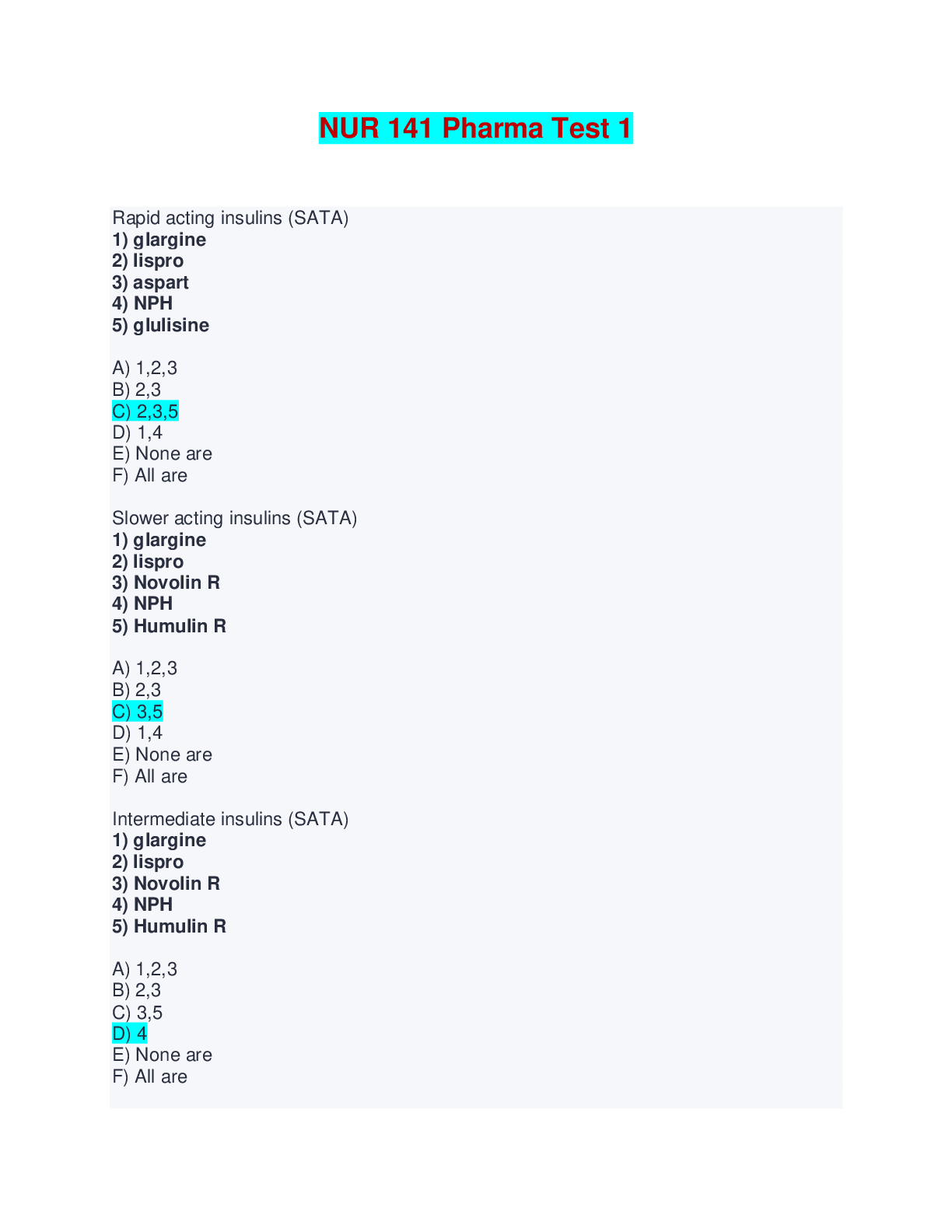
NUR 141 Pharma Test 1 - Answered with Rationales (Complete Solutions) Rapid acting insulins (SATA) 1) glargine 2) lispro 3) aspart 4) NPH 5) glulisine A) 1,2,3 B) 2,3 C) 2,3,5 D) 1,4 E) None are F) All are Slower acting insulins (SATA) 1) glargine 2) lispro 3) Novolin R 4) NPH 5) Humulin R A) 1,2,3 B) 2,3 C) 3,5 D) 1,4 E) None are F) All are Intermediate insulins (SATA) 1) glargine 2) lispro 3) Novolin R 4) NPH 5) Humulin R A) 1,2,3 B) 2,3 C) 3,5 D) 4 E) None are F) All are Long duration insulins (SATA) 1) glargine 2) lispro 3) Novolin R 4) NPH 5) Humulin R A) 1,2,3 B) 2,3 C) 3,5 D) 1 E) None are F) All are Rapid Acting Insulin onset time A) 1-1.5 hrs B) 15 mins C) 30 mins - 1 hr D) 1-2 hrs Rapid Acting Insulin Peak time A) 1-1.5 hrs B) 2-3 hrs C) 8-12 hrs D) None Rapid Acting Insulin duration time A) 6-8 hrs B) 5-7 hrs C) 18-24 hrs D) 24 hrs Short-Duration Insulin onset time A) 1-1.5 hrs B) 15 mins C) 30 mins - 1 hr D) 1-2 hrs Short-Duration Insulin Peak time A) 1-1.5 hrs B) 2-3 hrs C) 8-12 hrs D) None Short-Duration Insulin duration time A) 6-8 hrs B) 5-7 hrs C) 18-24 hrs D) 24 hrs Intermediate-Duration Insulin onset time A) 1-1.5 hrs B) 15 mins C) 30 mins - 1 hr D) 1-2 hrs Intermediate-Duration Insulin duration time A) 6-8 hrs B) 5-7 hrs C) 18-24 hrs D) 24 hrs Intermediate-Duration Insulin Peak time A) 1-1.5 hrs B) 2-3 hrs C) 8-12 hrs D) None Long-Duration Insulin onset time A) 1-1.5 hrs B) 15 mins C) 30 mins - 1 hr D) 1 hr Long-Duration Insulin Peak time A) 1-1.5 hrs B) 2-3 hrs C) 8-12 hrs D) None Long-Duration Insulin Duration time A) 6-8 hrs B) 5-7 hrs C) 18-24 hrs D) 24 hrs After diet changes have failed for a type 2 diabetic, what would be your next alternative? A) Metformin B) glargine C) lispro D) NPH Rationale: This is an Oral Hypoglycemic which is 2nd step of controlling Type 2 DM. Type 1 you have to use insulin. Glargine, lispro, and NPH are all insulin options. MOA: Blocks the muscarinic receptor. Mydriasis results from blocking of muscarinic receptors promoting contraction of the iris sphincter. Cycloplegia results from blocking of muscarinic receptors promoting contraction of the ciliary muscle. 1) Beta-Blockers 2) Anticholinergics 3) NSAIDs 4) Herbalogic (T or F)Your caring for a patient that has open-angle glaucoma. The MD prescribes Timolol eye drops. You check their medications and notice Propranolol. Should you administer Timolol? True False Rationale: Timolol is a Beta-adrenergic Blocker and Propranolol is a Beta-Blocker. Drugs ending in -olol are Beta-Blockers. Beta Blockers can cause slow HR. If you give both the patient could experience cardiac arrest. Check with your prescriber about proper action to take. (T or F)Your caring for a patient that has open-angle glaucoma. The MD prescribes Timolol eye drops. You know that you can apply the drops to the conjunctiva sac and have the patient blink a few times to spread the med evenly across the eye. True False Rationale: You should have the patient hold their closed for a minute and occlude the tear duct by the nose for 3-5 mins. This prevents the drug from becoming systemic. LAB VALUES: Potassium A) 3.5-5.0 B) 8.5-10.5 C) 1.8-3 D) 135-145 E) 35-45 F) 22-26 LAB VALUES: Calcium A) 3.5-5.0 B) 8.5-10.5 C) 1.8-3 D) 135-145 E) 35-45 F) 22-26 LAB VALUES: Magnesium A) 3.5-5.0 B) 8.5-10.5 C) 1.8-3 D) 135-145 E) 35-45 F) 22-26 LAB VALUES: Sodium A) 3.5-5.0 B) 8.5-10.5 C) 1.8-3 D) 135-145 E) 35-45 F) 22-26 LAB VALUES: Carbon Dioxide (PaCO2) A) 3.5-5.0 B) 8.5-10.5 C) 1.8-3 D) 135-145 E) 35-45 F) 22-26 LAB VALUES: Bicarbonate (HCO3-) A) 3.5-5.0 B) 8.5-10.5 C) 1.8-3 D) 135-145 E) 35-45 F) 22-26 LAB VALUES: pH A) 3.5-5.0 B) 8.5-10.5 C) 1.8-3 D) 135-145 E) 7.35-7.45 F) 22-26 (T or F) You can mix NPH with glargine(Lantus)? True False Rationale: Glargine(Lantus) is a long duration insulin and shouldn't be mixed. (T or F) You can mix NPH with regular insulin? True False What is the location that has the fastest absorption for insulin? A) Thigh B) Arm C) Abdomen D) Buttox What is the location that has the slowest absorption for insulin? A) Thigh B) Arm C) Abdomen D) Buttox Your caring for a conscious patient and their showing the following signs: Sweating Clammy Cold What would be your action of treatment? A) administer prescribed D50 via IV B) administer injection of prescribed glucagon C) give the patient 15gs of simple carbs D) administer 6 units of Lispro insulin Rationale: Patient is conscious showing signs of hypoglycemia. First thing we do is give 15 g of simple carbs, ie candy, 4-6oz of juice, gram cracker.... D50 is only if unconscious and IV available Glucagon is if unconscious and no IV available Pt is hypoglycemic and insulin would drive their sugars lower potentially killing them. Remember "Sweaty, Cold, and Clammy -> Give me Candy." You’re caring for a conscious patient and their showing the following signs: Warm Dry What would be your action of treatment? A) administer prescribed D50 via IV B) administer injection of prescribed glucagon C) give the patient 15gs of simple carbs D) administer prescribed insulin Rationale: Patient is conscious showing signs of hyperglycemia. In this situation we would probably administer insulin. D50 is only if unconscious and IV available and for hypoglycemia only Glucagon is if unconscious and no IV available and for hypoglycemia only Giving them carbs is only for hypoglycemia also Remember "Hot and Dry -> My Sugar is HIGH." You’re caring for a unconscious patient with an bag of 0.9% NS running and their showing the following signs: Sweating Clammy Cold What would be your action of treatment? A) administer prescribed D50 via IV B) administer injection of prescribed glucagon C) give the patient 15gs of simple carbs D) administer 6 units of Lispro insulin Rationale: The patient is unconscious showing signs of hyperglycemia with an IV present (0.9% NS). D50 is the the best option provided the IV is big enough. D50 is pretty You’re caring for a unconscious patient and their IV line is occluded. Their showing the following signs: Sweating Clammy Cold What would be your action of treatment? A) administer prescribed D50 via IV B) administer injection of prescribed glucagon C) give the patient 15gs of simple carbs D) administer 6 units of Lispro insulin Rationale: The patient is unconscious showing signs of hyperglycemia with an IV but is occluded(blocked). Glucagon is you best solution in this situation. (T or F) Your caring for a patient with Type 1 diabetes. Their showing signs of hyperglycemia. As a prudent RN, you would expect the MD. to prescribe and Oral Hypoglycemic like Metformin. True False Rationale: Oral Hypoglycemics like Metformin are only beneficial for Type 2 Diabetics. The issue for Type 1's is that they don't have insulin or are able to produce enough insulin to deal with the glucose. Oral Hypoglycemics affect the body's sensitivity to insulin not increase its amount. MOA: Increases tissue response to insulin and uptake of glucose by cells A) Canagliflozin B) Metformin C) Glipizide/Glyburide D) Sitagliptin MOA: Promotes insulin secretion by the pancreas. A) Canagliflozin B) Metformin C) Glipizide/Glyburide D) Sitagliptin MOA: Blocks reabsorption of filtered glucose in the kidneys, excretes glucose in urine, also helps promote weight loss. A) Canagliflozin B) Metformin C) Glipizide/Glyburide D) Sitagliptin MOA: Enhances the actions of incretin hormones to stimulate insulin release in response to meal stabilize glucose levels. Decreases hepatic glucose production. A) Canagliflozin B) Metformin C) Glipizide/Glyburide D) Sitagliptin (T or F)Your caring for a patient that is currently on Metformin. They will be having a diagnostic procedure in 2 days that requires Iodine Contrast. As a prudent nurse, you withhold the Metformin until after the procedure. True False Rationale: You should hold it for 48hrs before and after the procedure. (T or F)Your caring for a patient that is currently on Metformin. They will be having a diagnostic procedure in 2 days that requires Iodine Contrast. As a prudent nurse, you withhold the Metformin until 48hrs after the procedure. True False (T or F)Your caring for a patient that is currently on Metformin. They will be having a diagnostic procedure in 2 days that requires Iodine Contrast. As a prudent nurse, you withhold the Metformin the morning of the procedure until 48hrs after the procedure. True False Rationale: You should hold it for 48hrs before and after the procedure. (T or F)Your caring for a patient with Type 2 DM that is being prescribed Metformin. You look at the patient's Hx and notice they are also being treated for renal impairment and are on I&O's. Would you still give this medication? True False Rationale: A contraindication for Metformin is renal impairment along with hepatic impairment, ETOH(aka alcohol) use, or is over 80yo. This is because Metformin can be tough on the liver and kidneys. So if they are already impaired we could further damage them. (T or F)Your caring for a patient that currently on Glipizide. As a prudent nurse, you know that this drug could cause hypoglycemia because it triggers the pancreas' beta cells to produce more insulin. True False (T or F)Your caring for a patient that currently on Glipizide. As a prudent nurse, you know that this drug could cause hypoglycemia because it triggers the pancreas' alpha cells to produce more insulin. True False Rationale: The alpha cells of the pancreas produce glucagon not insulin. That would be the beta cells (T or F)Your caring for a patient that currently on Glipizide. As a prudent nurse, you know that this drug could cause hypoglycemia because it triggers the pancreas' beta cells to produce more glucagon. True False Rationale: The beta cells produce insulin which triggers the absorption of Glucose causing lower BGL(blood glucose level) and giving us HYPOglycemia. (T or F)Your caring for a patient that the MD has just prescribed Glipizide for Type 2 DM. As a prudent nurse, you know that your patient has had low urine output, <20 ml/hr, for the past few days and showing signs of edema. Would you administer this drug? True False Rationale: Because your patient hasn't been putting out much urine, normal is about 30-35 ml/hr, you should suspect renal problems/failure. Glipizide is contraindicated for Pt with renal/hepatic failure. (T or F)Your caring for a patient that the MD has just prescribed canagliflozin for Type 2 DM. As a prudent nurse, you know your patient is also on furosemide. Would you administer this drug? True False Rationale: Furosemide, Lasix, is a diuretic and we should be very cautious when combining these two as have similar MOA and will be hard on the kidneys, they will be working double time. (T or F)Your caring for a patient that the MD has just prescribed canagliflozin for Type 2 DM. As a prudent nurse, you know your patient is also on hydrochlorothiazide. Would you administer this drug? True False Rationale: Hydrochlorothiazide, -thiazides are diuretics, is a diuretic and we should be very cautious when combining these two as have similar MOA and will be hard on the kidneys, they will be working double time. You also want to be aware this drug is contraindicated for hepatic/renal impairments. (T or F)Your caring for a patient that the MD has just prescribed canagliflozin for Type 2 DM. As a prudent nurse, you know caution with this drug is important as risk for amputations are increased with canagliflozin. True False (T or F)Your caring for a patient that the MD has just prescribed glipizide for Type 2 DM. As a prudent nurse, you know caution with this drug is important as risk for amputations are increased with glipizide. True False Rationale: Amputation is a risk for canagliflozin not glipizide. (T or F)Your caring for a patient that the MD has just prescribed canagliflozin for Type 2 DM. As a prudent nurse, you know this drug's MOA and thus know your Pt is at risk for a UTI due to the glycosuria. True False You are caring for a patient with open-angle glaucoma. MD prescribes Latanoprost eye drops. After being applied, the patient voice concerns when their blue eyes turn brown. How would you react to this concern? A) "OH MY GOODNESS, We need a Doc STAT..." B) "Do not worry. That is a normal reaction for the medication. Your normal eye color will return." C) "Yes this is normal for the medication. It changes your eye color and is permanent. Hope you enjoy it.." D) "We will stop the treatment immediately and get with the Dr about an alternative." (T or F)Your caring for a patient with hyperthyroidism. As a prudent nurse, you know that normal drugs to treat this is an antithyroid like propylthiouracil and a beta-blocker like propranolol. True False Rationale: You may question the beta blocker, that slows the HR, being used with propylthiouracil(PTU) which could slow the HR. Remember not all adverse reactions happen. The beta-blocker would only be prescribed if the PTU isn't enough and the HR was still high. (T or F)Your caring for a patient with hyperthyroidism. As a prudent nurse, you know that normal drugs to treat this is an antithyroid like levothyroxine. True False Rationale: Levothyroxine is a thyroid medication for hypothyroidism not an antithyroid med. (T or F)When taking propylthiouracil, patient should take it every 8 hrs with or without food. True False (T or F)When taking propylthiouracil, patient should take it every 8hrs without food. Taking it with food affects it's absorption. True False Rationale: PTU should be taken every 8 hours with or without food. Either will work just do it the same every time. (T or F)Your caring for a patient with hypothyroidism. As a prudent nurse, you know that normal drugs to treat this is levothyroxine. True
False (T or F)Your caring for a patient with Cretinism. As a prudent nurse, you know that normal drugs to treat this is levothyroxine. True False Rationale: Hypothyroidism is Cretinism (T or F)Your caring for a patient with Myxedema. As a prudent nurse, you know that normal drugs to treat this is levothyroxine. True False Rationale: Myxedema is a severe case of hypothyroidism. A nurse is preparing to administer a scheduled dose of levothyroxine to an older adult client who is being treated in the hospital for a respiratory infection. Prior to administering the drug, the nurse should perform what assessment? A) Measurement of blood pressure B) Temperature measurement C) Chest auscultation for rales D) Assessment of pupillary response Rationale: In older adults receiving levothyroxine, regular monitoring of blood pressure and pulse is essential. Temperature, pupillary response, and chest auscultation are not necessary before safe administration of this medication. (T or F) When taking levothyroxine, the patient should take it every 8 hours with or without food. True False Rationale: Levothyroxine should be taken in the morning at the same time everyday on an empty stomach. (T or F) When taking levothyroxine, the patient should take it in the morning at the same time everyday on an empty stomach. True False
[Show More]