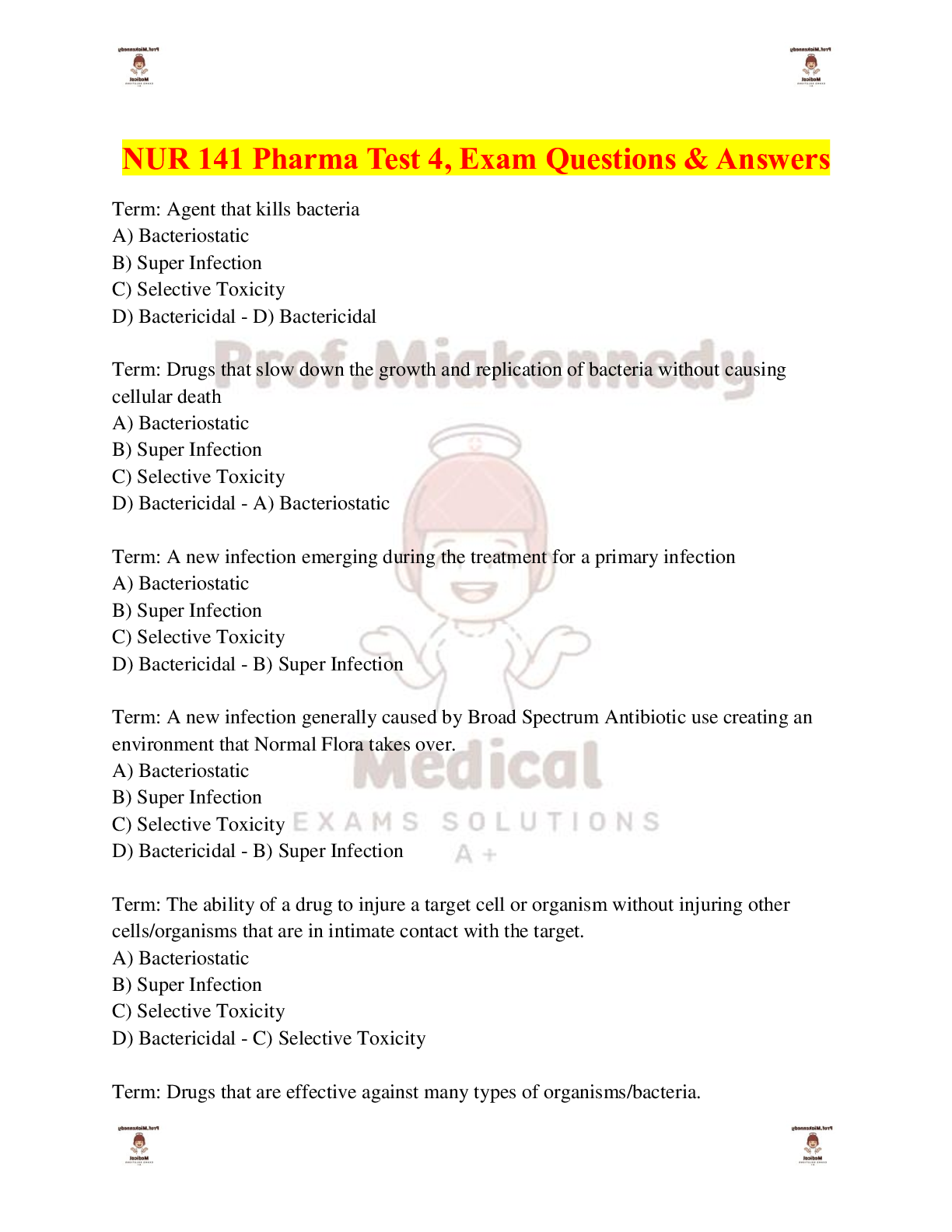
NUR 141 Pharma Test 4 - Answered with Rationales (Complete Solutions) Term: Agent that kills bacteria A) Bacteriostatic B) Super Infection C) Selective Toxicity D) Bactericidal Term: Drugs that slow down the growth and
...
NUR 141 Pharma Test 4 - Answered with Rationales (Complete Solutions) Term: Agent that kills bacteria A) Bacteriostatic B) Super Infection C) Selective Toxicity D) Bactericidal Term: Drugs that slow down the growth and replication of bacteria without causing cellular death A) Bacteriostatic B) Super Infection C) Selective Toxicity D) Bactericidal Term: A new infection emerging during the treatment for a primary infection A) Bacteriostatic B) Super Infection C) Selective Toxicity D) Bactericidal Term: A new infection generally caused by Broad Spectrum Antibiotic use creating an environment that Normal Flora takes over. A) Bacteriostatic B) Super Infection C) Selective Toxicity D) Bactericidal Term: The ability of a drug to injure a target cell or organism without injuring other cells/organisms that are in intimate contact with the target. A) Bacteriostatic B) Super Infection C) Selective Toxicity D) Bactericidal Term: Drugs that are effective against many types of organisms/bacteria. A) Broad Spectrum B) Narrow Spectrum C) Susceptibility D) Viruses Term: Drugs that are primarily effective against one or a limited type of organisms/bacteria. A) Broad Spectrum B) Narrow Spectrum C) Susceptibility D) Viruses Term: Vulnerability of the bacteria to an antibiotics' effects. A) Broad Spectrum B) Narrow Spectrum C) Susceptibility D) Viruses Term: Intracellular parasites that survive only in living tissues. A) Broad Spectrum B) Narrow Spectrum C) Susceptibility D) Viruses Generally speaking, gram + bacteria take on what color when staining is performed? A) pink B) green C) yellow D) purple Generally speaking, gram - bacteria take on what color when staining is performed? A) pink B) green C) yellow D) purple (SATA) A serious issue is when a bacteria becomes resistant to a drug, i.e. MRSA or VRE. Which of the following actions could result in a resistant bacteria? 1) Genetic Mutation of the Microorganism 2) Inadequate dose of an ABX 3) Patient not taking ABX for entire therapy duration 4) Sparingly using Broad Spectrum ABX when possible 5) Mainly using Narrow Spectrum ABX 6) Not using the appropriate ABX first A) 1,2 B) 4,5,6 C) 1,2,3,6 D) 2,3,4 E) All are causes F) None are causes Rationale: Genetic Mutations can be caused by 2,3, and 6. The key is a swift but thorough kill of the microorganism. Meaning, use the appropriate ABX, using the correct dosage, and for the appropriate durations. Any shortage of one of these could increase the resistance of the microorganism to further treatments. (T or F) It is acceptable to save your remaining antibiotics, if your feeling better and the symptoms have diminished, and use them later if needed? True False Rationale: You should always complete an ABX regiment no matter how you feel. This ensures that the microorganism is killed. Saving the antibiotics for later use could cause a resistant microorganism because the new scenario might be a different microorganism that requires a different ABX. (T or F) It is acceptable to take someone else's antibiotics because they are all the same anyways. True False Rationale: You should always complete an ABX regiment no matter how you feel. This ensures that the microorganism is killed. Saving the antibiotics for later use could cause a resistant microorganism because the new scenario might be a different microorganism that requires a different ABX. (T or F) It is advisable to take antibiotics for a viral infection. True False Rationale: Antibiotics are for bacteria not Viruses. Antivirals should be taken for Virus infections. (T or F) ABX can cause organ toxicity. The two main organs a prudent nurse would want to watch for this to happen to are the kidneys and the liver. True False Rationale: Remember the liver metabolizes a lot of things, especially medicines, and the kidneys filter out these things just the same. Both meaning over time buildups can occur creating toxic scenarios. MOA: We know that Beta-Lactam ABX like Amoxicillin interfere with/inhibits bacterial cell wall synthesis. True False MOA: We know that Beta-Lactam ABX like Ciprofloxacin interfere with/inhibits bacterial cell wall synthesis. True False Rationale: Ciprofloxacin isn't a Beta Lactam ABX, but instead a Fluoroquinolone. Fluoroquinolones disrupt DNA replication and cell division. Beta Lactams are like your PCN. -floxacin endings indicate fluoroquinolones. -cillin endings indicate your penicillins. (T or F) Most PCNs have better absorption rate with food. That is the reason it should be taken on a full stomach. True False Rationale: Food will actually slow the absorption of PCNs usually and should be taken on empty stomach, 1hr before or 2hr after meals and with full glass of water. Amoxicillin doesn't have to be taken on empty stomach. It can be taken with or without food. (T or F) PCN's are combined with Beta-Lactamase. This acts as a distraction for the bacteria allowing the PCN's to get to and impact the bacteria. True False Which of the following are Beta Lactamase? A) Clavulanic Acid B) Tazobactam C) Sulbactam D) All of above E) None of these
[Show More]