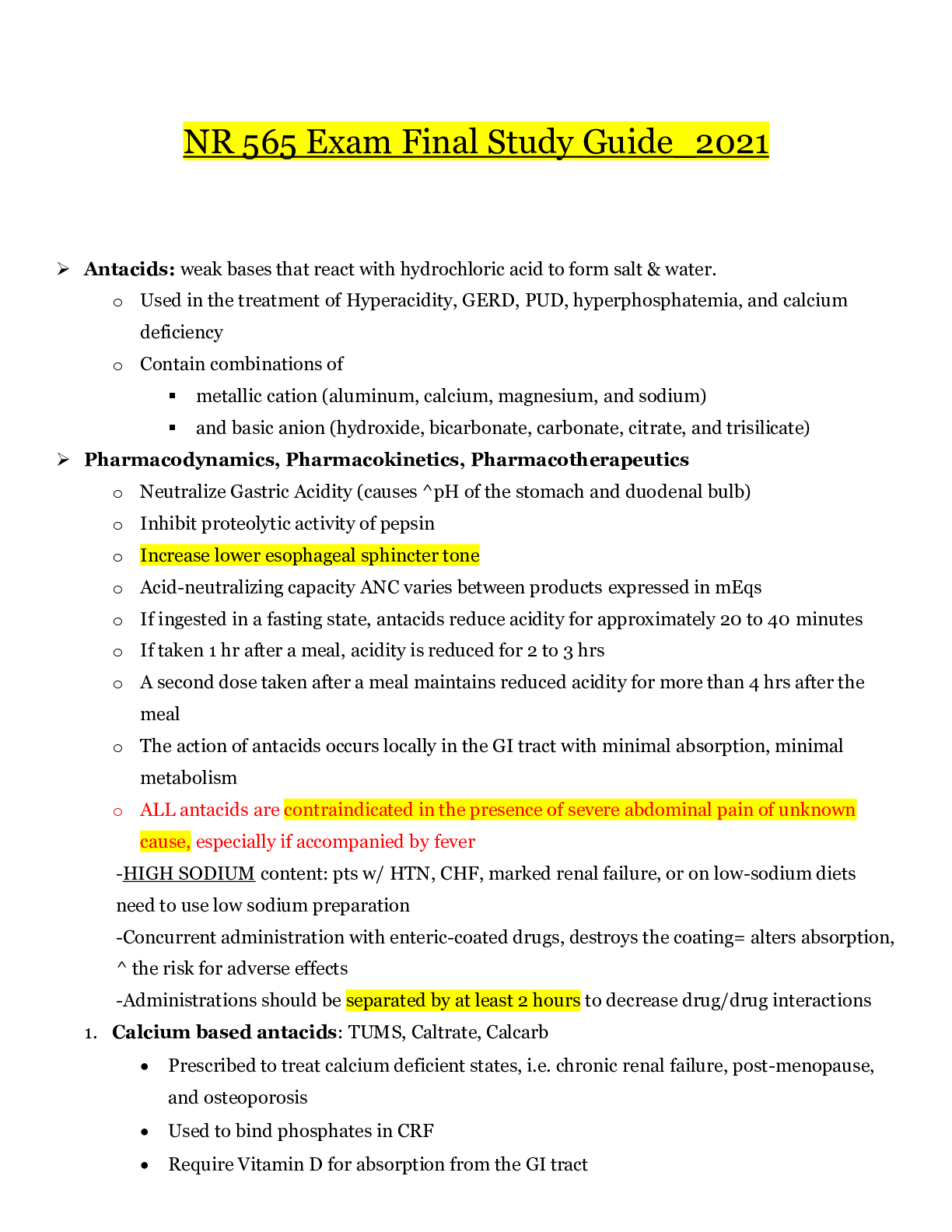
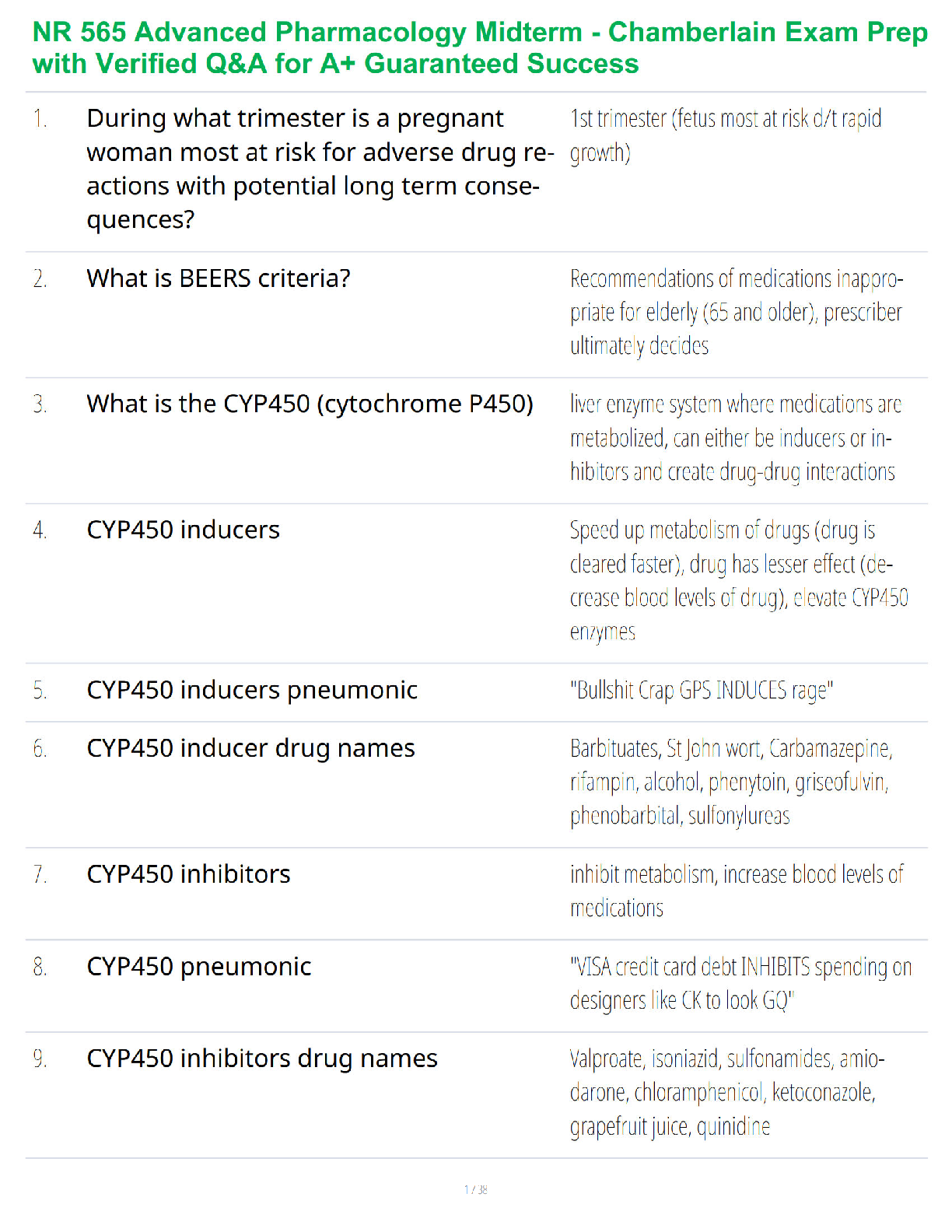
NR 565 Final Exam Study Guide_2022/2023
Antacids: weak bases that react with hydrochloric acid to form salt & water.
o Used in the treatment of Hyperacidity, GERD, PUD, hyperphosphatemia, and calcium deficiency
o
...
NR 565 Final Exam Study Guide_2022/2023
Antacids: weak bases that react with hydrochloric acid to form salt & water.
o Used in the treatment of Hyperacidity, GERD, PUD, hyperphosphatemia, and calcium deficiency
o Contain combinations of
metallic cation (aluminum, calcium, magnesium, and sodium)
and basic anion (hydroxide, bicarbonate, carbonate, citrate, and trisilicate)
Pharmacodynamics, Pharmacokinetics, Pharmacotherapeutics
o Neutralize Gastric Acidity (causes ^pH of the stomach and duodenal bulb)
o Inhibit proteolytic activity of pepsin
o Increase lower esophageal sphincter tone
o Acid-neutralizing capacity ANC varies between products expressed in mEqs
o If ingested in a fasting state, antacids reduce acidity for approximately 20 to 40 minutes
o If taken 1 hr after a meal, acidity is reduced for 2 to 3 hrs
o A second dose taken after a meal maintains reduced acidity for more than 4 hrs after the meal
o The action of antacids occurs locally in the GI tract with minimal absorption, minimal metabolism
o ALL antacids are contraindicated in the presence of severe abdominal pain of unknown cause, especially if accompanied by fever
-HIGH SODIUM content: pts w/ HTN, CHF, marked renal failure, or on low-sodium diets need to use low sodium preparation
-Concurrent administration with enteric-coated drugs, destroys the coating= alters absorption, ^ the risk for adverse effects
-Administrations should be separated by at least 2 hours to decrease drug/drug interactions
1. Calcium based antacids: TUMS, Caltrate, Calcarb
• Prescribed to treat calcium deficient states, i.e. chronic renal failure, post-menopause, and osteoporosis
• Used to bind phosphates in CRF
• Require Vitamin D for absorption from the GI tract
• Excreted mainly in feces, 20% in urine
• ADR: Contraindicated in the presence of hypercalcemia and renal calculi
• Can cause constipation- increase bulk, fluids and mobility, stool softener
• Administered 30min- 1hr on empty stomach or 3hr after meals
• Should not be administered with food containing large amounts of oxalic acid (spinach, rhubarb), or phytic acid (bran, cereals), they decrease the absorption of calcium
• Taking w/ foods containing phosphorus (milk, dairy) can lead to milk-alkali syndrome (N/V, confusion, headache).
• Taking with acidic fruit juice improve absorption
2. Aluminum based: AlternaGEL, Amphojel, Mylanta
• Inhibit smooth muscle contraction and slow gastric emptying
• Used to bind phosphates in CRF
• Not absorbable with routine use
• Aluminum concentrated in the CNS
• Bind with phosphate and excreted in feces
• Prolonged use in patients with renal failure may result in dialysis osteomalacia
o Aluminum deposits in bone and osteomalacia occurs
• Elevated aluminum tissue levels contribute to the development of dialysis encephalopathy
• Used to treat hyperphosphatemia in pts w/ renal failure & phosphate renal stone prevention
• Can cause constipation- increase bulk, fluids and mobility, stool softener
3. Magnesium based: Milk of mag, Maalox, Mylanta
• Can be used to treat magnesium deficiencies from malnutrition, alcoholism, or mag-depleting drugs
• Contraindicated in patients with renal failure & used with caution in pts with renal insufficiency
• Not absorbable with routine use
• Excreted in the urine
• Contraindicated in patients with renal failure, use with caution for patients with any degree of renal insufficiency
o Malfunctioning kidney is unable to excrete magnesium and hypermagnesemia may result
• Can cause diarrhea- increase fiber intake (Alkalosis may occur in renal impairment)
Clinical Use and Dosing
Rational drug selection
o ANC, sodium content, and cost
o Combination products with aluminum hydroxide and magnesium hydroxide have the highest ANC (use is moderate to severe disease
Monitoring
o Serum phosphate, potassium, and calcium during chronic use
o These drugs may cause increased serum calcium and decreased serum phosphate
o Chronic magnesium hydroxide use may cause elevated Mg levels in patients with renal failure or the elderly with decreased renal function
Patient education
o Take as prescribed, especially related to mealtimes
o Take 1-3 hrs after meals and at bedtime
o Chewable tablets chew thoroughly and drink half a glass of water
o Shake suspensions before administration
o Many drug interactions, separate doses by 2 hours apart
o Calcium based antacids should not be administer with food containing large amounts of oxalic acid (spinach, rhubarb) or phytic acid (brans, cereals) decrease absorption
o Avoid taking with food containing phosphorus (milk, dairy products) can cause milk-alkali syndrome (NV, confusion, HA)
o Consult provider: before taking antacids for more than 2 weeks if a problem recurs, if relief is not obtained, or if symptoms of GI bleeding (black, tarry stools, coffee ground emesis
o Aluminum and calcium antacids may cause constipation: increase bulk, increase fluid intake, and more mobility, stool softened
o Magnesium antacids may cause diarrhea, increase fiber
o Avoid smoking, avoid flat lying body position while sleeping, foods that irritate the gastric mucosa (spicy foods), or stimulate acid production (alcohol) and foods that decrease lower esophageal sphincter tone (caffeine, chocolate, fatty foods)
Antidiarrheals:
• Diarrhea that lasts for less than 2 weeks is considered acute; if it lasts more than 2 weeks, it is considered chronic.
• Pharmacodynamics, Pharmacokinetics
• Three main classes absorbent preparations (kaolin and pectin (Kapectolin) and bismuth subsalicylate (Pepto-Bismol, Kaopectate Liquid), opiates (diphenoxylate with atropine (Lomotil), diphenoxin with atropine (Motofen), and loperamide (Imodium)) and anticholinergics (IBD)
• Contraindications: Drugs that decrease gastric motility or delay intestinal transit time have induced toxic megacolon, especially in those with inflammatory bowel disease
• All antidiarrheals (except Crofelemer) require cautious use in older adults and when there is r/f impaction
• Older adults are especially sensitive to diphenoxylate or difenoxin r/t atropine and anticholinergic properties
• Not recommended for children under 12, none of the antidiarrheals are safe for children under 2 years old
• Antidiarrheals are contraindicated in the Tx of diarrhea in most children
• Standard of care: oral rehydration therapy
• ADRS Rebound constipation is the main adverse effect
-Kaolin-pectin (kapectolin): Acute diarrhea
• Kaolin is a clay-like powder that attracts and holds onto bacteria
• Pectin thickens the stool by absorbing moisture
• Used to treat simple diarrhea
• Act locally in the bowel, not systemically absorbed
• Pregnancy Category B
-Bismuth subsalicylate (Pepto bismol): Acute diarrhea, travelers’ diarrhea
Antisecretory and antimicrobial effects
Also used as part of a multidrug regimen for H. pylori
Undergoes chemical dissociation in GI, salicylate moiety is absorbed
Salicylate is metabolized in the liver and more than 90% is excreted in urine
Contraindicated in children or teenagers during or after recovery from chickenpox or flu-like illness
Contraindicated for patients with ASA hypersensitivity
For bismuth subsalicylate, additional reactions that all patients should be warned about are gray/black stools and black tongue, the results of the bismuth. Patients should be told to expect this reaction and that it does not indicate GI bleeding.
Bismuth subsalicylate may potentiate the risk for toxicity if taken w/ aspirin
R/f hypoglycemia in large doses with insulin or oral hypoglycemics
-Crofelemer (fulyzaq): Symptomatic relief of noninfectious diarrhea in adult pts w/ HIV/AIDS on antiretroviral therapy
Botanical blocking chloride secretion from the epithelial cells in the intestinal lumen, decreasing water loss and normalizing the flow of chloride and water in the intestinal tract
Minimal absorption after PO administration
Metabolism and excretion are not known
In clinical trials more likely to have URI, bronchitis, and cough than placebo group
Adverse GI effects flatulence, increased bilirubin, and nausea
-diphenoxylate w/atropine (Lomotil): Acute diarrhea
Constipating meperidine congener, lacks analgesic activity
At high doses can produce euphoria and physical dependence
Anticholinergics are useful only with inflammatory bowel disease
Well absorbed from GI tract
The atropine crosses the BBB (produces mild to moderate anticholinergic effects)
Rapidly and extensively metabolized to diphenoxylic acid (it’s metabolite)
Excreted in urine and feces
The atropine component of diphenoxylate and difenoxin contraindicates their use in narrow-angle glaucoma and requires cautious use in prostatic hyperplasia.
Children, especially those with Down syndrome have increased sensitivity to atropine
Use with extreme caution in children, not recommended for use in children younger than 12 y/o
Do not use with E. Coli, Salmonella, Shigella, or in pseudomembranous colitis
ADRs: r/t atropine: anticholinergic effects (dry mouth, flushing, tachycardia, urinary retention)
o Crosses BBB=dizziness, drowsiness, sedation, HA, euphoria, or depression
Additive or potentiating CNS effects with other CNS depressants and additive anticholinergic effects with other drugs that share these effects
-Difenoxin w/atropine (Motofen): Acute diarrhea9*****
Anticholinergics are useful only with inflammatory bowel disease
Rapidly metabolized to an inactive hydroxylated metabolite
Excreted mainly as conjugates in urine and feces
The atropine component of diphenoxylate and difenoxin contraindicates their use in narrow-angle glaucoma and requires cautious use in prostatic hyperplasia.
Children, especially those with Down syndrome have increased sensitivity to atropine
Use with extreme caution in children, not recommended for use in children younger than 12 y/o
Do not use with E. Coli, Salmonella, Shigella, or in pseudomembranous colitis
ADRs: r/t atropine: anticholinergic effects (dry mouth, flushing, tachycardia, urinary retention)
o Crosses BBB=dizziness, drowsiness, sedation, HA, euphoria, or depression
Additive or potentiating CNS effects with other CNS depressants and additive anticholinergic effects with other drugs that share these effects
-Loperamide (Imodium): Acute diarrhea, travelers’ diarrhea, chronic diarrhea associated w/inflammatory bowel disease
• Binds to opiate receptors of the intestinal wall, slows gastric motility
• Reduces fecal volume, increases viscosity and bulk, diminishes loss of fluid and electrolytes
• Does not cross BBB, limited CNS ADRs
• Partially metabolized by the liver and undergoes enterohepatic recirculation to be completely metabolized
• Eliminated in feces
• ADRs: r/t atropine: anticholinergic effects (dry mouth, flushing, tachycardia, urinary retention)
o To a lesser degree than diphenoxylate and difenoxin
o Dizziness and drowsiness (less CNS effects than difenoxin or diphenoxylate
• Additive or potentiating CNS effects with other CNS depressants and additive anticholinergic effects with other drugs that share these effects
Pharmacotherapeutics
• Precaution and contraindications
• Drugs that reduce intestinal motility or delay intestinal transit time may cause toxic megacolon, especially in IBD
• Diphenoxylate with atropine difenoxin with atropine, and loperamide should be used cautiously in IBD
o D/C if ABD distension occurs
• Use Diphenoxylate with atropine difenoxin with atropine, and loperamide use with caution in advanced hepatorenal disease and in all patients with abnormal LFTs (hepatic coma may occur)
• Atropine: contraindicated in narrow-angle glaucoma and requires cautious use in prostatic hyperplasia
• Children (especially those with Downs syndrome) have increased sensitivity to atropine
• Clinical Use and Dosing
Simple, Acute Diarrhea
• Absorbent preparations for adults: Kaolin-pectin or bismuth subsalicylate taken after each loose stool may be effective
• Majority of acute diarrhea are self-limiting, hydration important
• Maintain hydration
o Commercial hydrating fluids (Pedialyte) or powdered salts
o A pinch of table salt and a half-teaspoon of honey in 8 oz of fruit juice (older children and adults)
o Non-diet colas without carbonations (older children and adults)
o Alternate these solutions with 8 oz of water with one-quarter teaspoon baking soda to replenish electrolytes (NA, K, bicarbonate, and Cl)
• If the absorbents do not resolve the problem, diphenoxylate or difenoxin or loperamide may be added
Chronic Diarrhea Associated with IBD
• Steroids and sulfasalazine are needed
• Loperamide may be used as adjunct therapy
o May significantly improve symptoms especially with added fiber and anticholinergics
o If clinical improvement does not occur with doses of 16 mg/day for 10 days, symptoms are unlikely to be controlled by further use
Chronic Diarrhea Associated with Pancreatic Insufficiency
• Malabsorption r/t pancreatic insufficiency requires enzyme supplements, antidiarrheals not indicated
Chronic Infantile Diarrhea
• Bismuth subsalicylate: 2.5 mL every 4 hrs for children 2 to 24 months, 5 mL for 24-48 month children, and 10 mL for children 48 to 70 months
Diarrhea in HIV/AIDS Patients Taking Antiretroviral Drugs
• Crofelemer (Fulyzaq) symptomatic relief of noninfectious diarrhea in adults with HIV/AIDS on ARV therapy
• 125 mg tablet twice a day without regard for food
Traveler’s Diarrhea
• Bismuth subsalicylate: two tablets or 2 Fl oz before each meal and at bedtime (QID) for up to 3 weeks
• Prevention and treatment
• High-risk areas: Central and South American, Africa, Middle East, Mexico, and Asia
• E. Coli is the most common causative agent followed by Campylobacter, Shigella, and Salmonella
Rational Drug Selection
• Indication: Acute diarrhea, any of the antidiarrheals are appropriate
• Subsalicylate and loperamide are the only drugs indicated for traveler’s diarrhea
• Loperamide is the only drug with an indication for IBD
• Generic and brand name formulations available
Monitoring: No specific monitoring
Patient Education
• Take as directed, do not double doses, do not exceed max number of doses in 24 hrs
• Notify provider if diarrhea continues beyond 48 hrs or if ABD pain, fever, or distention occurs
• Use calibrated measuring devices for liquids, shake suspensions before measured
• Drug interactions may occur, especially with diphenoxylate and loperamide
• Do not take any OTC antidiarrheal before contacting your provider if taking digoxin, cephalosporin antimicrobials, warfarin or heparin, or CNS depressants (including ETOH)
• R/f salicylate poisoning if taking ASA and bismuth subsalicylate
• R/f rebound constipation
• Stop drug when s/s of diarrhea are reduced
• Bismuth subsalicylate can turn the tongue and stools gray/black
• Drugs with atropine: dry mouth, flushing, tachycardia, and urinary retention
• Loperamide also exhibits these reactions but to a lesser degree, add fiber and use oral rehydrating solutions
• GHWT
• Bland food diet, remove milk, could it be lactose intolerance?
Cytoprotective Agents:
o Agents used to treat or prevent ulcer formation
o Two drugs sucralfate (Carafate) and misoprostol (Cytotec)
Pt should report onset of black tarry stools or severe abdominal pain, which may indicate treatment failure and GI bleeding
Sucralfate (Carafate):
• Pharmacodynamics-Basic aluminum salt that binds to necrotic ulcer tissue where it acts as a barrier to acid, pepsin, and bile salts.
o Action is largely topical, no acid-neutralizing activity, little is absorbed
o May directly absorb bile salts and stimulate
[Show More]