CHEM 120 FINAL EXAM
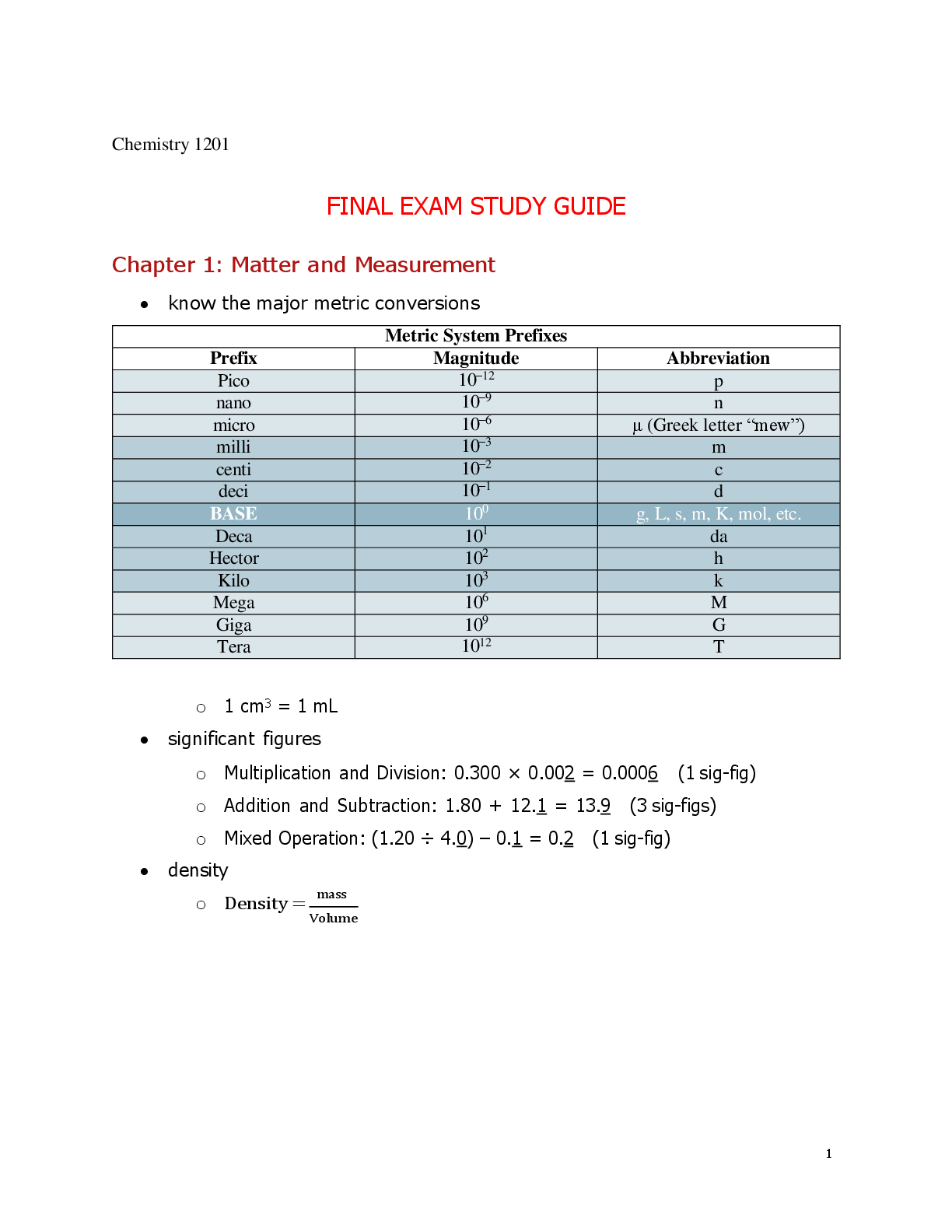
6. (TCO 6) A gas at a temperature of 95 degrees C occupies a volume of 165 mL. Assuming constant pressure, determine the volume at 25 degrees C. Show your work. (Points : 5)
7. (TCO 6
...
CHEM 120 FINAL EXAM
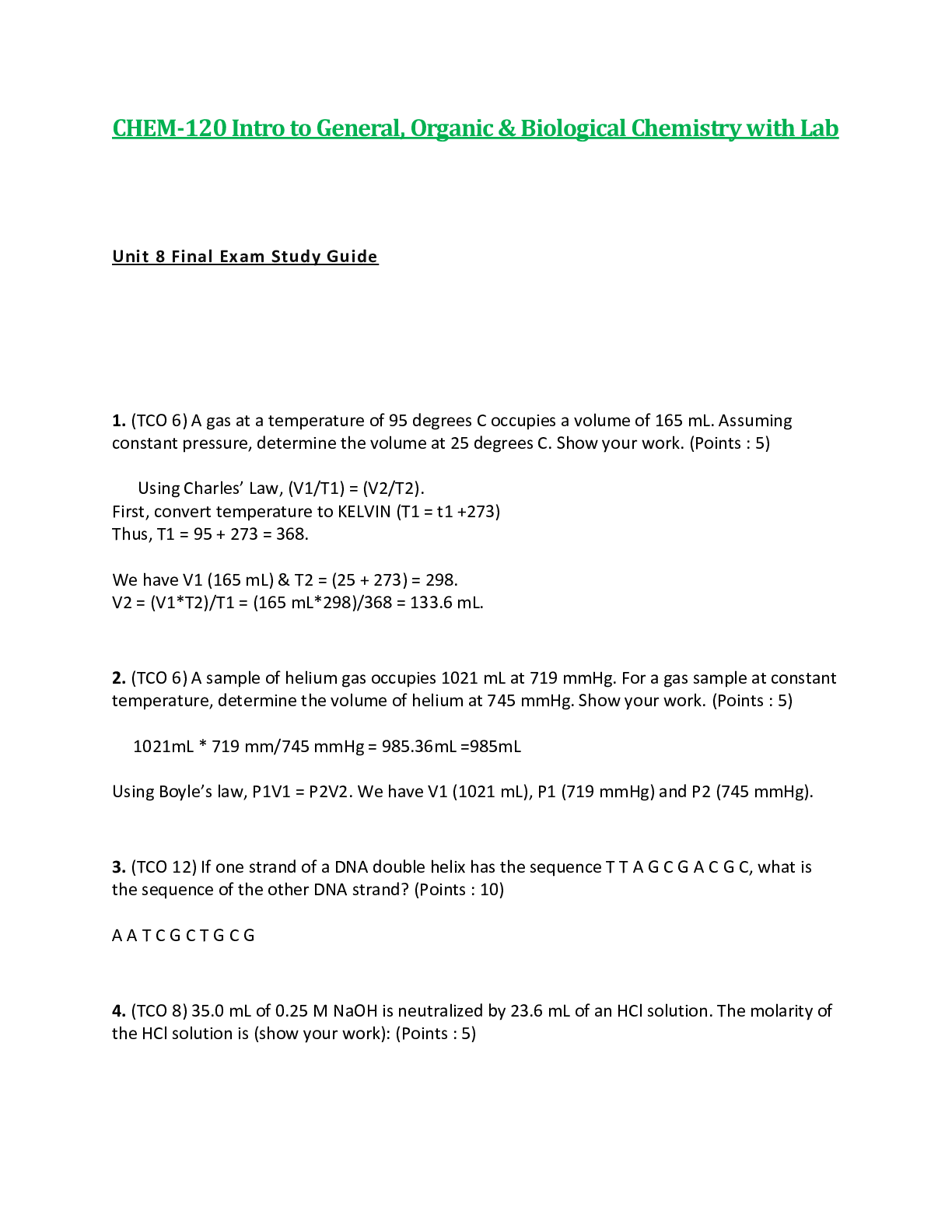
6. (TCO 6) A gas at a temperature of 95 degrees C occupies a volume of 165 mL. Assuming constant pressure, determine the volume at 25 degrees C. Show your work. (Points : 5)
7. (TCO 6) A sample of helium gas occupies 1021 mL at 719 mmHg. For a gas sample at constant temperature, determine the volume of helium at 745 mmHg. Show your work. (Points : 5)
8. (TCO 12) If one strand of a DNA double helix has the sequence T T A G C G A C G C, what is the sequence of the other DNA strand? (Points : 10)
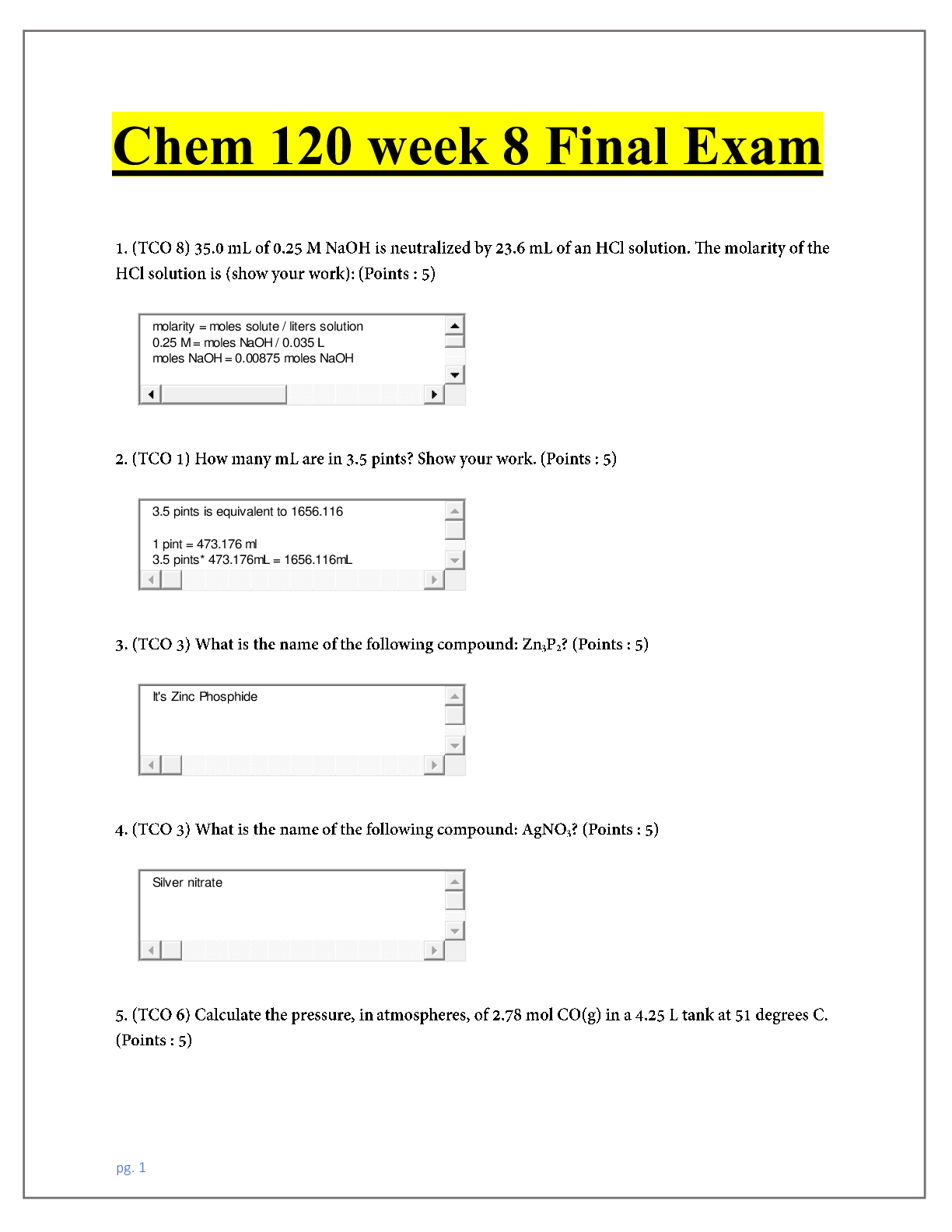
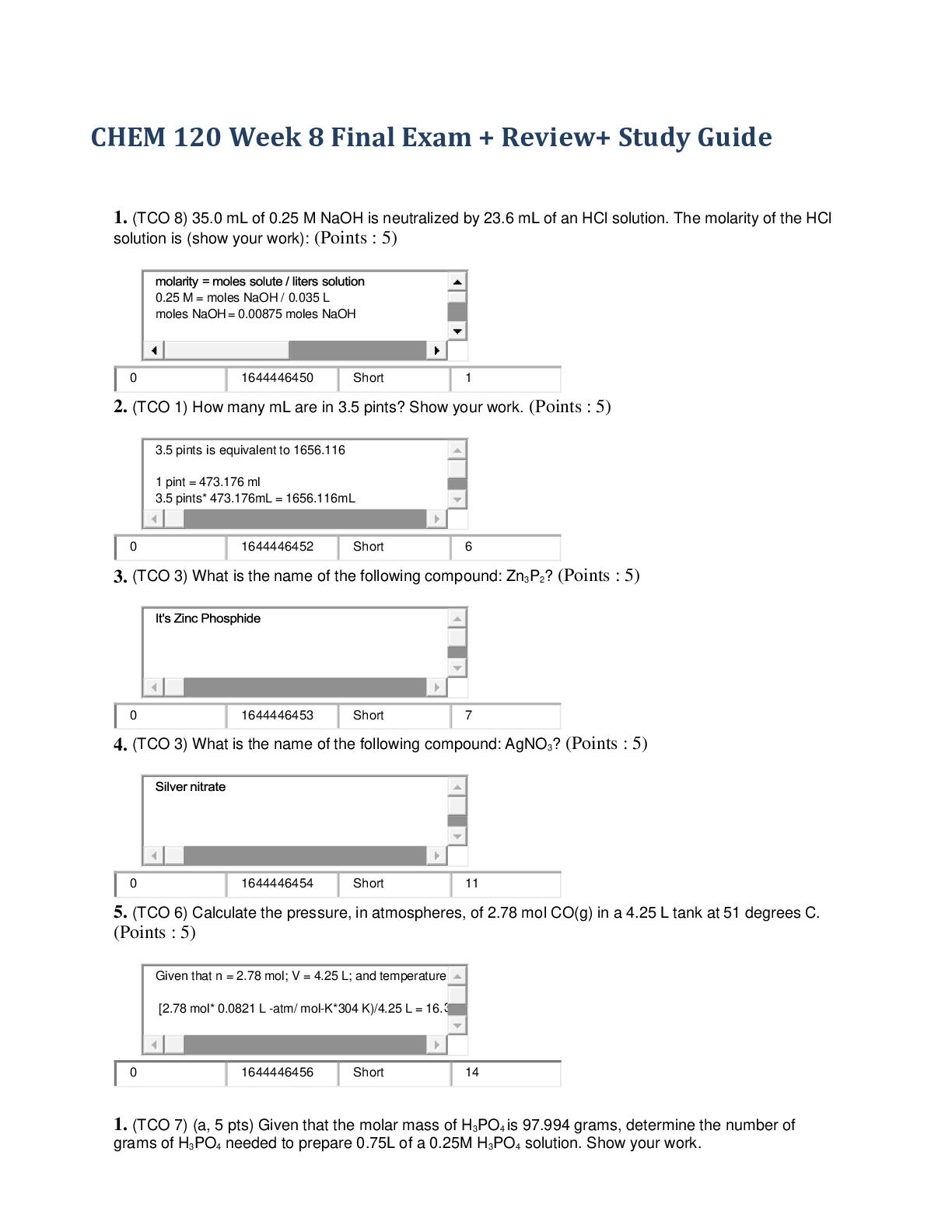
1. (TCO 8) 35.0 mL of 0.25 M NaOH is neutralized by 23.6 mL of an HCl solution. The molarity of the HCl solution is (show your work): (Points : 5)
2. (TCO 1) How many mL are in 3.5 pints? Show your work. (Points : 5)
3. (TCO 3) What is the name of the following compound: Zn3P2? (Points : 5)
4. (TCO 3) What is the name of the following compound: AgNO3? (Points : 5)
5. (TCO 6) Calculate the pressure, in atmospheres, of 2.78 mol CO(g) in a 4.25 L tank at 51 degrees C. (Points : 5)
1. (TCO 7) (a, 5 pts) Given that the molar mass of H3PO4 is 97.994 grams, determine the number of grams of H3PO4 needed to prepare 0.75L of a 0.25M H3PO4 solution. Show your work.
(b, 5 pts) What volume, in Liters, of a 0.25 M H3PO4 solution can be prepared by diluting 50 mL of a 2.5M H3PO4 solution? Show your work. (Points : 10)
2. (TCO 7) (a, 5 pts) What is the volume percent of a solution prepared by dissolving 21 g of NaOH in enough water to make a final volume of 120 mL? Show your work.
(b, 5 pts) How many mL of a 10% solution can be made from the solution in part a? Show your work. (Points : 10)
4. (TCO 11) Tungsten (W), with a mass number of 180 and an atomic number of 74, decays by emission of an alpha particle. Identify the product of the nuclear reaction by providing its atomic symbol (5 pts), mass number (5 pts), and atomic number (5 pts). (Points : 15)
6. (TCO 13) What is the mRNA sequence for the following segment of DNA:
--AAACGTGTGCTAACA-- (10 pts)? Based upon the mRNA sequence, what is the peptide sequence (10 pts)?
(Points : 20)
7. (TCO 5) Given the following unbalanced chemical equation: Al + Cl2-> AlCl3
(a, 5 pts) Balance the equation.
(b, 5 pts) How many moles of AlCl3 are produced from 1.75 mole of Cl2? Show your work.
(c, 5 pts) What is the molar mass of AlCl3? Show your work.
(d, 5 pts) Calculate the number of grams of AlCl3 produced from 1.75 mol Cl2. Show your work. (Points : 20)
8. (TCO 13) What is the mRNA sequence for the following segment of DNA:
--CTCGTGGTTTCATCC-- (10 pts)? Based upon the mRNA sequence, what is the peptide sequence (10 pts)?
(Points : 20)
1. (TCO 12) Transcription is the process by which DNA passes information to (Points : 5)
another strand of DNA.
transfer RNA.
ribosomal RNA.
messenger RNA.
a new cell.
2. (TCO 12) The portion of an enzyme where the substrate “fits” during the reaction is called the (Points : 5)
active site.
action site.
reaction site.
substrate site.
inhibitor site.
3. (TCO 12) Which of the following is not an unsaturated fatty acid? (Points : 5)
CH3CH2CH2CH=CHCOOH
CH3CH=CHCH=CHCOOH
CH3CH2CH2CH2CH2COOH
CH3CH2CH2CH2CH2CH=CHCOOH
CH3CH=CHCH2CH=CHCOOH
4. (TCO 12) The helical structure of certain proteins, such as wool, is a part of the protein’s (Points : 5)
primary structure.
secondary structure.
tertiary structure.
primary and secondary structures.
secondary and tertiary structures.
5. (TCO 12) Which of the following is a disaccharide? (Points : 5)
Cellulose
Starch
Fructose
Galactose
Lactose
6. (TCO 12) In cells, protein synthesis occurs on the (Points : 5)
Golgi apparatus.
mitochondria.
nucleus.
cytoplasm.
ribosomes.
7. (TCO 12) Which of the following is a monosaccharide? (Points : 5)
Cellulose
Starch
Galactose
Mannose
Lactose
8. (TCO 4) The best description of the shape of an ammonia molecule is _____. (Points : 5)
linear
pyramidal
bent
tetrahedral
None of the above
9. (TCO 4) Which of the following substances does not have polar covalent bonds? (Points : 5)
CO2
Br2
CH4
NF3
10. (TCO 8) According to the Bronsted-Lowry definition, which chemical in the following reaction is the acid?
H2CO3 + H2O -> H3O+ + HCO3- (Points : 5)
H2O
HCO3-
H2CO3
H3O+
None of the above
11. (TCO 8) According to the Bronsted-Lowry definition, which chemical in the following reaction is the base?
H2CO3 + H2O -> H3O+ + HCO3- (Points : 5)
H2O
H2CO3
HCO3-
H3O+
None of the above
12. (TCO 2) Match the atom with the appropriate description.
(Points : 15)
Potential Matches:
1 : Boron (B)
2 : Carbon (C)
3 : Neon (Ne)
4 : Nitrogen (N)
5 : Lithium (Li)
13. (TCO 10) Match the organic compound with its use or characteristic.
(Points : 15)
Potential Matches:
1 : Disinfectant
2 : Fingernail polish remover
3 : Alkaloid
4 : Insecticide
5 : Pineapple flavor
14. (TCO 9) Match the organic compound with its name.
(Points : 15)
Potential Matches:
1 : Ethanoic acid
2 : 1-propanol
3 : Ethylamine
4 : Heptanal
5 : Pentyl acetate
Week 8 : Final Exam - Final Exam
CHEM120 Final Exam Page 3
1. (TCO 7) (a, 5 pts) Given that the molar mass of H3PO4 is 97.994 grams, determine the number of grams of H3PO4 needed to prepare 0.25L of a 0.2M H3PO4 solution. Show your work.
(b, 5 pts) What volume, in Liters, of a 0.2 M H3PO4 solution can be prepared by diluting 50 mL of a 5M H3PO4 solution? Show your work. (Points : 10)
2. (TCO 7) (a, 5 pts) What is the mass/volume percent of a solution prepared by dissolving 43 g of NaOH in enough water to make a final volume of 120 mL? Show your work.
(b, 5 pts) How many mL of a 10% solution can be made from the solution in part a? Show your work. (Points : 10)
3. (TCO 12) Polyethylene is a polymer found in many applications, including packaging for fruit and vegetables. Discuss the structural differences between (1) polyethylene, (2) polypropylene, and (3) polystyrene and how the structure impacts their commercial uses. (Points : 15)
4. (TCO 11) Tungsten (W), with a mass number of 180 and an atomic number of 74, decays by emission of an alpha particle. Identify the product of the nuclear reaction by providing its atomic symbol (5 pts), mass number (5 pts), and atomic number (5 pts). (Points : 15)
6. (TCO 13) What is the mRNA sequence for the following segment of DNA:
--TAACGAATAGCCTGT-- (10 pts)? Based upon the mRNA sequence, what is the peptide sequence (10 pts)?
(Points : 20)
7. (TCO 5) Given the following unbalanced chemical equation: Al + Cl2-> AlCl3
(a, 5 pts) Balance the equation.
(b, 5 pts) How many moles of AlCl3 are produced from 1.75 mole of Cl2? Show your work.
(c, 5 pts) What is the molar mass of AlCl3? Show your work.
(d, 5 pts) Calculate the number of grams of AlCl3 produced from 1.75 mol Cl2. Show your work. (Points : 20)
8. (TCO 13) What is the mRNA sequence for the following segment of DNA:
--CTCGTGGTTTCATCC-- (10 pts)? Based upon the mRNA sequence, what is the peptide sequence (10 pts)?
(Points : 20)
Week 8 : Final Exam - Final Exam
CHEM120 Final Exam Page 2
1. (TCO 8) 45.0 mL of 0.75 M NaOH is neutralized by 53.6 mL of an HCl solution. The molarity of the HCl solution is (show your work): (Points : 5)
2. (TCO 1) How many meters are in 175 inches? Show your work. (Points : 5)
3. (TCO 3) What is the name of the following compound: Na2S? (Points : 5)
4. (TCO 3) What is the name of the following compound: AgNO3? (Points : 5)
5. (TCO 6) Calculate the volume, in liters, of a 4.12 mol H2S(g) at 60 degrees C and 1.75 atm. (Points : 5)
6. (TCO 6) A gas at a temperature of 185 degrees C occupies a volume of 575 mL. Assuming constant pressure, determine the volume at 15 degrees C. Show your work. (Points : 5)
7. (TCO 6) A sample of helium gas occupies 1045 mL at 721 mmHg. For a gas sample at constant temperature, determine the volume of helium at 745 mmHg. Show your work. (Points : 5)
8. (TCO 12) If one strand of a DNA double helix has the sequence ACGTCATGGC, what is the sequence of the other DNA strand? (Points : 10)
[Show More]