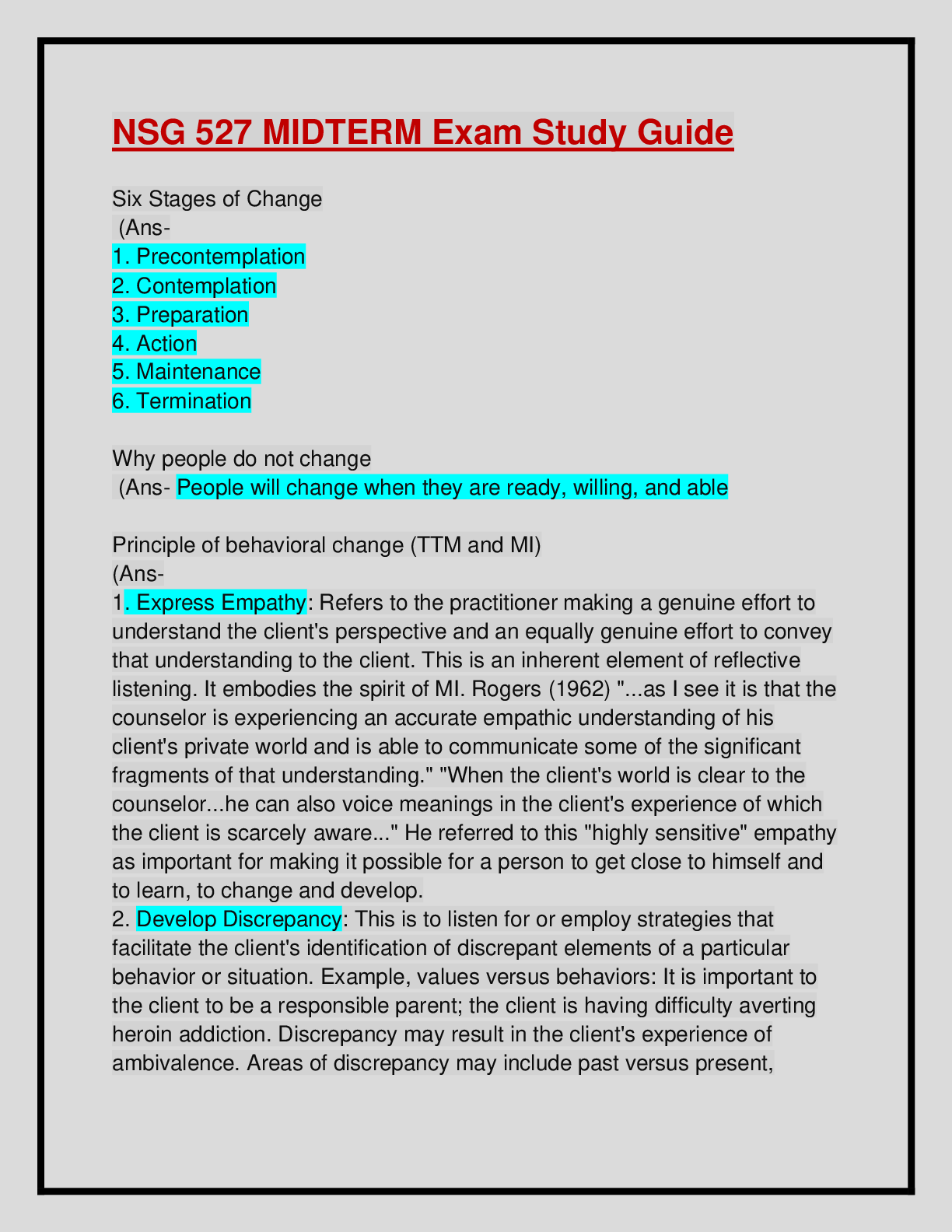
Six Stages of Change
(Ans-
1. Precontemplation
2. Contemplation
3. Preparation
4. Action
5. Maintenance
6. Termination
Why people do not change
(Ans- People will change when they are ready, willing, and able
...
Six Stages of Change
(Ans-
1. Precontemplation
2. Contemplation
3. Preparation
4. Action
5. Maintenance
6. Termination
Why people do not change
(Ans- People will change when they are ready, willing, and able
Principle of behavioral change (TTM and MI)
(Ans-
1. Express Empathy: Refers to the practitioner making a genuine effort to understand the client's perspective and an equally genuine effort to convey that understanding to the client. This is an inherent element of reflective listening. It embodies the spirit of MI. Rogers (1962) "...as I see it is that the counselor is experiencing an accurate empathic understanding of his client's private world and is able to communicate some of the significant fragments of that understanding." "When the client's world is clear to the counselor...he can also voice meanings in the client's experience of which the client is scarcely aware..." He referred to this "highly sensitive" empathy as important for making it possible for a person to get close to himself and to learn, to change and develop.
2. Develop Discrepancy: This is to listen for or employ strategies that facilitate the client's identification of discrepant elements of a particular behavior or situation. Example, values versus behaviors: It is important to the client to be a responsible parent; the client is having difficulty averting heroin addiction. Discrepancy may result in the client's experience of ambivalence. Areas of discrepancy may include past versus present, behaviors versus goals. Evoking change talk is one way to develop discrepancy.
3. Roll with Resistance -Avoid Argumentation: This refers to the provider's ability to sidestep or diminish resistance and proceed to connect with the client and move in the same direction. It also refers to avoiding arguments. Expressing empathy, understanding why a client has a particular belief might be the intervention. Shifting focus might be another.
4. Support Self-Efficacy: This is the provider's ability to support the client's hopefulness that change, or improvement is possible. Identifying and building upon a client's st
The interactive style of Motivational Interviewing
(Ans-
In MI, it is important for the practitioner to build rapport with clients to encourage desirable behavioral and lifestyle changes. Using MI, practitioners can more readily uncover health and lifestyle needs of their clients. This results in building trusting relationships and developing rapport with clients, which can motivate them to move toward successful and desirable change.
[Show More]