NUR 353 Exam 4 | Complete Solutions (Answered) The state or quality of being mobile or movable Mobility The state of not moving; motionless, not being able to move Immobility A term that encompasses similar concepts an
...
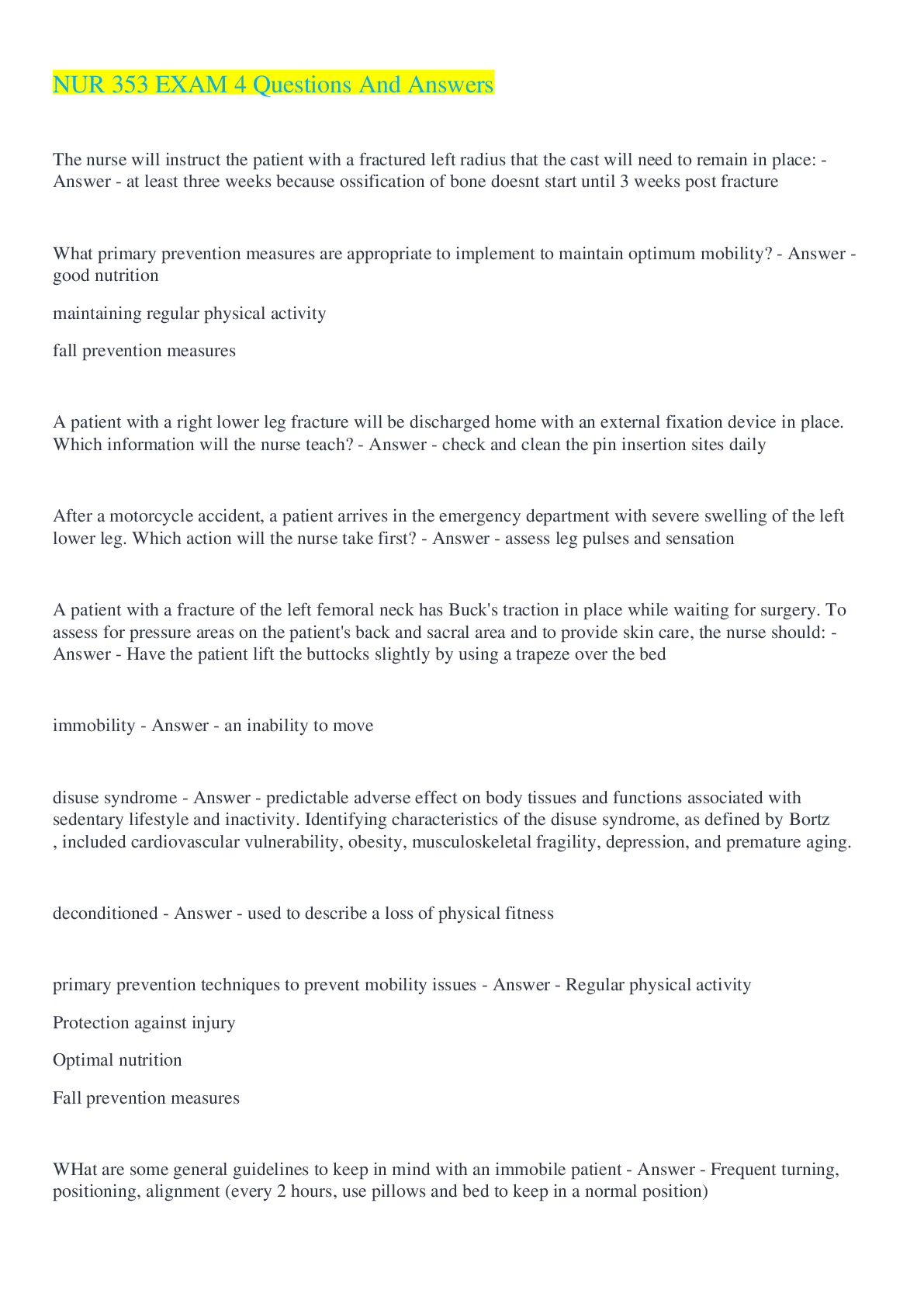
NUR 353 Exam 4 | Complete Solutions (Answered) The state or quality of being mobile or movable Mobility The state of not moving; motionless, not being able to move Immobility A term that encompasses similar concepts and includes nursing diagnoses related to inactivity. Risks for this include impaired skin integrity, constipation, altered respiratory function, altered peripheral tissue perfusion, activity intolerance, impaired physical mobility, injury, altered sensory perception, powerlessness, and body image disturbance. Disuse syndrome A general downslide of overall physical strength and endurance. Although most patients might have a tweak of this after a big surgery or major illness, this term is usually applied when a formerly independent, or mostly independent, person is now not able to perform routine activities, like their ADLs, and IADLs, and their progress continues to decline. Deconditioned List two screening tools to detect mobility/immobility. 1. Osteoporosis 2. Fall risk assessment When should fall assessment screening tools be used? Look in Giddens List some general care guidelines for a patient who is immobilized. 1. Frequent turning and changing positions every 2 hours in bed or 30 minutes in a chair. 2. Frequent skin assessment and skin care. 3. Range of motion exercises 4. Deep breathing exercises 5. Weight bearing exercises if possible 6. Measures to optimize elimination, such as high fluids, high fiber, and laxatives or stool softeners. 7. Ambulation, stretches, balance What should you give to a patient before moving around to decrease pain when moving their joints? Anti-inflammatory and pain medications A disruption or break in the continuity of bone Fracture The break goes completely through the bone Complete fracture Occurs partly across a bone shaft but the bone is still intact Incomplete fracture Describe the metabolic changes that occur with immobility. 1. Decreases metabolic rate, altering the metabolism of carbs, fats, and proteins 2. Fluid, electrolyte and calcium imbalances 3. Decreased appetite 4. Slowed peristalsis 5. Endocrine system is altered 6. Hypercalcemia, calcium is released from the bones in immobile patients, which can cause pathologic fractures because there is not enough calcium in the bones! You are caring for a patient who is immobile. Which of the following electrolyte imbalances would you expect in a patient who has been immobile? a. Hypercalcemia b. Hypokalemia c. Hyponatremia d. Hypermagnesemia (In immobile people, calcium is released from their bones into their blood stream. Normally, your kidneys will excrete this calcium but if they are unable to respond appropriately, hypercalcemia results.) List some gastrointestinal impairments caused by decreased mobility. 1. Constipation 2. Fluid intake decreases, risk for dehydration 3. Anorexia List two respiratory changes that occur with immobility. 1. Atelectasis (Collapse of alveoli) 2. Hypostatic pneumonia (Inflammation of the lung from stasis or pooling of secretions) List three cardiovascular changes that occur with immobility. 1. Orthostatic hypotension 2. Thrombus formation 3. Decreased cardiac output, resulting in increased workload List some musculoskeletal changes associated with immobility. (6) 1. Loss of endurance, strength and muscle mass and decreased stability and balance 2. Decreased muscle mass 3. Joint abnormalities (contractures--From muscle disuse, atrophy and shortening of the muscle fibers) 4. Disuse osteoporosis (Osteoporosis from immobility) 5. Pathological fractures from disuse osteoporosis 6. Impaired calcium metabolism List 3 urinary complications associated with immobility. 1. Urinary stasis from lack of gravity pulling the urine from the renal pelvis into the ureters to the bladder. 2. UTIs from urinary stasis 3. Renal calculi from hypercalcemia List one integumentary complication associated with immobility. Pressure ulcers List some psychosocial effects seen with immobility. 1. Social isolation 2. Helplessness 3. Loneliness 4. Depression An older-adult patient has been bedridden for 2 weeks. Which of the following complaints by the patient indicates to the nurse that he or she is developing a complication of immobility? a. Loss of appetite b. Gum soreness c. Difficulty swallowing d. Left-ankle joint stiffness (Patients whose mobility is restricted require range-of-motion (ROM) exercises daily to reduce the hazards of immobility. Temporary immobilization results in some muscle atrophy, loss of muscle tone, and joint stiffness. Two weeks of joint immobilization without ROM can quickly result in contractures.) An older adult has limited mobility as a result of a total knee replacement. During assessment you note that the patient has difficulty breathing while lying flat. Which of the following assessment data support a possible pulmonary problem related to impaired mobility? Select all that apply. a. B/P = 128/84 b. Respirations 26/min on room air c. HR 114 d. Crackles over lower lobes heard on auscultation e. Pain reported as 3 on scale of 0 to 10 after medication (Patients who are immobile are at high risk for developing pulmonary complications. The most common respiratory complications are atelectasis (collapse of alveoli) and hypostatic pneumonia (inflammation of the lung from stasis or pooling of secretions). Ultimately the distribution of mucus in the bronchi increases, particularly when the patient is in the supine, prone, or lateral position.) The nurse is caring for a patient whose calcium intake must increase because of high risk factors for osteoporosis. Which of the following menus should the nurse recommend? a. Cream of broccoli soup with whole wheat crackers, cheese, and tapioca for dessert b. Hot dog on whole wheat bun with a side salad and an apple for dessert c. Low-fat turkey chili with sour cream with a side salad and fresh pears for dessert d. Turkey salad on toast with tomato and lettuce and honey bun for dessert (Teach patient and/or caregiver the current recommended dietary allowances for calcium and review foods high in calcium (e.g., milk fortified with vitamin D, leafy green vegetables, yogurt, and cheese).) What is the correct order in which elastic stockings should be applied? 1. Identify patient using two identifiers. 2. Smooth any creases or wrinkles. 3. Slide the remainder of the stocking over the patient's heel and up the leg 4. Turn the stocking inside out until heel is reached. 5. Assess the condition of the patient's skin and circulation of the legs. 6. Place toes into foot of the stocking. 7. Use tape measure to measure patient's legs to determine proper stocking size. a. 1, 5, 7, 4, 6, 2, 3 b. 1, 7, 5, 4, 6, 2, 3 c. 1, 5, 7, 4, 6, 3, 2 d. 1, 5, 4, 7, 6, 3, 2 (This is the correct order in which elastic stockings should be applied.) To prevent complications of immobility, what would be the most effective activity on the first postoperative day for a patient who has had abdominal surgery? a. Turn, cough, and deep breathe every 30 minutes while awake b. Ambulate patient to chair in the hall c. Passive range of motion 4 times a day d. Immobility is not a concern the first postoperative day (Prevention of complications of immobility begins when the patient becomes immobilized. Every 30 minutes is not necessary and disruptive to the healing process. Active patient participation in exercises is more beneficial to preventing venous stasis.) A patient on prolonged bed rest is at an increased risk to develop this common complication of immobility if preventive measures are not taken: a. Myoclonus b. Pathological fractures c. Pressure ulcers d. Pruritus (Immobility is a major risk factor for pressure ulcers. Any break in the integrity of the skin is difficult to heal. Preventing a pressure ulcer is much less expensive than treating one; therefore preventive nursing interventions are imperative.) Which of the following nursing interventions should be implemented to maintain a patent airway in a patient on bed rest? a. Isometric exercises b. Administration of low-dose heparin c. Suctioning every 4 hours d. Use of incentive spirometer every 2 hours while awake (Incentive spirometry opens the airway, preventing atelectasis.) A patient has been on bed rest for over 4 days. On assessment, the nurse identifies the following as a sign associated with immobility: a. Decreased peristalsis b. Decreased heart rate c. Increased blood pressure d. Increased urinary output (Immobility disrupts normal metabolic functioning: decreasing the metabolic rate; altering the metabolism of carbohydrates, fats, and proteins; causing fluid, electrolyte, and calcium imbalances; and causing gastrointestinal disturbances such as decreased appetite and slowing of peristalsis.) The effects of immobility on the cardiac system include which of the following? Select all that apply. a. Thrombus formation b. Increased cardiac workload c. Weak peripheral pulses d. Irregular heartbeat e. Orthostatic hypotension (The three major changes are orthostatic hypotension, increased cardiac workload, and thrombus formation.) A nurse is teaching a community group about ways to minimize the risk of developing osteoporosis. Which of the following statements reflect understanding of what was taught? Select all that apply. a. "I usually go swimming with my family at the YMCA 3 times a week." b. "I need to ask my doctor if I should have a bone mineral density check this year." c. "If I don't drink milk at dinner, I'll eat broccoli or cabbage to get the calcium that I need in my diet." d. "I'll check the label of my multivitamin. If it has calcium, I can save money by not taking another pill." e. "My lactose intolerance should not be a concern when considering my calcium intake." (Patients at risk for or diagnosed with osteoporosis have special health promotion needs. Encourage patients at risk to be screened for osteoporosis and assess their diets for calcium and vitamin D intake. Multivitamins do not always have the needed amount of calcium for every individual. A patient needs to know his or her requirement and make a decision based on that.) A nurse is caring for an older adult who has had a fractured hip repaired. In the first few postoperative days, which of the following nursing measures will best facilitate the resumption of activities of daily living for this patient? a. Encouraging use of an overhead trapeze for positioning and transfer. b. Frequent family visits c. Assisting the patient to a wheelchair once per day d. Ensuring that there is an order for physical therapy (The trapeze bar allows the patient to pull with the upper extremities to raise the trunk off the bed, aid in transfer from bed to wheelchair, or perform upper-arm exercises. It increases independence and maintains upper body strength to help in performing activities of daily living.) Which of the following are physiological outcomes of immobility? a. Increased metabolism b. Reduced cardiac workload c. Decreased lung expansion d. Decreased oxygen demand (Physiologic outcomes of immobility include decreased metabolism, increased cardiac workload, decreased lung expansion, and increased oxygen demand.) The nurse is reviewing skin care of an immobilized patient with an unlicensed assistive employee. The nurse knows the employee understands the importance of skin care when making which statement? a. "Proper care of the skin is important because the immobilized patient does not want to smell bad." b. "Proper care of the skin is important because the immobilized patient is at high risk for breakdown." c. "Proper care of the skin is important because the immobilized patient will have many visitors." d. "Proper care of the skin is important because the immobilized patient will be incontinent." Patients who are experiencing immobility often have which of the following emotions? Select all that apply. a. Helplessness b. Hunger c. Anger d. Anxiety e. Increased communication f. Improved self-worth A child must experience mobility so he or she can explore and learn about the world. Lack of mobility in a child may interfere with which developmental milestone? a. Physiological bonding and growth b. Speech and hearing development c. Intellectual and psychomotor function d. Childhood play interaction List 3 individual risk factors for impaired mobility. 1. Traumatic injury, such as brain, spinal cord, and bones, joints and muscles. 2. Neurological conditions 3. Chronic conditions (and/or treatment interventions) List some common symptoms associated with altered mobility. 1. Pain 2. Reduced joint movement 3. Reduced sensation or loss of sensation 4. Falls 5. Fatigue 6. Altered gait or imbalance 7. Reduced functional ability List some common diagnostic tests used for immobility. 1. X-ray (For pathological fractures) 2. MRI 3. CT scans 4. Bone scan (For osteoporosis) 5. Bone mineral density (For osteoporosis) 6. Myelogram (Injection of dye into the spine and imaging the spine using x-ray, CT scans or MRI.) 7. Arthrography (Evaluates condition of the joints) 8. Arthroscopy (A surgical procedure doctors use to look at, diagnose, and treat problems inside a joint) 9. Electromyography (Evaluates and records the electrical activity produced by skeletal muscles.) Your immobile patient is showing signs of complications of immobility when they state that their joints feel tense. What diagnostic test do you anticipate the physician will order to evaluate the condition of the patients' joints? a. Bone mineral density b. Electromyography c. Arthrography d. Myelogram (An arthrography evaluates the condition of joints.) What diagnostic test would be used for a patient who is experiencing muscular atrophy due to prolonged bedrest? a. MRI b. Electromyography c. Arthroscopy d. Bone scan (An electromyography is a diagnostic procedure to assess the health of muscles and the nerve cells that control them (motor neurons). Motor neurons transmit electrical signals that cause muscles to contract. An EMG translates these signals into graphs, sounds or numerical values that a specialist interprets.) What type of gait with crutches would be used for someone who is learning to walk again? a. 1-point gait b. 2-point gait c. 3-point gait d. 4-point gait (This gait is used to train someone to walk again.) The two ends of the broken bone are separated from one another and out of their normal positions Displaced fracture Usually comminuted (more than two fragments) or oblique The periosteum is intact across the fracture and the bone fragments are still in alignment Nondisplaced fracture What is the first thing you should do if you suspect your patient has a fracture? a. Immobilize the affected limb or bone b. Ice the fractured bone to reduce pain c. Administer pain analgesics d. Attempt to move the bone back into place (Always immobilize the suspected fracture!) Anatomic realignment of a fracture Reduction Nonsurgical, manual realignment of bone fragments to their previous anatomic position. Traction and countertraction are manually applied to the bone fragments to restore position, length, and alignment. Usually performed while the patient is under local or general anesthesia. Immobilization afterwards Closed reduction The correction of bone alignment through a surgical incision. It usually includes internal fixation of the fracture with wires, screws, pins, plates, intramedullary rods, or nails. The type and location of the fracture, patient age, and concurrent disease may influence the decision to use this. Facilitates early ambulation Open reduction With lower extremities, how should you place the fracture? Elevate above the heart! Don't place in a dependent position to prevent compartment syndrome. The application of a pulling force to an injured or diseased body part or extremity Traction What should a nurse frequently check with a patient with a cast? BILATERAL neurovascular assessments What should your apply for the first 24 hours with a cast? Why? Ice, reduces swelling A patients fracture should be elevated above the heart for how long? The first 48 hours What is one thing a patient can use if the cast is itchy? A hair dryer on cool setting What should you NOT do if you have compartment syndrome? Elevate the extremity/affected limb/fractured bone What 3 things should a pt. report if they have a cast? 1. Swelling associated with pain and discoloration OR movement 2. Burning or tingling under cast 3. Sores or foul odor You should not bear weight on a cast for how long after a fracture? 48 hours Why should you not cover a fresh plaster cast? The air cannot circulate which causes heat build up and may cause a burn. Drying is delayed as well. How do you properly fit crutches? (4) 1. Look at the bottom of the crutches and set it to your height. 2. Put them under your armpits and relax your arms, your wrist should be lined up with the handle for your hands. 3. Your elbows should have a slight bend to them when holding the handles. 4. There should be a gap between the top of the crutches and your armpits. Why should you not lean your armpits on crutches? It can cause nerve damage How you do stand up from a chair with crutches? (4) 1. Put your affected leg forward. 2. Hold both of your crutches by the hand grips with the arm on your affected side. 3. Push up from the chair with your unaffected arm and your unaffected leg on the ground with your affected leg still elevated. 4. Use chair behind your for some balance when transferring one crutch to the unaffected side. How do you sit down with crutches? (4) 1. Back all the way to the surface (chair) until you feel it against your unaffected leg. 2. Bring the crutches to your injured side. Hold the crutches by the hand grips. 3. Reach down towards the chair with your arm of the unaffected side. 4. Keep affected limb forward/elevated while you ease yourself into the chair with your arm of the unaffected side. How do you go up stairs with crutches? (5) 1. Take steps forward until you are as close to the first stair as possible. 2. Move crutches to opposite side of hand railing. 3. Hold railing if there is one available. Step up with your unaffected leg while holding the hand grips of the crutches. 4. Hang injured leg behind unaffected leg while going up the stairs. 5. With each step, move crutches up to the step you are on after stepping with your unaffected leg.
[Show More]