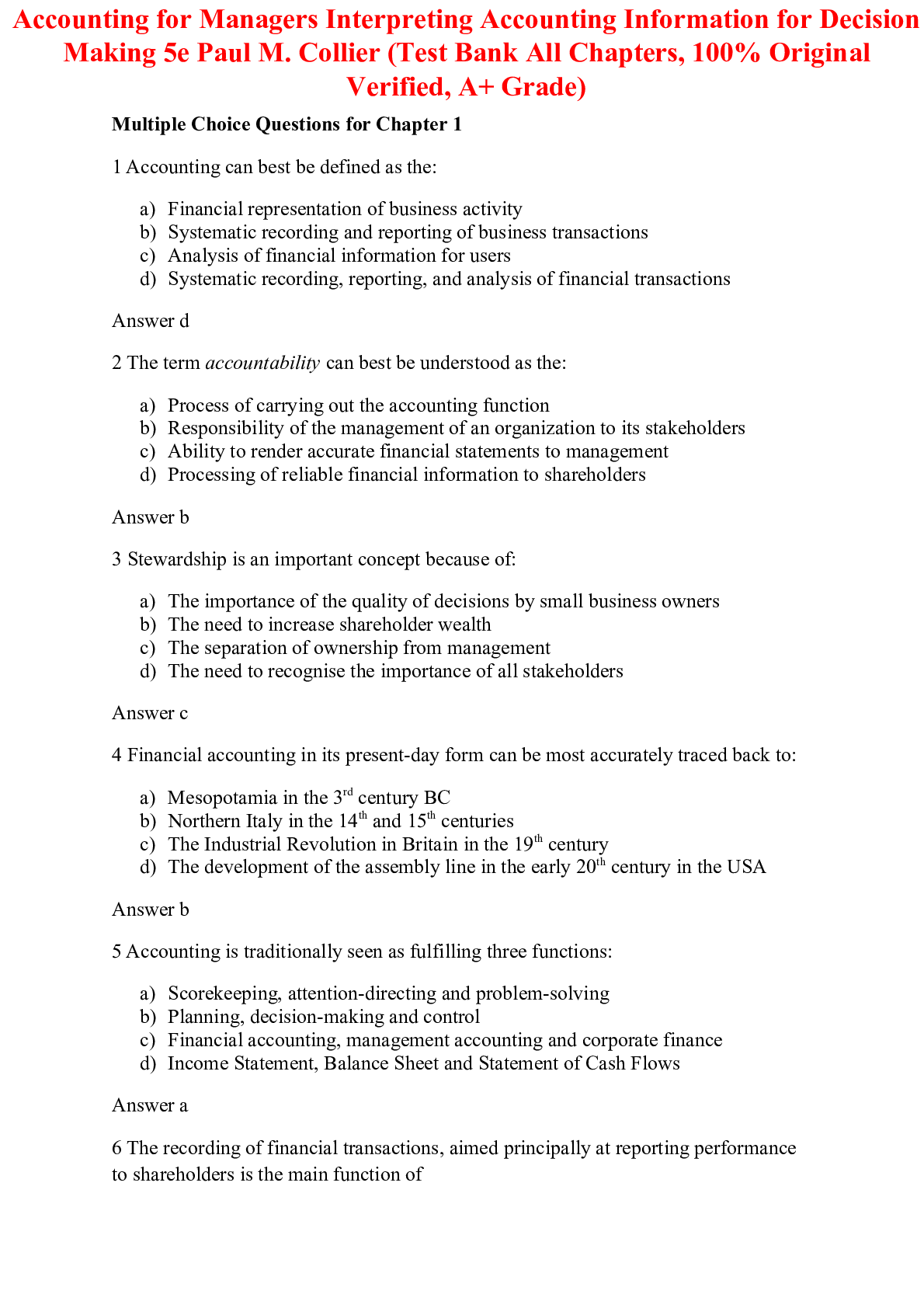
Solutions Manual For Accounting For Managers Interpreting Accounting Information for Decision Making 4e Paul M. Collier-1.1 Explain the difference between accounting, an account, and
accountability.
Accounting is a col
...
Solutions Manual For Accounting For Managers Interpreting Accounting Information for Decision Making 4e Paul M. Collier-1.1 Explain the difference between accounting, an account, and
accountability.
Accounting is a collection of systems and processes used to record, report and
interpret business transactions. An account is an explanation or report in
financial terms about those transactions. Accountability arises from the
stewardship function, that managers have to provide an account to other
stakeholders in the business.
1.2 Summarise the main activities of management accountants.
The main activities of management accountants includes participation in
planning, primarily through budgets; generating, analysing, presenting and
interpreting information to support decision-making, and monitoring and
controlling performance.
1.3 Explain how the role of management accounting has changed over the last
100 years.
The origin of management accounting was cost accounting in factories, where
accountants were close to the business and advised non-financial managers.
Management accountants have advised on economies of scale as well as of
scope as businesses grew and diversified as divisionalization, conglomerates
and multinational organizations increased the demand for accounting
information. Non-financial performance information has come to challenge
management accounting information. Although new techniques have been
developed, new manufacturing technologies and the growth of service
industries has not been matched by the changing role of management
accountants. Management accounting is increasingly decentred in
organizations, with IT carrying out the bulk of routine transaction processing.
Organizations are increasingly looking for management accountants to use
their financial expertise to contribute to strategy formulation and
implementation.
Chapter 2 Solutions
2.1 Explain the idea of value-based management and how shareholder value
relates to the interaction between product and capital markets.
Value-based management uses a variety of techniques to measure increases in
shareholder value, which is assumed to be the primary goal of all business
organizations. Shareholder value refers to the economic value of an
investment by discounting future cash flows to their present value using the
cost of capital for the business. To achieve shareholder value, a business must
generate profits in their markets for goods and services (product markets) that
exceed the cost of capital (the weighted average cost of equity and
borrowings) in the capital market.
2.2 Explain the key issues in corporate governance as they relate to
accounting.
The responsibilities of the Board include setting the company’s strategic goals,
providing leadership to senior management, monitoring business performance
and reporting to shareholders. The last two of these explicitly relate to
accounting, and the first two implicitly do so. In the UK the Combined Code
and in the US the Sarbanes-Oxley Act include important responsibilities of the
Board in relation to financial statements and performance management. The
role of a Board is to provide leadership of the company within a framework of
prudent and effective controls which enables risk to be assessed and managed.
These controls include many accounting controls including budgets, capital
expenditure evaluations, etc. The financial reports of a company are the
responsibility of the Board which must ensure that the company keeps proper
accounting records which disclose with reasonable accuracy the financial
position of the company at any time and ensure that financial reports comply
with the Companies Act. The Board is also responsible for safeguarding the
company’s assets and for taking reasonable steps to prevent and detect fraud.
[Show More]