1. A patient who is 32 weeks gestation is experiencing dark, red vaginal bleeding and the nurse determines the FHR to be 100 bpm
and her abdomen is rigid and boardlike. What action should the nurse take first?
A. Admin
...
1. A patient who is 32 weeks gestation is experiencing dark, red vaginal bleeding and the nurse determines the FHR to be 100 bpm
and her abdomen is rigid and boardlike. What action should the nurse take first?
A. Administer O2 per face mask
B. Abdominal manipulation
C. vaginal manipulation
D. Abdominal exam
Answer: A
Explanation: The nurse should immediately notify the healthcare provider and no abdominal or vaginal manipulation or exams
should be done. Administer O2 per face mask and monitor for bleeding at IV sites and gums due to the increased risk of DIC.
2. A patient who is 32 weeks gestation has the following symptoms: dark, red vaginal bleeding, 100 bpm FHR, rigid abdomen and
severe pain. What is the difference between abruptio placentae and placenta previa?
A. abruptio placentae: painless bright red bleeding occurring in the third trimester
B. abruptio placentae: occurs in the 2nd trimester
C. placenta previa: occurs in the 2nd trimester
D. placenta previa: painless bright red bleeding occurring in the third trimester
Answer: D
Explanation: The nurse must use knowledge base to differentiate between abruptio placentae (dark, red vaginal bleeding, 100 bpm
FHR, rigid abdomen and severe pain) from placenta previa (painless bright red bleeding occurring in the third trimester).
3. A nurse must use knowledge base to differentiate between abruptio placentae (dark, red vaginal bleeding, 100 bpm FHR, rigid
abdomen and severe pain) from placenta previa (painless bright red bleeding occurring in the third trimester). What assessments
should be done in case of a patient suspected of abruptio placentae or placenta previa?
A. abdominal or vaginal manipulation
B. Leopold’s maneuvers
C. internal monitoring
D. Monitor for bleeding at IV sites and gums due to the increased risk of DIC
Answer: D
Explanation: Patients with abruptio placentae or placenta previa (actual or suspected) should have NO abdominal or vaginal
manipulation. NO Leopold’s maneuvers. NO vaginal exams. NO rectal exams, enemas, or suppositories. NO internal monitoring.
4. A patient suspected of abruptio placentae or placenta previa should be monitorized for bleeding at IV sites and gums due to the
increased risk of DIC. What isn’t DIC related to?
A. cervical carcinoma
B. fetal demise
C. infection/sepsis
D. pregnancy-induced hypertension
Answer: A
Explanation: DIC is related to fetal demise, infection/sepsis, pregnancy-induced hypertension (Preeclampsia) and abruptio
palcentae. Cervical carcinoma is related to Podophyllin.
5. A patient which has been diagnosed with CVA has symptoms of aphasia, right hemiparesis, but no memory or hearing deficit. In
what hemisphere has the patient most probably suffered a lesion?
A. Left
B. Superior left side
C. Inferior right side
D. Right
Answer: D
Explanation: A patient with a diagnosis of CVA presents with symptoms of aphasia, right hemiparesis, but no memory or hearing
deficit has suffered a lesion in the left hemisphere.
6. A patient brought to the emergency room has the following symptoms: hypertension, , bladder and bowel distention, exaggerated
autonomic responses, headache, sweating, goose bumps, and bradycardia. What will the patient be diagnosed with in this case?
A. spinal shock
B. increased ICP
C. cerebral vascular accident
D. autonomic dysreflexia
Answer: D
Explanation: The symptoms of autonomic dysreflexia are hypertension, bladder and bowel distention, exaggerated autonomic
responses, headache, sweating, goose bumps, and bradycardia.1. If a child is on oral iron medication, the family should be thought by the nurse how it should be administered. Out of
the following options, what oral iron administration advice is inappropriate?
A. Oral iron should be given on empty stomach
B. Oral iron should be given with citrus juices
C. Oral iron should be given with dairy products
D. A dropper or straw should be used to avoid discoloring teeth
Answer: C
Explanation: Iron can be fatal in severe overdose and as a result, it should be kept away from children. Also, do not give it with
dairy products.
2. In Autosomal recessive disease, both parents must be heterozygous, or carriers of the recessive trait, for the disease
to be expressed in their offspring. If both parents are heterozygous, what is the chance the baby to have the disease as well?
A. 1:2
B. 1:3
C. 1:4
D. 1:1
Answer: C
Explanation: With each pregnancy, there is a 1:4 chance of the infant having the disease.
3. When it comes to X-linked recessive trait, the trait is carried on the X chromosome, therefore, usually affects male
offspring, (e.g., hemophilia). What is the chance for a pregnant woman carrier her offspring to get the disease?
A. Male child: 75% of having the disease
B. Female child: 50% of having the disease
C. Male child: 50% of having the disease
D. Female child: 25% of caring the disease
Answer: C
Explanation: With each pregnancy of a woman who is a carrier there is a 25% chance of having a child with hemophilia. If the child
is male, he has a 50% chance of having hemophilia. If the child is female, she has a 50% chance of being a carrier.
4. Supplemental iron is not given to clients with sickle cell anemia because the anemia is not caused by iron deficiency.
What aspect is very important in treatment of sickle cell disease because it promotes hemodilution and circulation of red cells
through the blood vessels?
A. HgbASB. HGBS
C. Hydration
D. Hydrotherapy
Answer: C
Explanation: Hydration is very important in treatment of sickle cell disease because it promotes hemodilution and circulation of red
cells through the blood vessels.
5. Allopurinol, a xanthine-oxidase inhibitor, is administered to prevent renal damage from uric acid build up during cellular
lysis. In what drugs combination is Prednisone usually used for reducing the mitosis of lymphocytes?
A. epinephrine
B. antineoplastic drugs
C. l-asparaginase
D. oral iron
Answer: B
Explanation: Prednisone is frequently used in combination with antineoplastic drugs to reduce the mitosis of
lymphocytes. Allopurinol, a xanthine-oxidase inhibitor, is also administered to prevent renal damage from uric acid build up during
cellular lysis.
6. An infant with hypothyroidism is often described as a “good, quiet baby” by the parents. What early disease detection
is essential in preventing mental retardation in infants?
A. Hyperthyroidism
B. Phenylhetonuria
C. Diabetes mellitus
D. Ketoacidosis
Answer: B
Explanation: Early detection of hypothyroidism and phenylhetonuria is essential in preventing mental retardation in
infants. Knowledge of normal growth and development is important, since a lack of attaintment can be used to detect the existence
of these metabolic/endocrine disorders and attainment can be used for evaluating the treatment’s effect.
7. Diabetes mellitus (DM) in children was typically diagnosed as insulin dependent diabetes until recently. What diabetes
type has been discovered to occur more often in Native-American, African-American, and Hispanic children and adolescents?
A. Type 1
B. Type 2C. Type 3
D. Type 4
Answer: B
Explanation: Diabetes mellitus (DM) in children was typically diagnosed as insulin dependent diabetes (Type I) until recently. A
marked increase in Type II DM has occurred recently in the US, particularly among Native-American, African-American, and
Hispanic children and adolescents.
8. There has been an increase in the number of children diagnosed with Type II diabetes with the increasing rate of obesity in
children is thought to be a contributing factor. What other factors are thought to be contributing in the increase of Type II diabetes
cases?
A. Hypotension
B. Hypokalaemia
C. Lack of physical activity
D. Hyperkalaemia
Answer: C
Explanation: There has been an increase in the number of children diagnosed with Type II diabetes. The increasing rate of obesity
in children is thought to be a contributing factor. Other contributing factors include lack of physical activity and a family history of
Type II diabetes.
9. Fractures in older children are common as they fall during play and are involved in motor vehicle accidents. What
fractures in children are related to child abuse?
A. Greenstick Fracture
B. Growth Plate Fracture
C. Torus Fracture
D. Spiral fracture
Answer: D
Explanation: Spiral fractures (caused by twisting) and fractures in infants may be related to child abuse.
10. Skin traction for fracture reduction should not be removed unless prescribed by healthcare provider. What fractures
have serious consequences in terms of growth of the affected limb?
A. Greenstick Fracture
B. Plate FractureC. Torus Fracture
D. Spiral fracture
Answer: B
Explanation: Fractures involving the epiphyseal plate (growth plate) can have serious consequences in terms of growth of the
affected limb.
11. Corticosteroids are used short term in low doses during exacerbations. What side effect do Corticosteroids have on
long term?
A. Adverse effects on growth
B. Adverse effects on bone structure
C. Hypoglycemia
D. Hypocalcemia
Answer: A
Explanation: Corticosteroids are used short term in low doses during exacerbations. Long-term use is avoided due to side effects
and their adverse effect on growth.
12. Skin traction for fracture reduction should not be removed unless prescribed by healthcare provider. What do the pin
sites can usually cause in an infant client?
A. Hypoglycemia
B. Hypocalcemia
C. Infection
D. Low vitamin K concentration
Answer: C
Explanation: Pin sites can be sources of infection. The nurse should monitor signs of infection and cleanse and dress pin sites as
prescribed.
13. The menstrual phase varies in length for most women. How many days usually are from ovulation to the beginning of
the next menstrual cycle?
A. 12 days
B. 14 days
C. 16 days
D. 18 daysAnswer: B
Explanation: From ovulation to the beginning of the next menstrual cycle is usually exactly 14 days. In other words, ovulation occurs
14 days before the next menstrual period.
14. Sperm lives approximately 3 days and eggs live about 24 hours. Which is the time interval a couple should avoid
unprotected intercourse after the ovulation?
A. 24 hours
B. 48 hours
C. 72 hours
D. 128 hours
Answer: C
Explanation: From ovulation to the beginning of the next menstrual cycle is usually exactly 14 days. In other words, ovulation occurs
14 days before the next menstrual period.
15. A woman who is 6 weeks pregnant has the following maternal history: a 2 yr. old healthy daughter, a miscarriage at 10
weeks, 3 years ago and an elective abortion at 6 weeks, 5 years ago. How can be described gravidity and parity in this case?
A. gravida 1, para 4
B. gravida 2, para 4
C. gravida 4, para 1
D. gravida 4, para 2
Answer: C
Explanation: With this pregnancy, the women is a gravida 4, para 1 (only 1 delivery after 20 weeks gestation).
16. The first day of a women’s last normal menstrual period was October 17. By using Nagele’s rule, what is the EDB?
A. July 10
B. July 24
C. June 10
D. June 24
Answer: BExplanation: If the first day of a woman’s last normal menstrual period was October 17, her EDB using Nagele’s rule is July 24.
Count back 3 months and add 7 days (always give February 28 days).
17. At approximately 28 to 32 weeks gestation, the maximum plasma volume increase of 25 to 40% occurs, resulting in
normal hemodilution of pregnancy and Hct values of 32 to 42%. What does Hct in reality represent, even if its values may look
“good”?
A. pregnancy-induced Hyperglycemia
B. pregnancy-induced Hypoglycemia
C. pregnancy-induced Hypertension
D. pregnancy-induced Hypotension
Answer: C
Explanation: High Hct values may look “good,” but in reality represent pregnancy-induced hypertension and a depleted vascular
space.
18. A 22-year old primigravida at 12 weeks gestation has a high Hgb of 9.6 g/dl and a Hct of 31% and she has gained 3
pounds during the first trimester, even if the gain of3.5 to 5 pounds during the first trimester is recommended. Taking into
consideration that the client is anemic, what supplements should be recommended to her?
A. Potassium
B. Magnesium
C. Iron
D. Calcium
Answer: C
Explanation: For the anemic pregnant client, supplemental iron and a diet higher in iron are needed.
19. As pregnancy advances, the uterus presses on abdominal vessels (vena cava and aorta). What position is best for
increasing perfusion according to the latest research?
A. left side-lying position
B. knee-chest position
C. side-lying position
D. right side-lying position
Answer: B
Explanation: Recent research indicates that the knee-chest position is best for increasing perfusion and that the side-lying position
(either left or right side-lying) is the second most desirable position to increase perfusion. Prior to this research, the left side-lying
position was usually encouraged.20. Fetal well-being is determined by assessing fundal height, fetal heart tones/rate, fetal movement and uterine activity
(contractions). What do the changes in fetal heart rate indicate?
A. leukorrhea
B. compromised blood flow to the fetus
C. Fluid discharge from vagina
D. Change in fetal movement
Answer: B
Explanation: Changes in fetal heart rate are the first and most important indicator of compromised blood flow to the fetus, and these
changes require action!
21. Changes in fetal heart rate are the first and most important indicator of compromised blood flow to the fetus, and these
changes require action! What is the normal FHR in a pregnant woman?
A. 150 to 180 bpm
B. 160 to 190 bpm
C. 110 to 160 bpm
D. 120 to 150 bpm
Answer: C
Explanation: Changes in fetal heart rate are the first and most important indicator of compromised blood flow to the fetus, and these
changes require action! Remember, the normal FHR is 110 to 160 bpm.
22. A 28 years old pregnant woman has the following symptoms: visual disturbance, persistent vomiting, swelling of face,
fingers or sacrum and severe continuous headache. What do these symptoms most probably indicate?
A. Preeclampsia/eclampsia
B. Dysuria
C. Chills
D. Fluid discharge from vagina
Answer: A
Explanation: Visual disturbance, persistent vomiting, swelling of face, fingers or sacrum and severe continuous headache are in
pregnant woman possible indications of indications of preeclampsia/eclampsia.
23. A nurse should teach the pregnant clients to immediately report any of the following danger signs because early
intervention can optimize maternal and fetal outcome. Which are the signs of infection in a pregnant woman?A. FHR is 110 to 160 bpm
B. Chills
C. Persistent vomiting
D. Visual disturbances
Answer: B
Explanation: Signs of infection in a pregnant woman are Chills, Dysuria, pain in abdomen, fluid discharge from vagina and increased
FHR.
24. A pregnant client has temperature over 100.4 F, Dysuria and fluid discharge from vagina. What could these signs most
probably indicate?
A. Preeclampsia
B. Eclampsia
C. Infection
D. Change in fetal movement
Answer: C
Explanation: Temperature over 100.4 F, Dysuria and fluid discharge from vagina are signs of infection.
25. Most providers prescribe prenatal vitamins to ensure that the client receives an adequate intake of vitamins. However,
only the healthcare provider can prescribe prenatal vitamins. Which is the quantity of milk a pregnant woman should drink per day
for ensuring that the daily calcium needs are met?
A. 1/2 quart milk
B. 1/3 quart milk
C. 1/4 quart milk
D. 1 quart milk
Answer: D
Explanation: It is recommended that pregnant women drink one quart of milk/day. This will ensure that the daily calcium needs are
met an help to alleviate the occurrence of leg cramps.
26. The screening for neural tube defects is highly associated with both false positives and false negatives. Through what
does the screening for neural tube defects in some states?
A. spina bifida
B. maternal serum AFP levelsC. MSAFP
D. distribution curves of maternal serum APP
Answer: B
Explanation: In some states, the screening for neural tube defects through either maternal serum AFP levels or amniotic fluid
AFP levels is mandated by state law. This screening test is highly associated with both false positives and false negatives.
27. In a 24 years old pregnant woman, the amniocentesis is done in early pregnancy. How should the bladder be to help
support the uterus and to help push the uterus up in the abdomen for easy access?
A. Empty
B. Full
C. ¼ Empty
D. ½ Full
Answer: B
Explanation: When an amniocentesis is done in early pregnancy, the bladder must be full to help support the uterus and to help
push the uterus up in the abdomen for easy access.
28. In a 24 years old pregnant woman, the amniocentesis is done in late pregnancy. How should the bladder be to avoid
puncturing the bladder?
A. Empty
B. Full
C. ¼ Empty
D. ½ Full
Answer: A
Explanation: When an amniocentesis is done in late pregnancy, the bladder must be empty to avoid puncturing the bladder.
29. The early decelerations in fetal heart rate monitoring are the transient decrease in heart rate which coincides with the
onset of the uterine contraction. Between what cm do the early decelerations caused by head compression and fetal descent usually
occur in the 2nd stage?
A. 2 and 6 cm
B. 4 and 7 cm
C. 3 and 8 cm
D. 7 and 10 cmAnswer: B
Explanation: Early decelerations, caused by head compression and fetal descent, usually occur between 4 and 7 cm and in the
2nd stage. Check for labor progress if early decelerations are noted.
30. A nurse consults a mother and detects cord prolapse. How should the examiner position the pregnant woman to
relieve pressure on the cord?
A. side-lying position
B. right side-lying position
C. High Flower’s position
D. knee-chest position
Answer: D
Explanation: If cord prolapse is detected, the examiner should position the mother to relieve pressure on the cord (i.e., knee-chest
position) or push the presenting part off the cord until IMMEDIATE Cesarean delivery can be accomplished.
31. A nurse consults a pregnant mother and detects late decelerations which indicate uteroplacental insufficiency. What
conditions are late decelerations associated with?
A. Down Syndrome, AIDS, abruptio placentae
B. postmaturity, preeclampsia, diabetes mellitus, cardiac disease, and abruptio placentae
C. Autism, renal failure, renal insufficiency and cardiac disease
D. Kidney failure, cardiac disease, Digitalis toxicity
Answer: B
Explanation: Late decelerations indicate uteroplacental insufficiency and are associated with conditions such as postmaturity,
preeclampsia, diabetes mellitus, cardiac disease, and abruptio placentae.
32. At the examination of an expecting woman, the deceleration patterns are associated with decreased or absent
variability and tachycardia. What should be done immediately in this case?
A. Position the mother in High Flower’s position
B. Position the mother in knee-chest position
C. immediate intervention and fetal assessment
D. Spontaneous abortion
Answer: CExplanation: When deceleration patterns (late or variable) are associated with decreased or absent variability and tachycardia, the
situation is OMINOUS (potentially disastrous) and requires immediate intervention and fetal assessment.
33. In case of a decrease in uteroplacental perfusion, the nursing interventions should include changing maternal position,
discontinuing Pitocin infusion, administering oxygen and notifying the healthcare provider. In what do the decreases in
uteroplacental perfusion result?
A. variable decelerations
B. late decelerations
C. early decelerations
D. ominous decelerations
Answer: B
Explanation: A decrease in uteroplacental perfusion results in late decelerations; cord compression results in a pattern of variable
decelerations.
34. The danger of nipple stimulation lies in controlling the “dose” of oxytocin stimulated from the posterior pituitary and the
chance of hyper-stimulation or tetany is increased. How long do the contractions last in case of hyper-stimulation?
A. over 90 sec
B. over 120 sec
C. over 150 sec
D. over 100 sec
Answer: A
Explanation: The contractions last in case of hyper-stimulation over 90 seconds or there are contractions with less than 30 seconds
in between.
35. Percutaneous umbilical blood sampling (PUBS) can be done during pregnancy under ultrasound for prenatal diagnosis
and therapy. What testing can not be done using this method?
A. clotting disorders
B. AIDS testing
C. Sepsis
D. Genetic testing
Answer: B
Explanation: Hemoglobinopathies, clotting disorders, sepsis, and some genetic testing can be done using this method.36. At the monthly examination, the nurse has detected an extra uterine pregnancy in the 29 year old woman. Which is the
L/S survival ratio for fetal maturity?
A. 1:2
B. 2:0
C. 2:1
D. 1:1
Answer: C
Explanation: The most important determinant of fetal maturity for extra-uterine survival is the L/S ratio (2:1 or higher).
37. A 32 year old woman comes to the monthly examination complaining to have the following symptoms: discomfort in
abdomen and contractions decrease in intensity and/or frequency with ambulation. What will this client be diagnosed with?
A. True labor
B. False labor
C. Intrauterine labor
D. Extra-uterine labor
Answer: B
Explanation: In case of a false labor, the discomfort is in abdomen and contractions decrease in intensity and/or frequency with
ambulation and no lower back pain is present.
38. A nurse is consulting a 19 years old pregnant client which made an abortion 12 months ago due to infection. What is
the normal maternal BP that indicates a normal health situation for the client?
A. BP: <120/90
B. BP: <180/90
C. BP: <140/90
D. BP: <150/120
Answer: C
Explanation: The normal maternal BP is <140/90.
39. A nurse is consulting a 19 years old pregnant client which made an abortion 12 months ago due to infection. What is
the normal maternal pulse that indicates a normal health situation for the client?
A. <150 bpmB. <100 bpm
C. <130 bpm
D. <120 bpm
Answer: B
Explanation: The normal maternal pulse is <100 bpm.
40. A nurse is consulting a 29 years old pregnant client which had prior pregnancy complications due to early
decelerations. What is the normal maternal temperature for her?
A. <100.4 F
B. <110.4 F
C. <120.4 F
D. <130.4 F
Answer: A
Explanation: The normal maternal temperature for any pregnant client is <100.4 F.
41. The most important determinant of fetal maturity for extra-uterine survival is the L/S ratio (2:1 or higher). What is often
the reason for slight elevation?
A. Low maternal temperature
B. High maternal pulse
C. Dehydration
D. Hypocalcemia
Answer: C
Explanation: Slight elevation is often due to dehydration and the work of labor. Anything higher indicates infection and must be
reported immediately.
42. Enema may be refused by woman due to pre-labor diarrhea or recent, large bowel movement and should not be
administered to a client in active labor. What should a person watch for if head is floating?
A. Infection
B. Hypoglycemia
C. Hypocalcemia
D. Cord prolapseAnswer: D
Explanation: An enema should not be administered to a client in active labor. If head is floating, watch for cord prolapse.
43. An enema should not be administered to a client in active labor. What color does the meconium-strained fluid that may
indicate fetal stress?
A. Dark red- purple
B. Yellow-green
C. Green-red
D. Yellow-Red
Answer: B
Explanation: Meconium-stained fluid is yellow-green and may indicate fetal stress.
44. A pregnant client comes to the hospital with the following symptoms: dizziness, tingling on fingers, and stiff mouth.
What will she most probably be diagnosed with?
A. respiratory alkalosis
B. digitalis toxicity
C. hyperglycemia
D. hypocalcemia
Answer: A
Explanation: Hyperventilation results in respiratory alkalosis due to blowing off too much CO2. Symptoms include: dizziness, tingling
on fingers, and stiff mouth.
45. A pregnant client with dizziness, tingling on fingers and stiff mouth is suffering of hyperventilation resulting in
respiratory alkalosis. What is the cause of hyperventilation?
A. Blowing too much O2
B. Blowing too much H2O
C. Lack of Fe
D. Lack of CH2
Answer: AExplanation: Hyperventilation results in respiratory alkalosis due to blowing off too much CO2. Have woman breathe into her
cupped hands or a paper bag in order to rebreathe CO2.
46. If pushing starts too early, the cervix can become edematous and never fully dilate. Which is the cervix diameter when
it is completely dilated?
A. 15 cm
B. 10 cm
C. 8 cm
D. 18 cm
Answer: B
Explanation: Cervix should be completely dilated (10 cm) before the client begins pushing. If pushing starts too early, the cervix can
become edematous and never fully dilate.
47. A nurse should determine cervical dilation before allowing client to push. What happens in the case that the client
starts pushing too early?
A. Cervix becomes edematous
B. Client can pass out because of the pain caused by the not dilated cervix
C. Fetus can suffer traumas
D. Fetus can die
Answer: A
Explanation: Determine cervical dilation before allowing client to push. Cervix should be completely dilated (10 cm) before the client
begins pushing. If pushing starts too early, the cervix can become edematous and never fully dilate.
48. Oxytocin drug causes the uterus to contract and because of that, the moment when it is administered is very important.
From your knowledge about this fact, when should oxytocin be administered?
A. After cervix is dilated
B. Before cervix is dilated
C. after the placenta is delivered
D. before the placenta is delivered
Answer: C
Explanation: Give the oxytocin after the placenta is delivered because the drug will cause the uterus to contract. If the oxytocic drug
is administered before the placenta is delivered, it may result in a retained placenta, which predisposes the client to hemorrhage and
infection.49. Oxytocin should be administered after the placenta is delivered because the drug will cause the uterus to contract.
What can happen if the drug is administered before placenta is delivered?
A. Will predispose the client to nausea
B. Will predispose the client to amnesia
C. Will predispose the client to hemorrhage
D. Will predispose the client to hypocalcemia
Answer: C
Explanation: If the oxytocic drug is administered before the placenta is delivered, it may result in a retained placenta, which
predisposes the client to hemorrhage and infection.
50. After the delivery, two of the perineal pads should be placed on perineum. What application should the nurse make use
of after delivery?
A. Apply from back to front so that the pad is dragged across the anus
B. Apply from front to back so that the pad is dragged across the anus
C. Not apply from back to front being careful not to drag pad across the anus
D. Apply from front to back being careful not to drag pad across the anus
Answer: D
Explanation: The applications of perineal pads after delivery are: placing two on perineum, not touching inside of pad and applying
from front to back, being careful not to drag pad across the anus.
51. Pitocin should be given with caution to clients with hypertension. What drug shouldn’t be given to clients with
hypertension due to its vasoconstrictive action?
A. analgesics
B. meperidine
C. codeine
D. methergine
Answer: D
Explanation: Methergine is NOT given to clients with hypertension due to its vasoconstrictive action. Pitocin is given with caution to
those with hypertension.
52. In the first 12 hours after delivery, the 22 years old client shows signs of hemorrhage. What is one of the common
reasons for uterine atony and/or hemorrhage in the first 24 hours after delivery?A. Empty bladder
B. Full bladder
C. Hypoglycemia
D. Low blood pressure
Answer: B
Explanation: FULL BLADDER is one of the most common reasons for uterine atony and/or hemorrhage in the first 24 hours after
delivery.
53. When examining a client after delivery, the nurse finds the fundus soft, boggy, and displaced above and to the right of
the umbilicus. What action should the nurse take first in this case?
A. have the client empty her bladder
B. perform fundal massage
C. administer narcotic analgesics
D. administer codeine and meperidine
Answer: B
Explanation: First the nurse should perform fundal massage; then have the client empty her bladder.
54. When examining a client after delivery, the nurse finds the fundus soft, boggy, and displaced above and to the right of
the umbilicus. After performing fundal massage and having the client emptying her bladder when should the nurse recheck fundus?
A. q15 minutes X 4 (1 hour)
B. q 45 minutes X 2 (1.5 hours);
C. q 30 minutes X 4 (2 hour);
D. q 30 minutes X 2 (1 hour);
Answer: A
Explanation: The nurse should recheck fundus q15 minutes X 4 (1 hour); q30 minutes X 2 hours.
55. If narcotic analgesics (codeine, meperidine) are given, a nurse should raise side rails and place call light within reach
and also instruct client not to get out of bed or ambulate without assistance. What is the side effect the client should know about?
A. Nausea
B. Diarrhea
C. Amnesia
D. DrowsinessAnswer: D
Explanation: If narcotic analgesics (codeine, meperidine) are given, the client should be cautioned about drowsiness as a side
effect.
56. Tears cause pain and swelling and because of that rectal manipulations should be avoided. What do the 2nd degree
tear involve?
A. epidermis
B. dermis, muscle, and fascia
C. anal sphincter
D. rectal mucosa
Answer: B
Explanation: A 2nd degree tear involves dermis, muscle, and fascia.
57. Tears cause pain and swelling and because of that rectal manipulations should be avoided. What tear degree extends
into the anal sphincter?
A. 1st degree tear
B. 2nd degree tear
C. 3rd degree tear
D. 4th degree tear
Answer: C
Explanation: A 3rd degree tear extends into the anal sphincter.
58. Rectal manipulations should be avoided because tears cause pain and swelling. What degree tear extends up the
rectal mucosa?
A. 1st degree tear
B. 2nd degree tear
C. 3rd degree tear
D. 4th degree tear
Answer: D
Explanation: A 4th degree tear extends up the rectal mucosa.59. Tears cause pain and swelling and because of that rectal manipulations should be avoided. What do the first degree
tear involves?
A. epidermis
B. dermis, muscle, and fascia
C. anal sphincter
D. rectal mucosa
Answer: A
Explanation: A 1st degree tear involves only the epidermis.
60. If it was documented that the fetus passed meconium in utero or the nurse noted LATE passage of meconium in
delivery room, the neonate MUST be attended by a pediatrician, neonatologist, and/or nurse practitioner to determine, through
endotracheal tube observation and suction, the presence of meconium below the cords. What can this fact result in?
A. Down syndrome
B. pneumonitis/meconium aspiration syndrome
C. Stanley syndrome
D. Asperger syndrome
Answer: B
Explanation: It can result in pneumonitis/meconium aspiration syndrome, which will necessitate a sepsis workup including a chest xray early in the transitional newborn period.
61. Apgar scores of 6 or < at 5 minutes require an additional Apgar assessment at 10 minutes. When should the
resuscitation begin of the compromised neonate?
A. Only after a 1 minute Apgar
B. Only after 2 minute Apgar
C. Do not wait until a 1 minute Apgar is assigned to begin resuscitation
D. Only after 5 minute Apgar
Answer: C
Explanation: Do not wait until a 1 minute Apgar is assigned to begin resuscitation of the compromised neonate.
62. A client in labor needs administration of analgesics. What type of analgesic administration is preferred in this case
because the onset and peak occurs more quickly and duration of the drug is shorter?A. IM
B. IV
C. Oral administration
D. VI
Answer: B
Explanation: IV administration of analgesics is preferred to IM for the client in labor because the onset and peak occurs more quickly
and duration of the drug is shorter.
63. IV administration of analgesics is preferred to IM for the client in labor because the onset and peak occurs more quickly
and duration of the drug is shorter. Which is the predictable onset with IV administration?
A. 2 minutes
B. 5 minutes
C. 10 minutes
D. 8 minutes
Answer: B
Explanation: The predictable onset of IV administration of analgesics is 5 minutes.
64. A 29 years old female client on delivery is administered IV analgesics. How long can the peak be in this case?
A. 1 hour
B. 20 minutes
C. 30 minutes
D. 15 minutes
Answer: C
Explanation: The peak in this case is 30 minutes.
65. IV administration of analgesics is preferred to IM for the client in labor because the onset and peak occurs more quickly
and duration of the drug is shorter. Which is the peak time after injection in this case?
A. 2 hours
B. 1-3 hours
C. 4-6 hoursD. 3-5 hours
Answer: B
Explanation: Peak duration is 1 to 3 hours after injection.
66. During the labor, a client is prescribed Phenergan tranquilizers that are used in this case as analgesic-potentiating
drugs. What effect do these drugs have in this case?
A. Pain relief
B. Decrease of maternal anxiety
C. Decrease of nausea symptoms
D. Stress management
Answer: B
Explanation: Tranquilizers (ataractics and/or phenothiazines) Phenergan, Vistaril, are used in labor as analgesic-potentiating drugs
to decrease maternal anxiety.
67. Tranquilizers (ataractics and/or phenothiazines) Phenergan, Vistaril, are used in labor as analgesic-potentiating drugs
to decrease maternal anxiety. What narcotic drugs produce narcosis and have a higher risk for maternal/fetal respiratory
depression?
A. Stadol
B. Nubain
C. Demerol
D. Vistaril
Answer: C
Explanation: Agonist narcotic drugs (Demerol, morphine) produce narcosis and have a higher risk for maternal/fetal respiratory
depression.
68. Antagonist drugs (Stadol, Nubain) have less respiratory depression, but have to be used with caution by the clients.
What is the drawback of the antagonist drugs?
A. withdrawal symptoms occur immediately
B. produce narcosis
C. onset and peak occurs more quickly
D. duration of the drug is shorterAnswer: A
Explanation: Antagonist drugs (Stadol, Nubain) have less respiratory depression but MUST be used with caution in a mother with
preexisting narcotic dependency since withdrawal symptoms occur immediately.
69. The first sign of block effectiveness is usually warmth and tingling of ball/big toe of foot. What block is used only for all
stages of labor?
A. Peri/epidural
B. Pudendal block
C. Subarachnoid block
D. saddle block
Answer: A
Explanation: Pudendal block and subarachnoid (saddle block) are used only for second stage of labor. Peri/epidural may be used
for all stages of labor.
70. Pudendal block and subarachnoid (saddle block) are used only for second stage of labor. Peri/epidural may be used
for all stages of labor. Which is usually the first sign of block effectiveness?
A. cold and tingling of ball/big toe of foot
B. warmth and tingling of ball/big toe of foot
C. Internal rotation
D. Regional rotation
Answer: B
Explanation: The first sign of block effectiveness is usually warmth and tingling of ball/big toe of foot.
71. The first sign of block effectiveness is usually warmth and tingling of ball/big toe of foot. When is internal rotation
harder to achieve?
A. when the pelvic floor is relaxed by anesthesia
B. when the pelvic floor is tensed
C. when the uterus is relaxed by anesthesia
D. when the uterus is tensed
Answer: A
Explanation: Internal rotation is harder to achieve when the pelvic floor is relaxed by anesthesia resulting in persistent occiput
posterior position of fetus.72. Monitoring for fetal position is important because the mother cannot tell you she has back pain, which is the cardinal
sign of persistent posterior fetal position. Why do the regional blocks, especially epidural and caudal, often result in assisted
(forceps or vacuum) delivery?
A. Due to the inability to push effectively in 3rd stage.
B. Due to the inability to push effectively in 2nd stage.
C. Due to the inability to push effectively in 4th stage.
D. Due to the inability to push effectively in 1st stage.
Answer: B
Explanation: Regional blocks, especially epidural and caudal, often result in assisted (forceps or vacuum) delivery due to the
inability to push effectively in 2nd stage.
73. Internal rotation is harder to achieve when the pelvic floor is relaxed by anesthesia resulting in persistent occiput
posterior position of fetus. What regional blocks often result in assisted (forceps or vacuum) delivery due to the inability to push
effectively in 2nd stage?
A. Epidermis
B. anal sphincter
C. rectal mucosa
D. caudal
Answer: D
Explanation: Regional blocks, especially epidural and caudal, often result in assisted (forceps or vacuum) delivery due to the
inability to push effectively in 2nd stage.
74. Nerve block anesthesia (spinal or epidural) during labor blocks motor as well as nerve fibers. What does result from
vasodilation below the level of the block?
A. Maternal hypertension
B. Maternal hypotension
C. Low BP
D. High BP
Answer: B
Explanation: Vasodilation below the level of the block results in blood pooling in the lower extemities and maternal hypotension.
75. Vasodilation below the level of the block results in blood pooling in the lower extemities and maternal hypotension.
Which is the quantity of IV lactated ringers the client should 20 minutes prior to operation be hydrated with?A. 100-200 cc
B. 300-500 cc
C. 500-1000 cc
D. 600-800 cc
Answer: Approximately 20 minutes prior to nerve block anesthesia, the client should be hydrated with 500 to 1000 cc of lactated
ringers IV.
76. Approximately 20 minutes prior to nerve block anesthesia, the client should be hydrated with 500 to 1000 cc of lactated
ringers IV. What should the nurse do if hypotension occurs?
A. Administer Stadol
B. Administer O2 at 10 L/min by facemask
C. Administer CO2 at 10 L/min by facemask
D. Administer Nubain
Answer: B
Explanation: If hypotension occurs – turn the client to her side, administer O2 at 10 L/min by facemask, and increase IV rate.
77. Normal leukocytosis of pregnancy averages 12,000 to 15,000 mm3. What leukocytosis values are common in the first
10 to 12 post-delivery days?
A. 18,000 mm3
B. 20,000 mm3
C. 22,000 mm3
D. 25,000 mm3
Answer: D
Explanation: The first 10 to 12 days post-delivery, values of 25,000 mm3 are common.
78. Elevated WBC and the normal elevated ESR may confuse interpretation of acute postpartal infections. If the nurse
assesses a client’s temperature to be 101 F on the client’s second postpartum day, what assessments should be made before
notifying the physician?
A. Check for Homan’s sign
B. Check for postnatal bleeding
C. Check for gastric burnsD. Check for BP
Answer: A
Explanation: In the client’s second postpartum day, the nurse should assess fundal height and firmness, perineal integrity, check for
a positive Homan’s sign and other symptoms, i.e., burning on urination, pain in leg, excessive tenderness of uterus.
79. A nurse should teach the client in the post-natal period about the lochia changes, perineal care, breastfeeding, and
sore nipples. What is the most common cause of uterine atony in the 1st PP day?
A. Renal failure
B. Kidney failure
C. retained placental fragments
D. blood loss
Answer: C
Explanation: After the 1st PP day, the most common cause of uterine atony is retained placental fragments. The nurse must check
for presence of fragments in lochial tissue.
80. Women can tolerate blood loss, even slightly excessive blood loss, in the postpartal period due to the 40% increase in
plasma volume during pregnancy. What is the max cc amount per day that a woman can void after the delivery to reduce this
volume increase that occurred during the pregnancy?
A. up to 1,000 cc/day
B. up to 3,000 cc/day
C. up to 2,000 cc/day
D. up to 4,000 cc/day
Answer: B
Explanation: In postpartal period can void up to 3,000 cc/day to reduce this volume increase that occurred during pregnancy.
81. After the delivery, the astute nurse should check for client’s Hgb and Hct for anemia and the blood pressure, sitting and
lying for orthostatic hypotension. What is the reason for women having syncopal spell on the first ambulation after delivery?
A. linea nigra changes
B. ovasomotor changes
C. hormonal changes
D. irritant vulvitisAnswer: B
Explanation: Women often have a syncopal spell (faint) on the first ambulation after delivery (usually related to ovasomotor
changes, orthostatic hypotension).
82. Women often have a syncopal spell (faint) on the first ambulation after delivery (usually related t ovasomotor changes,
orthostatic hypotension). What do the Kegel post-natal exercises help at?
A. Improve mobility
B. Improve urine retention
C. Improve blood circulation
D. Speed up the healing process of the postpartum blues
Answer: B
Explanation: Kegel exercises: increase integrity of introitus and improve urine retention. Teach client to alternate contraction and
relaxation of the pubococcygeal muscles.
83. Postpartum blues” are usually normal, especially 5 to 7 days after delivery. In what case is RhoGAM given to a mother
after delivery?
A. If mother is Rh-positive
B. If mother is Rh-negative
C. If the mother has a positive Coombs
D. If the mother delivers a Rh-negative fetus
Answer: B
Explanation: Remember RhoGAM is given to a Rh-negative mother who delivers a Rh-positive fetus and has a negative direct
Coombs. If the mother has a positive Coombs, there is no need to give RhoGAM since the mother is already sensitized.
84. Regardless of who performs the physical assessment, the nurse must know normal versus abnormal variations of the
newborn. What is the difference between caput succedaneum and cephalhematoma?
A. cephalhematoma crosses suture lines and is usually present at birth
B. cephalhematoma does NOT cross suture lines and manifests a few hours after birth
C. cephalhematoma: edema under the scalp
D. caput succedaneum: blood under the periosteum
Answer: BExplanation: It is difficult to differentiate between caput succedaneum (edema under the scalp) and cephalhematoma (blood under
the periosteum). The caput crosses suture lines and is usually present at birth, while the cephalhematoma does NOT cross suture
lines and manifests a few hours after birth.
85. The caput crosses suture lines and is usually present at birth, while the cephalhematoma does NOT cross suture lines
and manifests a few hours after birth. What is the danger of cephalhematoma increased by?
A. hypobilirubinemia
B. hyperbilirubinemia
C. hypocalcemia
D. hypercalcemia
Answer: B
Explanation: The danger of cephalhematoma is increased by hyperbilirubinemia due to excess RBC breakdown.
86. Hyperbilirubinemia reflexes are transient, and, as such, disappear usually within the first year of life. What does the
prolonged presence of these reflexes indicate in pediatric clients?
A. Pulse oximetry
B. CNS defects
C. heart defects
D. Defects of neuronal migration
Answer: B
Explanation: In the pediatric client, prolonged presence of these reflexes can indicate CNS defects.
87. The umbilical cord should always be checked at birth. What should the umbilical cord contain in a newborn?
A. 3 vessels, 2 veins which carry oxygenated blood to the fetus and 1 artery which carries unoxygenated blood back to the
placenta
B. 4 vessels, 2 veins which carry oxygenated blood to the fetus and 2 arteries which carry unoxygenated blood back to the
placenta
C. 3 vessels, 1 vein which carries oxygenated blood to the fetus and 2 arteries which carry unoxygenated blood back to the
placenta
D. 3 vessels, 1 artery which carries oxygenated blood to the fetus and 2 veins which carry unoxygenated blood back to the
placenta
Answer: C
Explanation: It should contain 3 vessels, 1 vein which carries oxygenated blood to the fetus and 2 arteries which carry
unoxygenated blood back to the placenta. This is the opposite of normal circulation in the adult.88. The umbilical cord in a newborn should contain 3 vessels, 1 vein which carries oxygenated blood to the fetus and 2
arteries which carry unoxygenated blood back to the placenta. What do cord abnormalities usually indicate?
A. Neurologic anomalies
B. renal anomalies
C. Congenital vertebral anomaly
D. Chromosome anomaly
Answer: B
Explanation: Cord abnormalities usually indicate cardiovascular or renal anomalies.
89. Cord abnormalities usually indicate cardiovascular or renal anomalies. What happens if fetal structures of foramen
ovale, ductus arteriosus and ductus venosus do not close postnatal?
A. cardiac and pulmonary compromise
B. renal compromise
C. gastro-intestinal compromise
D. neurological compromise
Answer: A
Explanation: Postnatally, the fetal structures of foramen ovale, ductus arteriosus and ductus venosus should close. If they do not,
cardiac and pulmonary compromise will develop.
90. If the structures of foramen ovale, ductus arteriosus and ductus venosus don’t close postnatally, cardiac and
pulmonary compromise will develop. What should be suctioned by the nurse firstly?
A. Nose
B. Moth
C. Lungs
D. Kidney
Answer: B
Explanation: Suctioning the mouth first and then the nose. Stimulating the nares can initiate inspiration which could cause
aspiration of mucus in oral pharynx.
91. The use of brown fat (special fat deposits fetus puts on in last trimester which are important to thermoregulation) for
energy, can result in ketoacidosis and possible shock in a newborn. What does hypothermia lead to?A. depletion of calcium
B. depletion of glucose
C. depletion of iron
D. depletion of proteins
Answer: B
Explanation: HYPOTHERMIA (heat loss) leads to depletion of glucose and, therefore, the use of brown fat (special fat deposits fetus
puts on in last trimester which are important to thermoregulation) for energy, resulting in ketoacidosis and possible shock.
92. Physiologic jaundice is the normal inability of the immature liver to keep up with normal RBC destruction. When does
jaundice occur in newborns?
A. 5-6 day of life
B. 2-3 day of life
C. 7-8 day of life
D. 9-10 day of life
Answer: B
Explanation: Physiologic jaundice (normal inability of the immature liver to keep up with normal RBC destruction) occurs at 2 to 3
days of life.
93. Physiologic jaundice (normal inability of the immature liver to keep up with normal RBC destruction) occurs at 2 to 3
days of life. When does jaundice become pathologic?
A. When it occurs before 24 hours or persists beyond 7 days
B. When it occurs before 14 hours or persists beyond 8 days
C. When it occurs before 12 hours or persists beyond 3 days
D. When it occurs before 10 hours or persists beyond 2 days
Answer: A
Explanation: Physiologic jaundice (normal inability of the immature liver to keep up with normal RBC destruction) occurs at 2 to 3
days of life. If it occurs before 24 hours or persists beyond 7 days, it becomes pathologic.
94. Physiologic jaundice which occurs 2 to 3 days after birth due to the liver’s inability to keep up with RBC destruction.
Who is the culprit in this case?
A. conjugated bilirubin
B. unconjugated bilirubinC. unconjugated penile
D. conjugated penile
Answer: B
Explanation: Typically, NCLEX-RN questions ask about normal problem of physiologic jaundice which occurs 2 to 3 days after birth
due to the liver’s inability to keep up with RBC destruction and bind bilirubin. Remember, unconjugated bilirubin is the culprit.
95. A nurse is caring for a newborn baby and the feeding hour arrived. In what case shouldn’t the nurse feed him and
inform the physician and anticipate gavage feedings in order to prevent further energy utilization and possible aspiration?
A. when the respiratory rate is over 50
B. when the respiratory rate is over 40
C. when the respiratory rate is over 60
D. when the respiratory rate is over 30
Answer: Do not feed a newborn when the respiratory rate is over 60. Inform the physician and anticipate gavage feedings in order
to prevent further energy utilization and possible aspiration.
96. A 7 lb. 8 oz. baby would need 50 calories X 7 lbs = 350 calories plus 25 calories (1/2 lb. or 8 oz.) = 375 calories per
day. Taking into consideration that most infant formulas contain 20 calories/ounce, how many ounces of formula are needed per
day?
A. 18.75
B. 14.75
C. 13.75
D. 16.75
Answer: A
Explanation: Dividing 375 by 20 = 18.75 ounces of formula needed per day for a 7 lb. 8 oz. baby.
97. A nurse caring for a 7 lb. 8 oz. baby feeds him with 18.75 ounces of infant formula needed per day. If every infant
formula contains 20 calories/ounce, which is the total amount of calories a baby needs per day?
A. 175 calories per day
B. 375 calories per day
C. 575 calories per day
D. 275 calories per day
Answer: BExplanation: A 7 lb. 8 oz. baby would need 50 calories X 7 lbs = 350 calories plus 25 calories (1/2 lb. or 8 oz.) = 375 calories per
day. Most infant formulas contain 20 calories/ounce. Dividing 375 by 20 = 18.75 ounces of formula needed per day.
98. A nurse should teach newbie parents to take both axillary and rectally temperature of the child. How long should the
thermometer be hold in place if it is rectally placed?
A. 2 minutes
B. 3 minutes
C. 4 minutes
D. 5 minutes
Answer: D
Explanation: Rectal temperature: the thermometer should be used with BLUNT end. Insert thermometer ¼ to ½ inch and hold in
place for 5 minutes. Hold feet and legs firmly.
99. A client with prior traumatic delivery and history of D&C may experience miscarriage or preterm. What is the most
common cause of miscarriages?
A. Incompetent cervix
B. Incompetent pelvis
C. Incompetent uterus
D. Incompetent vagina
Answer: A
Explanation: Clients with prior traumatic delivery, history of D&C, multiple abortions (spontaneous or induced), or daughters of DES
mothers may experience miscarriage or preterm labor related to INCOMPETENT CERVIX. The cervix may be surgically repaired
prior to pregnancy, or DURING gestation.
100. A woman of childbearing age presents at an emergency room with unilateral and bilateral abdominal pain. What should
the nurse correctly suspect in this case?
A. Appendicitis
B. ectopic pregnancy
C. entopic pregnancy
D. etiopic pregnancy
Answer: B
Explanation: Suspect ectopic pregnancy in any woman of childbearing age who presents at an emergency room, clinic, or office with
unilateral or bilateral abdominal pain. Most are misdiagnosed with appendicitis.101. A client who is 32 weeks gestation is experiencing dark, red vaginal bleeding and the nurse determines the FHR to be
100 bpm and her abdomen is rigid and boardlike. What action should the nurse take first?
A. Abdominal manipulation
B. vaginal manipulation
C. Abdominal exam
D. Administer O2 per face mask
Answer: D
Explanation: The nurse should immediately notify the healthcare provider and no abdominal or vaginal manipulation or exams
should be done. Administer O2 per face mask and monitor for bleeding at IV sites and gums due to the increased risk of DIC.
102. A client who is 32 weeks gestation has the following symptoms: dark, red vaginal bleeding, 100 bpm FHR, rigid
abdomen and severe pain. What is the difference between abruptio placentae and placenta previa?
A. abruptio placentae: painless bright red bleeding occurring in the third trimester
B. placenta previa: painless bright red bleeding occurring in the third trimester
C. abruptio placentae: occurs in the 2nd trimester
D. placenta previa: occurs in the 2nd trimester
Answer: B
Explanation: The nurse must use knowledge base to differentiate between abruptio placentae (dark, red vaginal bleeding, 100 bpm
FHR, rigid abdomen and severe pain) from placenta previa (painless bright red bleeding occurring in the third trimester).
103. A nurse must use knowledge base to differentiate between abruptio placentae (dark, red vaginal bleeding, 100 bpm
FHR, rigid abdomen and severe pain) from placenta previa (painless bright red bleeding occurring in the third trimester). What
assessments should be done in case of a client suspected of abruptio placentae or placenta previa?
A. Monitor for bleeding at IV sites and gums due to the increased risk of DIC
B. abdominal or vaginal manipulation
C. Leopold’s maneuvers
D. internal monitoring
Answer: A
Explanation: Clients with abruptio placentae or placenta previa (actual or suspected) should have NO abdominal or vaginal
manipulation. NO Leopold’s maneuvers. NO vaginal exams. NO rectal exams, enemas, or suppositories. NO internal monitoring.104. A client suspected of abruptio placentae or placenta previa should be monitorized for bleeding at IV sites and gums due
to the increased risk of DIC. What isn’t DIC related to?
A. fetal demise
B. infection/sepsis
C. pregnancy-induced hypertension
D. cervical carcinoma
Answer: D
Explanation: DIC is related to fetal demise, infection/sepsis, pregnancy-induced hypertension (Preeclampsia) and abruptio
palcentae. Cervical carcinoma is related to Podophyllin.
105. Podophyllin, which is usually used to treat HPV, but is contraindicated in pregnancy because its negative effects on it.
What is Podophyllin usually related to?
A. abruptio palcentae
B. Preeclampsia
C. infection/sepsis
D. fetal death
Answer: D
Explanation: Podophyllin, which is usually used to treat HPV, is contraindicated in pregnancy because it is associated with fetal
death, preterm labor, and cervical carcinoma.
106. Podophyllin, which is usually used to treat HPV, is contraindicated in pregnancy because it is associated with fetal
death, preterm labor, and cervical carcinoma. What is Toxoplasmosis usually related to?
A. exposure to cats
B. Preeclampsia
C. Hypertension
D. fetal demise
Answer: A
Explanation: Toxoplasmosis is usually related to exposure to cats, gardening (where cat feces may be found), or eating raw meat.
107. All women should have their titers checked during pregnancy. What can Rubella cause to the fetus in the first trimester?
A. renal failureB. congenital heart disease
C. neurological retard
D. pulmonary defects
Answer: B
Explanation: Rubella is teratogenic to the fetus during the FIRST trimester, causing congenital heart disease and/or congenital
cataracts. All women should have their titers checked during pregnancy.
108. All women should have their titers checked during pregnancy. In what case should a woman receive the vaccine AFTER
delivery and be instructed not to get pregnant within 3 months?
A. If titer’s are high
B. If titer’s are low
C. If congenital cataracts are present
D. If it is risk of congenital heart disease
Answer: B
Explanation: If a women’s titer’s are low, she should receive the vaccine AFTER delivery and be instructed not to get pregnant
within 3 months. Breastfeeding mothers may take the vaccine.
109. Metronidazole (Flagyl) is the treatment of choice for some vaginal infections. Why is it contraindicated for pregnant
women in the first trimester?
A. Causes hypertension
B. effect on the fetus
C. causes nausea
D. causes vomiting
Answer: B
Explanation: Although Metronidazole (Flagyl) is the treatment of choice for some vaginal infections, its use is contraindicated in the
first trimester of pregnancy, and its use during the second trimester is controversial. Medications usually recommended for the nonpregnant client with STDs may be CONTRAINDICATED for the pregnant client due to effect on the fetus.
110. The side effects of magnesium sulfate are well known and watched for during a pregnancy, however they still are
important for the organism. What should the serum blood levels of magnesium sulfate be in order to prevent convulsions and reach
therapeutic range?
A. above 2 mg/dl
B. above 4 mg/dlC. above 9 mg/dl
D. above 7 mg/dl
Answer: B
Explanation: Although the toxic side effects of magnesium sulfate are well known and watched for, it is just as important to get
serum blood levels of magnesium sulfate above 4 mg/dl in order to prevent convulsions and reach therapeutic range.
111. Although the toxic side effects of magnesium sulfate are well known and watched for, it is just as important to get serum
blood levels of magnesium sulfate above 4 mg/dl in order to prevent convulsions and reach therapeutic range. What are the toxic
symptoms of magnesium sulfate?
A. >12 respirations/minute
B. urine output <200 cc/4 hours
C. absent DTRs
D. Magnesium sulfate > 10 mg/dl
Answer: C
Explanation: A client should notify healthcare provider if any toxic symptoms occur (<12 respirations/minute, urine output <100 cc/4
hours, absent DTRs, Magnesium sulfate > 8 mg/dl).
112. Although the toxic side effects of magnesium sulfate are well known and watched for, it is just as important to get serum
blood levels of magnesium sulfate above 4 mg/dl in order to prevent convulsions and reach therapeutic range. What is the
magnesium sulfate toxicity antidote?
A. Ammonium phosphate, 20 ml vial of 10% solution
B. calcium gluconate, 20 ml vial of 10% solution
C. calcium oxide, 20 ml vial of 10% solution
D. Yutopar
Answer: B
Explanation: When administering magnesium sulfate, always have antidote available (calcium gluconate, 20 ml vial of 10%
solution).
113. Bete adrenergic agents such as terbutaline (Brethine) or ritodrine (Yutopar) used to stop preterm labor. What is the
major side effect of this drug?
A. Digitalis toxicity
B. Tachycardia
C. Renal failureD. Hypoglycemia
Answer: Tachycardia is the major side-effect of tocolytic drugs, which are bete adrenergic agents such as terbutaline (Brethine) or
ritodrine (Yutopar) used to stop preterm labor.
114. Brethine is used to stop preterm labor in a client. In what instance should the client withhold taking the drug?
A. if pulse >120 to 140
B. if pulse <120 to 140
C. if pulse >100 to 120
D. if pulse <120 to 140
Answer: A nurse should teach the client to to take her pulse prior to administration and withhold medication if pulse is not within the
prescribed parameters (usually whitheld if pulse >120 to 140).
115. Dystocia frequently requires the use of oxytocin for augmentation or induction of labor, but uterine tetany is a harmful
complication and careful monitoring is required. What is the desired effect when uterine tetany is administered?
A. contractions q4 to 5 minutes
B. contractions q1 to 2 minutes
C. contractions q2 to 3 minutes
D. contractions q5 to 6 minutes
Answer: C
Explanation: The desired effect is contractions q2 to 3 minutes, with duration of contractions no longer than 90 seconds.
116. If tetany occurs, turn off Pitocin, turn client to a side-lying position, and administer O2 by facemask. Which is oxytocin’s
most important side effect that can cause water intoxication?
A. ADH
B. ADD
C. DAD
D. HAD
Answer: A
Explanation: Oxytocin’s most important side effects is its antidiuretic (ADH) effect, which can cause water intoxification.117. Oxytocin’s most important side effects is its antidiuretic (ADH) effect, which can cause water intoxification. What can
decrease risk of water intoxification?
A. IV fluids containing sulfate
B. IV fluids containing chloride
C. IV fluids containing electrolytes
D. IV fluids containing potassium
Answer: C
Explanation: Using IV fluids containing electrolytes decreases the risk of water intoxification.
118. The uterus is most sensitive to becoming tetanic at the beginning of infusion. How long should the contraction of a client
be for preventing fetal hypoxia?
A. 30 sec
B. 40 sec
C. 60 sec
D. 90 sec
Answer: D
Explanation: The client must ALWAYS be attended and contractions monitored. Contractions should last NO longer than 90
seconds to prevent fetal hypoxia.
119. A client with previous uterine scars is prone to uterine rupture especially if oxytocin or forceps are used. When should a
nurse suspect a uterine rupture?
A. When the client complains of a sharp headache accompanied by nausea
B. When the client complains of a sharp pain accompanied by the abrupt cessation of contractions
C. When the client complains of diarrhea accompanied by vomiting
D. When the client shows signs of amnesia accompanied by irritability
Answer: B
Explanation: Women with previous uterine scars are prone to uterine rupture especially if oxytocin or forceps are used. If a woman
complains of a sharp pain accompanied by the abrupt cessation of contractions, suspect uterine rupture, a MEDICAL
EMERGENCY. Immediate surgical delivery is indicated to save the fetus and the mother.
120. Antihypertensive drugs are used in a preeclamptic client only rarely. In what case are these drugs administered to a
client?
A. If diastolic blood pressure is over 11 mmHgB. If diastolic blood pressure is over 110 mmHg
C. If diastolic blood pressure is over 81 mmHg
D. diastolic blood pressure over 91 mmHg
Answer: B
Explanation: Rarely are antihypertensive drugs used in the preeclamptic client. They are given only in the event of diastolic blood
pressure over 110 mmHg. (CVA danger).
121. Antihypertensive drugs are used in the preeclamptic client only in the event of diastolic blood pressure over 110 mmHg.
(CVA danger). What are the drugs of choice in this case?
A. Hydralazine HCL (Apresoline)
B. Sucralfate
C. Doxazosin
D. Gentamicin
Answer: A
Explanation: Rarely are antihypertensive drugs used in the preeclamptic client. They are given only in the event of diastolic blood
pressure over 110 mmHg. (CVA danger). Drug of choice is Hydralazine HCL (Apresoline).
122. Delivery is often described as the “cure” for preeclampsia. How many hours can the client convulse after delivery?
A. up to 18 hours
B. up to 48 hours
C. up to 24 hours
D. up to 62 hours
Answer: B
Explanation: Altough delivery is often described as the “cure” for preeclampsia, the client can convulse up to 48 hours after delivery.
123. Delivery is often described as the “cure” for preeclampsia, the client can convulse up to 48 hours after delivery. What is
the main nursing care goal for a client with preeclampsia?
A. maintain kidney infusion perfusion and prevent seizures
B. maintain uteroplacental perfusion and prevent seizures
C. prevent renal failure
D. prevent digitalis toxicityAnswer: B
Explanation: The major goal of nursing care for a client with preeclampsia is to maintain uteroplacental perfusion and prevent
seizures.
124. The major goal of nursing care for a client with preeclampsia is to maintain uteroplacental perfusion and prevent
seizures. What medications should be administered in a client with preeclampsia?
A. magnesium chloride
B. magnesium sulfate
C. ammonium chloride
D. ammonium sulfate
Answer: B
Explanation: Preeclampsia requires the administration of magnesium sulfate.
125. The major goal of nursing care for a client with preeclampsia is to maintain uteroplacental perfusion and prevent
seizures. When should the administering of magnesium sulfate be withheld?
A. If respirations <15/minute, absence of DTRs, and urine output <50 ml/hour.
B. If respirations <15/minute, presence of DTRs, and urine output <50 ml/hour.
C. If respirations <12/minute, absence of DTRs, and urine output <30 ml/hour.
D. If respirations <12/minute, presence of DTRs, and urine output <30 ml/hour.
Answer: C
Explanation: Withhold administration of magnesium sulfate if signs of toxicity exist: respirations <12/minute, absence of DTRs, and
urine output <30 ml/hour.
126. A nurse is caring for a female client during the labor. What should focus on the nursing care, if the client has a cardiac
disease?
A. maintenance of vaginal perfusion
B. maintenance of uterine perfusion
C. maintenance of uterine infusion
D. maintenance of vaginal infusion
Answer: BExplanation: Nursing care during labor and delivery for the client with cardiac disease is focused on prevention of cardiac
embarrassment, maintenance of uterine perfusion, and alleviation of anxiety.
127. A female client is experiencing preterm labor, but the use of beta-adrenergic agents such as terbutaline (Brethine) and
ritodrine HCL (Yutopar) are contraindicated for her. What side effect can this medication have on a client with cardiac disease?
A. chance of myocardial anemia
B. chance of myocardial ischemia
C. chance of myocardial leukemia
D. chance of hypertension
Answer: B
Explanation: Should these clients experience preterm labor, the use of beta-adrenergic agents such as terbutaline (Brethine) and
ritodrine HCL (Yutopar) are contraindicated due to the chance of myocardial ischemia.
128. Normal dieresis usually occurs in the postpartum period and can pose serious problems to the new mother with cardiac
disease. What is the reason of due to which can occur severe complications?
A. hypotension
B. the increased cardiac output
C. risk of cardiac failure
D. chance of myocardial ischemia
Answer: B
Explanation: Normal diuresis, which occurs in the postpartum period, can pose serious problems to the new mother with cardiac
disease because of the increased cardiac output.
129. Coumadin may NOT be taken during pregnancy due to its ability to cross the placenta and affect the fetus. What is the
drug of choice during the pregnancy in this case?
A. Ximelagatran
B. Heparin
C. Digoxin
D. Amiodarone
Answer: B
Explanation: Coumadin may NOT be taken during pregnancy due to its ability to cross the placenta and affect the fetus. HEPARIN
is the drug of choice; it does NOT cross the placental membrane.130. Pregnancy and non-pregnancy risk factors for hyperemesis gravidarum include first pregnancy, multiple fetuses, age
under 24, and history of this condition in other pregnancies, obesity, and high fat diets. What have recent researches found that it is
another possible causative factor in hyperemesis?
A. Gastric Helicobacters
B. Helicobacter pylori
C. Intestinal helicobacters – Elsevier
D. Campylobacters
Answer: B
Explanation: Recent research has found that Helicobacter pylori, (the bacterium that causes stomach ulcers) infection is another
possible causative factor in hyperemesis.
131. A female client is in a severe case of hyperemesis gravidarum. What may the healthcare provider prescribe for
retrieving nausea?
A. abatacept
B. antihistamines
C. acebutolol
D. Anturane (sulfinpyrazone)
Answer: B
Explanation: In severe cases of hyperemesis gravidarum, the healthcare provider may prescribe antihistamines, vitamin B6, or
phenothiazines to relieve nausea.
132. In severe cases of hyperemesis gravidarum, the healthcare provider may prescribe antihistamines, vitamin B6, or
phenothiazines to relieve nausea. What should also be prescribed for increasing the rate the stomach moves food into the
intestines, or antacids to absorb stomach acid and help prevent acid reflux?
A. Macrodantin (nitrofurantoin)
B. metoclopramide (Reglan)
C. magnesium salicylate-oral
D. Mandelamine (methenamine-oral)
Answer: B
Explanation: The provider also prescribe metoclopramide (Reglan) to increase the rate the stomach moves food into the intestines,
or antacids to absorb stomach acid and help prevent acid reflux.133. In severe cases of hyperemesis gravidarum, the healthcare provider may prescribe antihistamines, vitamin B6, or
phenothiazines to relieve nausea. What are usually women suffering from hyperemesis gravidarum deficient of?
A. in thiamin, riboflavin, vitamin B6, and vitamin A
B. in thiamin, ammonium chlorides, vitamin B12, vitamin K
C. in tetamin, riboflavin, vitamin B1, vitamin C
D. in thiamin, potassium, vitamin B2, vitamin B1
Answer: A
Explanation: Women who suffer from hyperemesis gravidarum are often deficient in thiamin, riboflavin, vitamin B6, vitamin A, and
retinol-binding proteins.
134. For glucose screening, a client is giving 50 gm of glucose and blood is drawn after one hour. In what case is the GTT
test done?
A. the blood glucose is greater than 145 mg/dl
B. the blood glucose is greater than 135 mg/dl
C. the blood glucose is greater than 153 mg/dl
D. the blood glucose is greater than 195 mg/dl
Answer: B
Explanation: If the blood glucose is greater than 135 mg/dl, the na three-hour glucose tolerance test (GTT) is done.
135. High incidence of fetal anomalies occurs in pregnant diabetic women. Therefore, fetal surveillance is very important.
What medication is not taken during the pregnancy due to potential teratogenic effects on fetus?
A. Oral hypoglycemic
B. magaldrate-oral
C. mao inhibitors-oral
D. maprotiline-oral
Answer: A
Explanation: Oral hypoglycemics are not taken in pregnancy due to potential teratogenic effects on fetus. Insulin is used for
therapeutic management.
136. A woman is admitted in labor with diagnosis of diabetes mellitus. What diseases or anomalies is she more prone to?
A. Hypotension, cardiac failure and infectionB. hyperemesis gravidarum and cardiac failure
C. Preeclampsia, hemorrhage and infection
D. Hyperemesis, hemorrhage and hyperemesis gravidarum
Answer: C
Explanation: A diabetic women is more prone to preeclampsia, hemorrhage and infection.
137. Delivery for diabetic persons is often scheduled between 37 to 38 weeks gestation to avoid the end of the 3rd trimester of
pregnancy because this is a VERY difficult time to maintain diabetic control. Why it is useful to discontinue long-acting insulin
administration on the day before the delivery is planned?
A. Insulin requirements are higher in labor and drop precipitously after delivery.
B. Insulin can endanger the life of the fetus
C. Insulin requirements are less in labor and drop precipitously after delivery.
D. Insulin can cause cardiac failure for the fetus
Answer: C
Explanation: It is useful to discontinue long-acting insulin administration on the day before the delivery is planned since insulin
requirements are less in labor and drop precipitously after delivery.
138. The intrauterine device may be associated with an increased risk of infection in vulnerable women. What can estrogencontaining birth controlling pills cause?
A. nausea
B. resistance to insulin
C. amnesia
D. digitalis toxicity
Answer: B
Explanation: Estrogen-containing birth control pills affect glucose metabolism by increasing resistance to insulin.
139. A baby delivered abdominally misses out on the vaginal squeeze and is born with more fluid in the lungs. What is the
newborn predisposed to?
A. TTN
B. TNN
C. MXND. RNN
Answer: A
Explanation: Babies delivered abdominally miss out on the vaginal squeeze and are born with more fluid in the lungs, predisposing
the newborn to transient tachypnea (TTN) and respiratory distress.
140. The classical, vertical incision on the uterus may involve part of the fundus, resulting in more postoperative pain,
bleeding, and an increased chance of uterine rupture. What does the low-transverse uterine incision usually results in?
A. less bleeding
B. more bleeding
C. amnesia
D. hemorrhage
Answer: A
Explanation: The preferable low-transverse uterine incision usually results in less postoperative pain, less bleeding, and less
incidents of ruptured uterus.
141. Due to the exploration and cleansing of the uterus just after delivery of the placenta, the amount of lochia may be scant
in the recovery room. What can pooling in the vagina and uterus while on bedrest result in when the client firstly ambulates?
A. hemorrhage
B. blood running down the client’s leg
C. pass out
D. inexplicable back pain
Answer: B
Explanation: Pooling in the vagina and uterus while on bedrest may result in blood running down the client’s leg when she first
ambulates.
142. Cesarean birth clients have the same lochial changes, placental site healing, and aseptic needs as do vaginal birth
clients. What does laparotomy of any kind, including cesarean birth, predisposes the client to?
A. Postoperative trauma
B. postoperative paralytic ileus
C. postoperative mood changes
D. postoperative hemorrhageAnswer: B
Explanation: Laparotomy of any kind, including cesarean birth, predisposes the client to postoperative paralytic ileus.
143. When the bowel is manipulated in surgery, it ceases preistalsis, which may persist. What symptoms can occur in this
case?
A. Diarrhea
B. Obstipation
C. Headache
D. Depression
Answer: B
Explanation: Symptoms include: absent bowel sounds, abdominal distention, tympany on percussion, nausea and vomiting, and of
course, obstipation (intractible constipation). Early ambulation is an effective nursing intervention.
144. A client has a postpartum infection and is in high risk of depression. What does postpartum infection imply?
A. Isolation from newborn
B. Back pain
C. Nausea
D. Vomiting
Answer: A
Explanation: Nurse must be especially supportive of postpartum client with infection because it usually implies isolation from
newborn until organism is identified and treatment begun.
145. A client suffers of postpartum UTI. What is the most common iatrogenic cause of UTI?
A. hematuria
B. urinary catheterization
C. urinary failure
D. kidney failure
Answer: B
Explanation: Most common iatrogenic cause of UTI is urinary catheterization.146. Urinary catheterization is one of the most common causes of UTI. What is usually administered to clients with
pyelonephritis?
A. IV antibiotic
B. Extra venous antibiotic
C. Analgesics
D. Tranquilizers
Answer: A
Explanation: Most common iatrogenic cause of UTI is urinary catheterization. Encourage clients to void frequently and not ignore the
urge. IV antibiotic are usually administered to clients with pyelonephritis.
147. A female client experiences postpartum infections. What increases the risk of the woman to have postpartum infections?
A. Hyperglycemia
B. Gastric defects
C. Cardiac problems
D. experienced problems during pregnancy
Answer: D
Explanation: Remember, the risk of postpartum infections increases for clients who experienced problems during pregnancy (e.g.,
anemia, diabetes) or experienced trauma during labor and delivery.
148. A client is taking anticoagulants. What can she expect during the menstrual periods?
A. light menstrual periods
B. heavy menstrual periods
C. pain during menstrual periods
D. irregular menstrual periods
Answer: B
Explanation: Clients taking anticoagulants can usually expect to have heavy menstrual periods.
149. A mother who is on antibiotic therapy after delivery asks whether she can breastfeed her son or not. In what case
shouldn’t the woman breastfeed him?
A. If the neonate has light weight
B. If the neonate is at risk for sepsis by maternal contactC. If the neonate has hypocalcaemia
D. If the neonate has glucose insufficiency
Answer: B
Explanation: In most cases, a mother who is on antibiotic therapy can continue to breastfeed unless the healthcare provider thinks
the neonate is at risk for sepsis by maternal contact.
150. Many times mastitis can be confused with a blocked milk sinus, which is treated by nursing closer to the lump and by
rotating the baby on the breast. When is breastfeeding contraindicating in this case?
A. If pus is in the breast milk
B. If sepsis is in the breast milk
C. If mother is anemic
D. If mother has hyperglycemia
Answer: A
Explanation: Breastfeeding is not contraindicated for women with mastitis, unless pus is in the breast milk, or the antibiotic of choice
is harmful to the infant. If either of these occurs, milk production can still be fostered by manual expression.
151. During medical emergencies such as bleeding episodes, clients need calm, direct explanations and assurance that all is
being done that can be done. Which is not a risk factor for hemorrhage?
A. Dystocia
B. prolonged labor
C. hyperglycemia
D. distended uterus
Answer: C
Explanation: Risk factors for hemorrhage include: dystocia, prolonged labor, over distended uterus, abruptio placentae, and
infection.
152. A nurse is detected postpartum hemorrhage in a 22 years old client. What immediate nursing actions should be taken
when a postpartum hemorrhage is detected?
A. Perform back massage
B. Administer oxytocin infusion
C. Administer Tryptophan
D. Administer TolbutamideAnswer: B
Explanation: when a postpartum hemorrhage is detected, the nurse should perform fundal massage, count pads to estimate blood
loss, assess and record vital signs, increase IV fluids and administer oxytocin infusion as prescribed.
153. A nurse is detected postpartum hemorrhage in a 22 years old client. In what case should the nurse notify the healthcare
provider?
A. if the fundus become firm with massage
B. if the fundus does not become firm with massage
C. if increase of IV fluids is needed
D. if oxytocin administering is needed
Answer: B
Explanation: The nurse should notify the healthcare provider if the fundus does not become firm with massage.
154. To avoid metabolic problems brought on by cold stress, the first step and number one priority, in management of the
newborn is to prevent loss of body heat, followed by ABCs. What is defined as “Jitteriness”?
A. clinical manifestation of hyperglycemia and hypercalcemia
B. clinical manifestation of hypoglycemia and hypocalcemia
C. clinical manifestation of hypocalaemia and hypocalcemia
D. clinical manifestation of hyperglycemia and hypocalcemia
Answer: B
Explanation: “Jitteriness” is a clinical manifestation of hypoglycemia and hypocalcemia. Laboratory analysis is indicated to
differentiate between two etiologies.
155. Newborn frequently have metabolic problems brought on by cold stress. What is the first step and number one priority,
in management of the newborn?
A. ABCs followed by IV fluids administration
B. prevent loss of body heat, followed by ABCs
C. prevent cardiac failure
D. ABCs followed by pain assessment
Answer: B
Explanation: To avoid metabolic problems brought on by cold stress, the first step and number one priority, in management of the
newborn is to prevent loss of body heat, followed by ABCs.156. Neonates produce heat by non-shivering thermogenesis, by burning brown fat. What is the newborn easily developing
acidosis from?
A. hypothermia
B. hypoxia
C. hyperglycemia
D. hypocalcemia
Answer: B
Explanation: Neonates produce heat by non-shivering thermogenesis, by burning brown fat. The neonate is easily stressed by
hypothermia and develops acidosis from hypoxia.
157. The nurse should prevent chilling in a newborn by keeping him under radiant warmer or in isolette. Which are the first
signs exhibited if cold?
A. prolonged acrocyanosis
B. purple skin
C. pale lips
D. tremor
Answer: A
Explanation: If cold, the first signs exhibited are prolonged acrocyanosis, skin mottling, tachycardia, and tachypnea.
158. If cold, the first signs exhibited are prolonged acrocyanosis, skin mottling, tachycardia, and tachypnea. What can rapid
warming may produce in a newborn?
A. Cardiac failure
B. Renal failure
C. Apnea
D. Coma
Answer: C
Explanation: If cold stressed, warm slowly over 2 to 4 hours since rapid warming may produce apnea.
159. A newborn has the score on the Silverman-Anderson index of Respiratory Distress of ten. What is this score indicating
about the respiratory status of the newborn?A. Perfect functioning respiratory system
B. severe respiratory distress
C. average functioning respiratory system
D. kidney failure
Answer: B
Explanation: The lower the score on the Silverman-Anderson index of Respiratory Distress, the better the respiratory status of the
neonate. A score of 10 indicates that a newborn is in severe respiratory distress.
160. A nurse should watch the newborn Hct in case that complication occurs. What newborns are difficult to oxygenate?
A. Anemic newborns
B. Newborns with hyperglycemia
C. Newborns with hypocalcemia
D. Newborns with hyperkalemia
Answer: A
Explanation: It is difficult to oxygenate either an anemic newborn (lack of oxygen-carrying capacity) or a newborn with polycythemia
(Hct >80%, thich, sluggish circulation).
161. It is difficult to oxygenate either an anemic newborn (lack of oxygen-carrying capacity) or a newborn with polycythemia.
How should the PO2 be maintained?
A. 50 to 90 mmHg
B. 40 to 80 mmHg
C. 30 to 60 mmHg
D. 20 to 50 mmHg
Answer: A
Explanation: The PO2 should be maintained between 50 to 90 mmHg.
162. In a newborn, a nurse should maintain the PO2 between 50 to 90 mmHg. What does PO2 <50 signify?
A. oxygen toxicity problems
B. hypoxia
C. anemiaD. polycythemia
Answer: B
Explanation: PO2 <50 signifies hypoxia.
163. In a newborn, a nurse should maintain the PO2 between 50 to 90 mmHg. What does PO2 > 90 signify?
A. oxygen toxicity problems
B. hypoxia
C. anemia
D. polycythemia
Answer: A
Explanation: PO2 > 90 signifies oxygen toxicity problems.
164. Antibiotic dosage is based on the neonate’s weight in kilograms. By what can sepsis be indicated?
A. hypothermia
B. both a temperature increase and a temperature decrease
C. hypoglycemia
D. hyperglycemia
Answer: B
Explanation: Sepsis can be indicated by both a temperature increase and temperature decrease.
165. A newborn is diagnosed with neonatal infection and is under drug therapy. What type of drugs can be used for treating
this infection?
A. Topicort
B. ototoxic and nephrotoxic
C. Triazolam
D. Trihex
Answer: B
Explanation: Drugs used to treat neonatal infections can be ototoxic and nephrotoxic. Close monitoring of therapeutic levels and
observation for side effects are required.166. Renal immaturity in the preterm infant makes the monitoring of IV fluid administration and drug therapy crucial. What is it
crucial for the nurse to monitor in this case?
A. Ammonium chloride levels
B. BUN and creatinine levels
C. Glucose level
D. Calcium level
Answer: B
Explanation: Closely monitor BUN and creatinine levels when administering the “mycin” antibiotics to treat infections in the neonate.
167. In a newborn, the tube passes into trachea. What sounds will he be able to make in this case?
A. Cry
B. Yell
C. become cyanotic
D. laugh
Answer: C
Explanation: If tube passes into trachea, newborn can make NO noise, i.e., no crying. Newborn may gag, cough, or become
cyanotic.
168. In order to asses for skin jaundice, a nurse has to apply with thumb over bony prominences to blanch skin. How will the
area look quickly after removing thumb?
A. Rosy
B. Pale white
C. Yellow
D. Pale purple
Answer: C
Explanation: After removing thumb, area will look yellow before normal skin color reappears.
169. In white skinned children, after removing the thumb from skin for assessing for skin jaundice, the skin area looks yellow.
Knowing which areas are best for assessment in white skin colour cases, where can be skin jaundice best observed in dark skinned
children?A. the nose
B. conjunctival sac and oral mucosa
C. forehead
D. sternum
Answer: B
Explanation: The best areas for assessment in white skinned children are the nose, forehead, and sternum. In dark-skinned infants,
observe conjunctival sac and oral mucosa.
170. Lab tests measure total and direct (conjugated, excretable, non-fat soluble) bilirubin levels. Which bilirubin is known to
be dangerous?
A. Conjugated non-fat soluble
B. Conjugated excretable
C. unconjugated fat-soluble
D. unconjugated excretable
Answer: C
Explanation: The dangerous bilirubin is the unconjugated, indirect (fat-soluble), which is measured by subtracting the direct from the
total bilirubin.
171. The preterm infant is at risk for fluid and electrolyte imbalances due to increased body surface area from extended body
positioning and larger body area in related to body weight. What is the risk of phototherapy treatment for hyperbilirubinemia (level >
12 mg/dl)?
A. increases the risk for cardiac defects
B. increases the risk for renal failure
C. increases the risk for respiratory failure
D. increases the risk for dehydration
Answer: D
Explanation: Phototherapy treatment for hyperbilirubinemia (level > 12 mg/dl) increases the risk for dehydration.
172. A client with paranoid schizophrenia on the psychiatric unit complains of chest pain. What should the nurse do in this
case?
A. Politely say that now is time for solving other types of problems
B. Send him to a physical nurseC. look at the perineal area
D. take his/her blood pressure
Answer: C
Explanation: If a client with paranoid schizophrenia on the psychiatric unit complains of chest pain take his/her blood pressure. The
nurse should assess in a “psychiatric situation” when the client describes a physical problem.
173. An OB client who has delivered a dead fetus complains of perineal pain on the psychiatric unit. What action should the
nurse take in this case?
A. Politely say that now is time for solving other types of problems
B. Send him to a physical nurse
C. look at the perineal area
D. take his/her blood pressure
Answer: C
Explanation: If the OB client complains who has delivered a dead fetus complains of perineal pain, the nurse should look at the
perineal area (she may have a hematoma).
174. Nurses are “nice” people, but they are also therapeutic. What type of communication is sometimes more important than
verbal communication?
A. Subjective communication
B. nonverbal communication
C. technical communication
D. objective communication
Answer: B
Explanation: Remember, a nurse’s nonverbal communication may be more important that his/her verbal communication.
175. A client has been diagnosed with anxiety and is under nursing care. What are the most common physiological
responses to it?
A. increased heart rate and blood pressure
B. urinary failure
C. hypoglycemia
D. hypocalcaemiaAnswer: A
Explanation: Common physiological responses to anxiety include increased heart rate and blood pressure; rapid, shallow
respirations; dry mouth, tight feeling in throat; tremors, muscle tension; anorexia; urinary frequency; palmar sweating.
176. A nurse is caring for a client with anxiety. Why is it so important for the nurse to check her own level of anxiety and
remain calm before caring for the client?
A. Anxiety is contagious and can be easily transferred from nurse to client and from client to nurse
B. Clients with anxiety are highly receptive of the nurse’s mood and can be negatively influenced by it
C. For being aware of the difference between normal anxiety level and acute anxiety symptoms
D. For being able to understand what the client is going through
Answer: A
Explanation: Anxiety is very contagious and is easily transferred from client to nurse AND from nurse to client. FIRST, the nurse
must assess his/her own level of anxiety and remain calm.
177. When a client described a phobia or expresses an unreasonable fear, the nurse should acknowledge the feeling (fear)
and refrain from exposing the client to the identified fear. What is the nurse’s task to do after trust between her and the client has
been established?
A. Prescribe the Dark adaptometry process
B. Prescribe the Eisoptrophobia process
C. Prescribe the Edward B. Lewis process
D. Prescribe desensitization process
Answer: D
Explanation: After trust is established, a desensitization process may be prescribed. Desensitization is the nursing intervention for
phobia disorders.
178. Compulsive acts are used in response to anxiety, which may or may not be related to the obsession. What should the
nurse do if the client talks about his obsessive themes?
A. Actively listen
B. Pretend to be uninterested
C. Change subject
D. End therapy session
Answer: AExplanation: It is the nurse’s responsibility to help alleviate anxiety. Interfering will increase anxiety. The nurse should: actively
listen to the client’s obsessive themes.
179. A nurse is assisting a client with postraumatic stress disorder. What has no relevance for a nurse to do while caring for
such a client?
A. Assess suicide risk
B. Acknowledge effects that ritualistic acts have on the client
C. Assist client to develop objectivity about the event and problem solve regarding possible means of controlling anxiety
related to the event
D. Actively listen to client’s stories of experiences surrounding the traumatic event
Answer: B
Explanation: For clients with postraumatic stress disorder, ritualistic acts have no importance; they have for the clients with anxiety.
180. When dealing with psychologically related disorders, it is crucial for nurses to be aware of their own behavior and be
open to the client’s problems. What disorders cannot be explained medically and they result from internal conflict?
A. Dissociative disorders
B. Somatoform disorders
C. Anxiety
D. postraumatic stress disorder
Answer: B
Explanation: Clients with Somatoform disorders have disorders that can not be explained medically: they result from internal conflict.
A nurse should be non-judgmental in this case.
181. The nurse’s behavior is very important while dealing with clients having psychological disorders. Regarding what
disorder should the nurse be aware that all behavior has meaning?
A. Dissociative disorders
B. Somatoform disorders
C. Anxiety
D. postraumatic stress disorder
Answer: A
Explanation: The nurse should be aware that ALL behavior has meaning when it comes to Dissociative disorders.182. A nurse that is treating a client with dissociative disorder has to be aware that all behavior has a meaning. By what is
dissociative disorder usually accompanied by for providing protection from pain?
A. Sleeping disorder
B. Decompression
C. Amnesia
D. Defibrillation
Answer: C
Explanation: The various types of amnesia, which accompany dissociative disorders, provide protection from pain.
183. Psychological may be regarded by nurses as a challenge. In what disorder case does the client is the client comfortable
with his disorder and believes that he is right and the world is wrong?
A. DISSOCIATIVE DISORDERS
B. SOMATOFORM DISORDERS
C. ANXIETY DISORDERS
D. PERSONALITY DISORDERS
Answer: D
Explanation: Persons with a personality disorder are usually comfortable with their disorder and believe that they are right and the
world is wrong. These individuals usually have very little motivation to change.
184. Eating disorders are known to be very dangerous and clients need the attentive eye of a nurse watching them. In what
case of disorder shouldn’t the nurse allow the clients to plan or prepare food for unit-based activities and provide others with food
and watching them eat?
A. Bulimia
B. Anorexia
C. Emetophobia
D. Phagophobia
Answer: B
Explanation: People with Anorexia gain pleasure from providing others with food and watching them eat. These behaviors reinforce
their perception of self-control. Do not allow these clients to plan or prepare food for unit-based activities.
185. People with Bulimia often use syrup of ipecac to induce vomiting. What can this habit lead to if therapy is not applied?
A. CHFB. Renal failure
C. Hypoglycemia
D. Respiratory failure
Answer: A
Explanation: People with Bulimia often use syrup of ipecac to induce vomiting which may cause cardiovascular problems such as
congestive heart failure (CHF).
186. A client is experiencing the following symptoms: significant change in appetite accompanied by a change in weight
(gain), fatigue and lack of energy, loss of ability to concentrate or think clearly and hyperinsomnia. What disorder does he most
probably have?
A. Mood disorder
B. Personality disorder
C. Eating disorder
D. Dissociative disorder
Answer: A
Explanation: Significant change in appetite accompanied by a change in weight (gain), fatigue and lack of energy, loss of ability to
concentrate or think clearly and hyperinsomnia indicate a mood disorder.
187. The nurse knows depressed clients are improving when they begin to take an interest in their appearance or begin to
perform self-care activities, which were previously of little or no interest. What should the nurse know if a depressed client becomes
happy or even elevated?
A. Curing is almost complete
B. Suspect an imminent suicide
C. Only a mood change followed by a severe depression
D. The client has found reason to live
Answer: B
Explanation: The nurse should suspect an imminent suicide attempt if a depressed client becomes “better,” e.g., happy or even
elated. Be aware – a happy affect may signify that the client feels relieved that a plan has been made and he/she is ready for the
suicide attempt.
188. An important intervention for the depressed client is to sit quietly with the client, but there are also antidepressant drugs
that can be helpful. Which is the side effect of the antidepressant drugs?
A. Sedation
B. DrowsinessC. hypertensive crisis
D. anticholinergic effects
Answer: D
Explanation: The side effects of antidepressant drugs are anticholinergic effects, and postural hypotension.
189. After taking the therapy drugs, a client has the following symptoms: sedation, drowsiness. From your knowledge about
the following drug groups, which one could have these side effects?
A. Antidepressant drugs
B. Anti-anxiety drugs
C. MAO inhibitors
D. MD inhibitors
Answer: B
Explanation: The side effects of Anti-anxiety drugs are known to be sedation, and drowsiness.
190. A nurse should know specific problems or concerns for drug therapy. What drugs have extrapyramidal effects on the
clients?
A. Lithium
B. Phenothiazines
C. Anti-anxiety drugs
D. MAO inhibitors
Answer: B
Explanation: Phenothiazines cause extrapyramidal effects (EPS).
191. A nurse should know specific problems or concerns for drug therapy. In what drug therapy case should the nurse advise
the client to have dietary restrictions to prevent hypertensive crisis?
A. Lithium
B. Phenothiazines
C. Anti-anxiety drugs
D. MAO inhibitorsAnswer: D
Explanation: In case of MAO inhibitors, the client should be advised to have dietary restrictions to prevent hypertensive crisis.
192. A nurse should monitor serum lithium levels carefully in order not to reach toxic levels. What is the therapeutic range for
serum lithium?
A. 0.5 and 1.5 mEq/L
B. 1.5 and 2 mEq/L
C. 2.5 and 3.5 mEq/L
D. 1.5 and 2.5 mEq/L
Answer: A
Explanation: The therapeutic range is between 0.5 and 1.5 mEq/L. the therapeutic and toxic levels are very close in reading. Signs
of toxicity are evident when lithium levels are more than 1.5 mEq/L.
193. When caring for a maniac client, the nurse should be prepared for for personal “put downs” and avoid arguing or
becoming defensive. What activities are appropriate for a manic client?
A. Hydrotherapy
B. Massage
C. Noncompetitive physical activities, which require the use of large muscle groups.
D. Fishing
Answer: C
Explanation: The recommended activities for a maniac client are noncompetitive physical activities, which require the use of large
muscle groups.
194. When evaluating client behaviors, consider the medications the client is receiving: exhibited behaviors may be
manifestations of schizophrenia or a drug reaction. By using the Bleuler’s four “As” method, decide which variant is not a
characteristic for schizophrenia?
A. Autism
B. Affect
C. Artisanal
D. Association
Answer: C
Explanation: The 4 “As” related to schizophrenia are Autism (preoccupied with self), Affect (flat), Association (loose) and
Ambivalence (difficulty making decisions).195. A nurse should know what defense mechanisms are used by chemically dependent clients. Which are the most
common coping styles used by these clients?
A. Rationalization
B. Exteriorization
C. Interiorization
D. Indifference
Answer: A
Explanation: Denial and rationalization are the two most common coping styles used – their use must be confronted so
accountability for the client’s own behavior can be developed.
196. A nurse is caring for a chemically dependent client since two days. What basic needs have priority when working with
chemically dependent clients?
A. Hydration
B. Nutrition
C. Physical activity
D. Habit change
Answer: B
Explanation: Nutrition is a priority. Alcohol and drug intake has superseded the intake of food for these clients.
197. When caring for a chemically dependent client, nutrition is the most important priority. What should the nurse expect
during withdrawal in an alcoholic?
A. DT
B. TT
C. TD
D. LDT
Answer: A
Explanation: In the alcoholic, delirium tremens (DT) occurs 12 to 36 hours after the last intake of alcohol. Know the symptoms
(tachycardia, tachypnea, diaphoresis, marked tremors, hallucinations, paranoia). In drug abuse, withdrawal symptoms are specific
to the type of drug.
198. A nurse is caring for a 40 year old alcoholic dependent. What medications can the nurse expect to administer to this
chemically dependent client?A. Triamcinolone
B. Antabuse
C. Triazolam
D. Acathisia
Answer: B
Explanation: In treating alcohol withdrawal, Librium or Ativan are commonly used. Antabuse is often used as s deterrent to drinking
alcohol.
199. A chemically dependent client comes to the hospital for help. What therapy type will most probably be the most effective
for him?
A. cognitive-behavioral therapy
B. psychoanalysis
C. group therapy
D. Gestalt Therapy
Answer: C
Explanation: For a chemical dependent client, group therapy is effective as well as support groups such as Alcoholics Anonymous,
Narcotics Anonymous, etc.
200. When caring for abused clients, it is crucial to establish a trust relationship. What abuse victims are at high risk for Post
Traumatic Stress Disorder?
A. Women
B. elderly person
C. Rape victims
D. Children
Answer: C
Explanation: Rape victims are at high risk for Post Traumatic Stress Disorder (PTSD). Immediate intervention to diminish distress is
vital. The nurse should also assess for and intervene for sequellae such as unwanted pregnancy, sexually transmitted diseases,
and HIV risk.
201. Confusion in the elderly is often “accepted” as part of growing old. What is probably the most common cause of the
confusion?
A. hypoglycemia
B. dehydration
C. traumaD. hypocalcemia
Answer: B
Explanation: Confusion in elderly persons may be due to dehydration with resulting electrolyte imbalance.
202. Providing consistent caregiver is a priority in planning nursing care for the confused older client; change increases
anxiety and confusion. What atypical antipsychotics are indicated for these clients?
A. Quetiapine
B. mood stabilizers
C. resperidine
D. olanzapine
Answer: B
Explanation: May also use atypical antipsychotics such as resperidine, quetiapine, olanzapine, Clozaril is not a front-line agent due
to side-effects. May also give mood stabilizers and antianxiety medications as indicated.
203. Providing consistent caregiver is a priority in planning nursing care for the confused older client because change
increases anxiety and confusion. What is the main difference between delirium and dementia?
A. delirium is acute, and reversible
B. dementia is acute, and reversible
C. delirium is gradual and permanent
D. dementia is more aggressive
Answer: A
Explanation: The basic difference between delirium and dementia is that delirium is acute, and reversible, whereas dementia is
gradual and permanent.
204. Children also experience depression and can be manifested in different ways. Out of the following variants, what option
does not relate to a child’s depression?
A. Headaches
B. Stomachaches
C. somatic complaints
D. insecurityAnswer: D
Explanation: Children also experience depression, which often presents as headaches, stomachaches, and other somatic
complaints. Be sure to assess suicidal risks, especially in the adolescent.
205. Older persons often complain that they cannot get to sleep at night and do not sleep soundly even after they fall
asleep. What side effects can the sleeping pills cause in older persons?
A. Nausea
B. Disorientation
C. Mood changes
D. Irritability
Answer: B
Explanation: A common response is use of prescription sleeping pills which can create still further problems of disorientation.
206. Both systolic and diastolic blood pressure tends to increase with normal aging, but the elevation of the systolic is
greater. To what does the systolic blood pressure refer to?
A. level of blood pressure during the contraction phase
B. stage when the chambers of the heart are filling with blood
C. level of blood pressure during the expansion phase
D. stage when the chambers of the heart are empting with blood
Answer: A
Explanation: Systolic refers to the level of blood pressure during the contraction phase whereas diastolic refers to the stage when
the chambers of the heart are filling with blood.
207. Dysrhythmias in the elderly are particularly serious since older persons cannot tolerate decreased cardiac output. What
can dysrhythmias result in for elderly persons?
A. TIAs
B. AITs
C. IATs
D. ATIs
Answer: A
Explanation: Dysrhythmias in the elderly are particularly serious since older persons cannot tolerate decreased cardiac output,
which can result in syncope, falls, and transient ischemic attacks (TIAs). Pulse may be rapid, slow, or irregular.208. Angina symptoms may be absent in the elderly or they may be confused with GI symptoms. Which is in elderly people
the major cause of respiratory disability?
A. Meningitis
B. Pneumonia
C. COPD
D. Bronchitis
Answer: C
Explanation: COPD is the major cause of respiratory disability in the elderly.
209. Aging, the muscles that operate the lings lose elasticity so that respiratory efficiency is reduced. What changes do the
aging factors lead to in the digestive system?
A. Chronic diarrhea
B. Chronic constipation
C. CDDA
D. CACC
Answer: B
Explanation: Aging changes that contribute to chronic constipation because the number of enzymes in the small intestine is reduced
and simple sugars are absorbed more slowly, resulting in decreased efficiency of the digestive process.
210. Aging has many effects on the normal physical functioning of the human body. Out of the following options, which one is
not a normal aging process?
A. Tooth loss
B. Chronic constipation
C. Reduced respiratory efficiency
D. Decreased vital capacity
Answer: A
Explanation: Tooth loss is NOT a normal aging process. Good dental hygiene, good nutrition, and dental care can prevent tooth
loss.
211. Older persons have a higher risk of developing renal failure because normal age-related changes result in compromised
renal functioning. What is the first sign a nurse should notice as the indicator of loss of renal integrity?A. Urinary output
B. Hematuria
C. Lungs failure
D. Kidney failure
Answer: A
Explanation: The nurse should pay careful attention to urinary output in older clients because it is the first sign of loss of renal
integrity.
212. The elderly with incontinence may seek isolation, thereby predisposing themselves to loneliness. What is the
percentage of community-based elderly suffering from difficulties with bladder control?
A. 30-50%
B. 15-30%
C. 20-40%
D. 40-60%
Answer: B
Explanation: 15 to 30% of community-based elderly and almost 50% of elderly living in nursing homes suffer from difficulties with
bladder control.
213. Older persons may be more sensitive to alcohol and caffeine since these substances inhibit the production of
antidiuretic hormone. Which is the percentage of the functioning glomeruli decrease in older people?
A. 15%
B. 50%
C. 25%
D. 60%
Answer: B
Explanation: As one ages, the total number of functioning glomeruli decreases until function has been reduced by nearly 50%.
214. An elderly client is brought by his family to the hospital having the following symptoms: depression, night wandering, is
passive, and fails to recognize the family members. What disease will the client be diagnosed with?
A. Parkinson disease
B. Alzheimer’s diseaseC. Sarcopenia
D. Dopamine dysregulation syndrome
Answer: B
Explanation: Alzheimer’s disease is the most common irreversible dementia of old age. It is characterized by deficits in attention,
learning, memory, and language skills.
215. Strokes from cerebral thrombosis are more common in older persons than are strokes from cerebral
hemorrhage. When do clots tend to develop most?
A. when patient is awake
B. when patient is sleeping
C. when patient is eating
D. when patient makes physical activity
Answer: A
Explanation: Clots tend to develop when patient is awake or just arousing.
216. Normal loss of brain cells is compounded by alcohol, smoking, and breathing polluted air. Which are the most common
endocrine disorders in the older adult?
A. Caregiving and dementia
B. Alzheimer’s disease
C. Parkinson disease
D. Diabetes
Answer: D
Explanation: The most common endocrine disorders in the older adult are thyroid dysfunctions and diabetes.
217. Strokes from cerebral thrombosis are more common in older persons than are strokes from cerebral hemorrhage. What
can the elderly persons develop because of impaired mobility, impaired skin integrity, decreased peripheral circulation, and lack of
physical activity?
A. Cataract
B. decubitus ulders
C. Heart failure
D. StrokeAnswer: B
Explanation: Impaired mobility, impaired skin integrity, decreased peripheral circulation, and a lack of physical activity place the
elderly at risk for developing decubitus ulders.
218. Due to the fact that peripheral circulation decreases as one ages, regular assessment of the feet is very important
because it increases the opportunity to discover and treat skin care problems early. What can make these problems become more
serious?
A. decreased circulation
B. blood pressure
C. hypocalcemia
D. hypoglycemia
Answer: A
Explanation: Problems that occur due to peripheral circulation decrease can become more serious because of decreased
circulation.
219. One of the most frequent problems of aging that occurs is dry, wrinkled skin. What is the reason of this occurrence in
elderly persons?
A. Loss of the subcutaneous fat and the second layer of skin
B. Increase of the subcutaneous fat and the second layer of skin
C. Dermis becomes too elastic
D. Loss of subcutaneous fat and the third layer of skin
Answer: A
Explanation: Older persons have a dry, wrinkled skin because they lose subcutaneous fat and the second layer of skin, the dermis,
becomes less elastic.
220. A client has diminished eyesight due to aging. What can this lead to?
A. Anxiety
B. Nausea
C. Lack of stimulation
D. Hypertension
Answer: CExplanation: Diminished eyesight results in loss of independence, lack of stimulation and fear of blindness.
221. The aging process has impact of almost every part of the organism. What can presbycusis result in?
A. fear of blindness
B. decreased sensory stimulation
C. loss of independence
D. hypertension
Answer: B
Explanation: Presbycusis (age-related hearing loss) can result in decreased socialization, avoidance of friends and family,
decreased sensory stimulation, and hazardous conditions when driving.
222. A client is prescribed to take salicylates medication. What are the common side effects of these drugs?
A. mild liver enzyme elevation
B. UTI
C. Anemia
D. Hair loss
Answer: A
Explanation: The side effects of salicylates are GI irritation, tinnitus, thrombocytopenia, mild liver enzyme elevation.
223. A nurse is caring for a client that is on NSAIDs medication. What is the priority nursing intervention used with clients
taking this type of medication?
A. teach client to take drugs with food
B. prevent client from taking drugs with milk
C. teach client to take medication before eating
D. prevent client to take medication before sleeping
Answer: A
Explanation: The priority nursing intervention used with clients taking NSAIDs is to administer or teach client to take drugs with food
or milk.
224. An elderly client has been brought to the hospital by his family and has been diagnosed with arthritis in a severe stage.
What are the most common joints that are replaced in a client with arthritis?
A. KneeB. Pelvis
C. cartilaginous joint
D. synovial joint
Answer: A
Explanation: the most common joints that are replaced in a client with arthritis are the joints of hip, knee, and finger.
225. A nurse is caring for a client that just went through a hand amputation operation. How can be described the post-op
stump care (after amputation) for the 1st 48 hours?
A. Nurse has to elevate stump only in the first 12 hours
B. Nurse has to elevate stump the first 24 hours
C. Nurse has to elevate stump the first 32 hours
D. Nurse has to elevate stump only after 48 hours have passed
Answer: B
Explanation: In the first 48 hours, the nurse should elevate stump the first 24 hours, but not after 48 hours, keep stump in extended
position and turn prone three times a day to prevent flexion contracture.
226. While caring for a client a client who is in traction for a long bone fracture, the nurse notices that he has a slight fever, is short of
breath, and restless. What does the client most likely have?
A. Digitalis toxicity
B. Fat embolism
C. Phantom pain
D. Venous thrombosis
Answer: B
Explanation: A client who is in traction for a long bone fracture which has a slight fever, is short of breath, and restless is most likely
to have fat embolism.
227. Fat embolism is characterized by hypoxemia, respiratory distress, irritability, restlessness, fever and petechiae. What
are the nursing actions if the nurse suspects fat embolism in a client?
A. Administer IV fluids
B. draw blood gas results
C. turn the client into high Flower’s positionD. administer the client tranquilizers
Answer: B
Explanation: If the nurse suspects fat embolism in a client, the first actions to do are notify physician STAT, draw blood gas results,
assist with endotracheal intubation and treatment of respiratory failure.
228. Due to a tragic car accident, a client suffers of immobility. What are the most common problems associated with this?
A. Venous thrombosis
B. UTI
C. Hypertension
D. Hypoglycemia
Answer: A
Explanation: The 3 problems associated with immobility are venous thrombosis, urinary calculi, and skin integrity problems.
229. An immobilized client with musculoskeletal problems is in danger of having thromboembolism. What are the efficient nursing
interventions for the prevention of thromboembolism in this client?
A. elevation of foot of bed 29 degrees to increase venous return
B. elevation of foot of bed 10 degrees to increase venous return
C. elevation of foot of bed 25 degrees to increase venous return
D. elevation of foot of bed 15 degrees to increase venous return
Answer: C
Explanation: The 3 nursing interventions for the prevention of thromboembolism in immobilized clients with musculoskeletal
problems are passive range of motion exercises, elastic stockings, and elevation of foot of bed 25 degrees to increase venous
return.
230. While caring for a client, the nurse does the following things: educe distraction before beginning conversation, look and listen to
client, and faces client directly. Out of the following options, what is the client most probably suffering of?
A. Blindness
B. Deafness
C. Anxiety
D. Dementia
Answer: B
Explanation: While caring for a deaf person, the nurse should reduce distraction before beginning conversation, look and listen to
client, give client full attention if they are a lip reader, and face client directly.
231. A nurse is assessing an unconscious client by using the Glasgow Coma Scale and the score indicates 6. What meaning does this
have regarding the client’s situation?
A. Client is in coma
B. Client is in clinical death
C. Client is not in coma
D. Client suffers of trauma
Answer: C
Explanation: The Glasgow Coma Scale is an objective assessment of the level of consciousness based on a score of 3 to 15, with
scores of 7 or less indicative of coma.
232. A client is caring for an elderly comatose client. What are the 4 4 nursing diagnoses for the comatose client in order of priority?
A. Ineffective breathing pattern, ineffective airway clearance, impaired gas exchange, and decreased cardiac output
B. decreased cardiac output, impaired gas exchange, ineffective airway clearance, and ineffective breathing pattern
C. impaired gas exchange, ineffective airway clearance, ineffective breathing pattern and decreased cardiac output
D. Ineffective breathing pattern, decreased cardiac output, ineffective airway clearance, and impaired gas exchange
Answer: A
Explanation: The 4 nursing diagnoses for the comatose client in order of priority are ineffective breathing pattern, ineffective airway
clearance, impaired gas exchange, and decreased cardiac output.
233. A nurse is caring for an unconscious client in a severe situation. How should the nurse position the client for max ventilation?
A. Position the client in High Flower’s position for max. ventilation
B. Position the client in prone position for max. ventilation
C. Position the client in supine position for max. ventilation
D. Position the client in Tendelenberg’s position for max. ventilation
Answer: BExplanation: The nurse should position the client for maximum ventilation in prone or semi-prone and slightly to one side.
234. Vascular accidents are known to have severe effects on clients. What persons are at at risk for cerebral vascular accidents?
A. Persons that use oral contraceptives
B. Persons with hypotension
C. Persons with hypoglycemia
D. Persons with renal failure
Answer: A
Explanation: Persons with history of hypertension, previous TIAs, cardiac disease (atrial flutter/fibrillation), diabetes, oral
contraceptive use, and the elderly are at risk for cerebral vascular accidents.
235. Complications of immobility include the potential for thrombus development. Which are the nursing interventions to prevent
thrombi?
A. IV fluids administration
B. frequent (q2h) position changes
C. salycilates drugs administration
D. morphine administration
Answer: B
Explanation: The 3 nursing interventions for preventing thrombi are frequent range of motion exercises, frequent (q2h) position
changes, and avoidance of positions which decrease venous return.
236. In an unconscious client, the nurse observes restlessness symptoms. What could not be a rationale of restlessness in this client?
A. return to consciousness
B. covert bleeding
C. distended bladder
D. hypocalcemia
Answer: D
Explanation: Anoxia, distended bladder, covert bleeding, or return to consciousness are the 4 rationales for the appearance of
restlessness in the unconscious client.
237. A nurse is caring for a comatose client since 3 days. What nursing interventions prevent corneal drying in a comatose client?
A. application of opthalmic ointment q8h
B. close assessment for corneal ulceration
C. close assessment for corneal drying
D. avoidance of positions which decrease venous return
Answer: A
Explanation: Irrigation of eyes PRN with sterile prescribed solution, application of opthalmic ointment q8h, and closing assessment
for corneal ulceration/drying are the nursing interventions that prevent corneal drying in a comatose client.
238. A comatose client is under IV hyperalimentation. When does a comatose client on IV hyperalimentation begin to receive tube
feedings instead?
A. When peristalsis resumes as evidenced by active bowel sounds, passage of flatus or bowel movement.
B. After establishment of regularity
C. After close assessment for corneal ulceration/drying.
D. After signs of distended bladder are detected
Answer: A
Explanation: A comatose client on IV hyperalimentation begin to receive tube feedings instead when peristalsis resumes as
evidenced by active bowel sounds, passage of flatus or bowel movement.
239. A cerebral vascular accident is a disruption of blood supply to a part of the brain. What can a cerebral vascular accident result in?
A. Diabetes Type II
B. Deafness
C. Blindness
D. loss of brain function
Answer: D
Explanation: A cerebral accident can result in sudden loss of brain function.
240. A client which has been diagnosed with CVA has symptoms of aphasia, right hemiparesis, but no memory or hearing deficit. In
what hemisphere has the client most probably suffered a lesion?
A. Right
B. Left
C. Superior left side
D. Inferior right sideAnswer: A client with a diagnosis of CVA presents with symptoms of aphasia, right hemiparesis, but no memory or hearing deficit
has suffered a lesion in the left hemisphere.
241. A client brought to the emergency room has the following symptoms: hypertension, , bladder and bowel distention, exaggerated
autonomic responses, headache, sweating, goose bumps, and bradycardia. What will the client be diagnosed with in this case?
A. autonomic dysreflexia
B. spinal shock
C. increased ICP
D. cerebral vascular accident
Answer: A
Explanation: The symptoms of autonomic dysreflexia are hypertension, bladder and bowel distention, exaggerated autonomic
responses, headache, sweating, goose bumps, and bradycardia.
242. A client brought to the emergency room has the following symptoms: hypotension, bladder and bowel distention, total paralysis,
lack of sensation below lesion. What will be the diagnosis for this client?
A. autonomic dysreflexia
B. spinal shock
C. increased ICP
D. cerebral vascular accident
Answer: B
Explanation: Hypotension, bladder and bowel distention, total paralysis, and lack of sensation below lesion are the symptoms of
spinal shock.
243. Increased BP, widening pulse pressure, increased or decreased pulse, respiratory irregularities and temperature increase are the
vital sign changes indicative of increased ICP. What is the most important indicator of increased ICP?
A. A change in the level of responsiveness
B. Hypertension
C. Coma
D. bowel distention
Answer: A
Explanation: The most important indicator of increased ICP is a change in the level of responsiveness.
244. An elderly person calls the nurse stating that he was knocked hard to the floor by his very hyperactive dog. What is a symptom
indicating medical attention?
A. Confusion
B. Restlessness
C. Anger
D. Stress
Answer: A
Explanation: Symptoms needing medical attention would include vertigo, confusion or any subtle behavioral change, headache,
vomiting, ataxia (imbalance), or seizure.
245. The vital signs of increased ICP are increased BP, widening pulse pressure, increased or decreased pulse, respiratory
irregularities and temperature increase. What activities and situations should be avoided that increase ICP?
A. Laying in same position
B. Change in bed position
C. Protein intake
D. Vitamin K intake
Answer: B
Explanation: Change in bed position, extreme hip flexion, endotracheal suctioning, compression of jugular veins, coughing, vomiting,
or straining of any kind should be avoided because increase ICP.
246. Hyperosmotic agents (osmotic diuretics) are used to treat intracranial pressure act. How do they work?
A. Dehydrate the brain and reduce cerebral edema by holding water in the renal tubules to prevent reabsorption
B. Hydrate the brain and increase cerebral edema by taking water from the renal tubules to create reabsorption
C. mask the level of responsiveness
D. decrease pupillary response
Answer: A
Explanation: Hyperosmotic agents (osmotic diuretics) dehydrate the brain and reduce cerebral edema by holding water in the renal
tubules to prevent reabsorption, and by drawing fluid from the extravascular spaces into the plasma.
247. A nurse is caring for a client with neurologic impairment. Why should narcotics be avoided in such clients?
A. dehydrate
B. mask the level of responsiveness as well as pupillary responseC. draw fluid from the extravascular spaces into the plasma
D. create headaches
Answer: B
Explanation: Narcotics should be avoided in clients with neurologic impairment because they mask the level of responsiveness as
well as pupillary response.
248. Many diseases have headaches and vomiting as symptoms. When should the nurse be alerted regarding these symptoms?
A. When vomiting not associated with nausea
B. When vomiting is associated with nausea
C. Headache which is more severe while sleeping
D. Headache which is more severe outdoors
Answer: A
Explanation: A nurse should be alerted about vomiting and headaches when headache is more severe upon awakening and
vomiting is not associated with nausea are symptoms of a brain tumor.
249. A client has the following symptoms: headache which is more severe upon awakening and vomiting not associated with nausea.
Even if many diseases have as symptoms headaches and vomiting, what do headache and vomiting most probably indicate in this
case?
A. brain tumor
B. Pilocytic Astrocytoma
C. Pituitary Tumors
D. Schwannoma
Answer: A
Explanation: Headache which is more severe upon awakening and vomiting not associated with nausea are symptoms of a brain
tumor.
250. A nurse is caring for a post-craniotomy client with infratentorial lesions. How should the nurse position the client’s head of the bed
in this case?
A. Infratentorial – flat; Supratentorial – elevated
B. Infratentorial – elevated; Supratentorial – flat
C. Infratumonar – elevated; Supratumonar- flat
D. Infratumonar – flat; Supratumonar- elevated
Answer: A
Explanation: For post-craniotomy clients with infratentorial lesions, the head of the bed should be positioned in this way:
Infratentorial – FLAT; Supratentorial – elevated.
251. A client has been diagnosed with sclerosis. What is the reason that it is thought the sclerosis has appeared?
A. because of an autoimmune process
B. as consequence of spinal cord injury
C. as consequence of increase ICP
D. because of extreme hip flexion
Answer: A
Explanation: Sclerosis is thought to occur because of an autoimmune process.
252. A client has been diagnosed with myasthenia gravis. What drugs treatment is efficient for treating this disease?
A. Advil
B. Acetasol
C. Clozapine
D. Anticholinesterase drugs
Answer: D
Explanation: Anticholinesterase drugs are used for treating myasthenia gravis because they inhibit the action of cholinesterase at
the nerve endings to promote the accumulation of acetylcholine at receptor sires, which should improve neuronal transmission to
muscles.
253. A client’s diet is lacking in iron, folate and/or vitamin B12; he uses salicylates, thiazides, diuretics and exposed to toxic agents
such insecticides. Out of the following diseases, what does he most probably have?
A. myasthenia gravis
B. anemia
C. digitalis toxicity
D. hypotension
Answer: B
Explanation: Diet lacking in iron, folate and/or vitamin B12; use of salicylates, thiazides, diuretics; exposure to toxic agents such as
lead or insecticides are potential causes of anemia.254. Activity intolerance and altered tissue perfusion are the 2 nursing diagnoses for the client suffering from anemia. What is the only
intravenous fluid compatible with blood products?
A. Water
B. Normal saline
C. Sugar
D. Vitamin C
Explanation: Normal saline is the only intravenous fluid compatible with blood products.
255. In a client occurs a hemolytic transfusion reaction. What should the nurse do in this case?
A. Turn off transfusion
B. Take blood pressure
C. Continue transfusion
D. Keep vein patent with normal saccharide
Answer: A
Explanation: If a hemolytic transfusion reaction occurs in a client, the nurse should take the following actions: Turn off
transfusion. Take temperature. Send blood being transfused to lab. Obtain urine sample. Keep vein patent with normal saline.
256. A nurse is caring for a client with a tendency to bleed. What shouldn’t the nurse do while caring for him?
A. Use a soft toothbrush
B. avoid salicylates
C. avoid using suppositories
D. use salicylates
Answer: D
Explanation: If a client has the tendency to bleed, the nurse should advise him to a soft toothbrush, avoid salicylates, and do not use
suppositories.
257. A nurse is assessing an immunosuppressed client. What sites should be assessed for infection in such a client?
A. Renal area
B. Oral cavity
C. Respiratory system
D. Gastro-intestinal system
Answer: B
Explanation: Oral cavity and genital area should be assessed for infection in immunosuppressed clients.
258. A client suffering from anemia has prescribed from his nurse intake of vitamin B12. What food types contain vitamin B12 in
considerable amount?
A. green leafy vegetables
B. beans
C. juices
D. banana
Answer: A
Explanation: 3 food sources of vitamin b12 are glandular meats (liver), milk, and green leafy vegetables.
259. A client is in danger of invasive catheters and lines. What technique should be used by the nurse in this case?
A. ABC technique
B. strict aseptic technique
C. strict septic technique
D. strict ABC technique
Answer: B
Explanation: care of invasive catheters and lines involves the strict use of aseptic technique. Change dressings 2 to 3 times/week or
when soiled. Use caution when piggybacking drugs, check purpose of line and drug to be infused. Use lines for obtaining blood
samples to avoid “sticking” client when possible.
260. One of the safety precautions for the administration of antineoplastic chemotherapy are checking for blood return prior to
administration to ensure that medication does not go into tissue. What for is Leucovorin used?
A. tranquilizer
B. antidote used with methotrexate to prevent toxic reactions
C. anti-depressive
D. antidote used with salicylates to prevent toxic reactions
Answer: B
Explanation: Leucovorin is used as an antidote with methotrexate to prevent toxic reactions.261. A nurse needs to collect blood through from a client. When should the nurse draw blood?
A. 30 minutes prior to administration of antibiotic
B. 30 minutes after administration of antibiotic
C. 15 minutes prior to administration of antibiotic
D. 15 minutes after administration of antibiotic
Answer: A
Explanation: The collection of through method implies the nurse to draw blood 30 minutes prior to administration of antibiotic.
262. A client has been diagnosed with Hodgkin’s disease and wants to know more information about it. What should the nurse tell him
that it is the characteristic cell found in Hodgkin’s disease?
A. Hypersegmented neutrophi
B. Fibroblast
C. Magnocellular neurosecretory cell
D. Reed-Sternberg
Answer: D
Explanation: Reed-Sternberg is the characteristic cell found in Hodgkin’s disease.
263. A nurse is caring for a client with Hodgkin’s disease. Out of the following options, which one is not an appropriate nursing
intervention for care of the client?
A. Protect from infection
B. Observe for anemia
C. Encourage high-nutrient foods
D. Isolation
Answer: D
Explanation: The 4 nursing interventions for care of the client with Hodgkin’s disease are protection from infection, observance of
anemia, encouraging high-nutrient foods and provide emotional support to client and family.
264. A client has been diagnosed with fibromas. What should be the nursing indications for a hysterectomy in this client?
A. Severe menorrhagia leading to need of use of narcotic analgesics
B. Severe menorrhagia leading to anemia
C. severe dysmenorrheal leading to anemia
D. severe dysmenorrheal is causing severe low back and pelvic pain
Answer: B
Explanation: in the client who has fibromas, the indication for a hysterectomy are as follows: Severe menorrhagia leading to anemia,
severe dysmenorrhea requiring narcotic analgesics, severe uterine enlargement causing pressure on other organs, severe low back
and pelvic pain.
265. A client has the following symptoms: incontinence/stress incontinence, urinary retention, and recurrent bladder infections. What
disease of the reproductive system might the client most probably have?
A. Cystocele
B. Fibromas
C. cervical cancer
D. breast cancer
Answer: A
Explanation: Symptoms and conditions associated with cystocele are incontinence/stress incontinence, urinary retention, and
recurrent bladder infections.
266. The symptoms most commonly associated with with cystocele are stress incontinence, urinary retention, and recurrent bladder
infections. What conditions are usually associated with cystocele?
A. menorrhagia leading to anemia
B. severe dysmenorrhea requiring narcotic analgesics
C. trauma in childbirth
D. severe low back and pelvic pain
Answer: C
Explanation: Conditions associated with cystocele include multiparity, trauma in childbirth, and aging.
267. A client just went though a hysterectomy operation with an A&P repair. What are the most important nursing interventions for this
postoperative client?
A. Do not permit pregnant visitors or pregnant caretakers in room
B. Avoid rectal temps
C. Discourage visits by small children
D. Nurse must wear radiation badge
Answer: BExplanation: the most important nursing interventions for the postoperative client who has had a hysterectomy with an A&P repair
are avoiding rectal temps and/or rectal manipulation; manage pain; and encourage early ambulation.
268. A nurse is caring for a client who just had radiation implants. What are the priority nursing care for this client?
A. Avoid rectal temps
B. Avoid rectal manipulation
C. encourage early ambulation
D. Do not permit pregnant visitors or pregnant caretakers in room
Answer: D
Explanation: The priority nursing care for the client who has had radiation implants are not permitting pregnant visitors or pregnant
caretakers in room, discourage visits by small children, and confine client to room. Nurse must wear radiation badge. Nurse limits
time in room. Keep supplies and equipment within client’s reach.
269. Cervical cancer is suspected in a female client. What screening tool is used by the nurse to detect this disease in the client?
A. devices using fluorescence
B. sensor
C. mid-infrared lasers
D. Pap smear
Answer: D
Explanation: Pap smear is used for detecting cervical cancer in a client.
270. Early cervical cancer detection is crucial in a client. What are the American Cancer Society’s recommendations for women ages
30 to 70 with three consecutive normal results?
A. Women with 2 consecutive normal results may have pap smear every 1 to 2 years
B. Women with 3 consecutive normal results may have pap smear every 2 to 3 years
C. Women with 4 consecutive normal results may have pap smear every 3 to 4 years
D. Women with 5 consecutive normal results may have pap smear every 4 to 5 years
Answer: B
Explanation: Women ages 30 to 70 with 3 consecutive normal results may have pap smear every 2 to 3 years.
271. A client is undergoing a hysterectomy for cervical cancer. What is altered body image related to?
A. postoperative incision
B. uterine removal
C. infection
D. anemia
Answer: B
Explanation: Altered body image is related to uterine removal. Pain is related to postoperative incision.
272. Early detection of breast cancer can lead to efficient treatment of the illness. At what age should the mammogram baseline be
followed by exams every 1 to 2 years?
A. 25
B. 35
C. 45
D. 28
Answer: B
Explanation: Breast self-exam monthly; mammogram baseline at age 35 followed by exams every 1 to 2 years in 40s and every
year after age 50; physical examination by a professional skilled in examination of the breast.
273. A nurse is caring for a post mastectomy client. What should the nurse do for decreasing edema in the client?
A. Discourage hand activity and use
B. Injection
C. Venipuncture
D. Position arm on operative side on pillow
Answer: D
Explanation: The 3 nursing interventions to help decrease edema post mastectomy are positioning arm on operative side on pillow,
avoid BP measurements, injections, or venipunctures in operative arm and encourage hand activity and use.
274. A client was diagnosed with nongonococcal urethritis and wants to know the cause of his disease. What is the most common
cause of it?
A. Treponema pallidum
B. Chlamydia trachomatis
C. Trichomonas vaginalis
D. Herpes Simplex Type IIAnswer: B
Explanation: the most common cause of nongonococcal urethritis is Chlamydia trachomatis.
275. Syphilis was one of the most deadly diseases of the 20th century. What is its causative agent?
A. Chlamydia trachomatis
B. Trichomonas vaginalis
C. Herpes Simplex Type II
D. Spirochete bacteria
Answer: D
Explanation: Treponema pallidum (spirochete bacteria) is the causative agent for syphilis.
276. A client diagnosed with STD has malodorous, frothy, greenish-yellow vaginal discharge. What type of STD are these symptoms
characteristic?
A. Chlamydia trachomatis
B. Trichomonas vaginalis
C. Herpes Simplex Type II
D. Spirochete bacteria
Answer: B
Explanation: Malodorous, frothy, greenish-yellow vaginal discharge is characteristic for Trichomonas vaginalis.
277. An 18 years old client is suspected of STD. What STD type is characterized by remissions and exacerbations in both males and
females?
A. Herpes Simplex Type II
B. Herpes Simplex Type I
C. AIDS
D. Trichomonas vaginalis
Answer: A
Explanation: Herpes Simplex Type II is characterized by remissions and exacerbations in both males and females.
278. Burn depth is a measure of severity. What burn degree of burn is characterized by destruction of epidermis and upper layers of
dermis; skin white or red, very edematous, sensitive to touch and cold air, and hair does not pull out easily?
A. 1st degree
B. 2nd degree
C. 3rd degree
D. 4th degree
Answer: B
Explanation: The 2nd degree burns are characterized by destruction of epidermis and upper layers of dermis; skin white or red, very
edematous, sensitive to touch and cold air, and hair does not pull out easily.
279. After an unfortunate kitchen accident in which the 2 year old child’s skin came in contact with a considerable amount of hot oil, the
child is brought to the hospital having the following burn symptoms: total destruction of dermis and epidermis; reddened areas do
not blanch with pressure, not painful, inelastic, waxy white skin to brown, leathery eschar. What type of burn has he most probably
suffered of?
A. 1st degree
B. 2nd degree
C. 3rd degree
D. 4th degree
Answer: C
Explanation: Full-thickness: 3rd degree = total destruction of dermis and epidermis; reddened areas do not blanch with pressure, not
painful, inelastic, waxy white skin to brown, leathery eschar.
280. Burn depth is a measure of severity. What are the characteristics of the 2nd burns degree?
A. pink to red skin (i.e., sunburn), slight edema
B. destruction of epidermis and upper layers of dermis
C. total destruction of dermis and epidermis
D. inelastic, waxy white skin to brown, leathery eschar
Answer: B
Explanation: Deep partial-thickness: 2nd degree = destruction of epidermis and upper layers of dermis; white or red, very edematous,
sensitive to touch and cold air, hair does not pull out easily.
281. A nurse needs to do fluid management in the emergent phase of the burned client she is caring of. What does fluid management
in the emergent phase imply?
A. Maintain patent infusion site in case supplemental IV fluids are needed
B. Replacement of fluids is titrated to urine outputC. No extra fluids needed, but high-protein drinks are recommended
D. heparin lock is helpful
Answer: B
Explanation: Stage I (Emergent phase): Replacement of fluids is titrated to urine output.
282. A nurse is caring for a burned client in and needs to maintain patent infusion site in case supplemental IV fluids are needed. In
what stage had the nurse to apply fluid management?
A. Stage I
B. Stage II
C. Stage III
D. Stage IV
Answer: B
Explanation: Stage II (Acute phase): Maintain patent infusion site in case supplemental IV fluids are needed; heparin lock is helpful;
may use colloids.
283. A nurse is caring for a burned client and needs to apply pain management. What pain medication should the nurse administer
prior to dressing wound?
A. Morphine 10 mg
B. Morphine 0.5 mg
C. Planum 10 mg
D. Rivotril 0.5 mg
Answer: A
Explanation: The nurse should administer pain medication, especially prior to dressing wound Morphine 10 mg.
284. Pain management of a burned client implies Morphine 10 mg administration and teaching of distraction/relaxation techniques.
What does outline admission care of the burned client imply?
A. Replacement of fluids is titrated to urine output
B. heparin lock is helpful
C. high-protein drinks are recommended
D. Provide a patent airway as intubation may be necessary
Answer: D
Explanation: Outline admission care of the burned client implies providing of a patent airway as intubation may be
necessary. Determine baseline data. Initiate fluid and electrolyte therapy. Administer pain medication. Determine depth and
extent of burn. Administer tetanus toxoid. Insert NG tube.
285. Nutritional status is a major concern when caring for a burned client. What is a specific dietary interventions used with burned
clients?
A. “free” water
B. Low-protein
C. High-calorie
D. Low-carbohydrate diet
Answer: B
Explanation: 3 specific dietary interventions used with burned clients are high-calorie, high-protein, and high-carbohydrate diet.
Medications with juice or milk. NO “free” water. Tube feeding at night. Maintain accurate, daily calorie counts. Weigh client daily.
286. A nurse is caring for a client with chemical burns. What method of extinguishing the burns should be used by the nurse in this
case?
A. remove clothing
B. immerse in tepid water
C. flush with water or saline
D. separate client from electrical source
Answer: C
Explanation: The method of extinguishing chemical burns is flushing the burns with water or saline.
287. A nurse is caring for a client with thermal burns. What method of extinguishing the burns should be used by the nurse in this case?
A. immerse in tepid water
B. flush with water or saline
C. roll the client on the floor
D. apply cold water with alcohol
Answer: A
Explanation: The method of extinguishing thermal wounds is immerse in tepid water and remove clothing.288. A client comes to the emergency room having the following symptoms: singed nasal hairs, circumoral burns; sooty or bloody
sputum, hoarseness, assymetry of respirations, and rales. What type of burn has he most probably suffered of?
A. Thermal burn
B. Electrical burn
C. Chemical burn
D. inhalation burn
Answer: D
Explanation: The 4 signs of an inhalation burn are singed nasal hairs, circumoral burns; sooty or bloody sputum, hoarseness, and
pulmonary signs including: assymetry of respirations, rales or wheezing.
(888) 265-4301
1281 South 1st street
San Jose, CA 95112 USA
Email Contact
36 Cards in this Set
Front
Back
When does birth weight double? 6 months
When does birth weight triple? 12 months
When does the posterior fontanel close? By 8 weeks
When does a baby give its 1st social smile? 2 months
When does a baby turn its head toward sounds? 3 monthsWhen does the Moro reflex disappear? 4 months
When does a child achieve steady head control? 4 months
When does a baby turn completely over? 5-6 months
When does a baby transfer objects hand to hand? 7 months
When does a baby play peek a boo for 1st time? After 6 months
When does stranger anxiety develop? 7-9 months
When does a child sit unsupported? 8 months
When does a child crawl? 10 months
When does a child’s fine pincer grasp appear? 10-12 months
When does a child wave bye bye? 10 months
When does a child walk with assistance? 10-12 months
When does a child say a few words in addition to mama or dada? 12 months
When does birth weight quadruple? 30 months
When do you achieve 50% of adult height? 2 years
What is the appearance of a toddler? Bowlegged and potbellied
What are the teeth of a toddler (1-3 year old) like? All 20 primary teeth are presentWhen does the anterior fontanel close? 12-18 months
When does a child throw a ball overhand for 1st time? 18 months
When can a child kick a ball? 2 yrs
When does a child feed self with cup and spoon? 2 yrs
When can daytime toilet training begin? 2 yrs
When can kids form 2-3 word sentences? 2 yrs
When can kids form 3-4 word sentences?
\ 3 yrs
When can child state full name? 2.5-3 years
When are temper tantrums common? Toddler (1-3)
What is Erickson’s Theory of the toddler (1-3)? Developing a sense of autonomy
What type of toys should you give to babies under 1 year old? Mobiles, rattles, squeaking toys, picture books, balls, colored
blocks, activity boxes
What happens to a baby under 1 whose parents are not able to
stay with him? May be inconsolable due to separation anxiety
What is Erickson’s Theory of infants under 1? Developing a sense of trust
What are the toys appropriate for the toddler (1-3)?
Board and mallet, push/pull toys, toy phone, stuffed animals,
storybooks with pictures, use of the hospital playroom bc of
mobility (which is important to their development).
How much weight does a preschool child (3-5) gain each year/
inches grown each year? 5 lbs and 2-3 inches/yearWhen do kids learn to run, skip, jump? Preschool
How old are you when you start riding tricycle? 3 years old
At what age is standing erect began? Preschool
When do you establish handedness? Preschool
At what age do you use scissors? 4 years old
What age ties shoelaces? 5 years old
At what stage do you learn colors and shapes? Preschool
What is the visual acuity of a preschooler? 20/20
What is the thinking of a preschooler like? Egocentric and concrete
When does a child learn sexual identity/curiosity/masturbation? Preschool
When are imaginary friends and fears common? Preschool
Aggressiveness at ___years old is replaced by independence at
___years old. 4, 5
What should you make sure a preschooler knows about their
illness? They did not cause it, painful procedures are not punishment
When is fear of mutilation from procedures common? How can you
help restore body integrity? Preschool, put on a Bandaid
What are appropriate toys for a preschooler? Coloring books, puzzles, cutting/pasting, dolls, clay, toys that
let you work out hospital experiencesWhat is Erickson’s Theory of Preschoolers? Developing a sense of initiative
School age (6-12 year olds) have what weight/height gain per year? 4-6 lbs and 2 inches per year
What is Erickson’s Theory of school-agers? Developing a sense of industry
When are primary teeth lost and permanent teeth established? school age
At what age are you able to write script? 8 years
Egocentric thinking in the school age child is replaced by
_________.
Social awareness of others
When are cause and effect relationships learned? School age
When does socialization with peers become important? School age
When do molars erupt? School age (6 year molars)
Whose growth spurt develops 1st? As early as what age? Girls-10 years old. Boys at 14.
Adult-like thinking begins at what age? 15
When does growth end? Girl-15, boys-17
What is Erickson’s theory for adolescents (12 to 19)? Developing sense of identity
After 6 months what is the baby’s concept of bodily injury? They can remember the pain
What is the toddler’s concept of bodily injury? Fear of intrusive procedures
What is the preschooler’s concept of bodily injury? Fear of body mutilationWhat is the school age childs concept of bodily injury? Fear of loss of control over their body
What is the adolescent’s concept of bodily injury? Change in body image
When can you start using the numeric pain scale? 9 and up
How can a non verbal child be assessed for pain? Using the FLACC pain assessment tool, that looks at the
face, leg movement, activity, cry, and consolability
What are the best nondrug measures to reduce pain in infants? Pacifiers, holding, rocking
What are the best nondrug measures to reduce pain in toddlers and
preschoolers? Distraction
What are the best nondrug measures to reduce pain in school age
and adolescents? Guided imagery
At what age can you teach a child how to use PCA? 5 years old
When is MMR vaccine given? 12-15 months and then 1 other time between 4 and 12 years
old
During a measles epidemic when can you give the MMR? 6 months and then again at 15 months
What are contraindications for MMR? Allergy to neomycin or eggs
How do you administer the MMR vaccine? SQ at 2 difft sites
After the MMR vaccine what is a normal finding? Light rash 2 weeks later
When do you give the DTaP vaccine? At 2 months, 4 months, and 6 months. THEN get boosters at
15-18 months and again at 4-6 years.
How do you give DTaP vaccine? IM apart from other vaccinesWhen do you have to stop giving DTaP vaccine? At age 7, bc then you switch to Td vaccine
After the injection of DTaP what should the nurse tell the parents to
do? Give acetaminophen (Tylenol)
When do you give the IPV vaccine? At 2 months and 4 months, THEN boosters at 6-18months
and again at 4-6 years old
How do you administer IPV? SQ or IM at separate site from other vaccines
What is the contraindication for IPV vaccine? Allergy to neomycin or streptomycin
How and when do you administer Hib vaccine? IM at 2, 4, and 6 months
When and how do you administer the HepB vaccine? IM at 0-2 months, 1-4 months, 6-18 months
When and how do you give the varicella vaccine? 12-18 months –should be given with the MMR vaccine OR
over 30 days apart
What are normal side effects from DPT and IPV vaccinations? Irritability, fever under 102, redness and soreness at injection
site for 2-3 days
What can decrease soreness after thigh injections? Warm washcloth on injection sites, bicycling the legs with
each diaper change
How do you treat fever in a child with a communicable disease? NON-ASPIRIN PRODUCT
What can you use for itching in communicable diseases? Diphenhydramine (benadryl)
What is Rubeola (Measles)? How is it transmitted? When is it
contagious? What are classic symptoms?
Highly contagious, viral disease that can cause neurologic
problems or death, transmitted by droplets; contagious
mainly during prodromal period when they have fever and
upper respiratory symptoms; symptoms include photophobia,
Koplik’s spots in the mouth, rash starting on face and
spreading downward.
When is chicken pox no longer contagious? Once scabs have formed on all lesionsWhat is German Measles?
A viral disease that can kill babies in 1st trimester; spread by
droplets and contact, a red maculopapular rash spreads from
face to rest of body and fades in 3 days
What is pertussis?
Whooping cough; caused by bacteria prolonged coughing for
4-6 weeks; treated with erythromycin; complications are
pneumonia, hemorrhage, and seizures
How do you measure past nutrition in a child? Height and head circumference
How do you measure current nutrition in a child? Weight, skinfold thickness, arm circumference
236 Cards in this Set
Front
Back
How do you measure the body fat content of a child? Skinfold thickness
What does vitamin B2 (riboflavin) deficiency look like?
How do you treat it?
Redness and itchiness of eyes, magenta tongue, delayed
wound healing
Give these kids green leafy veggies, liver, cow milk, cheddar
cheese
What does vitamin A deficiency (retinol) look like?
How do you treat these kids?
Rough dry skin, cornea problems, retarded growth
Give them orange foods (sweet potatoes, peaches, apricots)
What are signs of dehydration in an infant/child? Poor turgor, depressed fontanels, no tears, dry mucous
membranes, weight loss, decreasued urine output
What are lab signs of metabolic acidosis (caused by
dehydration)? pH under 7.3, low sodium and potassium, high Hct and BUN
When should you add potassium to IV fluids? ONLY when the child has adequeate urine output
What is the expected urine output for both infants and children
per hour? 1-2 mL/kg/hrHow many children die from child abuse each year? 3 to 5 thousand
How should burns in children be assessed? Using the Lund-Browder Chart, which takes into account the
changing proportions fo the child's body
How can the nurse BEST evaluate adequacy of fluid
replacement in children? Monitor urine output
What interventions should be done FIRST when caring for a
child who has ingested poison? Assess repiratory, cardiac, and neuro status
What are the cardinal signs of respiratory distress in children,
and other signs of resp. distress in kids?
Cardinal signs: restless, inc respirations, inc pulse, sweating
Other signs: flaring nostrils, retractions, grunting, bad breath
sounds, accessory muscle use, head bobbing, low PO2, high
PCO2, cyanosis, pallor
Which usually occurs 1st: cardiac failure or respiratoy failure in
children? Respiratory failure
What is epiglottitis caused by?
What is the classic position these kids are in?
What do you NEVER do in these patients?
HIB
Upright sitting position with chin out and tongue protruding
("tripod position")
NEVER examine the throat of this child!!
What causes bronchiolitis?
What lung sounds do you hear?
What are their respirations like?
RSV
Wheezing and rales
Respirations are shallow and fast
What is given to kids under 2 yrs old born either premature or
with lung/heart disease to give passive immunity to RSV? Synagis
What is a risk of untreated otitis media?
What do you see on assessment?
What can you do to ear for comfort?
Conductive hearing loss
Pulling at ears, fever, pain, enlarged lymph nodes, discharge
from ear IF drum is ruptured, V/D
Apply warm compress on earHow can you reduce body temperature in children to avoid
seizure risk? Tepid bath or Tylenol
Tonsillitis can be either bacterial or viral. If related to strep why is
treatment so important?
bc the child can develop acute glomerulonephritis or rheumatic
heart disease
Prior to tonsillectomy what lab values must be drawn? PT and PTT, assess for history of bleeding of family hx of
bleeding disorders
What are signs of postoperative tonsillectomy bleeding?
when is highest risk for hemorrhage?
These kids should NEVER be given what?
Clearing throat, vomiting fresh blood, frequent swallowing
1st 24 hours and 5-10 days post surgery
NO STRAWS!
What is the drug of choice for an acute asthma attack? Epinephrine bc it is a rapid acting bronchodilator
What are the normal PO2 and PCO2 values for kids in an arterial
blood gas draw?
PO2: 83-100
PCO2: 35-45
What nutritional support should be given to a child with CF? pancreatic enzyme replacement, fat soluble vitamins, low carb,
high protein, moderate fat diet
What type of genetic disease is CF? autosomal recessive
How do you care for a child in a mist tent? Monitor temperature. Keep clothing dry. Keep tent edges tucked
in, assess respiratory status.
An increased respiratory rate in kids puts them at risk for
_____________.
dehydration and acid/base imbalance
What is a patent ductus arteriosus?
Hole between the aorta and pulmonary artery, which normally
closes within 72 hours postbirth. If it stays open blood from the
aorta returns to the pulmonary artery, resulting in increased
blood flow to the lungs and pulmonary hypertension.
Describe acyanotic defects.
Examples
They can be 1 of three things:
1. L to R shunts
2. Increased pulmonary blood flow
3. Obstructive defectsVSD, ASD, PDA, AS, and coarctation of the aorta
Describe cyanotic heart defects.
Examples
They can be either:
1. R to L shunts
2. Decreased pulmonary blood flow
3. Mixed blood flow
The 3 T's: Tetralogy of Fallot, TA, TGV
What is a ventricular septal defect?
Acyanotic
Blood from the L ventricle is shunted to the R ventricle through
a hole and recirculated to the lungs, resulting in increased
pulmonary blood flow
What is an atrial septal defect?
Oxygenated blood from the L atrium is shunted into the R atrium
and lungs through a hole , resulting in increased pulmonary
blood flow.
What is a coarctation of the aorta?
It is a narrowing of the aorta which causes HTN in the upper
extremities and decreased/absent pulses in the lower
extremities.
What is aortic stenosis? A narrowing at or around the aortic valve; Oxygenation to the
systemic circulation is poor bc cardiac output is low.
What is a common finding in children with cyanotic heart defects
(3 T's)? polycythemia
What is truncus arteriosus? When the pulmonary artery and aorta do not separate. The
blood from the 2 ventricles mix and causes cyanosis
What is transposition of the great vessels? Incompatible with life, a medical emergency where babies
recieve prostaglandin E to keep ductus open.
Is CHF associated more with cyanotic or acyantoic defects? acyanotic
MANAGING DIGOXIN:
1. Before giving digoxin what must the nurse do?
2. What are therapeutic levels?
What is an early sign of digoxin toxicity?
1. Take child's apical pulse. If bradycardic do not administer.
2. 0.8-2.0ng/mL
3. Throwing or spitting upWhat electrolyte imbalance increases digoxin toxicity?
4. Hypokalemia
Rheumatic fever is an _______disease. It is the most common
cause of ________ in children. It is associated with an infection
of ________.
Rheumatic fever is a collagen disease that injures _________.
Inflammatory
Acquired heart disease
B-hemolytic strep bacteria
Heart, blood vessels, joints, subQ tissue
What assessment findings are associated with rheumatic fever?
Lab values?
Chest pain, SOB, tachycardia ALL the time, joint pain, chorea
(involuntary movements), rash, subQ nodules over bony
prominences, fever
Increased Erythrocyte sedimentation rate, increased ASO titer
(anistreptolysin O).
What medications are used to treat rheumatic fever? Penicillin, eryhtromycin, and aspirin
In ____________ (a type of congenital heart defect) the child
often experiences "tet spells" (_________), which are relieved by
which position?
Tetralogy of Fallot
hypoxic episodes
squatting or knee chest position
What is the nurse's goal in caring for kids with Down Syndrome? help the child reach its OPTIMAL level of functioning
What is cerebral palsy?
Its major risk factor?
An injury to the motor centers of the brain causes
neuromuscular problems of spaasticity or dyskinesia
(involuntary movements)
Low birth weight
What is "scissoring" a characteristic of? Cerebral Palsy; it occurs when legs are extended and crossed
over each other with feet plantar flexed.
If a mother of a Cerebral Palsy child says she is having "difficulty
with diapering," what is the mom describing? Spasticity
What should the nurse do while feeding a cerebral palsy child? Prevent aspiiration by sitting the child upright and supporting the
lower jaw
What is the most common allergy of kids with spina bifida? Latex
What are 2 nursing priorities for the infant with 1. Prevent infection of the sacmyelomeningocele? 2. Monitor for hydrocephalus (measure head circumference,
assess fontanel, and neuro functioning).
What is hydrocephalus and assessment findings?
Accumulation of CSF within the brain and is often associated
with spina bifida or meningitis
Symptoms: Increased ICP (low pulse, high BP), change in LOC,
vomiting, seizures, bulging fontanels, widening suture lines,
sunset eyes
What is the surgery like for kids with hydrocephalus?
A shunt is inserted into the brain ventricle and tubing is then
tunneled through skin to the peritoneum where excess CSF is
drained out
Seizures are more common in what age group? Under 2 yrs old
Describe tonic clonic seizures (grand mal).
You get an aura. Then you lose consciousness and the body
becomes stiff (tonic). Then you stop breathing and become
cyonotic before you go into spasms (clonic) and relax. Pupils
will be dilated and nonreactive to light, incontinent, and then you
lay there sleepy and disoriented
Describe absence seizures (petit mal).
Usually occur between 4 anbd 12 years old. You lose
consciousness for 5-10 seconds and appear to be daydreaming
because posture is kept and you get minor face and hand
movements. These kids may be doing poorly in school.
What is the most common cause of increased seizure activity? Medication noncompliance
What do you see in older children with bacterial meningitis
(normally caused by HIB)?
ICP, fever, chills, neck stiffness, opisthotonos, photophobia,
positive Kernig's Sign (inable to extend leg when knee is bent
toward chest), positive Brudzinski's sign (neck flexion causes
flexion movements of lower extremities)
What do you see in infants with bacterial meningitis? BULGING FONTANELS, poor feeding, vomiting, irritable,
seizures
With meningitis it is important to monitor hydration status and IV
therapy. Why?
Bc with meningtitis there may be inappropriate secretions of
ADH, causing fluid retention (cerebral edema) and dilutional
hyponatremia
What antibiotics are usually prescribed for bacterial meningitis? Ampicillin, penicillin, chloramphenicolHow do kids usually get Reye's syndrome? ASA + chicken pox/influenza
What is the most common presenting symptom of brain tumors? Headache upon awakening
How is a child usually positioned after brain tumor surgery? flat on his or her side
What is the mechanism for inheritance of Duchenne muscular
dystrophy? it is an x-linked recessive trait affecting mostly males
What is "Gower's sign?" An indicator of muscular dystrophy; difficulty moving to standing
position-child has to walk up legs using hands to stand up.
What is the first sign of renal failure? Decreased urine output
What are the symptoms of acute glomerulonephritis?
Dietary interventions?
blood in urine, recent strep infection, HTN, mild edema around
eyes, positive ASO titer
low sodium diet
what are the symptoms of nephrosis?
dietary interventions?
severa edema, massive proteinuria, frothy urine, anorexia,
negative ASO titer
high protein AND low salt
Decribe safe monitoring of prednisone administration and
withdrawal?
Give prednisone every other day, signs of ededma/mood
changes/GI distress should be reported; the drug should always
be tapered.
How can you prevent Urinary Tract Infections in kids? avoid bubble baths, pee a lot, drink lots of fluids (especially
acidic ones), wipe from frant to back
what is the vesicoureteral reflex? When urine backflows from the bladder up into the ureters.
Recurrent UTIs are common.
What do you see in a kid with Wilms Tumor? Mass at midline on abdomen, fever, pallor, lethargy, high BP (bc
of excess renin secretion)
What is THE MOST IMPORTANT thing for a nurse to do w/ a Prevent injury to the capsulated tumor by making sure noonechild who has Wilms Tumor? palpates the abdomen.
What is hypospadias?
Why is surgical correction usually done before preschool?
When the urethra opens on the ventral side of the penis behind
the glans
To schieve sexual identity, toilet training, and remove the fear of
castration anxiety
When is closure of cleft lip normally performed?
After surgery how is child positioned?
When the baby weighs 10 pounds and has Hgb of 10g/dL.
on side or upright in car seat (NOT PRONE)
When is closure of cleft palate usually performed?
After surgery how is the child positioned?
1 year of age to minimize speech impairment
on side or abdomen
How can you protect the surgical site on a child with cleft
lip/palate?
Apply elbow restraints, minimize crying, maintain Logan Bow to
lip if applied
What is an esophageal atresia with tracheoesophageal fistula?
When the upper esophagus ends in a blind pouch with the lower
esophagus connected to the trachea. It is a MEDICAL
EMERGENCY!!
In tracheoesophageal fistula what do you see on assessment? The 3 c's (coughing, choking, cyanosis), exxcess salivation,
resp. distress, aspiration pneumonia
What nursing actions are initiated for a child suspected of having
esophageal atresia with tracheoesophageal fistula? NPO immediately and suction secretions
What are the feeding techniques for a child with cleft lip/palate? Feed upright with lamb's nipple or prosthesis. Use frequent
bubbling.
What assessment findings do you see in kids with pyloric
stenosis?
Projectile vomiting, constant hunger, weight loss, dehydration,
palpable olive shaped mass in RUQ, visible walves of peristalsis
What lab values are seen in kids with pyloric stenosis? Low sodium, low potassium, metabolic alkalosis (low chloride,
increased ph, increased CO2)
What is postoperative nursing care for a child with pyloric
stenosis?
IV hydration, small frequent feedings of oral glucose or
electrolyte solutions, gradually increasing to full strength
formula. Position ON RIGHT SIDE in semi fowlers afterfeedings
What assessment findings do you see in a child with
intussusception (when 1 part of intestine telescopes into another
part of intestine)?
Intermittent abdominal pain, screaming when legs are pulled
toward abdomen, "currant jelly stools" (blood +mucus), sausage
shaped mass in RUQ with empty RLQ (Dance sign)
Why is a barium enema used to treat intussusception? It reduces intestinal telescoping via hydrostatic pressure instead
of surgery
What is Hirschsprung's Disease? Lack of persitalsis in area of colon where ganglion cells are
missing. Fecal matter accumulates above this area.
What do you see when assessing a Hirschsprung's Disease
child?
How do you take their temperature?
Failure to pass meconium in 1st 24 hours, distended abdomen,
ribbon like stools
Take axillary temperature.
What are signs of anorectal malformation? Failure to pass meconium in 24 hours, meconium appearing
from a fistula or in the urine, an unusual anal dimple
What are the Hgb norms for:
1. Newborn
2. Infant
3. Child
Newborn 14-24
Infant 10-15
Child 11-16
What are assessment findings in kids who have iron deficiency
anemia?
Pale, fatigue, milk intake over 32oz/day, pica, low Hgb, Low
serum iron values
What is the genetic transmission pattern of hemophelia? x-linked recessive transmitted by the mother and expressed by
male offspring. These children are missing factors 8 or 9.
What are assessment findings in a child with hemophelia?
Never give these kids______.
Prolonged bleeding(after circumcision or in general); loss of
motion in joints, prolonged PTT
Aspirin
Describe autosomal recessive transmission and give examples.
Both parent must be heterozygous carriers of the trait. Each
child has a 1 in 4 chance of having the disease.
ex.) sickle cell, CF, PKUDescribe X-linked recessive transmission. Give an example.
The trait is carried on the X chromosome, so it usually affects
male offspring. With each pregnancy of a woman who is a
carrier there is a 25% chance of having a child with the disease.
If male there is a 50% chance of getting disease. If female there
is a 50% chance of being a carrier.
ex.) hemophelia
What is the sequence of events in a vasooclusive crisis of sickle
cell anemia?
RBCs clump together and block small blood vessels. Cells
cannot get through the capillaries, causing pain and ischemia.
Lowered O2 affects the HgbS and causes sickling.
Why is hydration a priority in treating sickle cell disease? Hydration promotes hemodilution and circulation of RBCs
through the blood vessels
What should families and clients do to prevent sickle cell
episodes?
Keep hydrated, avoid high altitudes, avoid strenuous exercises,
avoid unknown sources of infection
Do you give supplemental iron to kids with sickle cell anemia? No, bc it is not caused by iron deficiency. You DO give them
folic acid, however, to stimulate RBC synthesis.
Nursing interventions and medical treatment for a child with
leukemia are based on which 3 physiological problems?
Anemia (decreased RBCs), Infection (neutropenia), and
bleeding thrombocytopenia (decreased platelets)
36 Cards in this Set
Front
Back
What should you have nearby when administering lasparaginase to a leukemic patient? Epinephrine and oxygen in case of anaphylaxis
An infant with ________is often described as a "good, quiet
baby" by the parents. Hypothyroidism
What do you see in children with hypothyroidism? sleepy, poor feeders, flat expression, constipations, hypoactive
What are the outcomes of untreated congenital hypothyroidism? Mental retardation, growth failure
What is phenylketonuria? An autosomal recessive disorder where the body cannotWhat is the result of PKU?
metabolize the aa phenylalanine
The buildup of phe leads to CNS damage (mental retardation)
and decreased melanin
On assessment of a child with PKU what do you see?
Newborn screening using Guthrie test is positive when serum
phenylalanine is 4mg/dL or higher. Vomiting, failure to gain
weight, hyperactive, musty urine odor
What are foods high in phenylalanine (which should be avoided
if you have PKU)?
high protein foods including meat, dairy, eggs, aspartame. This
low protein diet should be done until brain growth is complete
(6-8 years old).
What 2 formulas are prescribed for kids with PKU? Lofenelac and PKU-1
What are the 3 classic signs of diabetes? Polydipsia, polyuria (including bedwetting-"enuresis"),
polyphagia
Diabetes is diagnosed if the fasting blood sugar is greater
than_____mg/dl. 120+
What do you do if a diabetic child is in ketoacidosis?
Provide care for unconscious child, administer REGULAR
insulin IV in Normal Saline, monitor blood gases, maintain strict
I&O
What are the signs and symptoms of hypOglycemia?
tremors, sweating, headache, hunger, nausea, lethargy,
confusion, slurred speech, anxiety, tingling around mouth,
nightmares
What are the signs and symptoms of hypERglycemia? polydipsia, polyuria, polyphagia, blurry vision, weight loss,
weakness, syncope
What is the relationship between hypOglycemia and exercise? During exercise insulin uptake is increased and the risk for
hypOglycemia occurs.
What is a complete fracture? When bone fragments completely separate
What is an incomplete fracture? When bone fragments remain attachedWha is a comminuted fracture? When bone fragments of the bone shaft break free and lie in
surrounding tissue. Rare in children.
What type of fractures have serious consequences in terms of
growth of the affected limb? Fractures involving the epiphyseal (growth) plate
What re the 5 "P's" that may indicate ischemia in the fractured
limb?
pain, pallor, pulselessness, paresthesia (pins and needles),
paralysis
What is a skin traction? Force is applied to the skin. This should NEVER be removed
unless specifically prescribed by the MD
What is Buck's Skin Traction? For the lower extremities; keeps legs extended with no hip
flexion.
What is Dunlop Skin/Skeletal Traction? When there are 2 lines of pull on the arm
What is Russell Skin Traction? 2 lines of pull on lower extremity (1 perpendicular, 1
longitudinal)
What is Bryant's Skin Traction?
Both lower extremities are flexed 90 degrees at hips (rarely
used bc extreme elevation of legs causes decreased peripheral
circulation)
What is a skeletal Traction? When a pin or wire applies pull directly to the distal bone
fragment
What is a 90 degree skeletal traction? 90 degree flexion of the hip and knee. The lower leg is in a boot
cast. This can also be used on upper extremities.
What is a hip spica?
How do you help with toileting a child with a hip spica?
A special type of cast used to immobilize the hip joints and/or
the thigh
Use Bradford frame under the child. NEVER USE abduction bar
to turn a child.
What is compartment syndrome?
Assessment findings?
Damage to nerves and vasculature of an extremity due to
compression. You see coldness, severe pain, inability to move
extremity, poor capillary refillWhat are the signs and symptoms of congenital hip dysplasia in
infants?
Unequal skin fold of buttocks, positive Ortalani Sign (clicking
with abduction), limited abduction of affected hip, unequal leg
lengths
What are signs of hip dysplasia in older children?
Limp on affected side, positive Trendelenburg Sign (when
standing on one leg the pelvis drops on the side opposite to the
stance leg. )
How does the nurse conduct scoliosis screening?
Ask child to bend forward from hips with arms hanging free.
Examine child for curvature of the spine, rib hump, and hip
asymmetry
What instructions should the child with scoliosis receive about
the Milwaukee brace?
Wear it 23 hours each day. Wear t-shirt under brace. Check skin
for irritation. Perform back and abdominal exercises. Modify
clothing. Maintain normal activities as able.
A brace does not correct the curve of a child with scoliosis. It
only stops or slows the progression.
What is the potential outcome for untreated scoliosis? respiratory difficulty
What is postoperative nursing care of a child with scoliosis? Frequent neuro assessments, log roll for 5 days, keep npo,
monitor NG tube/bowel sounds
Describe log rolling.
Used postoperatively for scoliosis patients.
Requires 2+ people.
Client is moved on a draw sheet to the side of the bed away
from which they are to be turned (rolled toward the L if they are
to face the R).
Client is the turned in a simultaneous motion, maintaining the
spine in a straight position.
Pillows arranged for support and comfort
What nursing care is indicated for a child with juvenile
rheumatoid arthritis?
Prescribed exercise to maintain mobility, splinting of affected
joints, teach medication management and side effects
6 Cards in this Set
Front
Back1st Trimester Psychosocial Responses Ambivalence; financial worries; career concern
2nd Trimester Psychosocial Responses Quickening; pregnancy becomes real; pregnant woman accepts
pregnancy; ambivalence wanes
3rd Trimester Psychosocial Responses Introverted and self absorbed; begins to ignore partner
Throughout Pregnancy Psychosocial Responses Mood swings; ultrasensitive; strained relationship
Gravida and Parity Gravida - # of times a woman has been pregnant
Para - # of births past 20 weeks
TPAL Term, Preterm, Abortion, Living
HESI Hint Look for signs of maternal-fetal bonding during pregnancy
(talking to baby, nicknames, massaging)
HESI Hint Abuse begins during pregnancy; assess for abuse in private,
away from partner
Nagele Rule Count back 3 months from LMP and add 7 days
V/S During Pregnancy
BP - average 90-140/60-90
HR - 60-90
RR - 16-24
T - 97-100
Office Visits During Pregnancy
Every month until 28 weeks; every 2 weeks 28-36 weeks; every
week after 36 weeks
(for low risk clients)
Labs to check in prenatal visit HIV, Hep B, CMV, Toxoplasmosis, Rubella, Syphillis, TB, Rh
and blood type, Urinalysis
Rubella >1:10 = immunity
Foods Rich in Iron fish, red meat, green leafy vegetables, cereals, yellow
vegetables, citrus fruits, egg yolks, dried fruitsWeight Gain During Pregnancy 3.5-5lb during 1st tri; 0.9lb thereafter; total should be 25-35 lbs
Urine - Albumin & Glucose Albumin - no more than trace amount (r/t preeclampsia)
Glucose - no more than +1 (r/t gestational diabetes)
Fundal Height
12-13 wks - fundus rises out of symphysis; 20 wks - at
umbilicus; 24 wks - fundal height is measured in cm with the
number of cm = to # wks gestation
Fetal Heart Rate 10-12 weeks detectable using doppler; 15-20 weeks detectable
using fetoscope; 110-160 bpm is normal range
HESI Hint
Fetal well being is detected by fetal tone, FHR, UCs, fundal
height, fetal movement; changes in FHR are first and more
important indicator of compromised blood flow
HESI Hint
Teach clients to report immediately: visual changes, swelling of
face, fingers, sacrum, severe HA, persistent vomiting, infection,
fluid discharge, change in fetal movement
Nutrition Interventions Iron 30+mg/day; folic acid 800-1000mcg/day; increase vit A, C,
and calcium
HESI Hint
Only healthcare provider can prescribe prenatal vitamins but it is
the RN's responsibility to teach about proper diet and taking
vitamins
HESI Hint It is recommended that pregnant women consume 1 qt/day of
milk or yogurt to ensure adequate calcium (dec. leg cramps)
Position recommended for optimal perfusion to uterus, placenta,
fetus Knee-Chest Position
Maternal Risk Factors
Age <17 or >34; high parity; HTN; anemia; multiple gestation;
Rh incompatibility; Hx of dystocia Malnutrition; Infection; Medical
disease during pregnancy; abuse
HESI Hint
In some states, screening for neural tube defects by AFP or
amniotic fluid AFP levels is mandated by state law; this test is
highly associated with false positives and false negatives
Ultrasound High frequency sound waves are beamed into the abdomen;
echoes are returned to a machine that records the fetus' locationand size; bladder must be full
Ultrasound in 1st trimester Used for # of fetuses, presence of cardiac movement and
rhythm, uterine abnormalities, gestational age
Ultrasound in 2nd/3rd Trimester
fetal viability, gestational age, amniotic fluid vol, placental
location and maturity, uterine abnormalities, results of
amniocentesis
BPP
5 variables assessed: FHR, Fetal tone, fetal breathing
movements, body movements, amniotic fluid volume; score can
go up to 10 = good
HESI Hint Gestational age is best determined by an early sonogram rather
than a later one
Chorionic Villi Sampling Removes small piece of villi between 8-12 wks to test for genetic
dx; informed consent
Amniocentesis
Removal of amniotic fluid sample from uterus between 14-16
weeks; used for genetic dx, fetal maturity, fetal well-being;
meconium in fluid may indicate stress
L/S Ration Should be 2:1, indicates fetal lung maturity which is best
predictor of extrauterine survival
Nursing Care during amniocentesis Obtain Mom V/S and FHR, supine position, scrub with Betadine,
emotional support, assist to void after
HESI Hint When an amniocentesis is done in early pregnancy, bladder
must be full. In late pregnancy bladder must be empty
Contractions Duration, Frequency, Intensity (30mmHg is weak, 70mmHg is
strong)
What is the most important indicator of health of the fetal CNS? FHR
Accelerations of FHR caused by sympathetic response, occur in response to
movement, indicative of a reactive/healthy fetusEarly Decels Due to head compression, HR decels at beginning of contraction
and returns to baseline at end
Variability Absent or minimal; Short term is absent, long term is minimal; Causes - hypoxia, acidosis, maternal drug ingestion, fetal sleep
Bradycardia
Baseline is below 110 bpm for 10 min; causes - LATE
manifestation of hypoxia, maternal hypotension, med induced,
fetal heart block, cord compression
Tachycardia
baseline is about 160 bpm; causes: early sign of hypoxia, fetal
anemia, dehydration, maternal infection, maternal hyperthyroid
disease, med induced
Variable Decels Caused by cord compression
Variable Decels Nursing Interventions Change mom position, stimulate fetus, d/c Oxytocin, Administer
O2, perform vaginal exam, report to MD
Late Decels Indicative of uteroplacental insufficiency
[Show More]
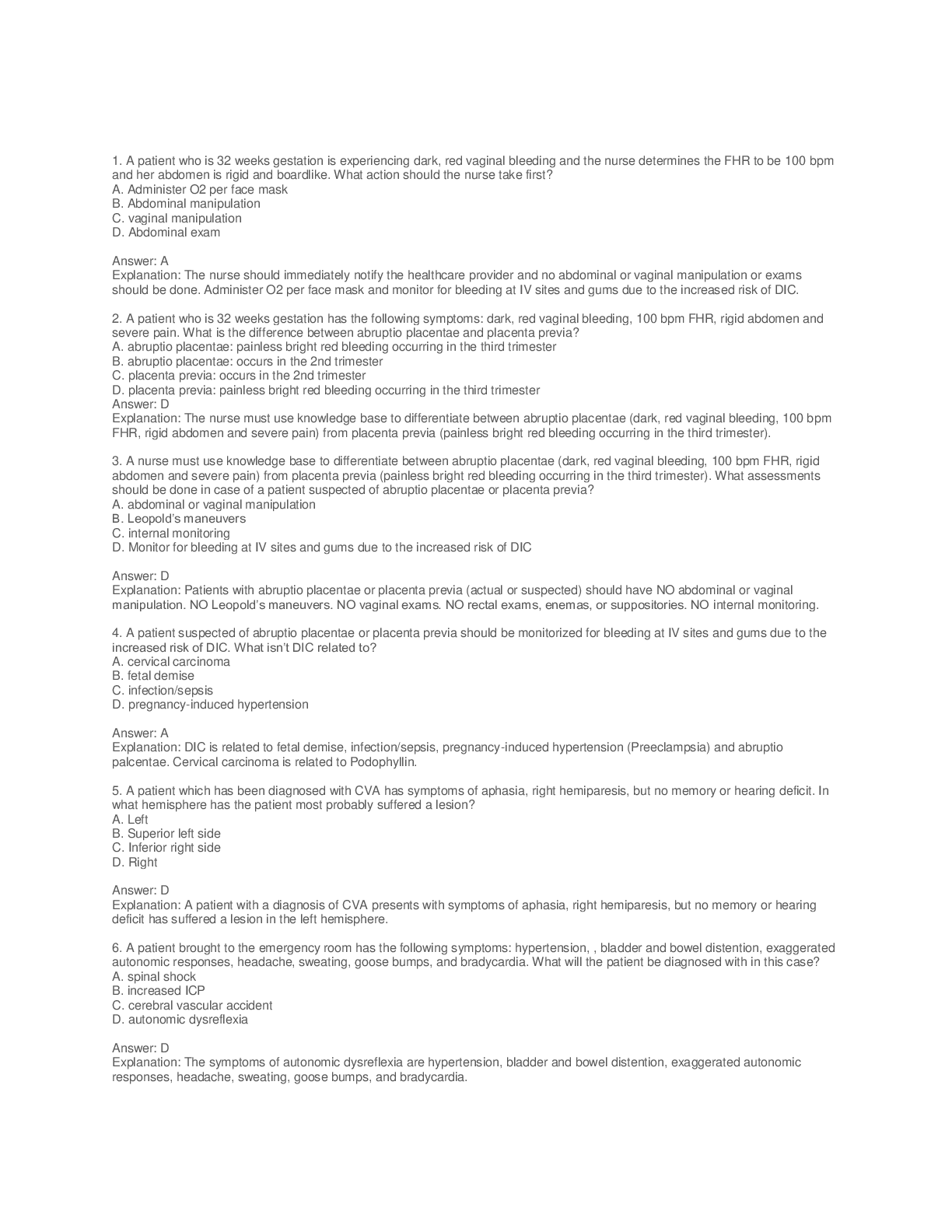


 Questions, Answers & Rationale, A+ Guide.png)


.png)

.png)
.png)
.png)


.png)