ATI RN NCLEX COMPREHENSIVE EXAM 2 2025 LATEST
WITH COMPLETE Q&A’S WITH RATIONALES
(GUARANTEED PASS) | RATED A+
1. The nurse is managing care for several clients in the outpatient clinic. Among the following
clients w
...
ATI RN NCLEX COMPREHENSIVE EXAM 2 2025 LATEST
WITH COMPLETE Q&A’S WITH RATIONALES
(GUARANTEED PASS) | RATED A+
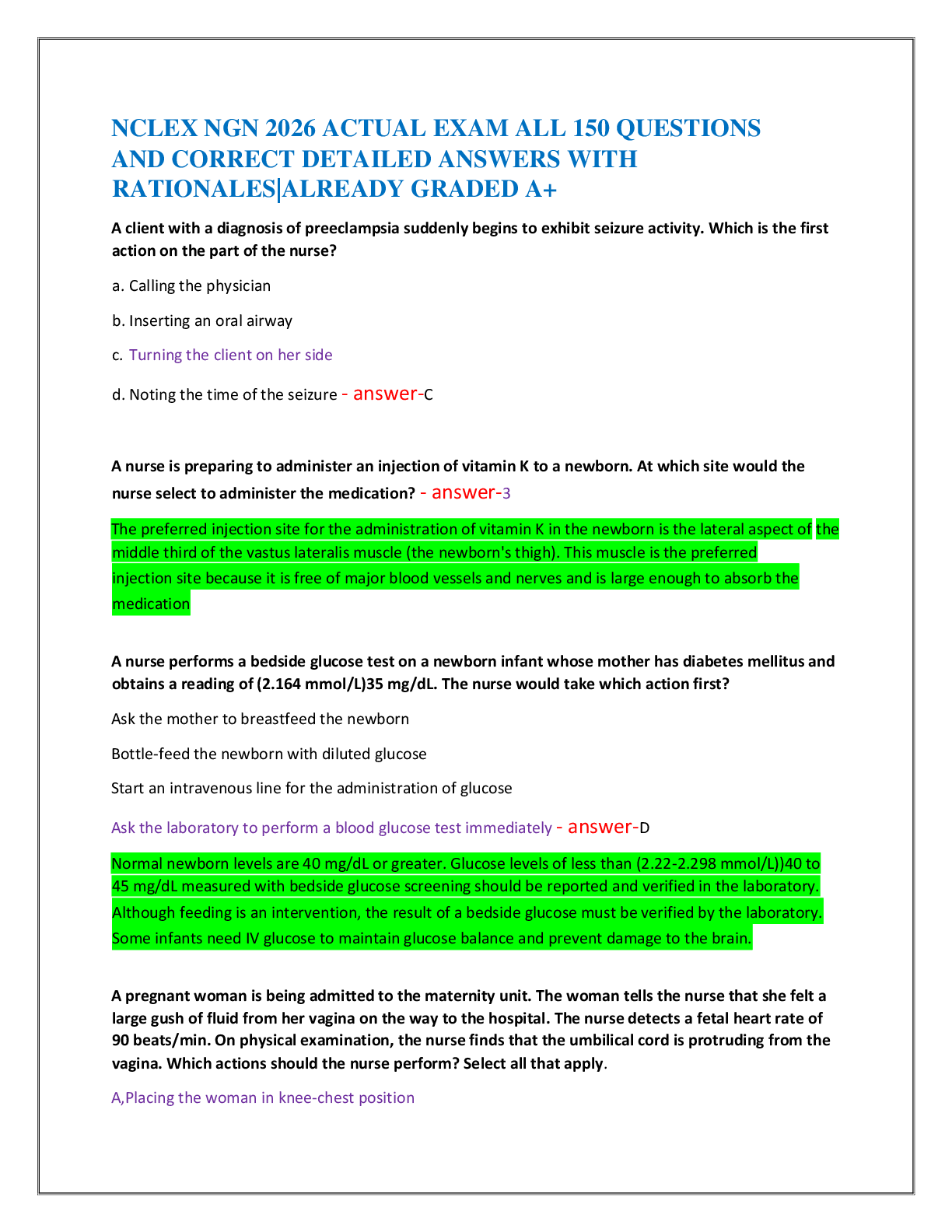
1. The nurse is managing care for several clients in the outpatient clinic. Among the following
clients who called, which one should the nurse prioritize in responding to first?
o A. A client with hepatitis A who states, “My arms and legs are itching.”
o B. A client with a cast on the right leg who states, “I have a funny feeling in
my right leg.”
o C. A client with osteomyelitis of the spine who states, “I am so nauseous that
I can’t eat.”
o D. A client with rheumatoid arthritis who states, “I am having trouble
sleeping.”
Correct Answer: E. A client with a cast on the right leg who states, “I have a funny feeling
in my right leg.”
It may indicate neurovascular compromise, requiring immediate assessment.
Option A: Bilirubin levels in hepatitis A may increase, and itching is a common
symptom.
Option C: A client feeling nauseous may require consultation but is not a
priority.
Option D: Clients with rheumatoid arthritis may feel pain in the affected areas at
night. They may need a prescription for painkillers but it is not urgent.
2. A 45-year-old male patient who recently underwent a kidney transplant is being monitored in
the post-operative period. During a routine check-up, the patient reports feeling generally unwell
and expresses discomfort in the area of the transplant. The nurse is vigilant for signs of organ
rejection. Which of the following assessments would most strongly prompt the nurse to suspect
organ rejection?
A. Sudden weight loss
B. Polyuria
Stuvia @Med Excellence Hub
C. Hypertension
D. Shock
Correct Answer: C. Hypertension
Hypertension, along with fever, and tenderness over the grafted kidney, reflects acute rejection.
3. A 55-year-old male patient is admitted with acute renal failure and is under the care of a
nurse. The patient’s recent blood work shows a significantly elevated potassium level, which is a
common complication in acute renal failure. The nurse is preparing for the prescribed treatment
to address this electrolyte imbalance. Given the patient’s condition and laboratory results, for
which of the following conditions should the nurse expect hypertonic glucose, insulin infusions,
and sodium bicarbonate to be used?
A. Hypernatremia.
B. Hypokalemia.
C. Hyperkalemia.
D. Hypercalcemia.
Correct Answer: C. Hyperkalemia.
Hyperkalemia is a common complication of acute renal failure. It’s life-threatening if immediate
action isn’t taken to reverse it. The administration of glucose and regular insulin, with sodium
bicarbonate, if necessary, can temporarily prevent cardiac arrest by moving potassium into the
cells and temporarily reducing serum potassium levels.
Option A: Hypernatremia is believed to be due to post-acute kidney injury
diuresis in the face of inability to maximally concentrate the urine because of
renal failure. The diuresis caused a disproportionate loss of water in excess of that
of sodium in the absence of replenishment of the water loss.
Option B: Hypokalemia is related to increased use of diuretics, decreased use of
RAS blockade, and malnutrition, all of which may impose additive deleterious
effects on renal outcomes.
Option D: Hypocalcemia is a frequent accompaniment of acute renal failure, but
Stuvia @Med Excellence Hub
paradoxically hypercalcemia also has been described in association with acute
renal failure. This may be caused by dissolution of dystrophic calcifications in
traumatized muscle and may lead to severe metastatic calcifications.
[Show More]