Liberty University CSTU 100 Quiz 2
· Question 1
3 out of 3 points
When was Neo-classical architecture brought to America?
18th century
· Question 2
3 out of 3 points
The first Greek c
...
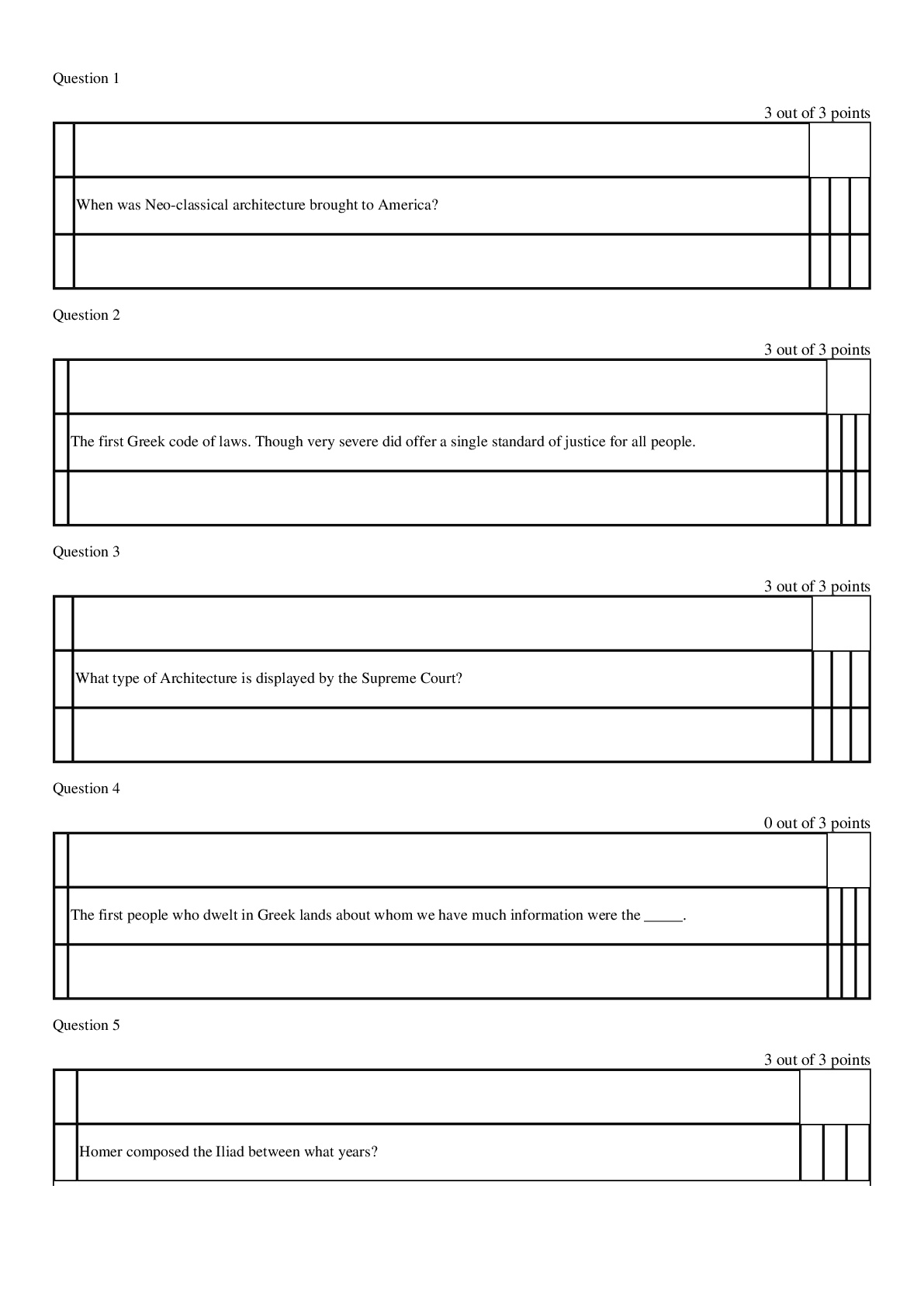
Liberty University CSTU 100 Quiz 2
· Question 1
3 out of 3 points
When was Neo-classical architecture brought to America?
18th century
· Question 2
3 out of 3 points
The first Greek code of laws. Though very severe did offer a single standard of justice for all people.
Draconian law code
· Question 3
3 out of 3 points
What type of Architecture is displayed by the Supreme Court?
Neo-classical
· Question 4
0 out of 3 points
The first people who dwelt in Greek lands about whom we have much information were the _____.
Trojans
· Question 5
3 out of 3 points
Homer composed the Iliad between what years?
750-700 BC
· Question 6
3 out of 3 points
The so-called “Archaic Grin” is associated with Greek sculptures? It can be seen on this sculpture.
Calf-Bearer
· Question 7
3 out of 3 points
When was the United States Capitol Building construction begun?
1793
· Question 8
3 out of 3 points
The worship of Olympian gods was a complex and fascinating religion. According to the Rawls textbook, at its most straightforward the religion used mythical gods and goddesses to explain what?
Natural forces
· Question 9
3 out of 3 points
During the Archaic Period the Greeks enlarged their economy and gained leisure time for other pursuits: gymnastics, education, philosophic-scientific investigation, discussions in the ___________.
Agora
· Question 10
3 out of 3 points
Who was not an early Athens reformer during the Archaic period?
Anacreon
· Question 11
3 out of 3 points
Who excavated the ancient city of Troy?
Schliemann
· Question 12
3 out of 3 points
What do Historians sometimes use to refer to the great leap that propelled Western culture forward?
Miracle of Greece
· Question 13
3 out of 3 points
Greek god of the sea.
Poseidon
· Question 14
3 out of 3 points
The Mycenae had developed a metal craftsmanship called ___________ , the hammering of metals into representational form.
Toreutics
· Question 15
3 out of 3 points
Greece is surrounded by four seas. Which of these is not one of them?
Galilee
· Question 16
3 out of 3 points
What types of columns decorated the front of the Supreme Court?
Corinthian
· Question 17
3 out of 3 points
A Wealthy-German merchant turned archaeologist discovered Troy in Northern Turkey.
Schliemann
· Question 18
3 out of 3 points
An Archaic Greek sculpture, of a standing male youth which is nude.
Kouros
· Question 19
3 out of 3 points
This archaeological monument is from the citadel of the kings from ancient Mycenae.
Lion Gate
· Question 20
3 out of 3 points
Who said “Justice in the life and conduct of the state is possible only as first it resides in the hearts and souls of its citizens.”
Plato
· Question 21
2 out of 2 points
According to your textbook, a culture without a divine monarch has no compelling need for monumental sculptures.
True
· Question 22
2 out of 2 points
The Parthenon is built during the 2nd century
False
· Question 23
2 out of 2 points
Sparta was able to rival Athens in cultural and intellectual achievements.
False
· Question 24
2 out of 2 points
The Greeks valued sculpting in bronze more than any other medium.
True
· Question 25
2 out of 2 points
The Greeks tired of the Persian’s attitude and attacked the Persian Empire’s Mainland in 490BC.
False
· Question 26
2 out of 2 points
The Indo-European tribe is believed to have lived about 3000 years ago in the area of Central Asia.
False
· Question 27
2 out of 2 points
Greece refused to absorb any of the cultural heritage from the Egyptians or the Mesopotamians.
False
· Question 28
2 out of 2 points
Several constants seem to run through all cultures. Seaports are, by their nature, urban centers, cities are more open to change than rural areas. Thus the farther people are from the seacoast, the more resistant they will be to change and new ideas.
True
· Question 29
2 out of 2 points
The quote “Equal Justice for All” is proudly displayed above the United States Capital Building.
False
· Question 30
2 out of 2 points
Individualistic to the extreme, the Greeks had no organized religion and, consequently, no hierarchy of priests.
True
[Show More]

















 midterm help.png)