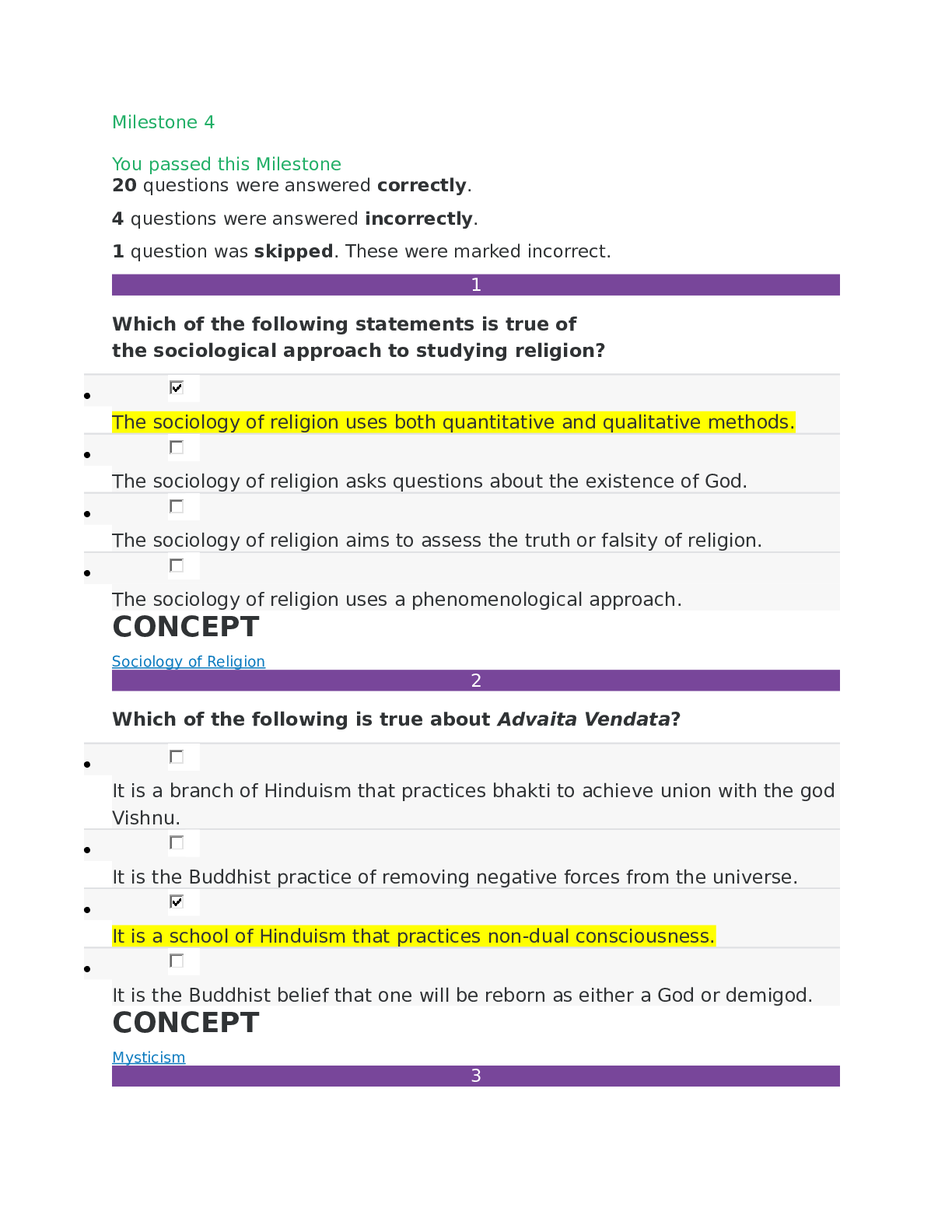
Which of the following statements is true of
the sociological approach to studying religion?
The sociology of religion uses both quantitative and qualitative methods.
The sociology of religion asks questions abo
...
Which of the following statements is true of
the sociological approach to studying religion?
The sociology of religion uses both quantitative and qualitative methods.
The sociology of religion asks questions about the existence of God.
The sociology of religion aims to assess the truth or falsity of religion.
The sociology of religion uses a phenomenological approach.
CONCEPT
Sociology of Religion
2
Which of the following is true about Advaita Vendata?
It is a branch of Hinduism that practices bhakti to achieve union with the god
Vishnu.
It is the Buddhist practice of removing negative forces from the universe.
It is a school of Hinduism that practices non-dual consciousness.
It is the Buddhist belief that one will be reborn as either a God or demigod.
CONCEPT
Mysticism
3
Which of the following is true of religious perspectives on charging
interest?
Christianity prohibited charging interest in the Middle Ages, but now has no
problem with it.
Hindus believe that charging interest creates good karma.
Buddhists believe that charging interest goes against the teachings of the
Buddha.
Islam has nothing to say regarding charging interest.
CONCEPT
Religion and Economics
4
Which of the following best characterizes ritual in terms of who may
carry out the action?
Both individuals and communities
Individual persons in private
The religious leaders in a community
The whole community
CONCEPT
Action
5
You skipped this question and it was marked incorrect.
Which of the following describes a major difference between Taoic
and Abrahamic religions?
Taoic religions share an emphasis on the balance of the universe, while
Abrahamic religions share a central figure in genealogy.
Taoic religions share a belief in one God, while Abrahamic religions share a
belief in many gods.
Taoic religions share a central figure in genealogy, while Abrahamic religions
share an emphasis on the balance of the universe.
Taoic religions originated in India, while Abrahamic religions originated in the
United States.
CONCEPT
Comparative Religion
6
Select the true statement about law in primitive societies.
People in primitive societies were the first to enforce the separation of
church and state.
People in primitive societies were often governed by formal theocracies.
People in primitive societies lacked any sense of morality or personal
responsibility.
People in primitive societies were governed by natural laws, such as weather.
CONCEPT
Law
7
What is the separation of church and state?
The creation of separate religious and secular spheres in a society.
The natural tendency of humans to separate religious and political thought.
The theological idea that God's commands ought to apply to state
institutions, as well as to individuals.
The political system in which the secular leader and religious leader are two
separate branches of the government.
CONCEPT
Law
8
Which of the following best describes henotheism?
Henotheism is the belief in multiple gods and goddesses.
Henotheism is the belief that there is no god.
Henotheism is the belief that one primary god exists, but others are worthy
of worship.
Henotheism is the belief in one god.
CONCEPT
Polytheism & Henotheism
9
Indicate which of the following is true of Christian mysticism.
One may experience emptiness.
One may experience “no-self.”
One may see a vision of the divine.
One may have a drug-induced state of ecstasy.
CONCEPT
Mysticism
10
Which of the following is true of zakat?
Zakat is a Buddhist concept.
Zakat is defined as interest-based profit.
Zakat is given to religious leaders.
Zakat is defined as charity.
CONCEPT
Religion and Economics
11
Which is true of an Islamic perspective on evil?
Evil arises from society’s disruption of the state of nature.
Evil arises from humankind’s actions independent of God.
Evil is a mere illusion.
Evil is caused by an evil God.
CONCEPT
Evil
12
What was the primary reason for the Crusades?
Belief in gods other than the monotheistic deity
Control of eastern Europe, north Africa, and Palestine
Clashes over theology
Struggle for control over religious texts
CONCEPT
Religious Wars & Violence
13
Which of the following foods is not considered halal?
Coffee
Pork
Goat
Beef
CONCEPT
Religion and Food
14
The observance of religiously-based dietary restrictions in Judaism
is known as:
Halal or Haram
Kosher or Kashrut
Lent or Liturgy
Karma or Dharma
CONCEPT
Religion and Food
15
Which of the following is true of the philosophical approach
to studying religion?
Philosophy of religion determines how religion is passed down generation to
generation.
Philosophy of religion never attempts to compare religions.
Philosophy of religion examines the various denominations within religions.
Philosophy of religion asks questions about the existence of God.
CONCEPT
Philosophy of Religion
16
Which religious tradition views marriage as one of the "Five Relationships?"
Buddhism
Taosim
Jainism
Confucianism
CONCEPT
Marriage, Family and Sexuality
17
Many religions deal with the concept of suffering, which could
most generally be defined as:
the spiritual trials experienced in life.
any form of physical discomfort.
physical, psychological, or spiritual pain.
falling short of God's commands.
CONCEPT
Suffering
18
What distinguishes the concept of sin in Buddhism from that of
Christianity?
In Buddhism, God is capable of sin as well.
In Buddhism, sins cannot be forgiven.
In Buddhism, sin is not necessarily a bad thing.
In Buddhism, disobeying God is not seen as the root of sin.
CONCEPT
Sin
19
The American belief that all people are created equal, which is
empirically indemonstrable yet believed to be true, could be
categorized as a(n)
myth.
analogy.
allegory.
parable.
CONCEPT
Parable, Myth, and Allegory
20
Which of the following statements is true of the historical approach
to studying religion?
The historical approach studies changes in religion over time.
The historical approach compares beliefs and practices of religions.
The historical approach relies on quantitative methods.
The historical approach relies on qualitative methods.
CONCEPT
Historical Approaches
21
What is eternity in the context of religion?
The ability to have complete causal control over reality.
A state in which time is never ending or does not exist.
The cosmological view that the cosmos has no "edge."
A state of being in all possible places at one time.
CONCEPT
Death and Eternity
22
Which of the following accurately reflects a Muslim perspective on
the environment?
People are God’s representatives on earth and should care for the
environment.
People should respect the environment as they would their mother.
The environment is for people to dominate.
The environment should be maintained in a state of balance.
CONCEPT
The Environment
23
The Buddhist story of Enyadatta is an example of which of the
following?
Parable
Myth
Revelation
Allegory
CONCEPT
Parable, Myth, and Allegory
24
Which of the following is true of a Buddhist perspective of the
environment?
The environment was given to people by God so they have dominion over it.
The environment is to be cared for by people because they are God’s
representatives on earth.
The environment is to be cared for as a middle way to maintain balance.
The environment is to be cared for because it is like our mother.
CONCEPT
The Environment
25
Which of the following events in the Buddha's life is not associated
with a pilgrimage site in northeast India?
The Buddha's birth
The first sermon
The birth of the Buddha's son
Parinirvana
[Show More]