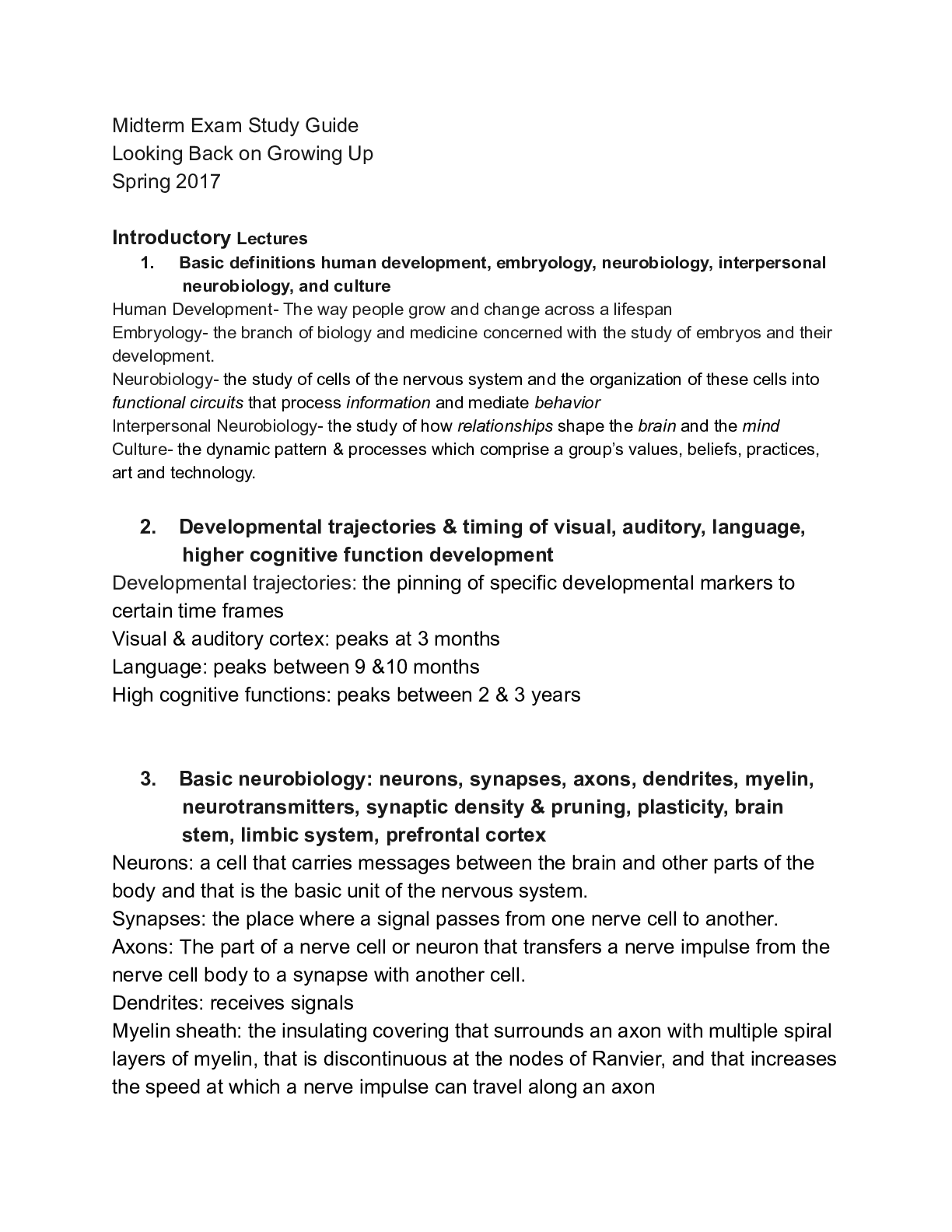
Midterm Exam Study Guide
Looking Back on Growing Up
Spring 2017
Introductory Lectures
1. Basic definitions human development, embryology, neurobiology, interpersonal
neurobiology, and culture
2. Developmental tra
...
Midterm Exam Study Guide
Looking Back on Growing Up
Spring 2017
Introductory Lectures
1. Basic definitions human development, embryology, neurobiology, interpersonal
neurobiology, and culture
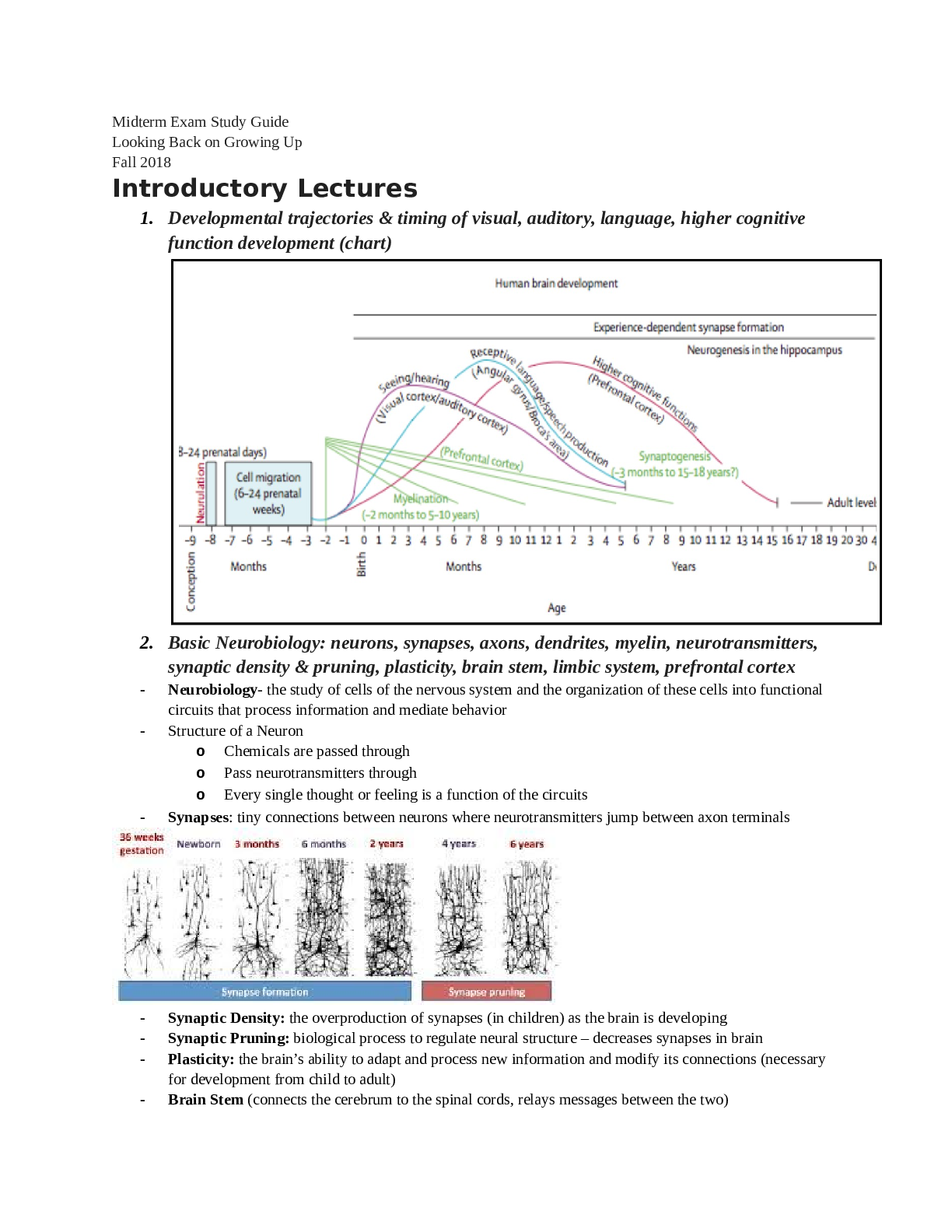
2. Developmental trajectories & timing of visual, auditory, language,
higher cognitive function development
3. Basic neurobiology: neurons, synapses, axons, dendrites, myelin,
neurotransmitters, synaptic density & pruning, plasticity, brain
stem, limbic system, prefrontal cortex
Synaptic density:
4. Babies
1. Basic genetic terminology: gene, allele, DNA/RNA/protein,
genotype, phenotype, heritability, range of reaction, epigenetics
2. Common misconceptions about gene-environment interactions
3. Patterns of inheritence: Mendelian (dominant-recessive) vs.
multifactorial with examples
4. Passive, evocative, and active gene-environment interactions
5. Shared vs. nonshared environments
6. Gene x Environment Interactions <→ Neuroscience examples
7. What’s Eating Gilbert Grape? and Theory of Everything
Pregnancy, Birth & the First Year
1. Trends in hormone levels during pregnancy & associated symptoms
2. Teratogens: definition, examples, timing & vulnerability
3. Maternal stress during pregnancy
4. Breastfeeding & formula pros & cons
5. Premature infants and development
6. Postpartum depression (prevalence, effect on infant development,
attachment)
7. Infancy: reflexes, growth patterns, brain development, gross & fine
motor development, language, basic learning processes, memory,
media
8. Temperament (dimensions & classifications) & goodness of fit
9. Juno
(1-3) Toddlerhood & Attachment
1. Key ingredients for successful attachment, phases of attachment
2. Ainsworth & the Strange Situation
3. 4 patterns of attachment & the caregiving styles they reflect: secure,
insecure – avoidant, ambivalent/resistant, disorganized
3. Harlow’s monkeys and attachment
4. Adult Attachment Interview
5. Toddlerhood: major milestones and tasks, independence, emotional
control, physical growth, cognitive/language development, social
and emotional development
7. Matilda
Cognitive Development
1. Basic tenets & stages of Piaget’s theory of development, major criticisms of his
theory
2. Object permanence, animistic thinking, egocentricity, conservation
3. Basic tenets of Vygotsky’s sociocultural theory of development
4. The zone of proximal development, scaffolding
5. Role of mediators and culture in development
6. Bandura’s social learning theory
7. Squid & the Whale
1. Bronfenbrenner’s ecological systems theory
2. Ecobiodevelopmental framework and early childhood adversity
3. Definitions of resilience, risk, positive adaptation, competence
4. Human adaptive systems
5. 4 models of resilience: compensatory/main effect, protective/moderating,
challenge, GxE interactions
6. Developmental considerations in resilience
7. Luthar on the role of relationships
8. Post-traumatic growth
9. Serotonin transporter gene variations & rearing environments in Rhesus
monkeys
10. Beast of the Southern Wild
Adolescent Development & Peers
1. Historical perspective on emergence of adolescence
2. Adolescent health paradox
3. Main causes of mortality/morbidity
4. Physical changes during puberty
5. Brain functioning and development during adolescence
6. Influence of peers on risk taking
7. Me Earl and the Dying Girl
[Show More]