Central Dogma and Genetic Medicine
Genetics Published January 2018
www.BioInteractive.org Page 1 of 4
Click & Learn
Student Worksheet
Central Dogma and Genetic Medicine
OVERVIEW
This worksheet complements the Cent
...
Central Dogma and Genetic Medicine
Genetics Published January 2018
www.BioInteractive.org Page 1 of 4
Click & Learn
Student Worksheet
Central Dogma and Genetic Medicine
OVERVIEW
This worksheet complements the Central Dogma and Genetic Medicine Click & Learn.
PROCEDURE
As you proceed through the Click & Learn, follow the instructions below and answer the questions in the spaces
provided.
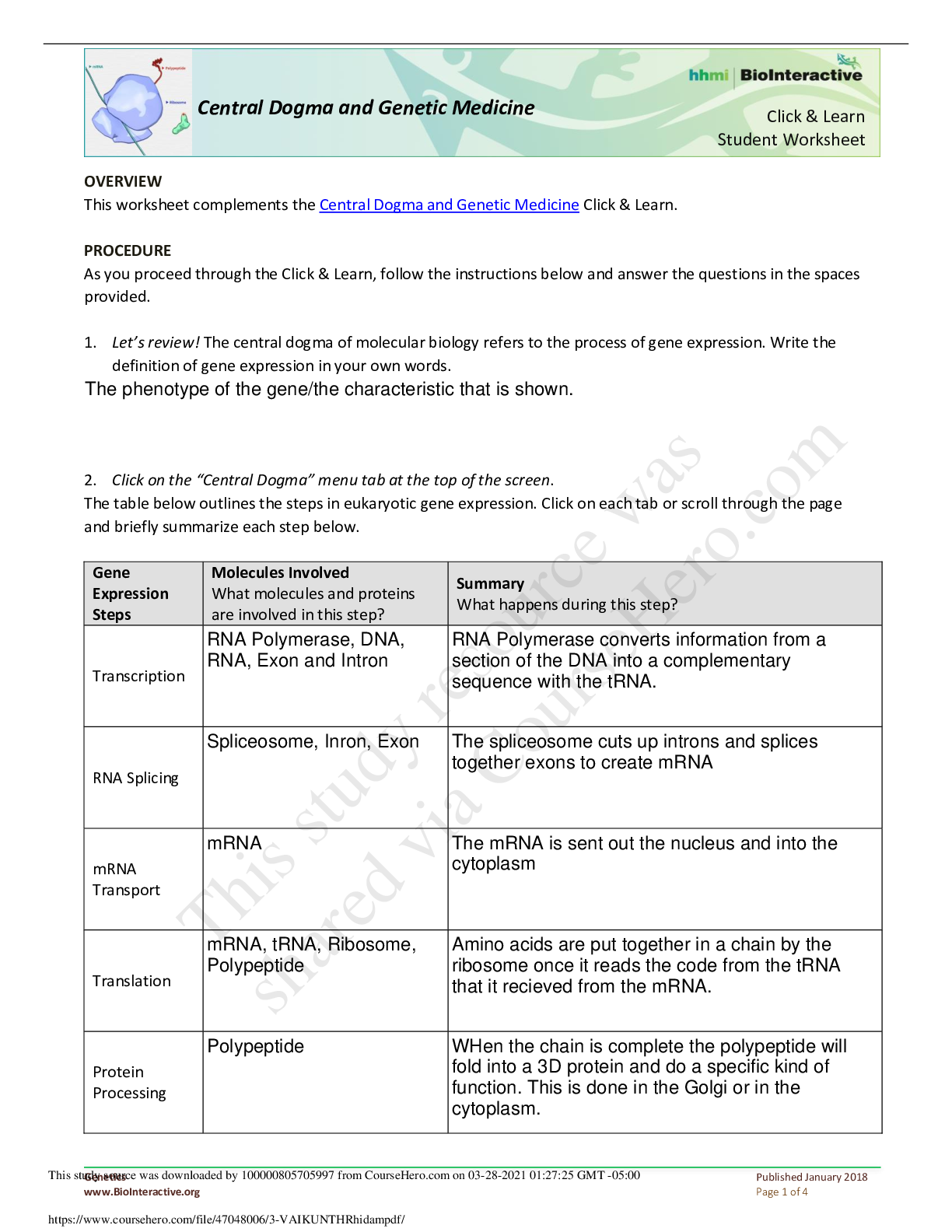
1. Let’s review! The central dogma of molecular biology refers to the process of gene expression. Write the
definition of gene expression in your own words.
2. Click on the “Central Dogma” menu tab at the top of the screen.
The table below outlines the steps in eukaryotic gene expression. Click on each tab or scroll through the page
and briefly summarize each step below.
Gene
Expression
Steps
Molecules Involved
What molecules and proteins
are involved in this step?
Summary
What happens during this step?
Transcription
RNA Splicing
mRNA
Transport
Translation
Protein
Processing
The phenotype of the gene/the characteristic that is shown. WHen the chain is complete the polypeptide will
fold into a 3D protein and do a specific kind of
function. This is done in the Golgi or in the
cytoplasm.
RNA Polymerase, DNA,
RNA, Exon and Intron
RNA Polymerase converts information from a
section of the DNA into a complementary
sequence with the tRNA.
Spliceosome, Inron, Exon The spliceosome cuts up introns and splices
together exons to create mRNA
mRNA The mRNA is sent out the nucleus and into the
cytoplasm
mRNA, tRNA, Ribosome,
Polypeptide
Amino acids are put together in a chain by the
ribosome once it reads the code from the tRNA
that it recieved from the mRNA.
Polypeptide
This study source was downloaded by 100000805705997 from CourseHero.com on 03-28-2021 01:27:25 GMT -05:00
https://www.coursehero.com/file/47048006/3-VAIKUNTHRhidampdf/
This study resource was
shared via CourseHero.comCentral Dogma and Genetic Medicine
Genetics Published January 2018
www.BioInteractive.org Page 2 of 4
Click & Learn
Student Worksheet
3. Mutations in the DNA can affect the structure and function of proteins. Some mutations may even cause
genetic diseases. Scientists and doctors can intervene at different points during gene expression to develop
treatments for such genetic diseases—or genetic medicine. Let’s learn about the genetic medicines that are
being developed.
Select the “Genetic Medicine” tab located on the top right of the screen. Click on the tab corresponding to the
genetic medicine(s) that your instructor assigns to you, or scroll through the interactive and click on the pink
“+” sign labeled with that genetic medicine. Read the “Genetic Medicine” tab material, watch the video, and
read the information in the “Learn more” link. Then, complete the appropriate row(s) below.
Genetic
Medicine
Short Summary
Write a one-sentence summary of
how this genetic medicine works.
Detailed Description
Describe how this genetic medicine would be used to treat a genetic
disease. (For example, mention how it would fix the disease-causing
mutation and/or result in a functioning protein.)
CRISPR�Cas9
Gene
Therapy
Gene
Switches
Exon
Skipping
RNA
Interference
Small
Molecule
Drug Cas9 unwinds the DNA,
while the guide Rna will
bind to the target
sequence and scientists
can add or replace DNA.
This could be used to fix mutations, caused by
diseases, by removing the faulty sequence with the
correct sequence for a normal functioning protein.
The harmful section of the
virus is replaced with a
theraputic gene and this is
then put into the body
Gene Therapy can infect the target cells with the
correct Genome and fix/remove the DNA that is
injected by the virus. This will keep proteins
functioning normally.
Gene switches affect the
activity of RNA
Polymerase by binding to
different proteins.
Gene switches can be turned on or off, so harmful
diseases caused by mutaions could potentially be
turned off.
Antisense RNA binds to a
sequence of RNA that
causes the splicing agent
to skip over a segment,
thus removing an exon.
Exon skipping changes how the RNA splices, so the
disease causing exons can be removed and a partially
function protein can be created.
RISC attaches to a
sequence in the mRNA
and expression of that
gene is prevented.
RNA interference can supress diseases causing gene
by preventing the creation of some proteins.
Small-molecule drugs can be
easily taken in by cells so they
can block the negative affects
or enhance the function of a
protein
Small-molecule drugs can be taken in with pills or
injected into the body the restore a protein to function
properly. Asprin inhibits an enzyme that cause
inflamation. This study source was downloaded by 100000805705997 from CourseHero.com on 03-28-2021 01:27:25 GMT -05:00
https://www.coursehero.com/file/47048006/3-VAIKUNTHRhidampdf/
This study resource was
shared via CourseHero.comCentral Dogma and Genetic Medicine
Genetics Published January 2018
www.BioInteractive.org Page 3 of 4
Click & Learn
Student Worksheet
4. Now let’s learn about some of the diseases that may be treated using these genetic medicines.
Scroll through the interactive and click on the pink “+” sign that is labeled with the disease(s) that your
instructor has assigned to you. Next, click on the “Case Study” tab at the top to reveal information about the
disease. Read the “Case Study” material, watch the video, and read the information in the “Learn more” link.
Then fill in the appropriate row(s) in the table below.
Name of
Disease
What are the key characteristics of the disease and whom does it affect?
How can the featured genetic medicine be used to treat the disease?
Leber
Congenital
Amaurosis
Sickle Cell
Disease
Duchenne
Muscular
Dystrophy
Huntington’s
Disease
Cystic Fibrosis
This disease affects 2-3 people per 10,000 new borns in the US. It cause
extreme far-sightedness or blindness at birth. It's caused by a genetic mutation
which doesn't allow the retina to convert light properly. Gene Therapy can be
used to replace the mutated gene with LCA that puts a normal gene into the
retina for improved vision.
Sickle-Cell Disease makes the patient have sickle shaped blood cells that
causes a low oxygen rate, higher chance of blood clots, and are immune to
malaria. Scients try to use gene switches in order to turn off the gene that gives
these blood cells the sickle shape.
It is a sex linked disease that almost always affects males. It ives progressive
muscle weakness and the muscle cells become more damaged. Eventually the
muscle cells that keep the heart pumping shut down as well. Scientists try using
exon splicing in order to splice out the exons containing the disease which
allows for a semi-functioning protein instead of none at all.
It's an autosomal dominant disease that affects the brain. Sytoms come during
adulthood(dimentia, decreasing motor function, and soon death). RNA
interference is used to reduce the production of mutant HTT protein by
destroying it in the mRNA. HTT is needed for brain function, but this mutated
version kills the brain cells over time.
It's an autosomal recessive disease that is caused by a mutation to the CFTR
gene. This mutaion inhibits the channel that transports chloride ions to not
function properly. Instead mucus is created that will block air pathways and
cause bad infections. A small molecule, lumacaftor, improves the processing by
increasing the amount of protein in the cell membrane.
This study source was downloaded by 100000805705997 from CourseHero.com on 03-28-2021 01:27:25 GMT -05:00
https://www.coursehero.com/file/47048006/3-VAIKUNTHRhidampdf/
This study resource was
shared via CourseHero.comCentral Dogma and Genetic Medicine
Genetics Published January 2018
www.BioInteractive.org Page 4 of 4
Click & Learn
Student Worksheet
APPLY WHAT YOU HAVE LEARNED
5. You are a researcher working on a treatment for Hutchinson-Gilford progeria syndrome, an extremely rare
genetic disorder that causes accelerated aging in children. Children with progeria generally appear healthy
at birth but soon start growing more slowly than other children and lose their hair. Additional symptoms
include stiffness of joints, heart problems, and stroke. These children typically die of heart disease at an
average age of 13 years.
Progeria is caused by a mutation in a single gene, called lamin A. Scientists have identified over 1,400
mutations in the lamin A gene that result in changes in transcription, RNA splicing, and/or protein
production. Lamin A codes for a protein required for the structural support of the nuclear envelope in cells.
Without a functional protein, the nuclear envelope becomes unstable, eventually damaging the nucleus and
causing cells to die.
Based on what you learned in this Click & Learn, propose a genetic medicine strategy you could develop to
treat patients with progeria. Describe which step in gene expression you might target and why you would
target that step, the intervention tool you would use, and explain how this strategy would treat the disease.
If we target the RNA splicing step in gene expression, then we will have the best chance to
treat pateints with progeria. RNA splicing should splice out the exon that has the disease
causing mutation so that a semi-function protein could be made. The protein should be able to
support the nuclear envelope, even though it is semi-functioning, and reduce cell death for the
patients.
This study source was downloaded by 100000805705997 from CourseHero.com on 03-28-2021 01:27:25 GMT -05:00
https://www.coursehero.com/file/47048006/3-VAIKUNTHRhidampdf/
This study resource was
shared via CourseHero.com
Powered by TCPDF (www.tcpdf.org
[Show More]










![Preview of Bloomberg Answers BMC [Solutions]](https://scholarfriends.com/storage/Bloomberg Answers.png)

