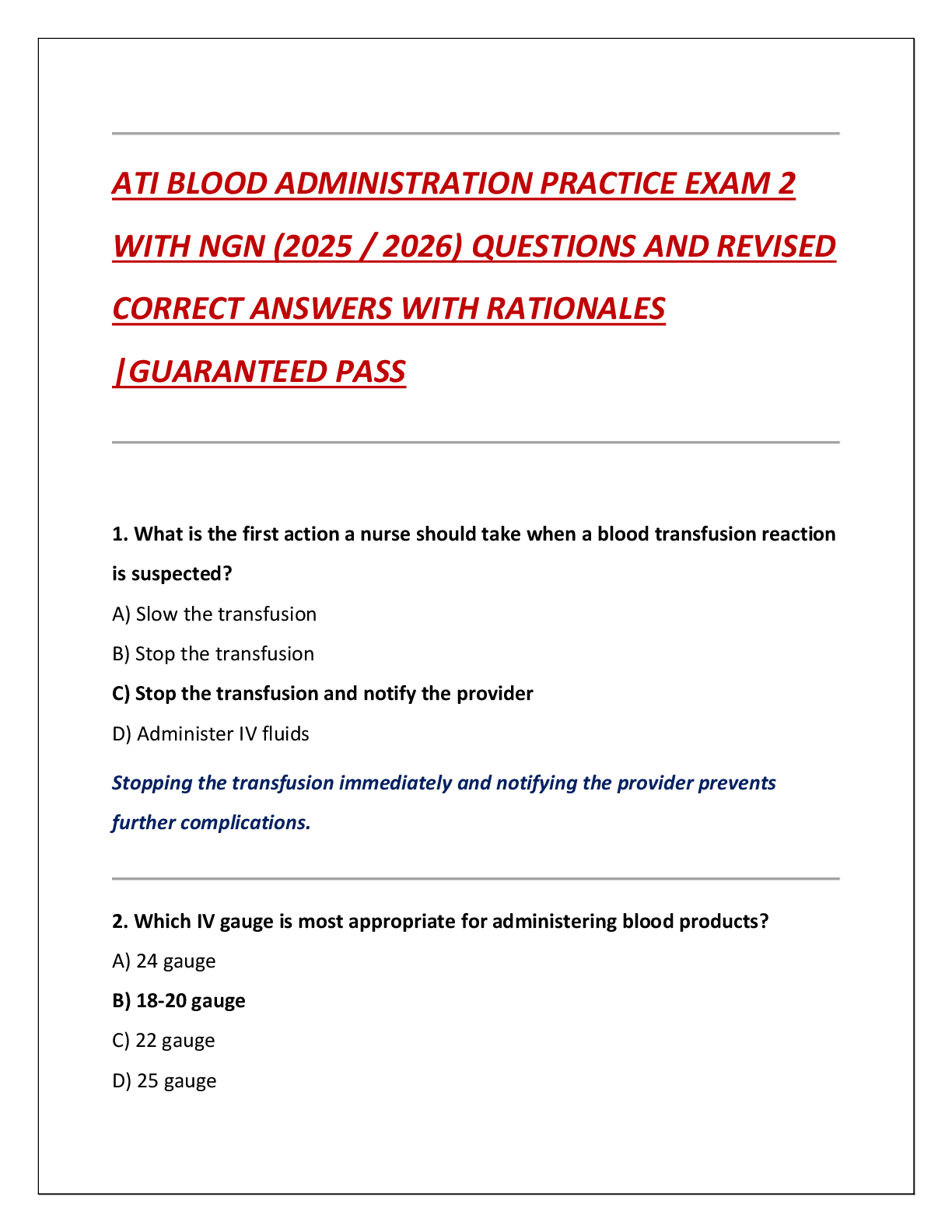
ATI Blood Administration
1. A patient who’s anticipating a total hip replacement is considering autologous transfusion. When teaching this patient about autologous transfusion, it’s important to emphasize that:
a. “I
...
ATI Blood Administration
1. A patient who’s anticipating a total hip replacement is considering autologous transfusion. When teaching this patient about autologous transfusion, it’s important to emphasize that:
a. “It reduces the risk of mismatched blood”—it eliminates the risk of alloimmunization because the patient is his/her own donor, therefore there’s no risk of exposure to another person’s antigens
b. “A hemoglobin level above 9.5mg/dL is required
i. NO. A hemoglobin of 11mg/dL is required for autologous donation
c. “There is no need to test the blood for infectious diseases”
i. NO. All blood collected for transfusion—autologous or not—is tested for HIV and hepatitis B. A patient who has either of these viruses is not a candidate for autologous transfusion
d. “Donations may be made every other day”
i. Autologous transfusions can be made every 3 to 4 days
2. A type of protein the immune system produces to neutralize a threat of some kind, such as an incompatible substance of the blood, is called an…
a. “Antibody”—Antibodies are also referred to as agglutinins
b. “Antigen”
i. NO. An antigen is a protein on the RBC’s surface membrane. Antigens are capable of inducing a specific immune response and interacting adversely with the products of that response.
c. “Agglutinogen”
i. NO. An agglutinogen is synonymous with antigen. They are called agglutinogens because they promote the agglutination (clumping) of RBCs
d. “Allergen”
i. NO. This is an antigenic substance capable of producing immediate hypersensitivity
3. A platelet transfusion is indicated for a patient who…
a. “Has thrombocytopenia” (low platelet count)—When platelet counts drop below 20,000/mm3, a transfusion of platelets is generally indicated
i. Thrombocyte = platelet
ii. –penia = deficiency of
b. “Is in hypovolemic shock (hemorrhagic shock)”
i. NO. This is a condition in which the liquid portion of the blood (plasma) is too low; results when you lose > 20% of your body’s blood/fluid supply. Fluid loss of this amount makes it impossible for the heart to pump a sufficient amount of blood to your body
ii. Typically, plasma is used to expand blood volume
iii. For severe hemorrhage, whole blood may be transfused
c. “Has hemolytic anemia”
i. NO. Various types of hemolytic anemia (ex: sickle-cell anemia & thalassemia—insufficient/abnormal amounts of hemoglobin) are treated with RBC transfusions
d. “Has a systemic infection”
i. NO. No particular blood component can be used to combat a systemic infection. Instead, anti-infective meds are used
4. Prior to administering a blood transfusion, it is essential to explain to the patient that…
a. “He/she must immediately report any subjective symptoms like chills, nausea, or itching”—med professionals can ID objective signs of a transfusion rxn (ex: vital sign changes, flushing, cyanosis, coughing, dyspnea, etc.) but may not be able to tell if the client is experiencing subjective symptoms
b. “You will check vitals every 15 mins through the transfusion”
i. Check vital signs prior to infusion (baseline) and after the first 15 minutes of beginning the transfusion. Assuming vitals are WNL, reassessing will fall to every 30 minutes to an hour until 1 hour AFTER transfusion is complete (timeline subject to change depending on the patient’s overall condition)
c. “If no rxn in the first 15-30 minutes, he won’t have adverse effects later”
i. NO. Serious rxns tend to occur early in the transfusion, but other types of rxns can occur later
ii. Delayed hemolytic rxns—can appear up to 14 days post transfusion: after the antibody level has increased enough for rxn onset
iii. Disease transmission from the blood product is another example of a delayed transfusion rxn (very rare)
d. “You might have a nursing assistant check on client periodically”
i. NO. Monitoring for this isn’t something you can delegate to an assistive personnel. Patient should be monitored by a nurse regularly
5. A patient is about to receive a unit of packed blood cells when he/she poses a concern about acquiring a disease from the blood. What would be the best response?
a. “Donated blood is carefully screened for infectious disease”
i. Offers factual info to help allay concerns
b. “It is impossible to get an infection from donor blood”
i. Although the risk is low, it isn’t impossible to have a septic rxn to a transfusion. Risk of blood borne infection in the US via transfusion is extremely low, but there is no 100% guarantee of safety
c. “The US blood supply is among the safest in the world”
i. True, but offers reassurance without any solid information to dispel fears. Reassurance is a non-therapeutic communication technique
d. “Why not ask your doctor about other txt options?”
i. You risk increasing the patient’s fears about the transfusion—as though you are confirming that the concern about infectious disease is entirely realistic
6. You’re caring for a client with severe trauma whose blood type is A. A blood transfusion is ordered stat. You know that the client can safely receive blood from blood group O because…
a. “Blood type O contains *no* A antigens”
i. Type O contains no antigens at all—AKA: universal donor
ii. Type O blood can be transfused to people with any ABO-related type without risking an ABO incompatibility
iii. Hemolytic rxns are triggered by the specific antigens in the transfused blood. Therefore, since O has no antigens it’s safe!
b. “Type A blood contains O antibodies”
i. NO. There are no O antibodies in any type of blood
c. “Type O blood contains no A antibodies”
i. NO. Type O blood contains both A & B antibodies.
ii. However, note that those antibodies would not cause harm to a person with type A blood
d. “Type A blood contains O antigens”
i. NO. There are no O antigens in type A blood (or in any other type of blood). There are only A and/or B antigens in some blood types.
7. Patient began a transfusion of packed RBCs an hour ago and has suddenly developed shaking chills, muscle stiffness, and a fever spike to 101.4. He appears flushed and reports a headache and “nervousness”. Your patient has most likely developed which type of transfusion rxn?
a. Febrile nonhemolytic—MOST COMMON type of transfusion rxn
i. The characteristic fever usually develops within 2 hours of beginning the transfusion
ii. Classic symptoms: chills, headache, flushing, anxiety, and muscle pain
iii. Usually a result of sensitization to the plasma, platelets or WBCs
iv. This rxn is not life-threatening, but can be frightening and uncomfortable
b. Acute hemolytic—a life threatening rxn characterized by fever, chills, anxiety, nausea, chest tightness, dyspnea, tachycardia, tachypnea, and hypotension
i. Usually immediate/can begin after only 10 mL of blood
ii. Cause is an incompatibility of blood
c. Septic—Hypotension is a classic symptom of a septic rxn, and in most cases, symptoms develop after the unit is transfused (perhaps even several hours later)
i. Though a rapid onset of chills/fever is common, the other manifestations in the question are not
ii. Contaminated blood products are the usual cause
d. Allergic—flushing, urticaria (hives), itching, and wheezing are common signs of an allergic rxn
i. Though flushing is common with allergic rxns, the other manifestations in the question are not
ii. These rxns are thought to be the result of a sensitivity rxn to a plasma protein in the donor’s blood
8. When administering a transfusion of packed RBCs, it’s important to…
a. “Make sure the entire unit is transfused within 4 hours”
i. More than 4 hours increases the risk for bacterial proliferation
ii. Ideally infused within 2 hours: though patients at risk for FVE will require slower rates (not to exceed 4 hours)
b. “Allow the blood to warm to room temp for one hour”
i. NO. Blood cannot be left in a room-temp environment for > 30 minutes prior to infusion because:
1. RBCs can break down and release K+ into the bloodstream, this putting the patient at risk for hyperkalemia
2. Increase risk of bacterial growth
ii. If transfusion is delayed, the blood must be kept at a specific temp in the blood bank
c. “Begin transfusion at a rate of 10mL/hr”
i. NO. A rate of 2mL/hr is preferred initially because many of the more serious transfusion rxns occur after only a small amount of blood is transfused
ii. After the first 15 minutes, it’s generally safe to increase the flow to the prescribed rate
d. “Change the blood tubing after every unit infused”
i. For patients receiving multiple units, generally blood tubing is replaced after every 2 units (to reduce the risk of bacterial contamination)
ii. Varies with agency policy—some allow 4-6 units without changing
9. Which is an essential nursing action prior to starting a blood transfusion
a. “Ensure informed consent has been obtained”
i. This must be done prior to administration of the blood
ii. It’s the responsibility of the healthcare provider to answer the patient’s questions about need, risks, and benefits, but a nurse can witness the patient’s signature indicated informed consent
b. “Establish IV access with a 22g needle”
i. NO. Best to use an 18g or 19g due to the viscosity of blood
ii. A 22g needle lumen is too narrow to infuse blood properly
c. “Prime an infusion set with LRS”
i. NO. Blood is always given with 0.9% NaCl (normal saline), and never with LRS
ii. Don’t give with solution containing dextrose because it causes lysis of RBCs
d. “Suggest that the patient consider autologous transfusion”
i. This is the process of collecting, storing, and re-infusing the patient’s OWN blood, but is not possible in all situations
ii. Would be no need to suggest it to a patient who has no objection to a standard blood transfusion
10. A patient is about to receive a unit of packed RBCs. The unit has arrived and you’re about to start the transfusion. Which procedure will help you protect the patient against the possibility of a blood-group incompatibility?
a. Comparing the ID numbers on the blood unit with those on the order form of the wristband
i. Compare patient’s ID from hospital wristband, check facility ID number, check 2nd patient identifier (DOB) with blood order sheet, check barcode wrist band, compare unique ID number with number on the blood order form
b. “Obtain a blood sample from patient for typing and cross matching”
i. Though it’s true that a type/crossmatch prevents incompatibilities, the blood bank can’t issue the blood until AFTER the type and crossmatch results are in
c. “Giving a prescribed pre-med 30 minutes prior to stating the transfusion”
i. Acetaminophen/other antipyretic (fever reducing) agent may be prescribed by the provider, but this is done to prevent febrile rxns, NOT blood-group incompatibilities
d. “Observing the patient for 15-30 minutes after transfusion is initiated”
i. This is considered standard procedure since most rxns manifest during the infusion of the first 50 to 100 mL (or sooner)
ii. This helps to detect NOT prevent blood-group incompatibility
[Show More]



.png)
.png)


![Preview of Wound Management Principles and Practices, 4th Edition By Betsy Myers | [eBook][PDF]](https://browseimages.nyc3.digitaloceanspaces.com/paper-thumbnails/2023/07/25/paper-338275-thumb-oo3LHSAbX3DDhdaD-661f3ed5.jpg)