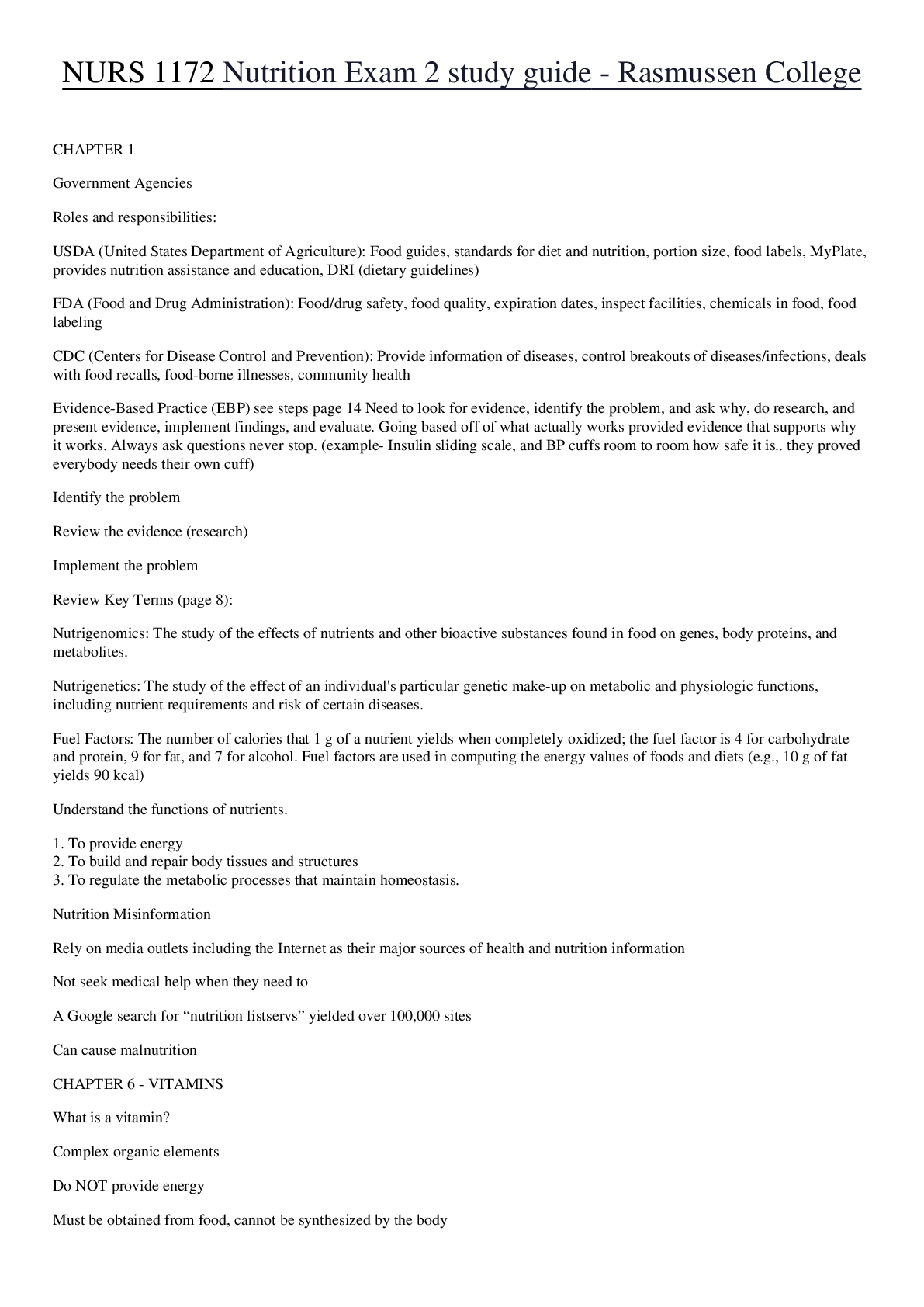
NURS 1172 Nutrition Exam 2 study guide - Rasmussen College
I. CHAPTER 1
A. Government Agencies
1. Roles and responsibilities:
• USDA (United States Department of Agriculture): Food guides, standards for diet and n
...
NURS 1172 Nutrition Exam 2 study guide - Rasmussen College
I. CHAPTER 1
A. Government Agencies
1. Roles and responsibilities:
• USDA (United States Department of Agriculture): Food guides, standards for diet and nutrition, portion size, food labels, MyPlate, provides nutrition assistance and education, DRI (dietary guidelines)
• FDA (Food and Drug Administration): Food/drug safety, food quality, expiration dates, inspect facilities, chemicals in food, food labeling
• CDC (Centers for Disease Control and Prevention): Provide information of diseases, control breakouts of diseases/infections, deals with food recalls, food-borne illnesses, community health
B. Evidence-Based Practice (EBP) see steps page 14 Need to look for evidence, identify the problem, and ask why, do research, and present evidence, implement findings, and evaluate. Going based off of what actually works provided evidence that supports why it works. Always ask questions never stop. (example- Insulin sliding scale, and BP cuffs room to room how safe it is.. they proved everybody needs their own cuff)
1. Identify the problem
2. Review the evidence (research)
3. Implement the problem
C. Review Key Terms (page 8):
• Nutrigenomics: The study of the effects of nutrients and other bioactive substances found in food on genes, body proteins, and metabolites.
• Nutrigenetics: The study of the effect of an individual's particular genetic make-up on metabolic and physiologic functions, including nutrient requirements and risk of certain diseases.
• Fuel Factors: The number of calories that 1 g of a nutrient yields when completely oxidized; the fuel factor is 4 for carbohydrate and protein, 9 for fat, and 7 for alcohol. Fuel factors are used in computing the energy values of foods and diets (e.g., 10 g of fat yields 90 kcal)
D. Understand the functions of nutrients.
1. To provide energy
2. To build and repair body tissues and structures
3. To regulate the metabolic processes that maintain homeostasis.
E. Nutrition Misinformation
• Rely on media outlets including the Internet as their major sources of health and nutrition information
• Not seek medical help when they need to
• A Google search for “nutrition listservs” yielded over 100,000 sites
• Can cause malnutrition
II. CHAPTER 6 - VITAMINS
A. What is a vitamin?
• Complex organic elements
• Do NOT provide energy
• Must be obtained from food, cannot be synthesized by the body
• It is needed in very small quantities called micronutrients to perform a particular metabolic function and prevent an identified deficiency disease.
B. Classification of vitamins (Box 6-1 p. 102)
1. Fat-soluble: A, D, E, and K (easier to cause toxicity because it can be stored in body, the excess is not removed). 1% or 2% milk better for you because there is vitamin D in it. Vitamin D is fat soluble and helps vitamin d to process quicker and more effectively.
2. Water-soluble: C and all B vitamins. Vitamin C Thymine B6, B12, riboflavin
C. Understand the following for both fat and water soluble vitamins
1. Functions: Perform a particular metabolic function and prevent an identified deficiency disease.
2. Deficiencies: Vitamin D deficiency can cause rickets, osteoporosis, fatigue and muscle breakdown, inability to process calcium. Vitamin C deficiency scurry caused by lack of vitamin C.
3. Food Sources: Vitamin C - citrus fruits, Vitamin A – cheese, eggs, dairy, melons, tomato juice, carrots Vitamin D liver, dark green leafy veggies? Vitamin E ( antioxidant) found in dark green leafy veggies, nuts, fortified cereals, vegetable oils
4. Clinical Applications: Supplements
III. CHAPTER 7 - MINERALS
A. How are minerals different from vitamins? (Review Table 7-1 pg.138)
• Simple organic elements
• Serve as cofactors
• Must also be obtained from food
• Not as easily absorbed
• Not easily destroyed in cooking
B. Classification (Box-1, pg. 139)
1. Major: calcium, potassium, phosphorus, chloride, magnesium, sulfur, sodium
2. Trace: iron, iodine, zinc, copper, manganese, chromium, selenium, fluoride, molybdenum
C. Functions:
a. Structural
b. Metabolic
-
-
-
-
-
-
-
-
-
-
-
-
-
Maintaining balance - water distribution
BMI
Strengths and limitations
Waist circumference
Energy
Organic
Requirements
Food borne illness prevention
Responsible agencies
Misinformation
Food selection
Influences
Assessing growth and development
Infants
Children
chapter 16/Measurements
Aging process
Nutrition Care Process (NCP)
Nutritional screening
Nutritional assessment
Medication/herbal supplements
Goals
Measurements
BMI
RMR
Weight loss
Waist circumference
Length and stature
Nutrition diagnosis
Nutrition Intervention
Nutrition Evaluation
Clinical signs of nutritional status
Nutrition for hospitalized patients
Modes of feeding
Table 16-5 pg.375
[Show More]