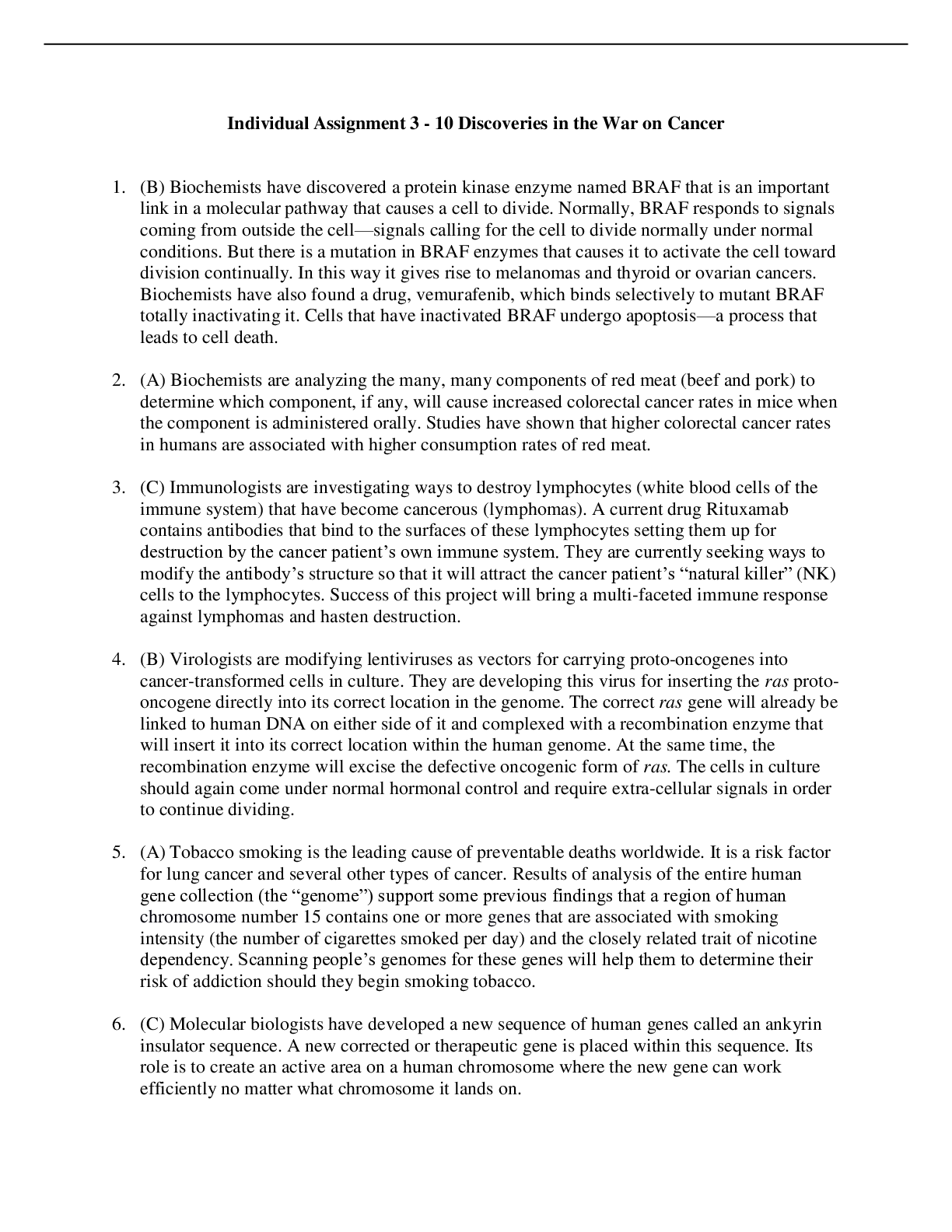
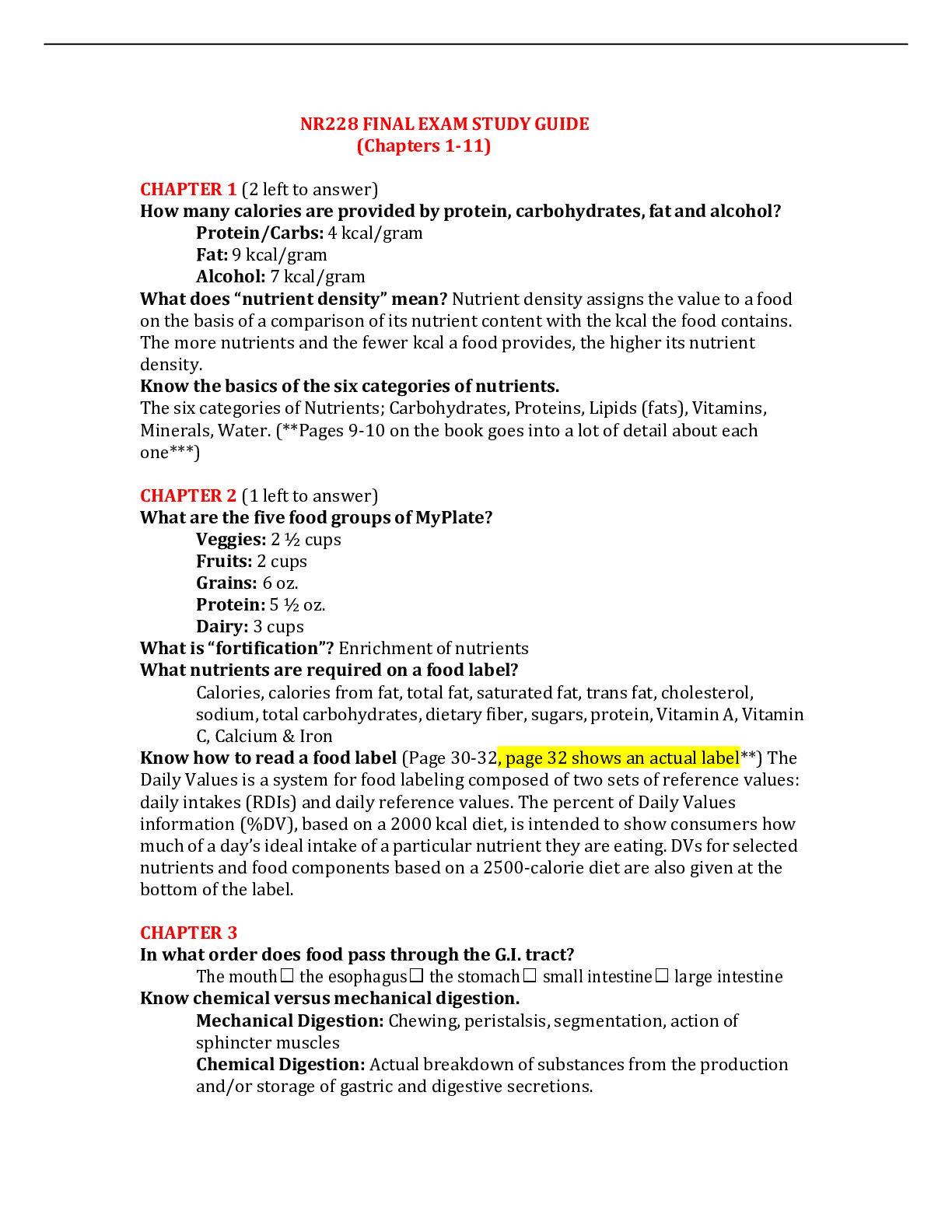
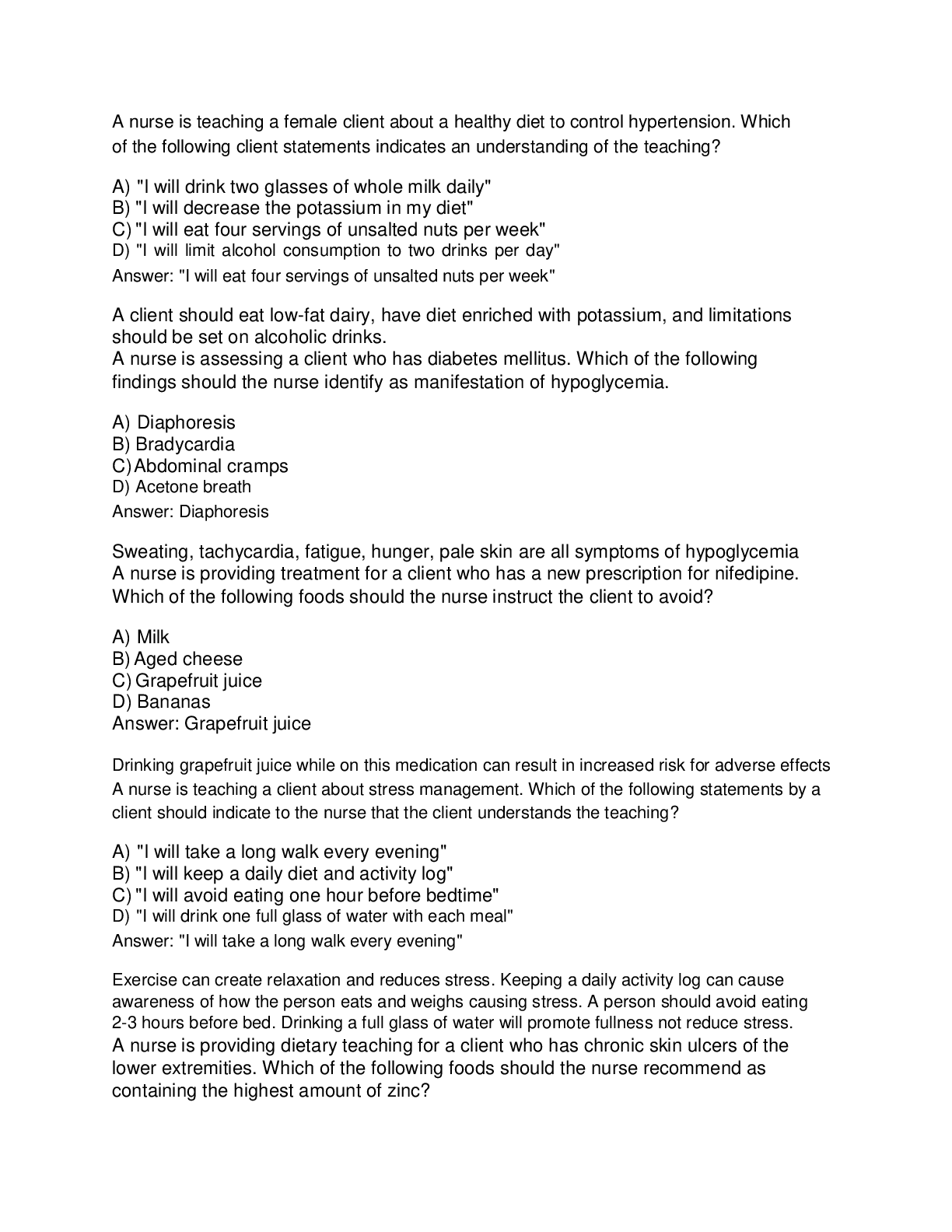
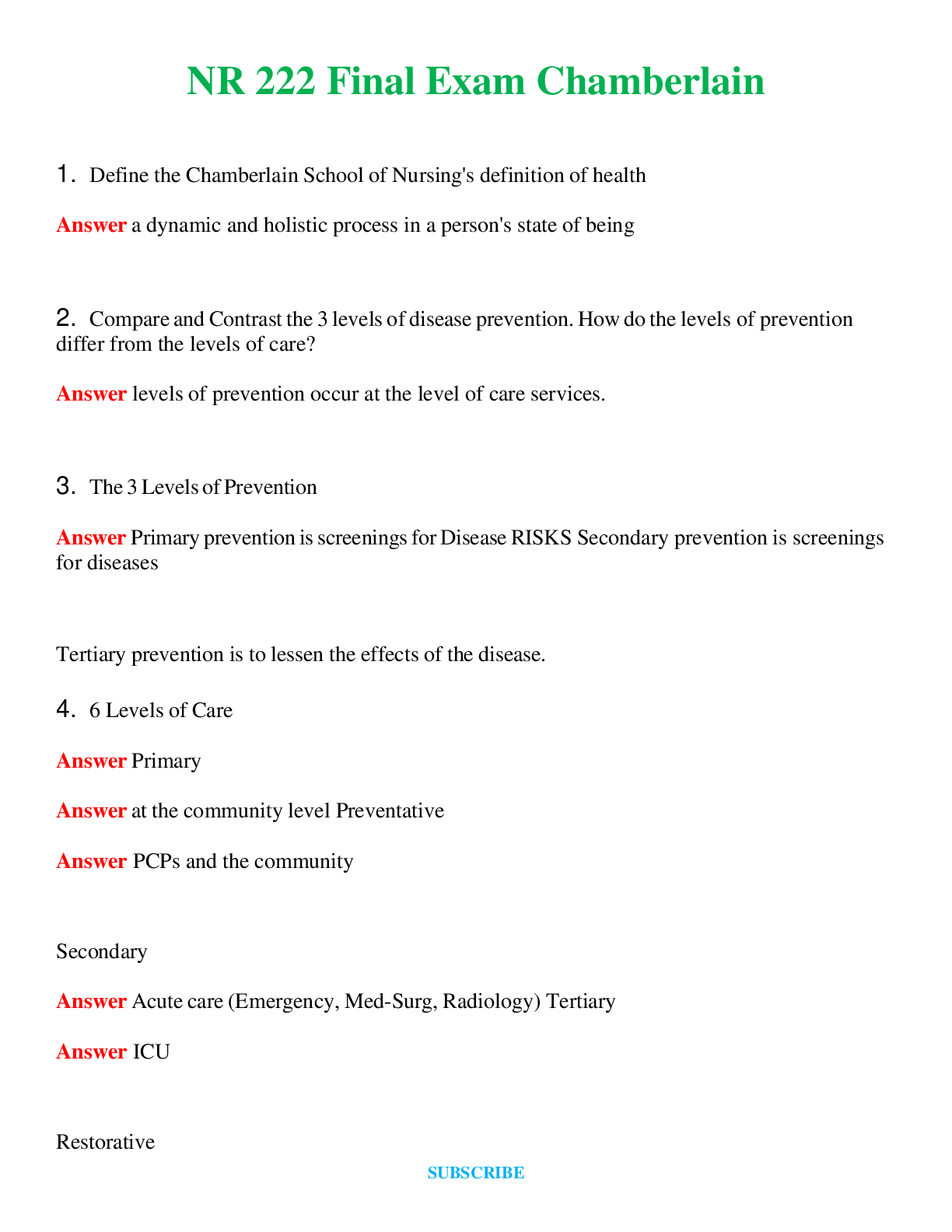
NR222 Final Exam
1.) The nurse is to instruct the client about the long- term
consequences of non-compliance to prescribed medication. Which
education strategy would be most appropriate for the nurse to
use in order
...
NR222 Final Exam
1.) The nurse is to instruct the client about the long- term
consequences of non-compliance to prescribed medication. Which
education strategy would be most appropriate for the nurse to
use in order to develop the affective learning domain of the
client?
• A. Lecture followed by a simple written test.
• B. Role playing and group discussion
• C. Video presentation and handouts
• D. Demonstration and practice
2.) A nurse manager is teaching a group of nurses about the
levels of prevention. Which example of the tertiary level of
prevention should be included in the instruction.
• A. Surgery to repair a hip dislocation of an older adult
client.
• B. Teaching breastfeeding to expectant mothers in a
prenatal clinic.
• C. Chemotherapy treatment to a client newly diagnosed
with cancer.
• D. Physical therapy to a patient who has a right sided
paralysis from a stroke.
3.) A nurse is establishing health promotion goals for a
female client who smokes cigarettes, has hypertension and has a
BMI of 26. Which of the following goals should the nurse include?
• A. The client will list foods that are high in calcium, which
should be avoided.
• B. The client will walk for 30 mins a day 5 days a week.
• C. The client will increase calorie intake by 200 cal per
day.
• D. The client will replace cigarettes with smokeless
tobacco products.
4.) Which of the following emphasizes that an individuals
belief in being personally capable of preforming the behavior is
required to influence one’s own health?
A. Social Cognitive Theory
B. Self–Efficacy Theory
C. Health Belief Model
D. Theoretical Model
5.) The nurse is discussing the importance of routine
preventive care with a Hispanic family who has recently
immigrated to the United States. Which factor will the nurse
consider as a barrier in the family’s interest to receive
professional health care? Select All That Apply
A. Lack of health insurance
B. Concern about invasion of privacy
C. Absence of transportation services
D. Limited proficiency in the English Language
E. Belief and accessibility to folk healers and remedies
F.The availability of family members for support and
help
6.) The following are true about Healthy People 2020
initiative (Select All That Apply)
• A. Healthy People Initiative provides science-based, 10
year national objectives for improving the health of all
Americans.
• B. Healthy People initiative seeks to change the health
practices of people who are most at risk to illness and
injury thereby decreasing the cost of health care and
maintenance.
• C. For 3 decades, Healthy People initiative has established
benchmarks and monitored progress over time in order to
encourage collaborations across communities and sectors.
• D. Healthy People initiative was developed to established
health improvement priorities and measure the impact of
prevention activates.
• E. Healthy People initiative gives protocols to each state
on how conduct community health prevention education
and giving nurses standards on educational programs.
• F. Healthy People initiative empower individuals towards
making informed health decisions .
7.) True statements about the ANA Code of Ethics (Select All
That Apply):
• A. The nurses primary commitment is to self first; then , if
the situation is favorable, commitment to the patients
whether the individual, family, group, community, or
population.
• B. The nurse has authority, accountability and
responsibility for nursing practices; make decisions; and
takes action consistent with the obligations to provide
optimal patient care.
• C. The profession of nursing articulates its values through
individual nurses without recommendations from
professional organizations; maintaining integrity and
principles of social justice into nursing and healthy policy
is optimal for nurses.
• D. The nurse owes the same duties to self as to other,
including the responsibility to promote health and safety,
preserve wholeness of character and integrity, maintain
competence and continue personal and professional
duties.
• E. It is the nurses responsibility to protect human rights,
promote health diplomacy, and reduce health disparities.
• F. Nurse advocates for, and protects the rights, health, and
safety of the patient.
8.) The following are health concerns and issues of migrant
workers (Select All that Apply)
• A. Pesticide exposure
• B. Iron deficiency anemia
• C. Constipation and Dehydration
• D. Tuberculosis
• E. Chronic Conditions
• F. Dental Disease
9.) Which data represents objective findings? (Select All That
Apply)
• A. Lab values
• B. Pain level state by the patients
• C. Patients stated emotional status
• D. Respiratory and pulse oximetry reading.
• E. The nurse’s description of the patient’s gait.
10.) The steps included in the nursing process include:
(Select All That Apply)
• A. Use a nursing diagnosis to state the problem.
• B. Plan care to help meet stated patient goals
• C. Collect data and asses the patient
• D. Establishes priorities, patient goals and outcomes.
• E. Determine appropriate nursing interventions for patient
care.
• F. Order labs that are needed for the patient.
11.) What information is about nursing standards of care?
• A. Nursing standards of care guidelines for nursing
practice.
• B. Nursing standards of care are defined in Nurse Practice
Acts.
• C. Nursing standards of care are used to measure nursing
conduct in malpractice suit.
• D. Nursing standards of care are specific guidelines only
for unlicensed assistive personnel.
• E. Nursing standards of care are upheld by law and
indicate what standards nurse must follow.
• F. Nursing standards of care are used to determine
whether the nurse acted as any reasonably prudent nurse
under the same or similar conditions.
12.) The nurse is discussing the importance of routine
healthcare with a Hispanic family who has recently immigrated to
the United States. Which factor will the nurse consider as a barrier
to the family’s interest to receive professional health care?
(Select All That Apply?)
• A. Lack of health insurance.
• B. Concern about invasion of privacy.
• C. Absence of transportation services.
• D. Limited proficiency in the English language
• E. Belief and accessibility to folk healers and remedies
• F. The availability of family member for support and help.
13.) Which statement by the nurse best describes values?
• A. Values are not constant; they change over time.
• B. Values learned in childhood remain the same for a
lifetime.
• C. It is impossible for people to understand their own
values.
• D. The clients values are not considered when care is
provided.
14.) Which educational strategy would be most appropriate
to use in order to provide affective learning domain of the client?
• A. Lecture followed by simple written test
• B. Video presentation and handouts
• C. Role playing and group discussion
• D. Demonstration and practice
15.) The American Nurses Association (ANA) has
recommended the following competency for RNs?
• A. The RN’s to recognize their own values, beliefs, and
cultural heritage.
• B. The RNs to function independently and occasionally
engage in collaboration.
• C. The RNs to be concerned about the existence of
vulnerable cultural groups.
• D. The RNs to provide health care opportunities to those
with financial capabilities.
16.) An RN is teaching a group of patients about Diabetes
Management material from a Diabetes Education Program. Which
of the following should an RN prepare prior to each teaching
session?
• A. Plan handouts on general principles that patients can
understand materials at the high school level.
• B. Implement changes during class whenever a patient
complains the material is too difficult to understand.
• C. Assess materials to be relevant plan changes according
to the needs of patients, implement teaching according to
the patients ability to understand the information.
• D. Assess, plan, implement, and evaluate teaching
materials only according to the recommendations of the
director of nursing.
17.) Which statement is true regarding secondary
prevention?
• A. The nurse creates a care plan for the patients
outpatient therapy.
• B. The nurse identifies individuals in an early detectable
state of the disease process.
• C. The nurse focuses on increasing the patient’s self-care
by providing prevention instructions.
• D. The nurse is driven by the objective to minimize the
effect of the disability through rehabilitation.
18.) One Leading Health Indicator (LHI) of Healthy People
2020 is the availability of medical services to all people. Which
topic does this cover
• A. Injury and Violence
• B. Environmental Quality
• C. Access to Health Services
• D. Clinical Preventative Services
19.) How would the nurse approach this ethical dilemma:
Two patients are on the list for kidney transplants and they will
both die without one. Which patient would get the one kidney that
is immediately available for transplantation.
• A. Choose the patients who has the ability to fiancé the
hospitalization and treatment.
• B. Advocate for the younger of the two clients since that
client will live longer.
• C. Use ethical principles to guide the decision making
process.
• D. Select a client who is most productive in society.
20.) The leading health indicators found in Healthy People
2020 are the following: (Select all that apply)
• A. Access to health services
• B. Holistic and CAM strategies
• C. Oral Health
• D. Issues related to legal and illegal immigration
• E. Environmental health
• F. Holistic Care
21.) Which statement best describes Erikson’s Theory of
Development.
• A. The premise of the theory is that individuals are
interdependent beings.
• B. Developmental stages result in an attempt to make
sense of the world.
• C. A healthy personality will achieve the pre-conventional
stage by 15.
• D. An individuals achievements of identity is through
sequential psychosocial stages.
22.) A patient with chest pain is being admitted to the ER.
When asked about the next of kin the patients states, “Don’t
bother calling my daughter; she is always too busy.” Which is best
response by the nurse?
• A. “She might be upset if you don’t call her.”
• B. “ What does your daughter do that makes her so
busy?”
• C. “Is there someone else that you would like me to call
for you?”
• D. “I cant imagine that your daughter wouldn’t want to
know that you are sick.”
23.) A patient states, “Do you think I could have cancer?”
The nurse responds, “What did the doctor tell you?” Which
interviewing approach did the nurse use?
• A. Paraphrasing
• B. Confrontation
• C. Reflective Technique
• D. Open-ended question
24.) A patient is admitted to the hospital with cirrhosis of the
liver causes by long-term alcohol abuse. Which is the best
response by the nurse when the patient says “I really don’t
believe that my drinking a couple of beers a day has anything to
do with my liver problem?”
• A. “You find it hard to believe that beer can hurt the liver”
• B. “How long is it that you have been drinking several
beers a day?”
• C. “ Each beer is equivalent to one shot of liquor so its just
as damaging to the liver as hard liquor.”
• D. “ Do you believe that beer is not harmful even though
research shows that it is just as bad for you as hard
liquor?”
25.) A patient is extremely upset and mentions something
about work-related issues that the nurse cannot understand.
Which is the nurses best response?
• A. “Its natural to worry about your job.”
• B. “ Your job must be very important to you.”
• C. “Calm down so I can understand what you are saying.”
• D. “ I’m not quite sure I heard what you were saying about
your work.”
26.) A nurse must conduct a focused interview to complete
an admission history. Which interviewing technique should the
nurse use?
• A. Probing
• B. Clarification
• C. Direct questions
• D. Paraphrasing statements
27.) The home care nurse is visiting an older client whose
spouse died 6 months ago. Which behaviors by the client
indicates effective coping?
• A. Neglecting personal grooming
• B. Looking as old snapshots of family.
• C. Participating in a senior citizens program
• D. Visiting spouses grave once a month
• E. Decorating a wall with the spouses pictures and awards
received.
28.) A nurse is planning to provide personal health care
information to several patients. Which patients should the nurse
anticipate will be more motivational to learn?
• A. 55 y/o F who has a mastectomy and is very anxious
about her body image.
• B. 56 y/o M who has a heart attack last week and is
requesting information about exercise
• C. 18 y/o M who smokes two packs per day and is in denial
about the dangers or smoking.
• D. 47 y/o F who has a long leg cast after sustaining a
broken leg and is still experience severe pain.
29.) The nurse asses a patient and collects a variety of data.
Identify the human response that are subjective data. Select all
that apply:
• A. Nausea
• B. Jaundice
• C. Dizziness
• D. Diaphoresis
• E. Hypotension.
30.) A nurse is collecting information to prepare a teaching
plan for a patient with type 1 diabetes. Which question asked by
the nurse is associated with collecting information in the cognitive
domain of leaning?
• A. “ How do you inspect your feet each day?”
• B. “Can you measure a serum glucose levels?”
• C. “ What do you know about diabetes mellitus?”
• D. “Are you able to preform a subcutaneous injection?
31.) Which of the following emphasizes an individuals belief
and being personably capable of preforming the behavior is
required to influence ones own health.
• A. Social cognitive theory
• B. Self efficiency theory
• C. Health Belief Model
• D. Transtheoretical Model
32.) A nurse sets up an education program to discuss health
disparities for high school students, one of the first steps of the
process is for: Which of the following
• A. Describe health behaviors
• B. Decrease morbitity
[Show More]


x.png)


![Preview of NUR2488 / NUR 2488 Exam 2 Study Guide [In Class Review] : Mental Health Nursing - Rasmuss](https://scholarfriends.com/storage/Mental Health Exam 2 Study Guide [In class review] MY21.png)