PROTEIN ENERGY MALNUTRITION
Definition
Malnutrition: The World Health Organization defines malnutrition as "the cellular imbalance between supply of nutrients and energy and the body's demand for them to ensure
...
PROTEIN ENERGY MALNUTRITION
Definition
Malnutrition: The World Health Organization defines malnutrition as "the cellular imbalance between supply of nutrients and energy and the body's demand for them to ensure growth, maintenance, and specific functions."
PEM: Invariably reflects combined deficiencies in protein, energy and micronutrients
Nutrition: It is the provision of adequate energy and nutrients (in terms of amount and mix and timeliness) to the cells for them to perform their physiological function (of growth, reproduction, defense, repair, etc).
Kwashiorkor and marasmus are 2 forms of PEM that have been described.
The distinction between the 2 forms of PEM is based on the presence (kwashiorkor) or absence (marasmus) of edema.
Marasmus involves inadequate intake of protein and calories, whereas a child with kwashiorkor has fair-to-normal calorie intake with inadequate protein intake.
Although significant clinical differences between kwashiorkor and marasmus exist, some studies suggest that marasmus represents an adaptation to starvation whereas kwashiorkor represents a dysadaptation to starvation.
In addition to PEM, children may be affected by micronutrient deficiencies, which also have a detrimental effect on growth and development.
The most common and clinically significant micronutrient deficiencies in children and childbearing women throughout the world include deficiencies of iron, iodine, folate, vitamin D, and vitamin A.
Classification
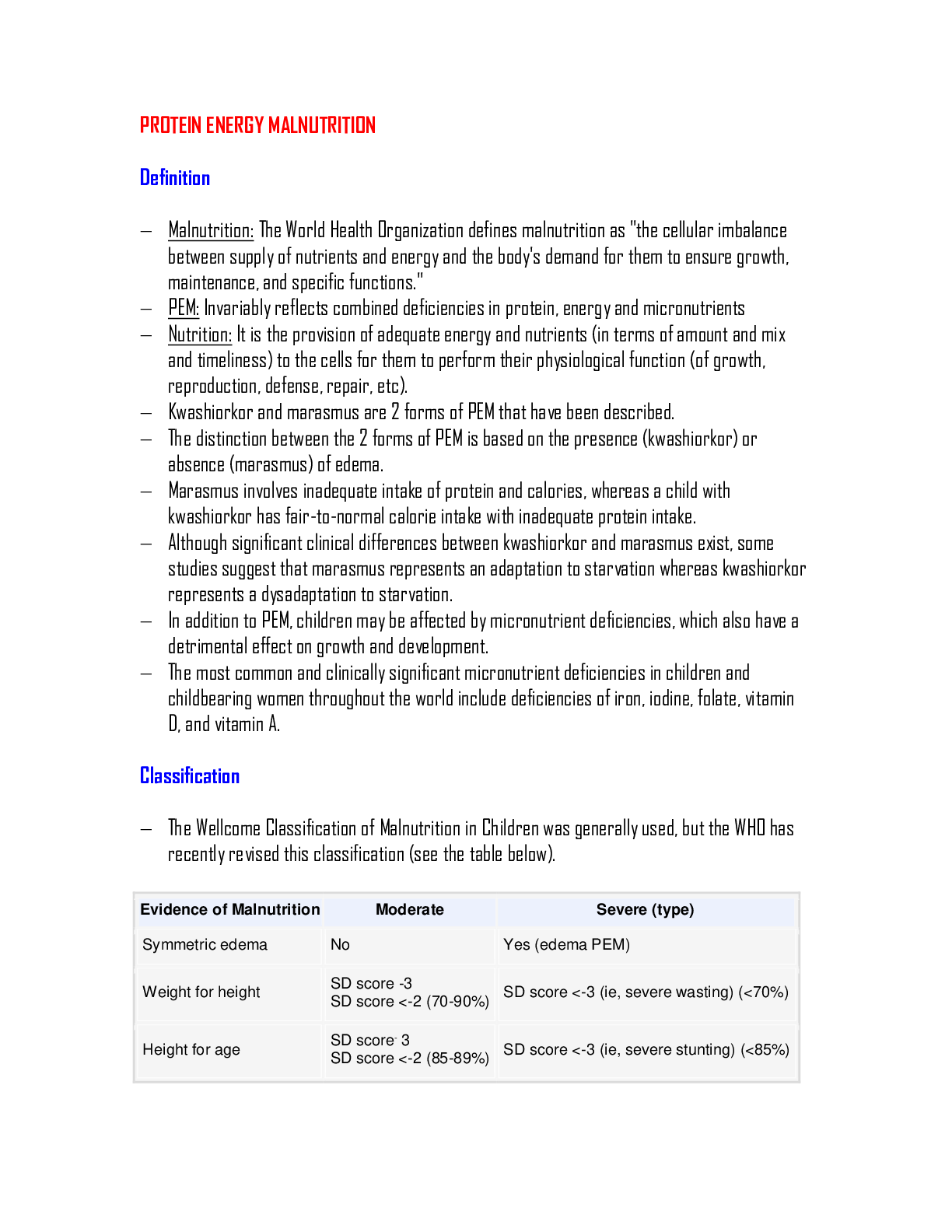
The Wellcome Classification of Malnutrition in Children was generally used, but the WHO has recently revised this classification (see the table below).
Evidence of Malnutrition Moderate Severe (type)
Symmetric edema No Yes (edema PEM)
Weight for height SD score -3
SD score <-2 (70-90%) SD score <-3 (ie, severe wasting) (<70%)
Height for age SD score- 3
SD score <-2 (85-89%) SD score <-3 (ie, severe stunting) (<85%)
The World Health Organization (WHO) developed criteria for the classification of severe malnutrition in children
These criteria are based upon the degree of wasting and the presence of edema
The child's weight for his or her height and the height for his or her age are expressed as Z-scores, calculated as the observed value minus the median value of the reference population divided by the standard deviation of the reference population.
Wasting or stunting is considered severe or moderate if the Z-score for weight-for-height or height-for-age is greater than -3 or between -2 and -3, respectively.
Children with symmetrical edema involving at least the feet are considered to have severe malnutrition.
[Show More]