MULTIPLE CHOICE
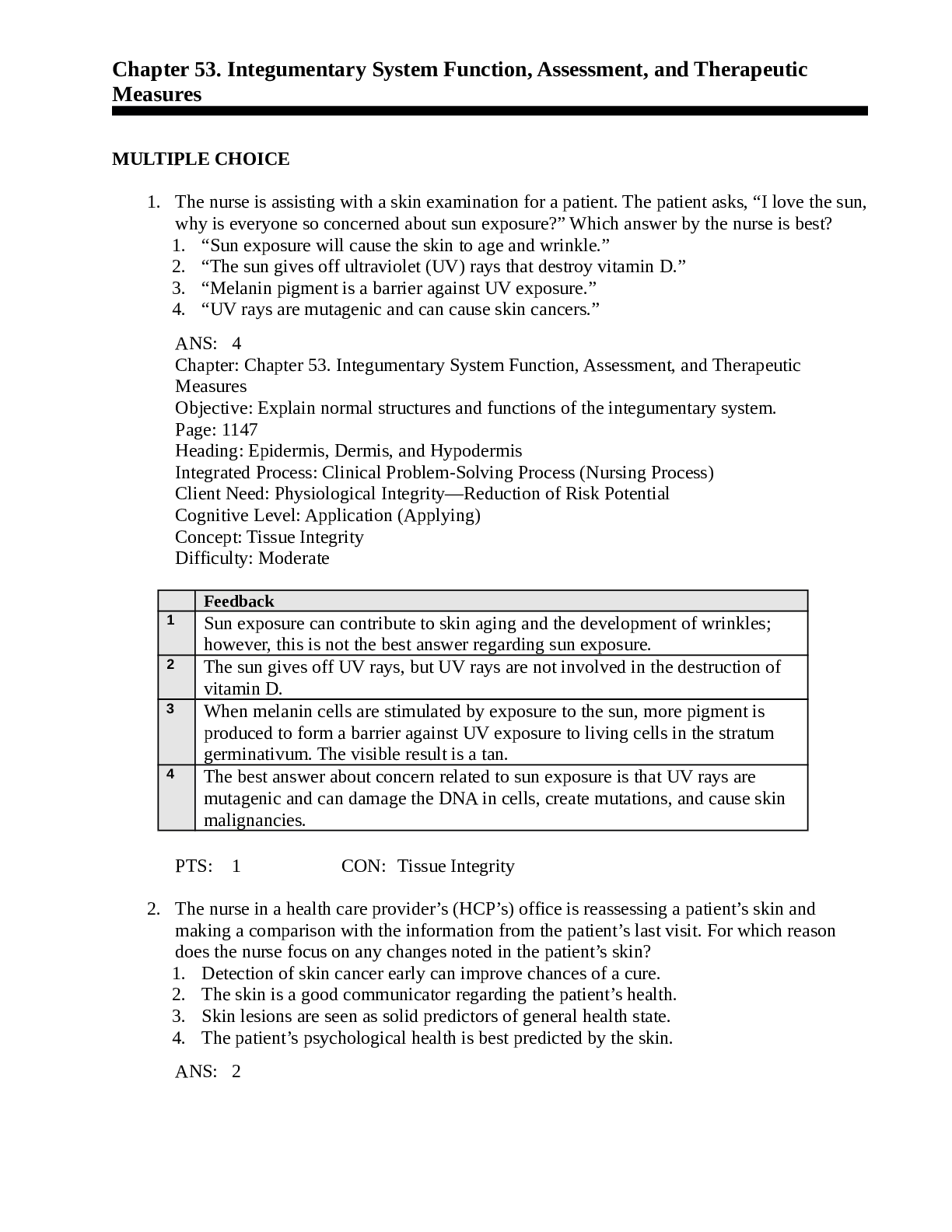
1. The nurse is assisting with a skin examination for a patient. The patient asks, “I love the sun,
why is everyone so concerned about sun exposure?” Which answer by the nurse is best?
1. “Sun exposure
...
MULTIPLE CHOICE
1. The nurse is assisting with a skin examination for a patient. The patient asks, “I love the sun,
why is everyone so concerned about sun exposure?” Which answer by the nurse is best?
1. “Sun exposure will cause the skin to age and wrinkle.”
2. “The sun gives off ultraviolet (UV) rays that destroy vitamin D.”
3. “Melanin pigment is a barrier against UV exposure.”
4. “UV rays are mutagenic and can cause skin cancers.”
ANS: 4
Chapter: Chapter 53. Integumentary System Function, Assessment, and Therapeutic
Measures
Objective: Explain normal structures and functions of the integumentary system.
Page: 1147
Heading: Epidermis, Dermis, and Hypodermis
Integrated Process: Clinical Problem-Solving Process (Nursing Process)
Client Need: Physiological Integrity—Reduction of Risk Potential
Cognitive Level: Application (Applying)
Concept: Tissue Integrity
Difficulty: Moderate
Feedback
1 Sun exposure can contribute to skin aging and the development of wrinkles;
however, this is not the best answer regarding sun exposure.
2 The sun gives off UV rays, but UV rays are not involved in the destruction of
vitamin D.
3 When melanin cells are stimulated by exposure to the sun, more pigment is
produced to form a barrier against UV exposure to living cells in the stratum
germinativum. The visible result is a tan.
4 The best answer about concern related to sun exposure is that UV rays are
mutagenic and can damage the DNA in cells, create mutations, and cause skin
malignancies.
PTS: 1 CON: Tissue Integrity
2. The nurse in a health care provider’s (HCP’s) office is reassessing a patient’s skin and
making a comparison with the information from the patient’s last visit. For which reason
does the nurse focus on any changes noted in the patient’s skin?
1. Detection of skin cancer early can improve chances of a cure.
2. The skin is a good communicator regarding the patient’s health.
3. Skin lesions are seen as solid predictors of general health state.
4. The patient’s psychological health is best predicted by the skin.
ANS: 2Chapter: Chapter 53. Integumentary System Function, Assessment, and Therapeutic
Measures
Objective: List data to collect when caring for a patient with an integumentary system
disorder.
Page: 1148
Heading: Nursing Assessment of the Integumentary System
Integrated Process: Clinical Problem-Solving Process (Nursing Process)
Client Need: Physiological Integrity—Reduction of Risk Potential
Cognitive Level: Analysis (Analyzing)
Concept: Tissue Integrity
Difficulty: Moderate
Feedback
1 Skin cancer can be detected early with regular skin inspections; however, the
nurse’s focus on changes is not just related to skin cancer.
2 The nurse knows the condition of the skin can be caused by underlying
systemic conditions or manifestations of issues just related to the skin. Both
situations make it important for the nurse to focus on changes from the last
examination.
3 Skin lesions are not solid predictors of a patient’s general health issues. Some
skin lesions are just indications of skin problems.
4 Psychological stress can contribute to a patient’s skin condition; however, this
connection varies among individuals.
PTS: 1 CON: Tissue Integrity
3. The nurse is preparing to reexamine the skin of a patient who has a history of malignant skin
growths. Which preparation by the nurse is incorrect?
1. Allow the patient to leave on underwear and socks.
2. Plan to use the techniques of inspection and palpation.
3. Include the hair, nails, scalp, and mucous membranes.
4. Explain the need for a penlight and magnifying glass.
ANS: 1
Chapter: Chapter 53. Integumentary System Function, Assessment, and Therapeutic
Measures
Objective: List data to collect when caring for a patient with an integumentary system
disorder.
Page: 1149
Heading: Physical Examination
[Show More]