CHAPTER 53 - FEMALE REPRODUCTIVE
PROBLEMS EXAM REVIEW LATEST UPDATE 2022
A patient is scheduled for an induced abortion using instillation of hypertonic saline
solution. Which information will the nurse plan to disc
...
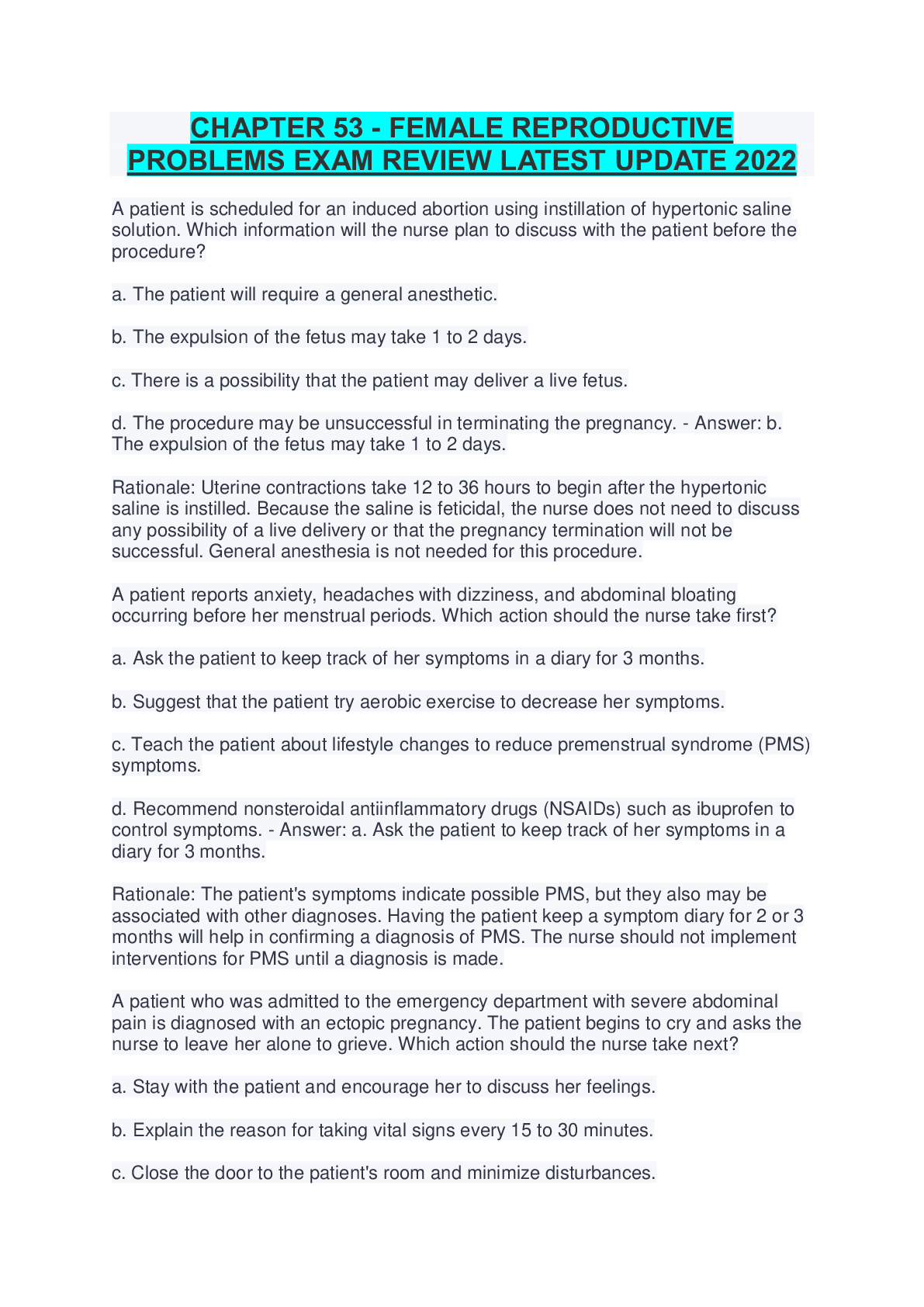
CHAPTER 53 - FEMALE REPRODUCTIVE
PROBLEMS EXAM REVIEW LATEST UPDATE 2022
A patient is scheduled for an induced abortion using instillation of hypertonic saline
solution. Which information will the nurse plan to discuss with the patient before the
procedure?
a. The patient will require a general anesthetic.
b. The expulsion of the fetus may take 1 to 2 days.
c. There is a possibility that the patient may deliver a live fetus.
d. The procedure may be unsuccessful in terminating the pregnancy. - Answer: b.
The expulsion of the fetus may take 1 to 2 days.
Rationale: Uterine contractions take 12 to 36 hours to begin after the hypertonic
saline is instilled. Because the saline is feticidal, the nurse does not need to discuss
any possibility of a live delivery or that the pregnancy termination will not be
successful. General anesthesia is not needed for this procedure.
A patient reports anxiety, headaches with dizziness, and abdominal bloating
occurring before her menstrual periods. Which action should the nurse take first?
a. Ask the patient to keep track of her symptoms in a diary for 3 months.
b. Suggest that the patient try aerobic exercise to decrease her symptoms.
c. Teach the patient about lifestyle changes to reduce premenstrual syndrome (PMS)
symptoms.
d. Recommend nonsteroidal antiinflammatory drugs (NSAIDs) such as ibuprofen to
control symptoms. - Answer: a. Ask the patient to keep track of her symptoms in a
diary for 3 months.
Rationale: The patient's symptoms indicate possible PMS, but they also may be
associated with other diagnoses. Having the patient keep a symptom diary for 2 or 3
months will help in confirming a diagnosis of PMS. The nurse should not implement
interventions for PMS until a diagnosis is made.
A patient who was admitted to the emergency department with severe abdominal
pain is diagnosed with an ectopic pregnancy. The patient begins to cry and asks the
nurse to leave her alone to grieve. Which action should the nurse take next?
a. Stay with the patient and encourage her to discuss her feelings.
b. Explain the reason for taking vital signs every 15 to 30 minutes.
c. Close the door to the patient's room and minimize disturbances.
d. Provide teaching about options for termination of the pregnancy. - Answer: b.
Explain the reason for taking vital signs every 15 to 30 minutes.
Rationale: Because the patient is at risk for rupture of the fallopian tube and
hemorrhage, frequent monitoring of vital signs is needed. The patient has asked to
be left alone, so staying with her and encouraging her to discuss her feelings are
inappropriate actions. Minimizing contact with her and closing the door of the room is
unsafe because of the risk for hemorrhage. Because the patient has requested time
to grieve, it would be inappropriate to provide teaching about options for pregnancy
termination.
A patient is considering the use of combined estrogen-progesterone hormone
replacement therapy (HRT) during menopause. Which information will the nurse
include during their discussion?
a. Use of estrogen-containing vaginal creams provides the same benefits as oral
HRT.
b. Increased risk of colon cancer in women taking HRT requires frequent
colonoscopy.
c. HRT decreases osteoporosis risk and increases the risk for cardiovascular
disease and breast cancer.
d. Use of HRT for up to 10 years to prevent symptoms such as hot flashes is
generally considered safe. - Answer: c. HRT decreases osteoporosis risk and
increases the risk for cardiovascular disease and breast cancer.
Rationale: Data from the Women's Health Initiative indicate an increased risk for
cardiovascular disease and breast cancer in women taking combination HRT but a
decrease in hip fractures. Vaginal creams decrease symptoms related to vaginal
atrophy and dryness, but they do not offer the other benefits of HRT, such as
decreased hot flashes. Most women who use HRT are placed on short-term
treatment and are not treated for up to 10 years. The incidence of colon cancer
decreases in women taking HRT.
Which statement by the patient indicates that the nurse's teaching about treating
vaginal candidiasis was effective?
a. "I will tell my partner that we cannot have intercourse for a month."
b. "I should clean carefully after each urination and bowel movement."
c. "I can douche with warm water if the itching continues to bother me."
d. "I will insert the antifungal cream right before I get up in the morning." - Answer: b.
"I should clean carefully after each urination and bowel movement."
Rationale: Cleaning of the perineal area will decrease itching caused by contact of
the irritated tissues with urine and reduce the chance of further infection of irritated
tissues by bacteria in the stool. Sexual intercourse should be avoided for 1 week.
Douching will disrupt normal protective mechanisms in the vagina. The cream should
be used at night so that it will remain in the vagina for longer periods of time.
The nurse is caring for a patient with pelvic inflammatory disease (PID) requiring
hospitalization. Which nursing intervention will be included in the plan of care?
a. Monitor liver function tests.
b. Use cold packs PRN for pelvic pain.
c. Elevate the head of the bed at least 30 degrees.
d. Teach the patient how to perform Kegel exercises. - Answer: c. Elevate the head
of the bed at least 30 degrees.
Rationale: The head of the bed should be elevated to at least 30 degrees to promote
drainage of the pelvic cavity and prevent abscess formation higher in the abdomen.
Although a possible complication of PID is acute perihepatitis, liver function test
results will remain normal. There is no indication for increased fluid intake.
Application of heat is used to reduce pain. Kegel exercises are not helpful in PID.
A 32-yr-old patient has oral contraceptives prescribed for endometriosis. What
instruction should the nurse give this patient?
a. Expect to experience side effects such as facial hair.
b. Take the medication every day for the next 9 months.
c. Take calcium supplements to prevent developing osteoporosis during therapy.
d. Use a second method of contraception to ensure that she will not become
pregnant. - Answer: b. Take the medication every day for the next 9 months.
Rationale: When oral contraceptives are prescribed to treat endometriosis, the
patient should take the medications continuously for 9 months. Facial hair is a side
effect of synthetic androgens. The patient does not need to use additional
contraceptive methods. The hormones in oral contraceptives will protect against
osteoporosis.
A patient with endometriosis asks why she is being treated with a contraceptive.
What information should the nurse explain about this therapy?
a. It suppresses the menstrual cycle by mimicking pregnancy.
b. It relieves symptoms such as vaginal atrophy and hot flashes.
c. It prevents a pregnancy that could worsen the menstrual bleeding.
d. It leads to permanent suppression of abnormal endometrial tissues. - Answer: a. It
suppresses the menstrual cycle by mimicking pregnancy.
Rationale: Medroxyprogesterone induces a pseudopregnancy, which suppresses
ovulation and causes shrinkage of endometrial tissue. Menstrual bleeding does not
occur during pregnancy. Vaginal atrophy and hot flashes are caused by synthetic
androgens such as danazol or gonadotropin-releasing hormone agonists such as
leuprolide. Although hormonal therapies will control endometriosis while the therapy
is used, endometriosis will recur once the menstrual cycle is reestablished.
A 56-yr-old patient is concerned about having a moderate amount of vaginal
bleeding after 5 years of menopause. What topic should the nurse plan to discuss
with this patient?
a. Endometrial biopsy.
b. Endometrial ablation.
c. Uterine balloon therapy.
d. Dilation and curettage (D&C). - Answer: a. Endometrial biopsy.
Rationale: A postmenopausal woman with vaginal bleeding should be evaluated for
endometrial cancer, and endometrial biopsy is the primary test for endometrial
cancer. D&C will be needed only if the biopsy does not provide sufficient information
to make a diagnosis. Endometrial ablation and balloon therapy are used to treat
menorrhagia, which is unlikely in this patient.
Which patient in the women's health clinic will the nurse expect to teach about an
endometrial biopsy?
a. A 55-yr-old patient who has 3 to 4 alcoholic drinks each day.
b. A 35-yr-old patient who has used oral contraceptives for 15 years.
c. A 25-yr-old patient who has a family history of hereditary nonpolyposis colorectal
cancer.
d. A 45-yr-old patient who has had six previous full-term pregnancies and two
spontaneous abortions. - Answer: c. A 25-yr-old patient who has a family history of
hereditary nonpolyposis colorectal cancer.
Rationale: Patients with a personal or familial history of hereditary nonpolyposis
colorectal cancer are at increased risk for endometrial cancer. Alcohol use does not
increase this risk. Multiple pregnancies and oral contraceptive use offer protection
from endometrial cancer.
What topic should the nurse plan to discuss with a patient who has been diagnosed
with stage 0 cervical cancer?
a. Radiation
b. Conization
c. Chemotherapy
d. Radical hysterectomy - Answer: b. Conization
Rationale: Because the carcinoma is in situ, conization can be used for treatment.
Radical hysterectomy, chemotherapy, or radiation will not be needed.
A 31-yr-old patient who has been diagnosed with human papillomavirus (HPV)
infection gives a health history that includes smoking tobacco, taking oral
contraceptives, and having been treated twice for vaginal candidiasis. Which topic
will the nurse include in patient teaching?
a. Use of water-soluble lubricants.
b. Risk factors for cervical cancer.
c. Antifungal cream administration.
d. Possible difficulties with conception. - Answer: b. Risk factors for cervical cancer.
Rationale: Because HPV infection and smoking are both associated with increased
cervical cancer risk, the nurse should emphasize the importance of avoiding
smoking. An HPV infection does not decrease vaginal lubrication, decrease the
ability to conceive, or require the use of antifungal creams.
A patient is on the surgical unit after a total abdominal hysterectomy. Which finding
requires contacting the health care provider?...
[Show More]

.png)