FIN 494 Final Exam Prepared_2020
@3,4,6 10check 15
Exchange rate is currently $0.7 US per 1 Canadian Dollar. Interest rate is 2% in the US and 1% in Canada. A bank is short a futures contract on 1,000,000 Canadian
...
FIN 494 Final Exam Prepared_2020
@3,4,6 10check 15
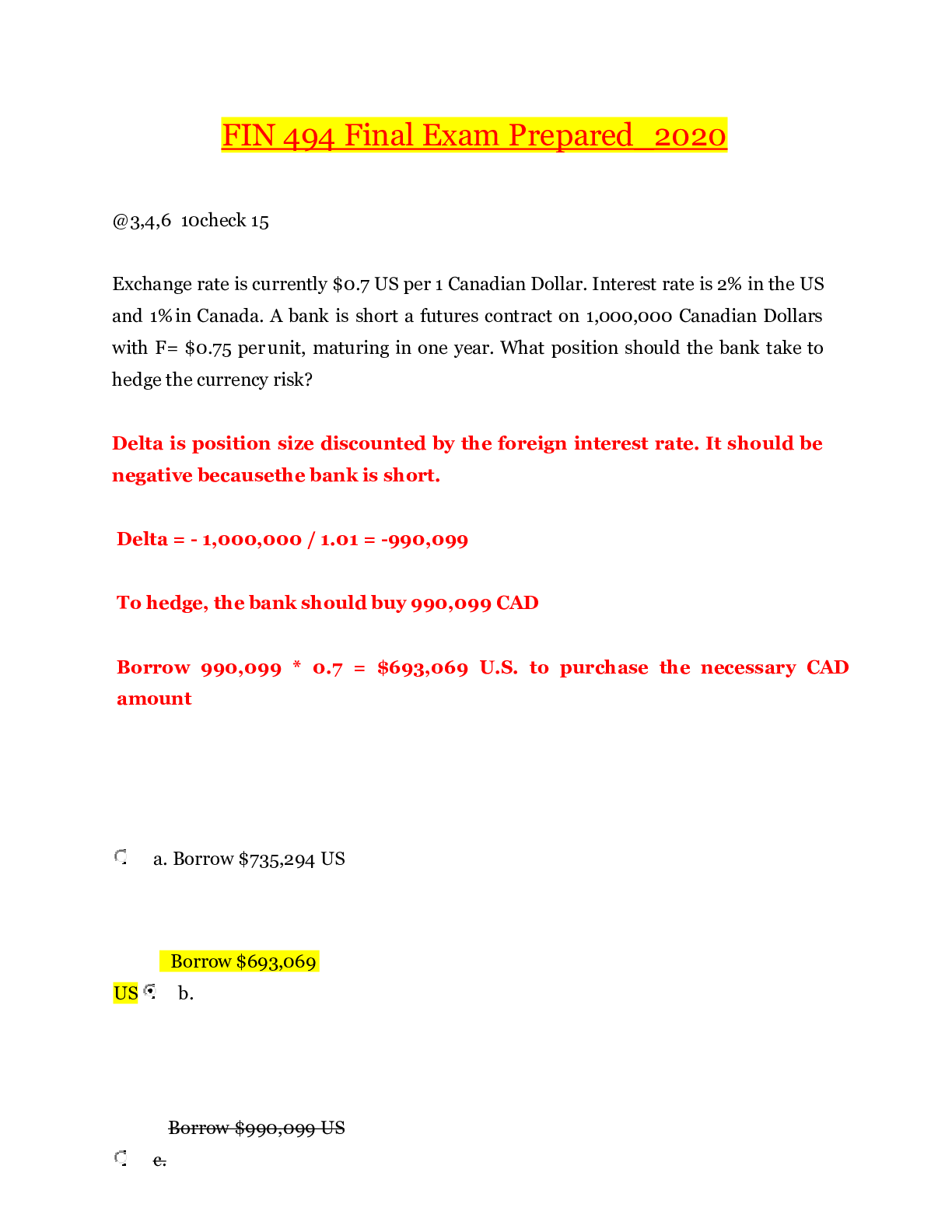
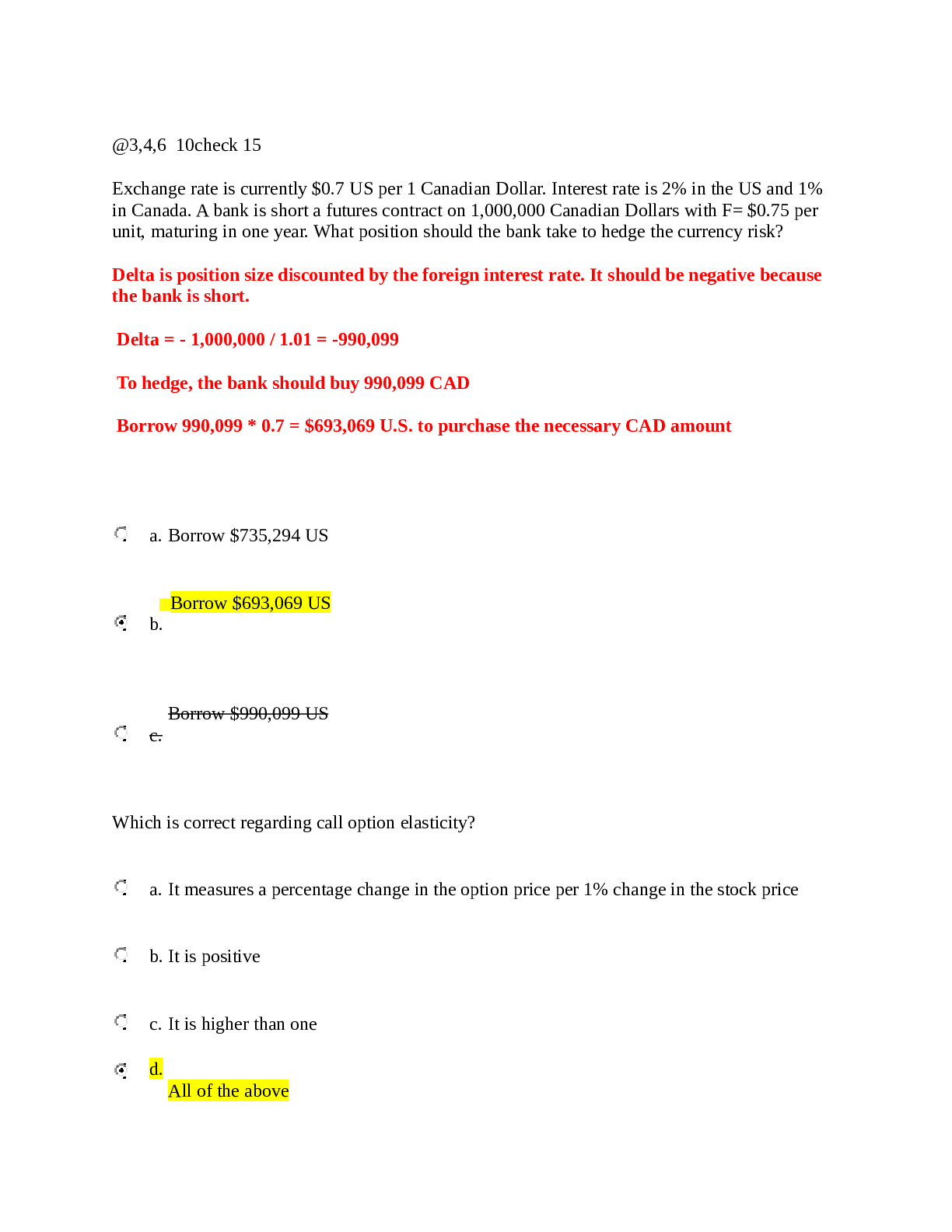
Exchange rate is currently $0.7 US per 1 Canadian Dollar. Interest rate is 2% in the US and 1% in Canada. A bank is short a futures contract on 1,000,000 Canadian Dollars with F= $0.75 per unit, maturing in one year. What position should the bank take to hedge the currency risk?
Delta is position size discounted by the foreign interest rate. It should be negative because the bank is short.
Delta = - 1,000,000 / 1.01 = -990,099
To hedge, the bank should buy 990,099 CAD
Borrow 990,099 * 0.7 = $693,069 U.S. to purchase the necessary CAD amount
a. Borrow $735,294 US
Borrow $693,069 US b.
Borrow $990,099 US
c.
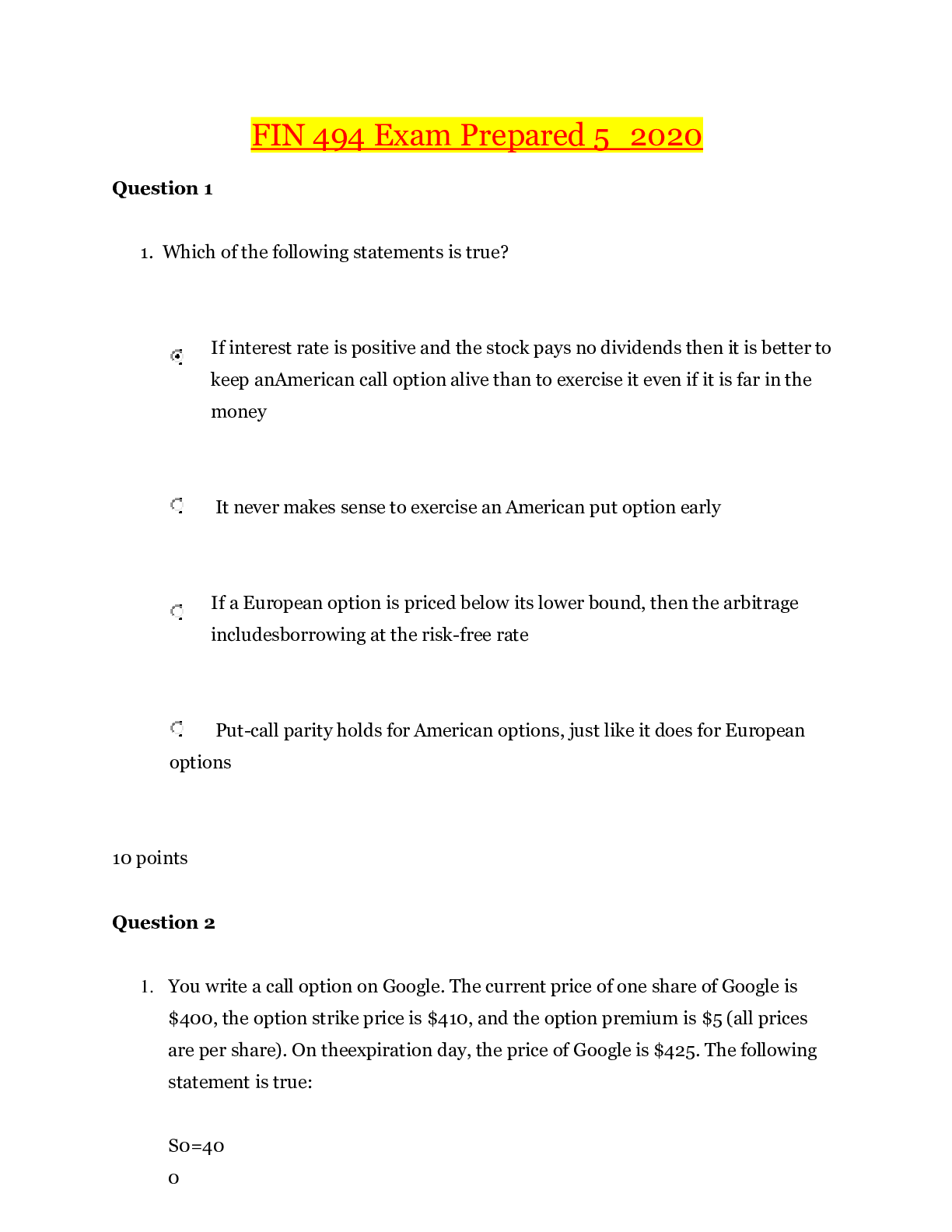
Which is correct regarding call option elasticity?
a. It measures a percentage change in the option price per 1% change in the stock price
b. It is positive
c. It is higher than one
d.
All of the above
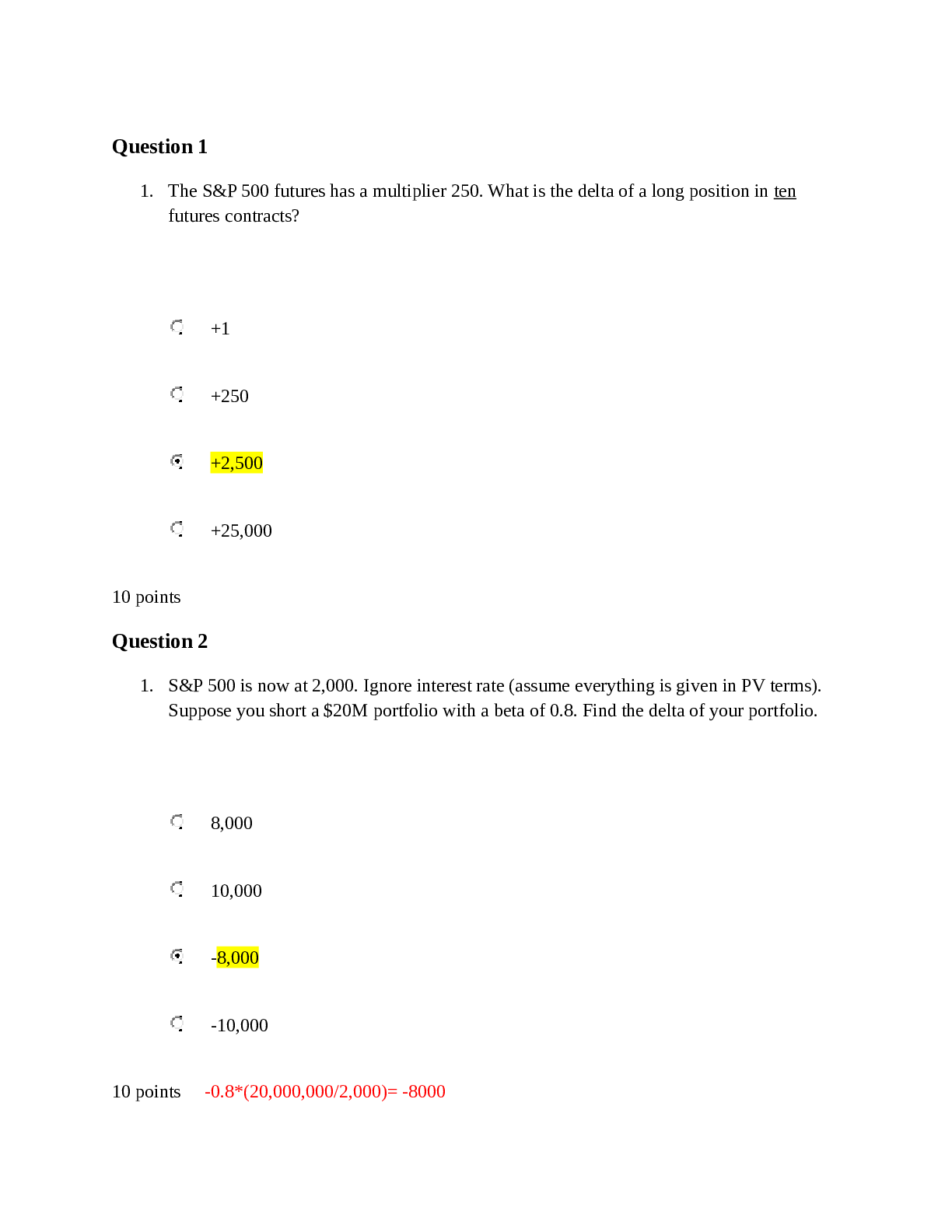
Delta of a contract is +1 and gamma is 0. Which type of contract is this?
Futures is a linear contract, it has gamma of zero. A call and a put are non-linear contracts, they cannot have zero gamma.
a. A futures contract
b. A put option
c. A call option
Exchange rate is currently $0.7 US per 1 Canadian dollar. Interest rate is 2% in the US and 1% in Canada. A company has entered a futures contract to buy 1,000,000 Canadian dollars for
$710,000 U.S. in one year. Which of the following statements is correct? Expected future exchange rate is found from interest rate parity 0.7*(1.02)/(1.01) = 0.706931
For 1,000,000 that’s $706,931
The company is buying for more than that.
a. The company has contracted to buy Canadian dollars at the expected future exchange rate
The company has contracted to buy Canadian dollars above the expected future
b. exchange rate
c.
The company has contracted to buy Canadian dollars below the expected future exchange
rate
Delta of a call option is 0.85. Stock price is currently $50. How much money do you need to borrow to hedge a short position in 200 call contracts (each contract is for 100 shares of stock), provided that you finance the hedge entirely with borrowed funds?
Delta of option position = 0.85*200*100 = 17,000 Need to buy 17,000 shares of stock to hedge.
17,000 * $50 = $850,000
a. 1,000,000
b. 850,000
c. 500,000
d. 950,000
Discount factor is 0.985. Stock XYZ is selling for $40 a share. A European option on this stock with a strike price of $38 is trading at $0.50 per share. If it is known that this option is priced above its intrinsic value, what type of option is it?
The intrinsic value for American call is S – X if the call is in the money, zero otherwise. The intrinsic value for American put is X – S if the put is in the money, zero otherwise. S – X = 40 – 38 = 2, therefore the call should be priced above $2
The put is out of the money; therefore, the put should be worth > 0
Given that this option is priced at $.50 and we are given that it is priced above its intrinsic value, it ought to be a put.
a.
A call
b. A put
The is a higher bound of the price of an American call option.
a. Strike price
b. Present value of strike price
c. Stock price
d. Intrinsic value= lower bound
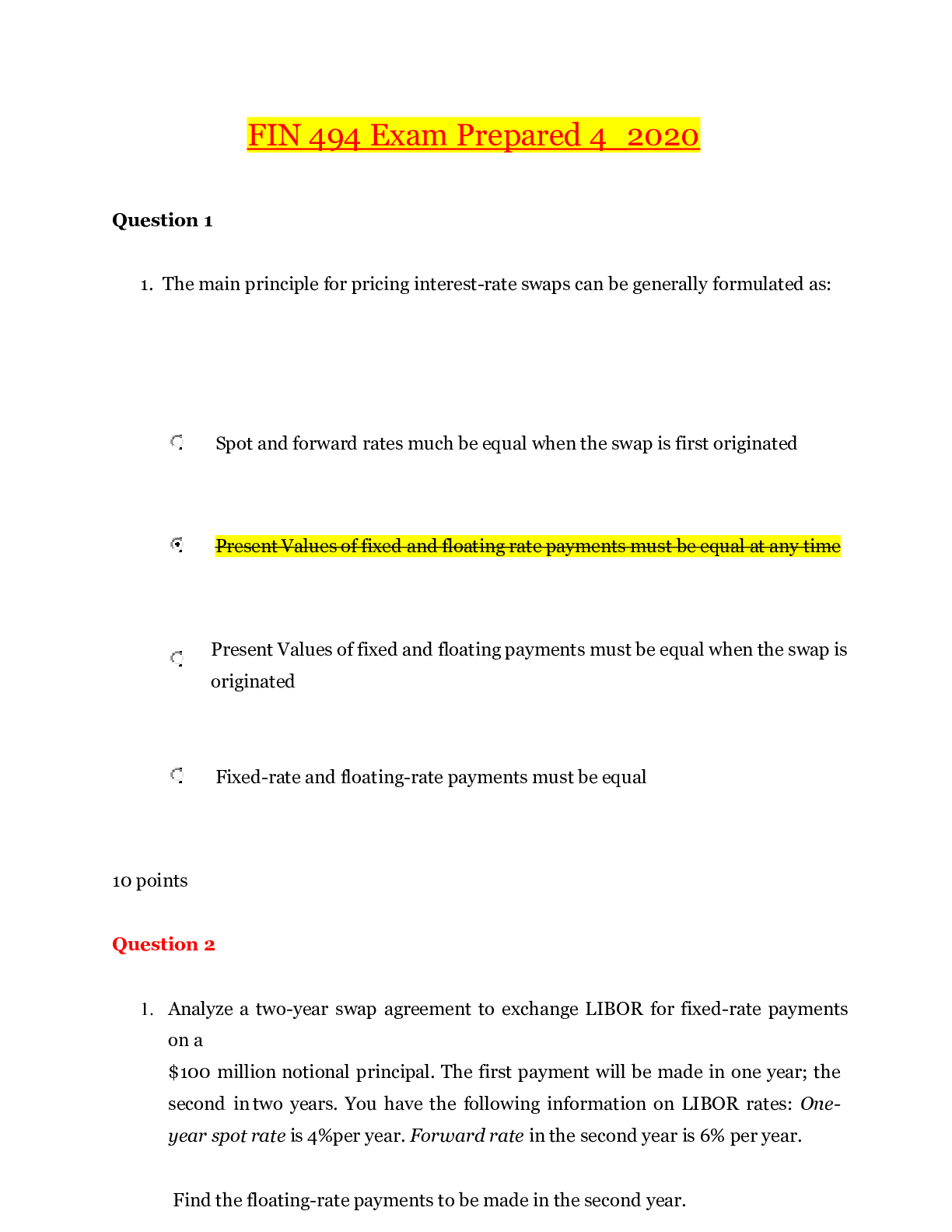
You sell a two-year interest rate swap with annual payments and notional principal of $100 million. At the time you enter the contact, one-year spot rate is 3% and the two-year spot rate is 5.5%. Forward rate for the second year is 8.1%. Find the way to calculate the present value of the floating-rate payments
The second payment is found using forward rate, 100*0.081 = 8.1 million
The discounting is done using the two-year spot rate of 5.5%. Need to square it because we are discounting back two years.
Alternatively, we could write
$3/1.03 + $8.1/[(1.081)(1.03)]
That would give the same result because (1.055)2 = (1.081)(1.03) from the definition of forward rate.
a. $3/1.03 + $8.1/(1.055)2
b. $3/1.03 + $5.5/(1.081)
c.
$3/1.03 + $8.1/(1.081)2
d. $3/1.03 + $5.5/(1.055)
Which of the following strategies protects the consumer of a commodity from a possible price increase?
A long call increases in value if the commodity price increases. The gain on the long call position will offset the loss on the short commodity position that the consumer has physically.
a. Short put
b. Long put
c. Short call
d. Long call
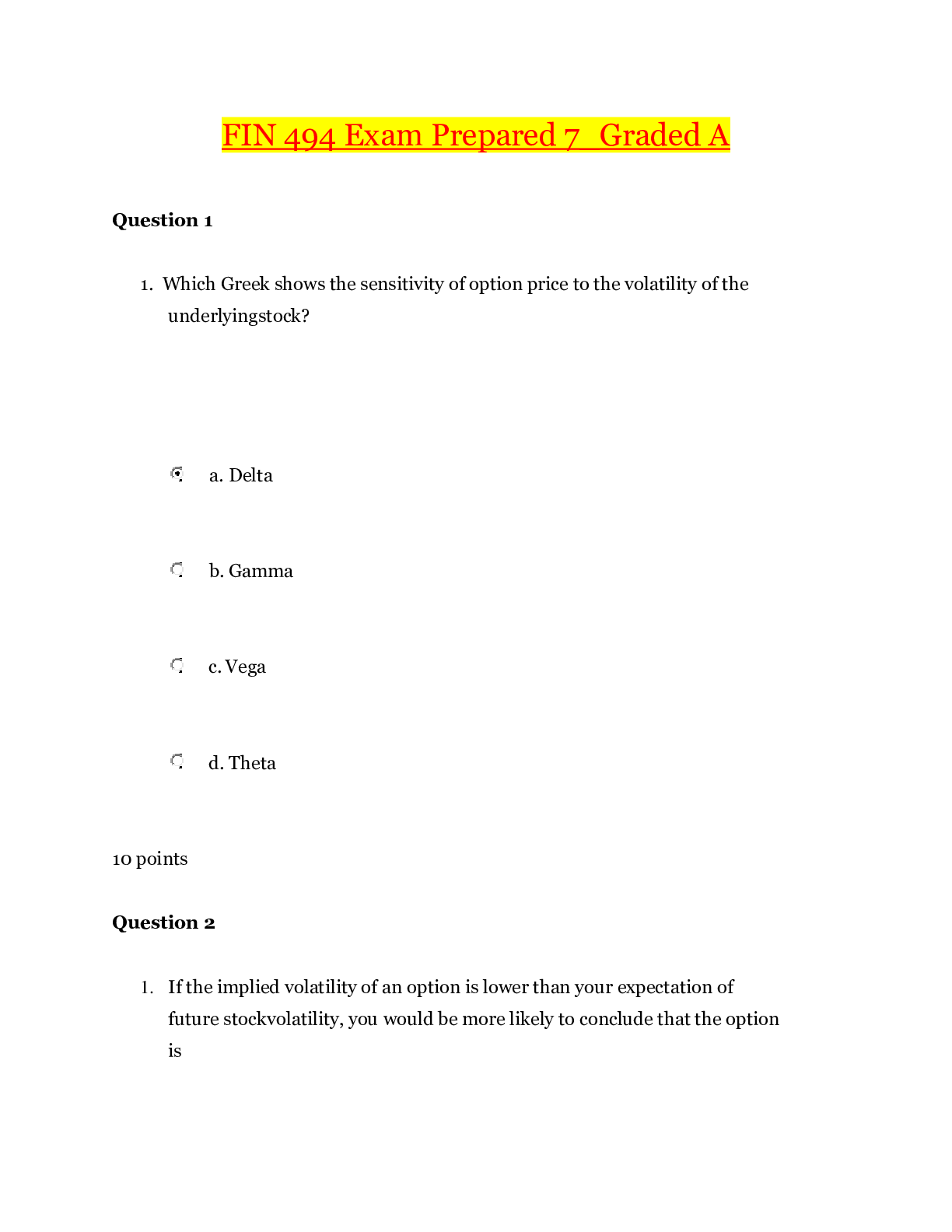
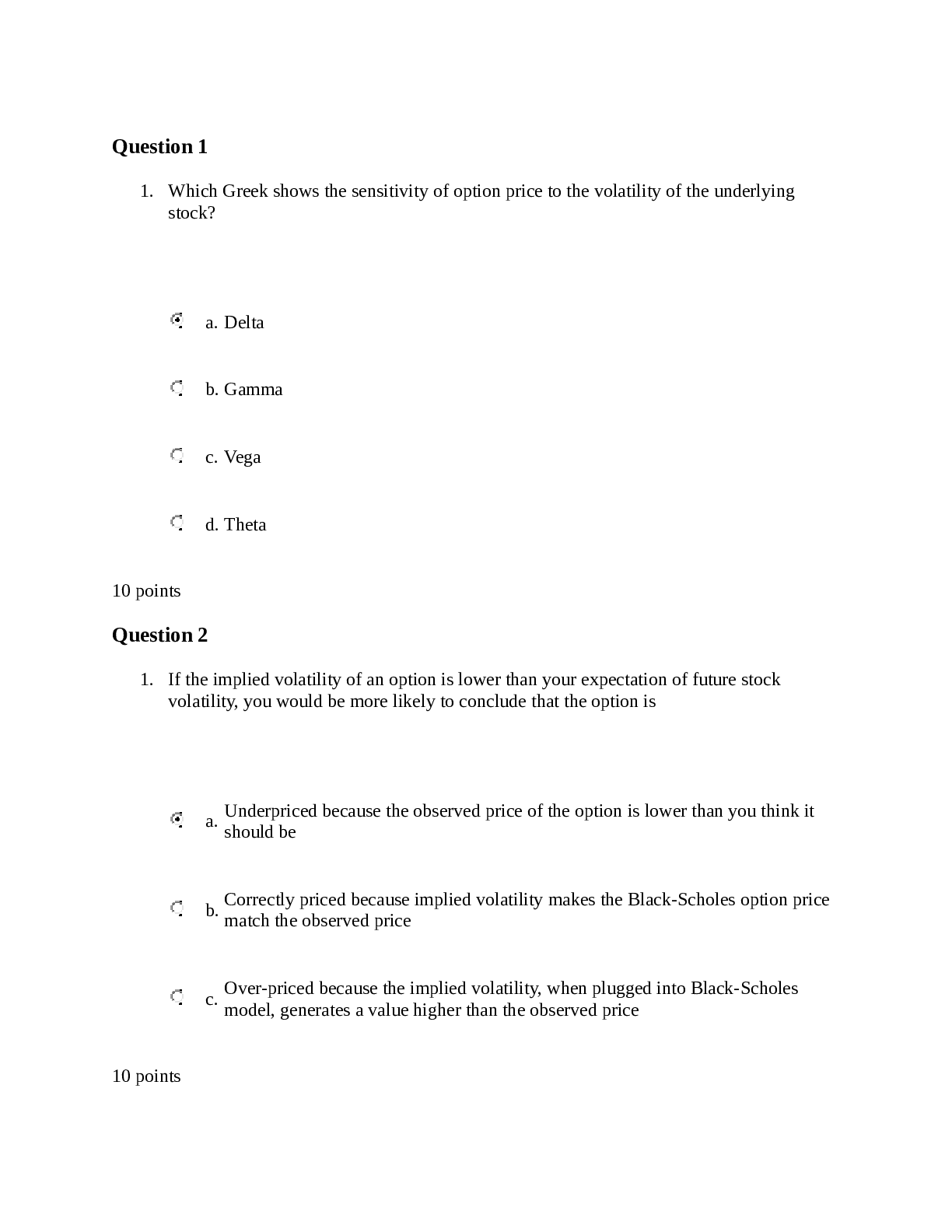
Which of the Greeks measures the sensitivity of option price to the interest rate? Rho meaures sensitivity of option price to interest rates
Delta measures sensitivity of option price to price in underlying asset Gamma measures sensitivity with respect to delta
a. vega
b. theta
c. gamma
d. rho
For a call option, which of the following statements is INCORRECT?
Volatility cannot be negative. Rho is positive because when interest rate increases, the value of a call option increases. Gamma and delta of a call option are both positive as well.
a. Gamma is positive
b. Pho is positive
c. Implied volatility is negative
d. Delta is positive
Which of the following is NOT one of the assumptions of the Black-Scholes model?
a. There are no jumps in the stock price
b. There are no transaction costs
c. Time is continuous
d. Volatility of the stock is normally distributed
Volatility smile is a relationship between:
a. Option's delta and the underlying stock price
b. Past volatility of the underlying stock and the option's time to expiration
c. Implied volatility of the option and the option's delta
d. Implied volatility of the option and the option's strike price
[Show More]