FIN 494 Exam Prepared 5_2020
Question 1
1. Which of the following statements is true?
If interest rate is positive and the stock pays no dividends then it is better to keep an American call option alive than to
...
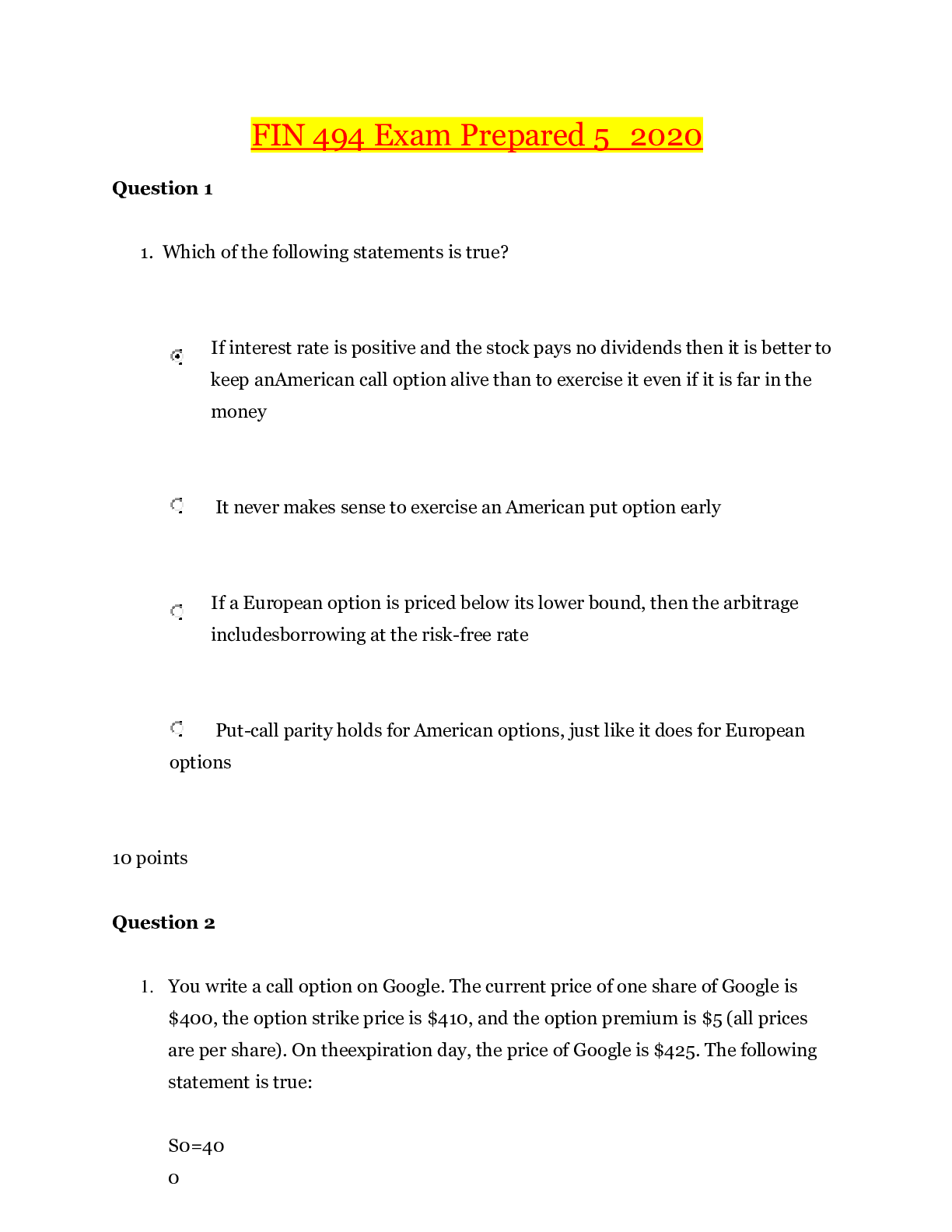
FIN 494 Exam Prepared 5_2020
Question 1
1. Which of the following statements is true?
If interest rate is positive and the stock pays no dividends then it is better to keep an American call option alive than to exercise it even if it is far in the money
It never makes sense to exercise an American put option early
If a European option is priced below its lower bound, then the arbitrage includes borrowing at the risk-free rate
Put-call parity holds for American options, just like it does for European options
10 points
Question 2
1. You write a call option on Google. The current price of one share of Google is $400, the option strike price is $410, and the option premium is $5 (all prices are per share). On the expiration day, the price of Google is $425. The following statement is true:
S0=400 X=410 ST=425 C=5
Write= -(St-X) -(425-410)= -15
The call is in the money
Your payoff is negative
Your payoff is positive and equal to 10
A and B
A and C
10 points
Question 3
1. Given the following data as of the close of trading on 10/26/18:
Quest Diagnostics (DGX): 91.47
Options on DGX: American, expire January 18, 2019
c
X
p
23.7
70
105
14.2
Which of the options in the table above is priced above its lower bound?
Neither option
The call
The put
Both options
10 points We can see that all the options are above their lower bound.
Part (b) : Now if the 80 strike option is going at 11 and as per our calculations, the lower bound should be 11.88 - hence we can profit from arbitrage as below:
• We purchase the option for 11 and if we exercise it immediately, we would receive = 91.47 - 80 = 11.47
• Since we purchased the option for 11, there is a risk free profit of 0.47 which is the arbtrage profit
Question 4
1. Given the following information on the available options, you need to hedge the underlying commodity as a producer with a zero-cost collar. A zero-cost collar means buying a put option and writing a call option that has the closest premium to the put. The underlying price is $630. You choose a one-year put option with $620 strike.
Jan- 21-
64 Expire Strike Call Put
PV
Jan-21-
630 65 500 158.4511 25.58539
630 Jan-21-
65
530
138.3005
35.22183
630
Jan-21- 65
560
120.0379
46.75599
630
Jan-21- 65
590
103.6494
60.17585
630
Jan-21- 65
620
89.07566
75.42293
630
Jan-21- 65
650
76.22209
92.40239
630
Jan-21- 65
680
64.96979
110.9945
630
Jan-21- 65
710
55.18534
131.0646
630
Jan-21- 65
740
46.72803
152.4702
630
Jan-21- 65
770
39.45681
175.0686
What is the strike of the call option that you need to write to create a nearly zero-cost collar?
650
680
710
740
10 points
Question 5
1. Which of the following strategies yields positive profits when the stock price is low but not when the stock price is high?
bearish spread
bullish spread
straddle
protective put
10 points A bear spread is an options strategy implemented by an investor who is mildly bearish and wants to maximize profit while minimizing losses. The goal is to net the investor a profit when the price of the underlying security declines
Question 6
1. One year ago, you wrote a put option with strike price $30 and one year to expiration. Option premium was $12. Ignore the interest rate. Today is the expiration day, and you still have an open short position in the put. The underlying stock is trading at $42. Your profit is
Zero. You just broke even.
18
42
12
10 points The option will not be exercised since the strike price is lower than the market price Profit is equal to premium received
Question 7
1. Which of the following strategies pays off when the volatility is expected to be low?
Long straddle
Short straddle
Bullish spread
Bearish spread
10 points A short straddle is an option where trader sell both call and put option with same strike price and expiration date.It is used when trader believes that share will not move much i.e. vloatility will be lower.
So Short straddle is correct option here.
Question 8 (wrong)
1. S&P 500 Index is at 2780. A European June 21, 2020 SPX call option struck at 2500 is trading at $316.94. An identical put is trading at $55.15. A T-bill with 200 days to maturity is quoted at a yield of 2.46. Which of the following positions would be included in the arbitrage strategy?
Buy the stock
Write the put
Borrow at the risk-free rate
Write the call
10 points
Question 9
1. Given the following data as of the close of trading on 10/26/18:
Quest Diagnostics (DGX): 91.47
T-bill: Asked 2.28, Days to Maturity 84
A call option maturing on the same day as the T-bill and struck at $80 trades at a premium of $11.00
What is the minimum profit from the following arbitrage strategy? Find the nearest answer.
[Show More]