Return to Assessment List
Part 1 of 1 - 100.0 Points
Question 1 of 20
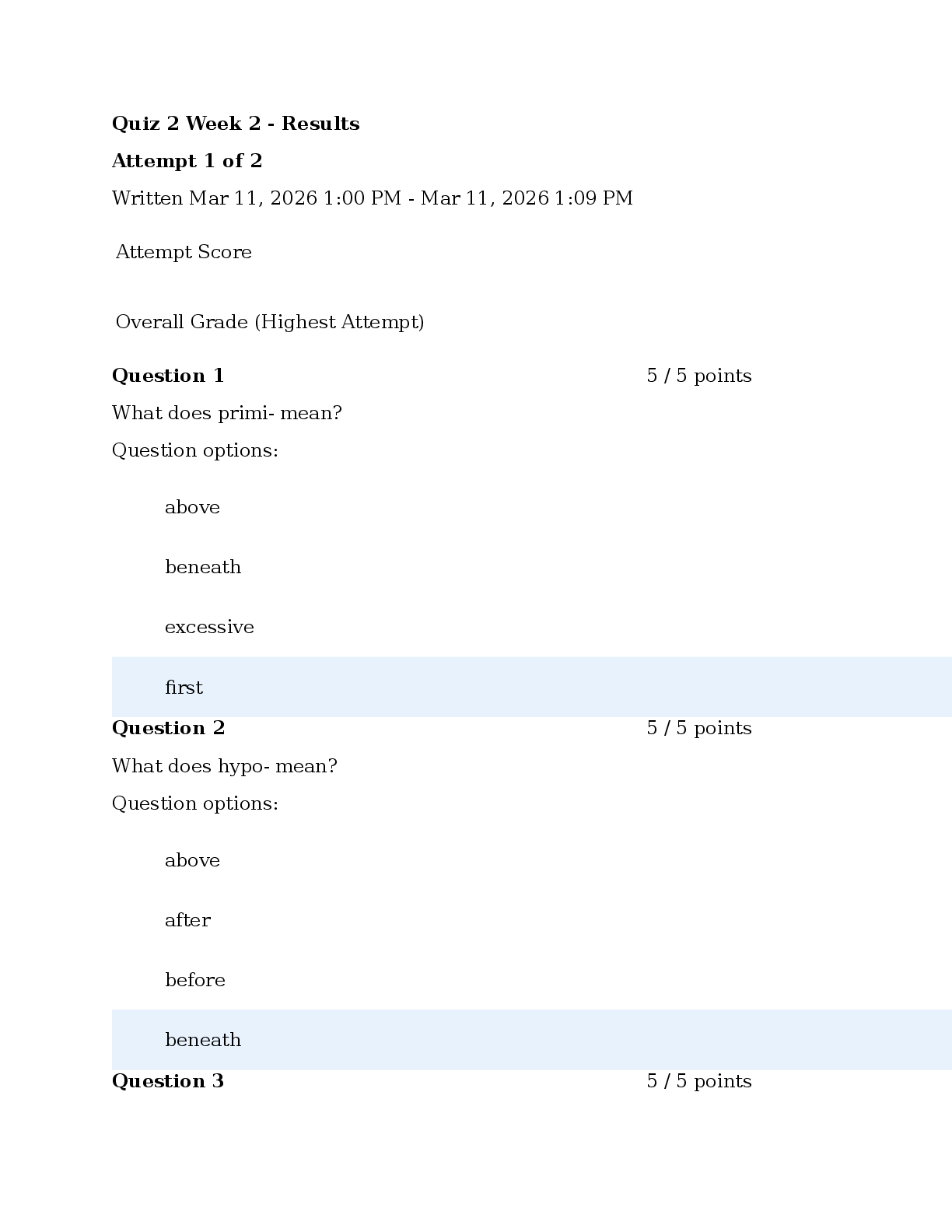
What does primi- mean?
5.0 Points
A. above
B. beneath
C. excessive
D. first
Question 2 of 20
Wh
...
Return to Assessment List
Part 1 of 1 - 100.0 Points
Question 1 of 20
What does primi- mean?
5.0 Points
A. above
B. beneath
C. excessive
D. first
Question 2 of 20
What does hypo- mean?
5.0 Points
A. above
B. after
C. before
D. beneath
Question 3 of 20
What does ante- mean?
5.0 Points
A. against
B. before
C. favoring
D. more than normal
Question 4 of 20
What does semi- mean?
5.0 Points
A. beneath or below normal
B. excessive
C. half or partly
D. same
Question 5 of 20
What does centi- mean?
5.0 Points
A. 1 cent
B. 100 or 1/100
C. 1000 grams
D. 1/1000
Question 6 of 20
Which term means absence of water?
5.0 Points
A. anesthetic
B. anhydrous
C. esthetic
D. hydrous
Question 7 of 20
Which term means located between cells?
5.0 Points
A. cellular
B. extracellular
C. intercellular
D. intracellular
Question 8 of 20
Which term describes a membrane that allows the passage of some substances but prevents the passage 5.0 Points of others?
A. contraceptive
B. ipsilateral
C. semipermeable
D. transdermal
Question 9 of 20
Which of the following structures is more complex?
5.0 Points
A. cell
B. organ
C. organelle
D. tissue
Question 10 of 20
Which of the following have the ability to divide without limit and give rise to specialized cells?
5.0 Points
A. molecules
B. organelles
C. stem cells
D. viscera
Question 11 of 20
Which of the following are threadlike structures within the nucleus that contain DNA?
5.0 Points
A. chromosomes
B. deoxyribonucleic acid
C. epithelia
D. phalanges
Question 12 of 20
What is another name for a dactylogram?
5.0 Points
A. an encephalogram
B. a fingerprint
C. a brain disorder
D. a diagnostic blood test
Question 13 of 20
Which term means an excess of blood in part of the body caused by increased blood flow?
5.0 Points
A. hyperemia
B. macrocytosis
C. phagocytosis
D. thrombosis
Question 14 of 20
Which of the following means having no tendency to repair itself or develop into new tissue?
5.0 Points
A. alytic
B. analytic
C. aplastic
D. anplastic
Question 15 of 20
Which of the following is true of leukocytosis?
5.0 Points
A. It is the same as leukemia.
B. It is an increase in the number of leukocytes.
C. It is usually associated with anemia.
D. It is characterized by a deficiency of hemoglobin.
[Show More]