Information Technology > QUESTIONS & ANSWERS > University of Maryland, Baltimore County - IS 733assign4 (All)
University of Maryland, Baltimore County - IS 733assign4
Document Content and Description Below
Last updated: 4 years ago
Preview 1 out of 8 pages
Instant download
Buy this Document to get the Full Access Instantly
Provided by Students Who Aced it
We Verify Document Content to Gurantee Accuracy
Reviews( 0 )
Document information
Connected school, study & course
About the document
Uploaded On
Apr 20, 2021
Number of pages
8
Written in
All

Additional information
This document has been written for:
Uploaded
Apr 20, 2021
Downloads
0
Views
147
Topic Tags
Recommended For You
Get more on QUESTIONS & ANSWERS »
SC 900 Microsoft Exam Updated Practice Questions in June 2026...
SC 200 Microsoft Exam Updated Practice Questions in June 2026...
FCP FMG AD-7.6 Fortinet Exam Practice Questions for FCP in Net...
D337 IoT Study Guide / Internet of Things & Infrastructure Exa...

eBook Combinatorial and Algorithmic Mathematics 1st Edition By...
D281 LINUX FOUNDATION OA AND PRE ASSESSMENT TEST BANK 2/WGU 2...
Solution Manual For Automotive Technology: A Systems Approach,...

Test Bank Management Information Systems, Managing the Digital...

eBook [PDF] Quality Control in the Assisted Reproductive Techn...
Solutions Manual CompTIA A+ Guide to IT Technical Support 12th...
Test Bank For The New Perspectives Collection, Microsoft 365 &...

TEST BANK For Information Technology Project Management 9th E...
D281 LINUX FOUNDATION OA AND PRE ASSESSMENT TEST BANK 1/WGU 2...
D281 LINUX FOUNDATION OA AND PRE ASSESSMENT TEST BANK 3/WGU 2...
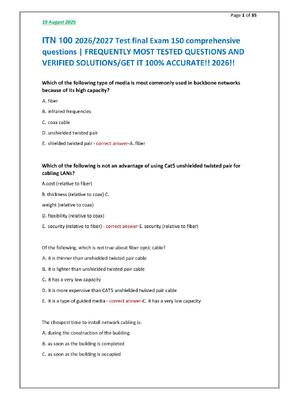
ITN 100 2026/2027 Test final Exam 150 comprehensive questions...
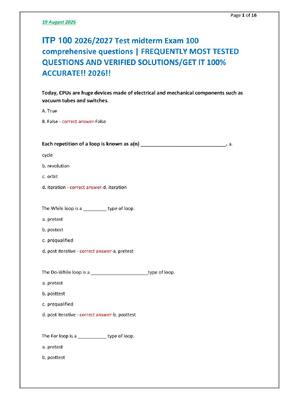
ITP 100 2026/2027 Test midterm Exam 100 comprehensive questio...
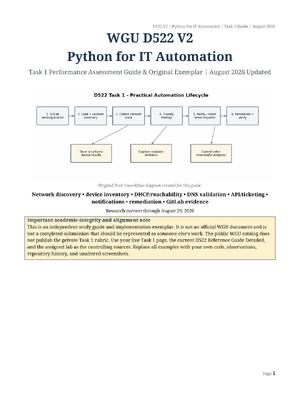
WGU D522 V2 Task 1 Performance Assessment | Complete Python IT...