Solution Manual & Test Bank for Project Management: The Managerial Process 7th Edition by Erik W. Larson
Chapter 1
Modern Project Management
Chapter Outline
1. What Is a Project?
A. What a Project Is Not
B. The Pro
...
Solution Manual & Test Bank for Project Management: The Managerial Process 7th Edition by Erik W. Larson
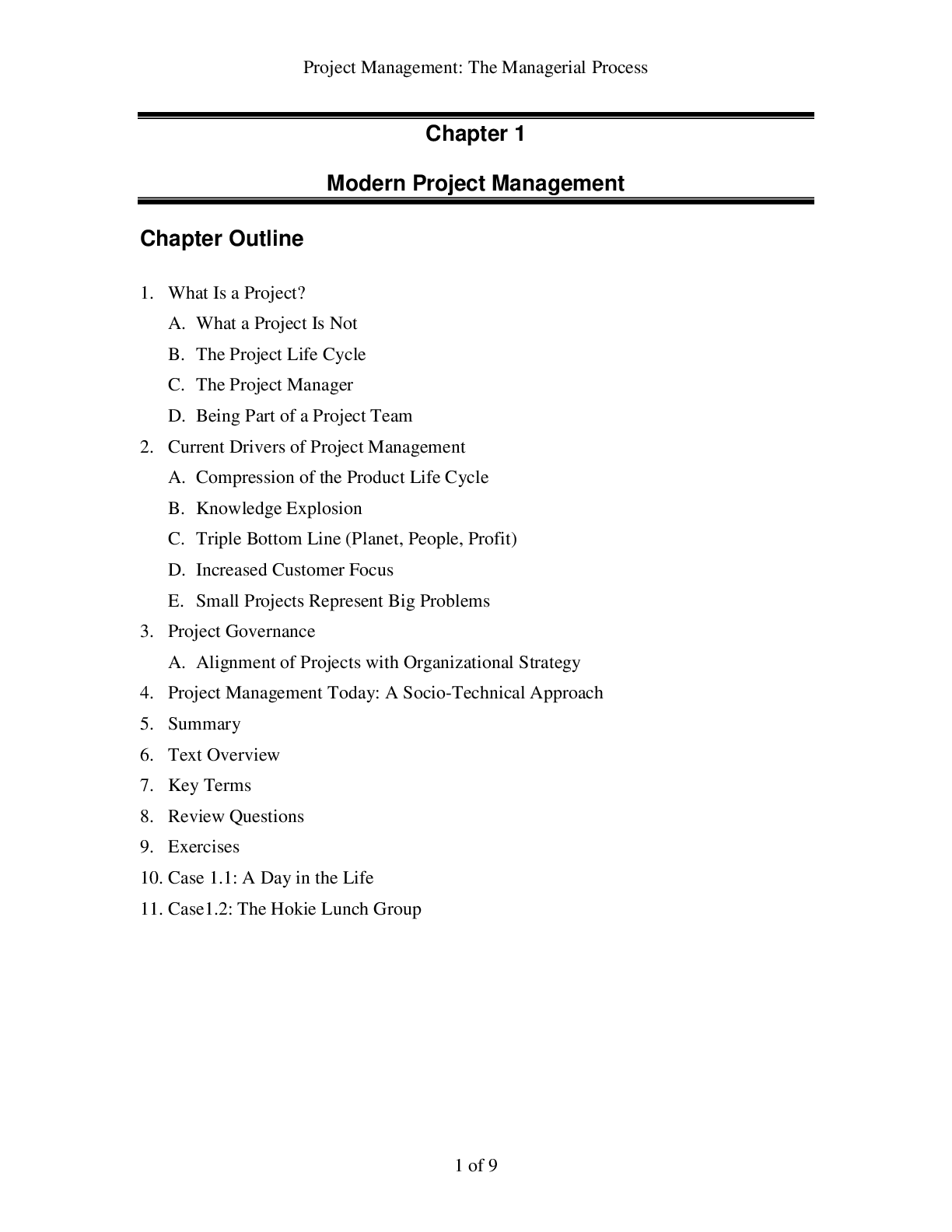
Chapter 1
Modern Project Management
Chapter Outline
1. What Is a Project?
A. What a Project Is Not
B. The Project Life Cycle
C. The Project Manager
D. Being Part of a Project Team
2. Current Drivers of Project Management
A. Compression of the Product Life Cycle
B. Knowledge Explosion
C. Triple Bottom Line (Planet, People, Profit)
D. Increased Customer Focus
E. Small Projects Represent Big Problems
3. Project Governance
A. Alignment of Projects with Organizational Strategy
4. Project Management Today: A Socio-Technical Approach
5. Summary
6. Text Overview
7. Key Terms
8. Review Questions
9. Exercises
10. Case 1.1: A Day in the Life
11. Case1.2: The Hokie Lunch Group
Project Management: The Managerial Process
2 of 9
Chapter Learning Objectives
After reading this chapter you should be able to:
LO 1-1 Understand why project management is crucial in today’s world.
LO 1-2 Distinguish a project from routine operations.
LO 1-3 Identify the different stages of project life cycle.
LO 1-4 Understand the importance of projects in implementing organization
strategy.
LO 1-5 Understand that managing projects involves balancing the technical and
sociocultural dimensions of the project.
Project Management: The Managerial Process
3 of 9
Review Questions
1. Define a project. What are five characteristics which help differentiate projects
from other functions carried out in the daily operations of the organization?
A project is a complex, non-routine, one-time effort limited by time, budget, resource,
and specifications. Differentiating characteristics of projects from routine, repetitive
daily work are below:
a. A defined life span
b. A well-defined objective
c. Typically involves people from several disciplines
d. A project life cycle
e. Specific time, cost, and performance requirements.
2. What are some of the key environmental forces that have changed the way
projects are managed? What has been the effect of these forces on the
management of projects?
Some environmental forces that have changed the way we manage projects are the
product life cycle, knowledge growth, global competition, organization downsizing,
technology changes, time-to-market. The impact of these forces is more projects per
organization, project teams responsible for implementing projects, accountability,
changing organization structures, need for rapid completion of projects, linking
projects to organization strategy and customers, prioritizing projects to conserve
organization resources, alliances with external organizations, and so on.
3. Why is the implementation of projects important to strategic planning and the
project manager?
Strategic plans are implemented primarily through projects—e.g., a new product, a
new information system, a new plant for a new product. The project manager is the
key person responsible for completing the project on time, on budget, and within
specifications so the project’s customer is satisfied. If the project is not linked to the
strategic plan of the organization, resources devoted to the project are wasted and a
customer need is not met. This lack of connectivity occurs more in practice than most
would believe.
4. The technical and sociocultural dimensions of project management are two sides
to the same coin. Explain.
The system and sociocultural dimensions of project management are two sides of the
same coin because successful project managers are skillful in both areas. The point is
successful project managers need to be very comfortable and skillful in both areas.
Project Management: The Managerial Process
4 of 9
5. What is the impact of governance to managing an individual project? Why is
this approach important in today’s environment?
Governance signals to the project manager that decisions at a higher level can impact
management of an individual project. Reviews (called “Gating”) during project
implementation assess current performance and priorities and decide to continue, halt,
hold, or revised the project.
Governance is most frequently used to balance resources and risk over all
organizational resources. It is also used to enforce or alter priorities and to ensure
project align with organizational strategies and goals. In today’s fast-paced world
priorities can change quickly and can impact in process projects.
[Show More]