BIO 183 Lab Assignment 13 (Homework)
Kelly Shaw
BIO 183, section 601, Spring 2017
Instructor: Betty Black
Current Score : 26.5 / 28 Due : Sunday, April 16 2017 11:59 PM EDT
2/3 submissions
1. 1/1 points
In the Gri
...
BIO 183 Lab Assignment 13 (Homework)
Kelly Shaw
BIO 183, section 601, Spring 2017
Instructor: Betty Black
Current Score : 26.5 / 28 Due : Sunday, April 16 2017 11:59 PM EDT
2/3 submissions
1. 1/1 points
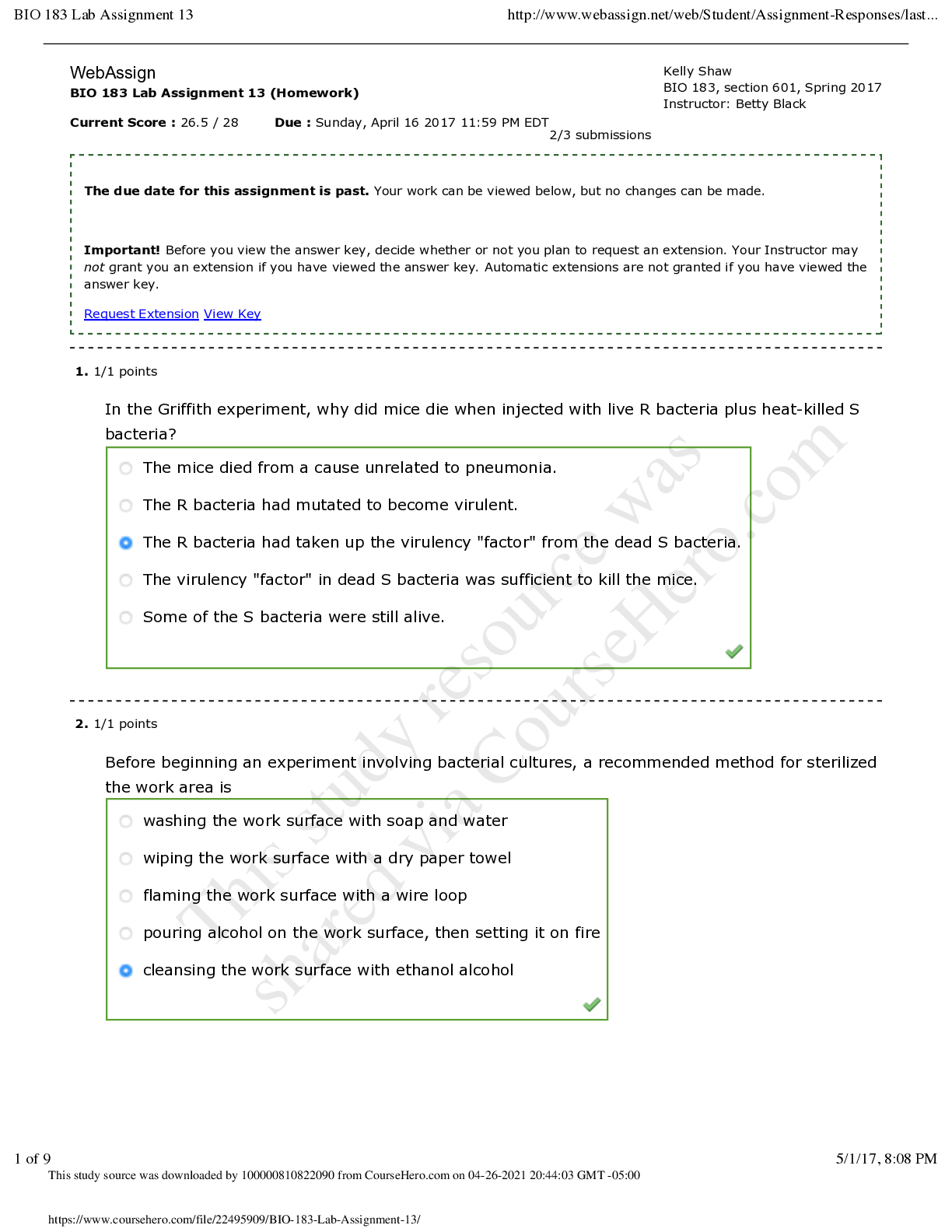
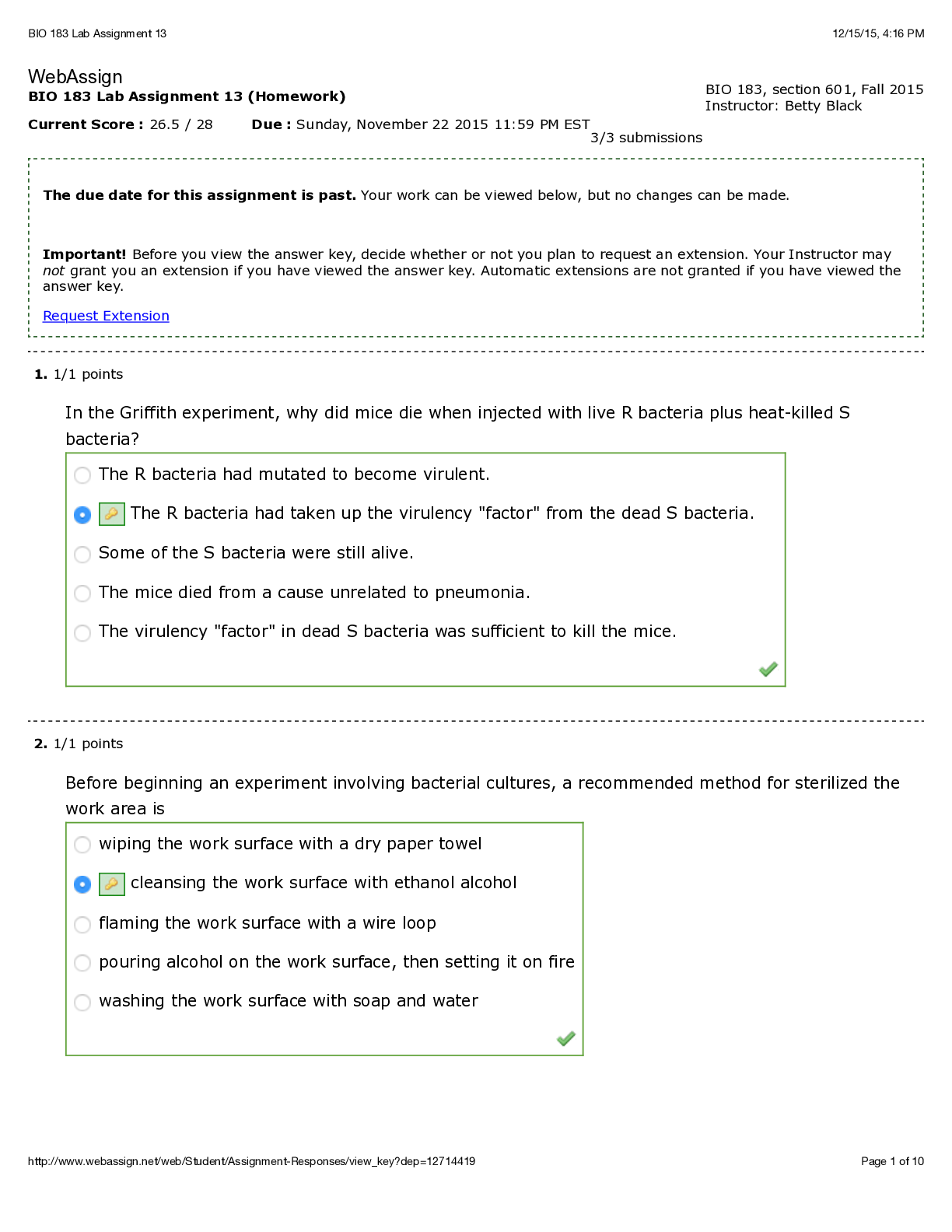
In the Griffith experiment, why did mice die when injected with live R bacteria plus heat-killed S
bacteria?
2. 1/1 points
Before beginning an experiment involving bacterial cultures, a recommended method for sterilized
the work area is
WebAssign
The due date for this assignment is past. Your work can be viewed below, but no changes can be made.
Important! Before you view the answer key, decide whether or not you plan to request an extension. Your Instructor may
not grant you an extension if you have viewed the answer key. Automatic extensions are not granted if you have viewed the
answer key.
Request Extension View Key
The mice died from a cause unrelated to pneumonia.
The R bacteria had mutated to become virulent.
The R bacteria had taken up the virulency "factor" from the dead S bacteria.
The virulency "factor" in dead S bacteria was sufficient to kill the mice.
Some of the S bacteria were still alive.
washing the work surface with soap and water
wiping the work surface with a dry paper towel
flaming the work surface with a wire loop
pouring alcohol on the work surface, then setting it on fire
cleansing the work surface with ethanol alcohol
BIO 183 Lab Assignment 13 http://www.webassign.net/web/Student/Assignment-Responses/last...
1 of 9 5/1/17, 8:08 PM
3. 1/1 points
In an experiment involving bacterial cultures, what is the purpose of "streaking"?
4. 3/3 points
In which section of the dish shown in the simple transformation experiment would you expect
transformation of bacteria to occur? Write a short essay that explains your answer.
I would expect transformation of bacteria to occur in the section that contains the streptomycinsensitive strain and samples of the lysate (S + RL). The lysate solution contains plasmids that
were released from the streptomycin resistant strain. Based on what I have learned about
transformation, I think that the plasmids from the dead resistant cells (lysate solution) will
incorporate into the streptomycin-sensitive strain and make that strain resistant as well.
Score: 03 out of 3
Comment:
Graded: 03 points by Pope TA, Madison on Monday, April 24 2017 03:10 PM EDT.
It is a way to grow large numbers of bacteria in liquid media.
It is a way to spread bacteria in a small region of a Petri dish so that individual colonies
are more easily seen.
It is a way to suspend bacteria in liquid media of a tube.
It is a way to sterilize the wire loop used for bacterial transfer.
It is a way to spread bacteria over the entire surface of the agar in a Petri dish.
BIO 183 Lab Assignment 13 http://www.webassign.net/web/Student/Assignment-Responses/last...
5. 1/1 points
In the above experiment, why was there no growth in dish sector RL?
6. 2/2 points
In step 2 of the experiment, bacteria are transferred from the S, R, and S + RL sections of the
dish to a new dish containing nutrients plus streptomycin. Students performing this experiment
are told that if growth occurred in the sector RL of step 1, they were not to use the S+RL bacteria
from their own plates but to borrow a sample of this culture from students obtaining the
successful results in the photographs.
Write a short essay that explains why students should not use their S + RL culture if the RL
culture in their dish grew.
If the RL culture in the students' dish grew, then that would mean that the bacteria from this
group of cells was not killed completely because it was able to grow. The purpose of the RL group
was to kill the cells, releasing plasmids into the solution. If the cells were not killed, then all of
their plasmids were not released. Since the purpose of this experiment is to observe cell
transformation, then we would need those plasmids to be released. The S + RL culture would not
show the correct results because if the RL group did not have plasmids released because the cells
were not dead, then that section of the dish would show no growth/no transformation.
Score: 02 out of 2
Comment:
Graded: 02 points by Pope TA, Madison on Monday, April 24 2017 03:18 PM EDT.
The bacteria in this sector were killed before placing them on the
agar.
The bacteria in this sector have not been transformed.
The bacteria in this sector are not resistant to streptomycin.
The bacteria in this sector have been transformed.
The bacteria in this sector are slower growing, so cannot be seen
yet.
BIO 183 Lab Assignment 13 http://www.webassign.net/web/Student/Assignment-Responses/last...
3 of 9 5/1/17, 8:08 PM
7. 1/1 points
Which of the following best explains the final results (step 3) of the experiment?
8. 2/2 points
Mistakes are sometimes made in experiments. Write a short essay that indicates how the dish in
step 3 would look if the following mistakes had been made:
a) S bacteria (instead of R bacteria) were used during the detergent/heating step.
b) The wire loop was not sterilized between bacterial transfers during the experiment.
If the S bacteria was used during the detergent/heating step, then there would be no growth
shown on the plate S + RL. This is because the lysate solution would have contained the plasmids
from the streptomycin sensitive strain and therefore there would have been no transformation
because that section would contain all of the S strain. The only section that would have shown
grown would have been the R section.
If you do not sterilize the loop properly, then cells from different strains could be transferred to
parts of the dish that you do not want to be there. For example, the RL sample could have been
transferred to the S section of the dish. This would end up in the S section of the dish showing
growth, when it would not if it was only the sensitive cells on that part of the plate. Likewise, if
the loop was not cleaned and cells from the S strain were transferred to the R section, less
growth could have been shown due to the presence of the sensitive cells.
Score: 2 out of 2
Comment:
Graded: 2 points by Farawi TA, Dania on Thursday, April 20 2017 10:20 PM EDT.
Bacteria grew in R because this strain was streptomycin-resistant and in S + RL because
the S bacteria were transformed.
Bacteria grew only in S + RL because only these bacteria were transformed.
Bacteria grew in S because this strain was streptomycin-resistant and in S + RL because
the R bacteria were transformed.
Bacteria grew in all sectors because the S bacteria were transformed.
Bacteria grew in R and in S + RL because the bacteria in both sectors were transformed.
BIO 183 Lab Assignment 13 http://www.webassign.net/web/Student/Assignment-Responses/last...
4 of 9 5/1/17, 8:08 PM
9. 2/2 points
Indicate whether each statement is true or false by writing the word true or false in the blank.
If a bacterium contained the pGLO plasmid, which of the following could it do?
False Survive in an environment containing streptomycin.
True Survive in an environment containing ampicillin.
True Emit a green glow if placed under an ultraviolet light.
True Pass the GFP gene to other bacteria if killed in their presence.
10.1/1 points
In the GFP experiment, bacteria took up the pGLO plasmids when they were
11.1/1 points
Looking at set up for the GFP experiment (in which the dishes are numbered), which dish(es) will
contain transformed bacteria?
lysed with a detergent
killed by boiling
frozen, then briefly heated
grown on a medium containing ampicillin
put under an ultraviolet light
Dish 1 only
Dish 3 only
Dishes 3 and 4
Dish 2 only
Dishes 1 and 2
BIO 183 Lab Assignment 13 http://www.webassign.net/web/Student/Assignment-Responses/last...
5 of 9 5/1/17, 8:08 PM
12.1/1 points
The function of arabinose in the GFP experiment is to
13.2/2 points
Study the results of the GFP experiment, then write a short essay that answers the following
questions:
a) Why is there no growth in the LB/AMP dish on the top row?
b) Why is there more growth in the LB dish than in the LB/AMP dish beneath it (on the bottom
row)?
The LB/AMP dish on the top row did not show any growth because it did not receive the
heat-shocked pGLO plasmid. Therefore, the bacteria was not able to incorporate that plasmid into
the DNA, and the bacteria was unable to grow because it did not have the gene for ampicillin
resistance. There is more growth in the LB dish than the LB/AMP dish beneath it because there is
no ampicillin present in this dish and the bacteria are able to grow normally and do not need the
plasmids from the pGLO DNA.
Score: 2 out of 2
Comment:
Graded: 2 points by Farawi TA, Dania on Thursday, April 20 2017 11:41 PM EDT.
Provide a way to control the expression of the GFP gene.
Allow the bacteria to grow in a nutrient-free
environment.
Allow the bacteria to grow in the presence of ampicillin.
Provide a way to insert the GFP gene into the bacteria.
None of these is the function of arabinose.
BIO 183 Lab Assignment 13 http://www.webassign.net/web/Student/Assignment-Responses/last...
6 of 9 5/1/17, 8:08 PM
14.1/1 points
At the end of the GFP experiment, what two conditions are required for bacteria to fluoresce under
ultraviolet light?
15.2/2 points
At the end of the GFP experiment, (1) one of the fluorescent colonies is suspended in a large flask
of growth medium and incubated. Then (2) the bacteria are lysed, and (3) the bacterial
suspension is poured through a chromatography column.
Indicate whether each statement is true or false by writing true or false in the blanks.
True Fluorescent colonies were suspended in growth media and incubated to increase the
number of transformed bacteria.
False Bacteria were lysed to remove bacteria that had not been transformed.
True The purpose of column chromatography was to obtain a pure sample of GFP from the
bacterial suspension.
False The matrix of the column bound everything in the bacterial suspension except the GFP.
They must have lost the pGLO plasmid and grow in the presence of ampicillin.
They must grow in the absence of both ampicillin and arabinose.
They must contain the pGLO plasmid and grow in the presence of arabinose.
They must have lost the pGLO plasmid and grow in the presence of arabinose.
They must contain the pGLO plasmid and grow in the presence of ampicillin.
BIO 183 Lab Assignment 13 http://www.webassign.net/web/Student/Assignment-Responses/last...
7 of 9 5/1/17, 8:08 PM
16.2.5/3 points
Refer to the directions in your assignment for questions 16-17.
There is a point mutation in segment 2 of the miacalcin DNA. The mutated DNA has the following
sequence:
A C A, C A C, G A C, C C T, A T C , G A T, A G T
For your answer:
a) Write the sequence for the new mRNA.
b) Write the amino acid sequence based on this mRNA.
c) Indicate whether the mutation was a nucleotide insertion, deletion, or substitution and where in
the DNA fragment it occurred. Then explain how the mutation affected the amino acid sequence in
segment 2.
a) UGU, GUG, CUG, GGA, UAG, CUA, UCA
b) Cys, Val, Leu, Gly, STOP, Leu, Ser
c) This was a DNA nonsense mutation where the LYS amino acid was changed to a stop codon.
This occurred on the fifth codon of this segment. This results in the DNA fragment stopping coding
at this part of the segment and would not code the other two amino acids after it.
Score: 02.5 out of 3
Comment: whether the mutation was a nucleotide insertion, deletion, or substitution?
Graded: 02.5 points by Wise, Catherine on Monday, April 17 2017 02:03 PM EDT.
BIO 183 Lab Assignment 13 http://www.webassign.net/web/Student/Assignment-Responses/last...
8 of 9 5/1/17, 8:08 PM
17.2/3 points
Refer to the directions in your assignment for questions 16-17.
There is a point mutation in segment 3 of the miacalcin DNA. The mutated DNA has the following
sequence:
G T C, T C A, A T G, T G T, T C G, A G
For your answer:
a) Write the sequence for the new mRNA.
b) Write the amino acid sequence based on this mRNA.
c) Indicate whether the mutation was a nucleotide insertion, deletion, or substitution and where in
the DNA fragment it occurred. Then explain how the mutation affected the amino acid sequence in
segment 3.
a) CAG, AGU, UAC, ACA, AGC, UC
b) Gln, Ser, Tyr, Thr, Ser,
c) This was a nucleotide insertion, where one nucleotide was inserted in and thus the entire amino
acid sequence shifted and changed which amino acid would be coded. This insertion happened
after the first codon in the segment and shifted all other codons down the line in order to change
all the rest of the amino acids.
Score: 02 out of 3
Comment: c) deletion of 4th nucleotide - C
Graded: 02 points by Adams TA, Sara on Wednesday, April 19 2017 02:44 PM EDT.
BIO 183 Lab Assignment 13
[Show More]

.png)







 Correct Study Guide, Download to Score A.png)
 Correct Study Guide, Download to Score A.png)
 Correct Study Guide, Download to Score A.png)