BIO 183 quiz 10 1/24/12 7:08 PM
http://www.webassign.net/web/Student/Assignment-Responses/last?dep=3630010 Page 1 of 5
1/1 submissions
Current Score : 11 / 15 Due : Sunday, December 4 2011 11:59 PM EST
1. 1/1 points
...
BIO 183 quiz 10 1/24/12 7:08 PM
http://www.webassign.net/web/Student/Assignment-Responses/last?dep=3630010 Page 1 of 5
1/1 submissions
Current Score : 11 / 15 Due : Sunday, December 4 2011 11:59 PM EST
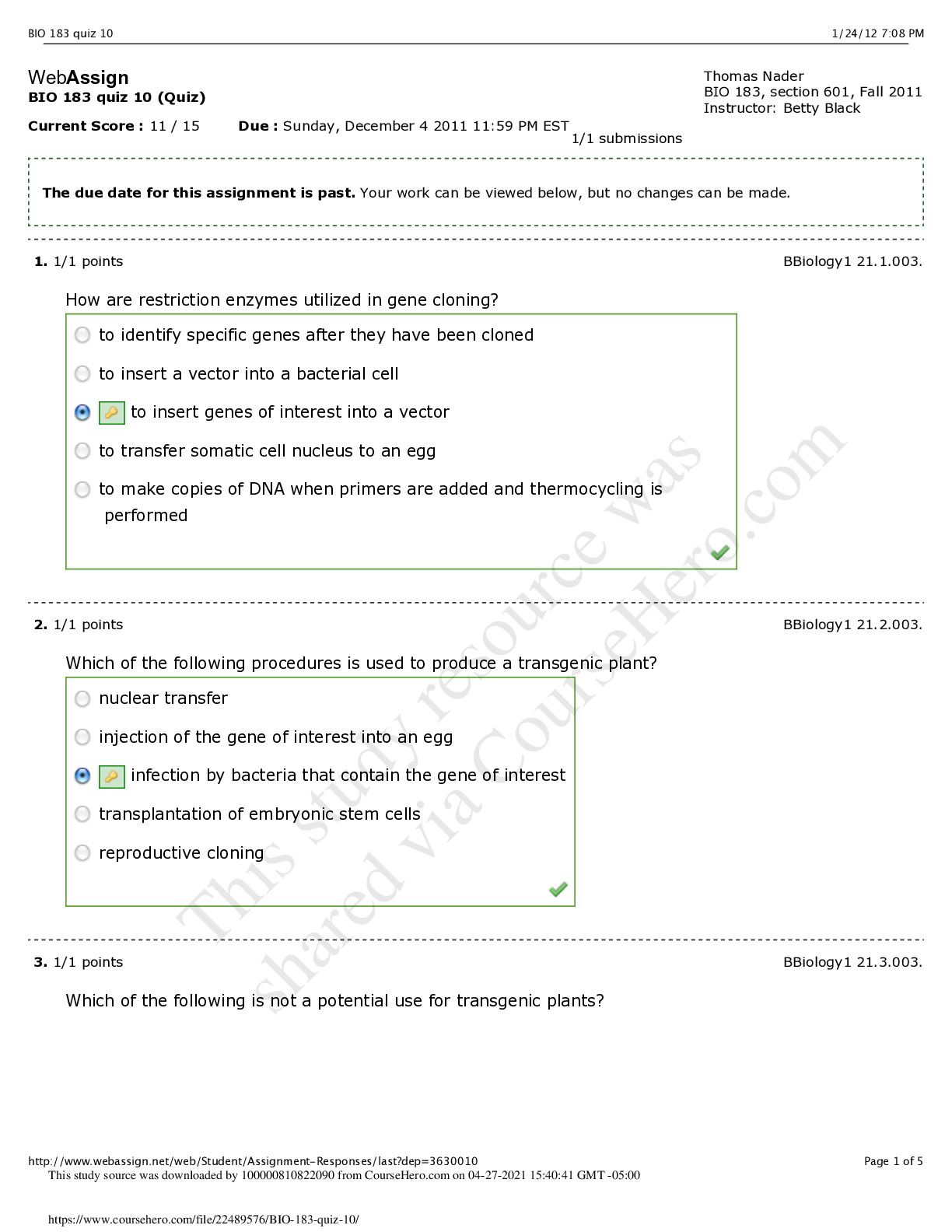
1. 1/1 points BBiology1 21.1.003.
How are restriction enzymes utilized in gene cloning?
2. 1/1 points BBiology1 21.2.003.
Which of the following procedures is used to produce a transgenic plant?
3. 1/1 points BBiology1 21.3.003.
Which of the following is not a potential use for transgenic plants?
BIO 183 quiz 10 (Quiz)
Thomas Nader
BIO 183, section 601, Fall 2011
Instructor: Betty Black
WebAssign
The due date for this assignment is past. Your work can be viewed below, but no changes can be made.
to identify specific genes after they have been cloned
to insert a vector into a bacterial cell
to insert genes of interest into a vector
to transfer somatic cell nucleus to an egg
to make copies of DNA when primers are added and thermocycling is
performed
nuclear transfer
injection of the gene of interest into an egg
infection by bacteria that contain the gene of interest
transplantation of embryonic stem cells
reproductive cloning
BIO 183 quiz 10 1/24/12 7:08 PM
http://www.webassign.net/web/Student/Assignment-Responses/last?dep=3630010 Page 2 of 5
4. 1/1 points BBiology1 21.4.003.
Which of the following is used to clone genes?
5. 1/1 points BBiology1 21.5.003.
Which of the following is a goal of gene therapy?
6. 1/1 points BBiology1 21.6.003.
Which of the following is true of human reproductive cloning?
to provide foods of higher nutritional quality
to provide plants that are resistant to insect damage
to provide plants that are resistant to herbacides
to provide stem cells for therapeutic cloning
to clean up toxic substances in the environment
cDNA hybridization
nuclear transfer
polymerase chain reaction (PCR)
DNA libraries
molecular pharming
to use domestic animals to produce human proteins
to produce genetically modified foods
None of these.
to alleviate the symptoms of human diseases caused by a mutated
gene
to clean up chemical spills in the environment
BIO 183 quiz 10 1/24/12 7:08 PM
http://www.webassign.net/web/Student/Assignment-Responses/last?dep=3630010 Page 3 of 5
7. 0/1 points BBiology1 20.1.003.
In the PCR method of DNA amplification, what happens when the temperature is lowered to 50°C?
8. 1/1 points BBiology1 22.1.003.
Which of the following membrane components is hydrophilic?
9. 1/1 points BBiology1 22.2.003.
It is probably possible, but has never been done due to moral considerations.
It has been done several times, even though illegal.
Many biologists are currently trying to achieve it.
Its purpose is to produce human tissues for transplantation which has been
accomplished.
A religious group has successfully cloned many humans.
Reverse transcriptase copies a specific region of DNA.
The DNA becomes highly compacted.
Primers bind to the specific regions of the DNA.
DNA strands of the double helix separate.
A DNA polymerase that works at high temperatures synthesizes complementary strands of
DNA.
cholesterol
polar head of a phospholipid
fatty acid of a phospholipid
None of these.
helical region of an integral (transmembrane)
protein
BIO 183 quiz 10 1/24/12 7:08 PM
http://www.webassign.net/web/Student/Assignment-Responses/last?dep=3630010 Page 4 of 5
The membrane structure shown by the arrow is a
10.1/1 points BBiology1 22.3.003.
Which of the following is an adaptation of some Arctic fish to prevent their membranes from freezing?
11.1/1 points BBiology1 22.4.003.
A protein channel within an integral membrane protein is most often used for transport of
peripheral protein
carbohydrate groups of glycoprotein
cholesterol molecule
phospholipid
transmembrane (integral) protein
These fish can increase the amount of glycoproteins in their membranes at low temperatures.
These fish can remove most phospholipids from their membranes at low temperatures.
None of these.
These fish can increase the percent of saturated fatty acids in their membranes at low
temperatures.
These fish can increase the amount of cholesterol in their membranes at low temperatures.
12.0/1 points BBiology1 22.6.003.
Which of the following is an example of exocytosis?
13.1/1 points BBiology1 22.8.003.
Which of the following types of transport does not require an input of energy?
small, charged molecules and ions.
molecules that must be transported against a concentration gradient.
nutrients such a glucose and amino acids.
large, non-polar molecules.
large, polar molecules.
a cell co-transporting sodium and glucose
a cell secreting a liquid product
a cell using ATP to accumulate large amounts of
potassium
a cell taking in small amounts of liquid by bulk
transport
a macrophage engulfing a yeast cell
Transport of potassium into a cell against its concentration gradient.
Transport sodium out of a cell against its concentration gradient.
Facilitated diffusion using a carrier protein.
Secondary active transport
All of these require energy.
[Show More]


.png)
.png)