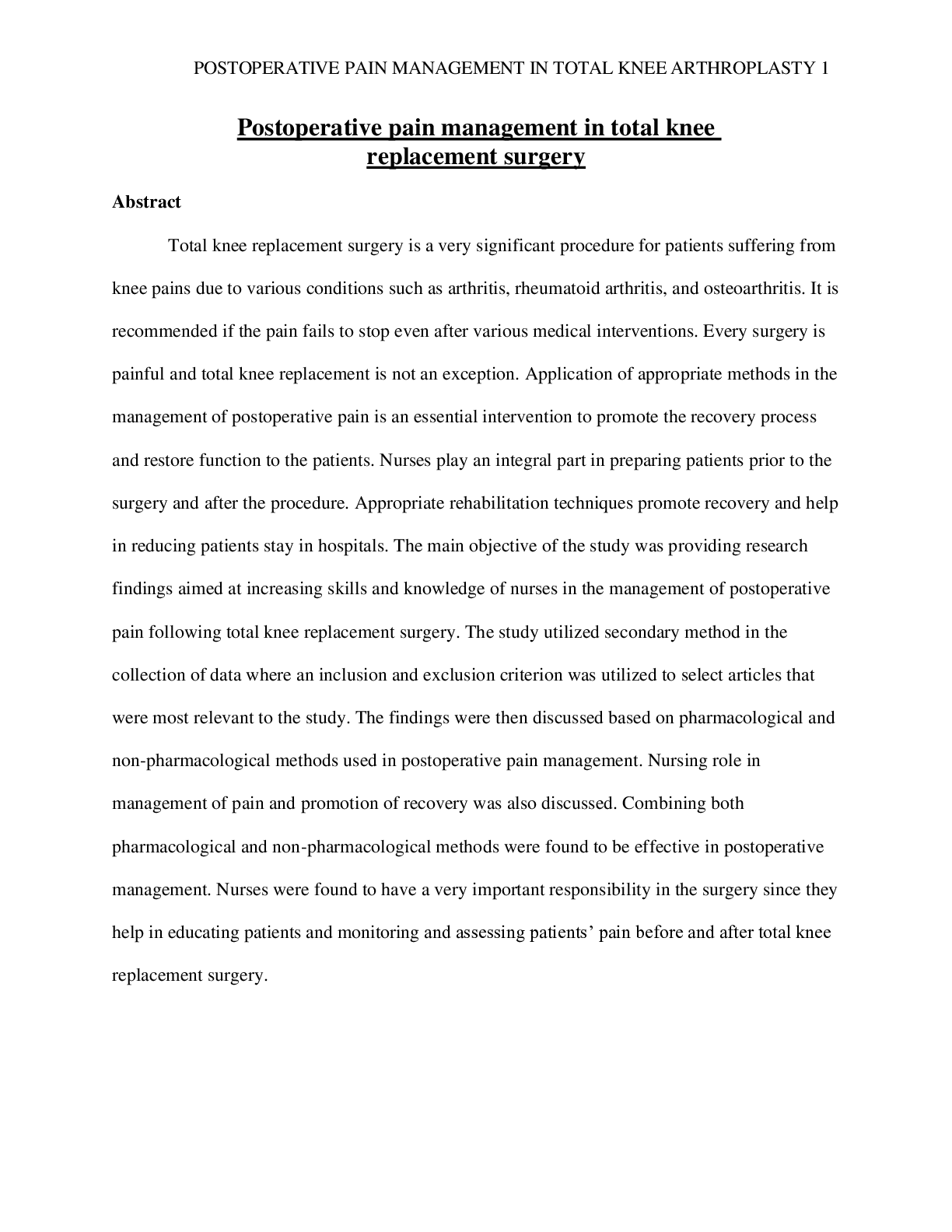
Risking factors for knee replacement surgery Arthritis
Arthritis is the major cause for knee replacement procedure among many patients in the world. Arthritis can affect any join in a human body but is mostly affects
...
Risking factors for knee replacement surgery Arthritis
Arthritis is the major cause for knee replacement procedure among many patients in the world. Arthritis can affect any join in a human body but is mostly affects the knee joint. The condition causes poor mobility and pain to the patients making the procedure an important
medical intervention to help the patients in regaining their mobility and relieve pain. Arthritis causes stiffness in the knee joint which inflicts pain on individuals and hinders their ability to move around and carry out their daily activities (Jorgensen and Kehlet, 2013). Rheumatoid arthritis, post-traumatic arthritis, and osteoarthritis are the major types of arthritis in the knee joint (Patel et al., 2014). Undertaking the procedure improves the quality of life for the patients.
Total Knee Arthroplasty (TKA)
TKA is a knee replacement procedure which is common and successful in the treatment of immobility and relieving pain among patients. The procedure is usually recommended after all medical interventions have been carried out without success. The procedure is carried out through replacement of patella’s posterior surface, proximal tibia and distal femur with a synthetic material that is cemented in place. The procedure involves removing an individual’s femur bone and placing a metal shell in its place. A plastic prosthesis is then used to replace tibia which is removed during total knee replacement surgery (Skou et al., 2013). The health providers then try to establish whether to place a plastic button under the surface of the kneecap or not. The decision is based on the condition of a patient’s kneecap portion.
During the operation, the doctors decide various things depending on the risks and benefits it poses to the patient. One such consideration is whether to sacrifice, retain, or substitute posterior cruciate ligament with a polythene post. Such considerations and designs help the patients in regaining their mobility and improve the quality of their life (Noble, Moore and Liu, 2013).
Knee replacement surgery is recommended following severe knee stiffness or pain that hinders the patient’s daily activities such as climbing stairs and walking. The pain makes it hard for the patients to walk as it causes pain which requires them to use a walker or a cane. It is also
recommended if the patients are suffering from moderate to severe joint pains while they are resting during daytime or night hours. A health provider may also recommend the procedure following a chronic knee swelling and inflammation that have not been addressed by other medical interventions or resting (Kelley et al., 2013).
.....................................................CONTINUED..................................................
[Show More]

![Preview of Walden University NURS 6640 Midterm Exam [76 Questions] (2021)](https://scholarfriends.com/storage/Walden University NURS 6640 Midterm Exam.png)












x.png)



.png)