STATGR5205 Midterm - Fall 2017 - October 18
Name:
UNI:
The GU5205 midterm is closed notes and closed book. Calculators are allowed. Tablets,
phones, computers and other equivalent forms of technology are strictly pro
...
STATGR5205 Midterm - Fall 2017 - October 18
Name:
UNI:
The GU5205 midterm is closed notes and closed book. Calculators are allowed. Tablets,
phones, computers and other equivalent forms of technology are strictly prohibited. Students
are not allowed to communicate with anyone with the exception of the TA and the professor.
If students violate these guidelines, they will receive a zero on this exam and potentially
face more severe consequences. Students must include all relevant work in the handwritten
problems to receive full credit.
Problem 1 [65 pts]
Consider the simple linear regression model
(1) Yi = !0 + !1xi + ✏i, ı = 1, . . . , n, ✏i iid ⇠ N(0, #2),
and least squares estimators
!ˆ1 = Sxy
Sxx and !ˆ0 = Y¯ " !ˆ1x. ¯
For this problem, you can use the following results:
(2) E[!ˆ0] = !0, E[!ˆ1] = !1, V ar[!ˆ0] = #2✓n1 + Sx¯xx 2 ◆, V ar[!ˆ1] = S#xx 2 .
For this exercise, use the scalar form of the simple linear regression model, i.e.,
don’t use matrices.
Part A (5 pts)
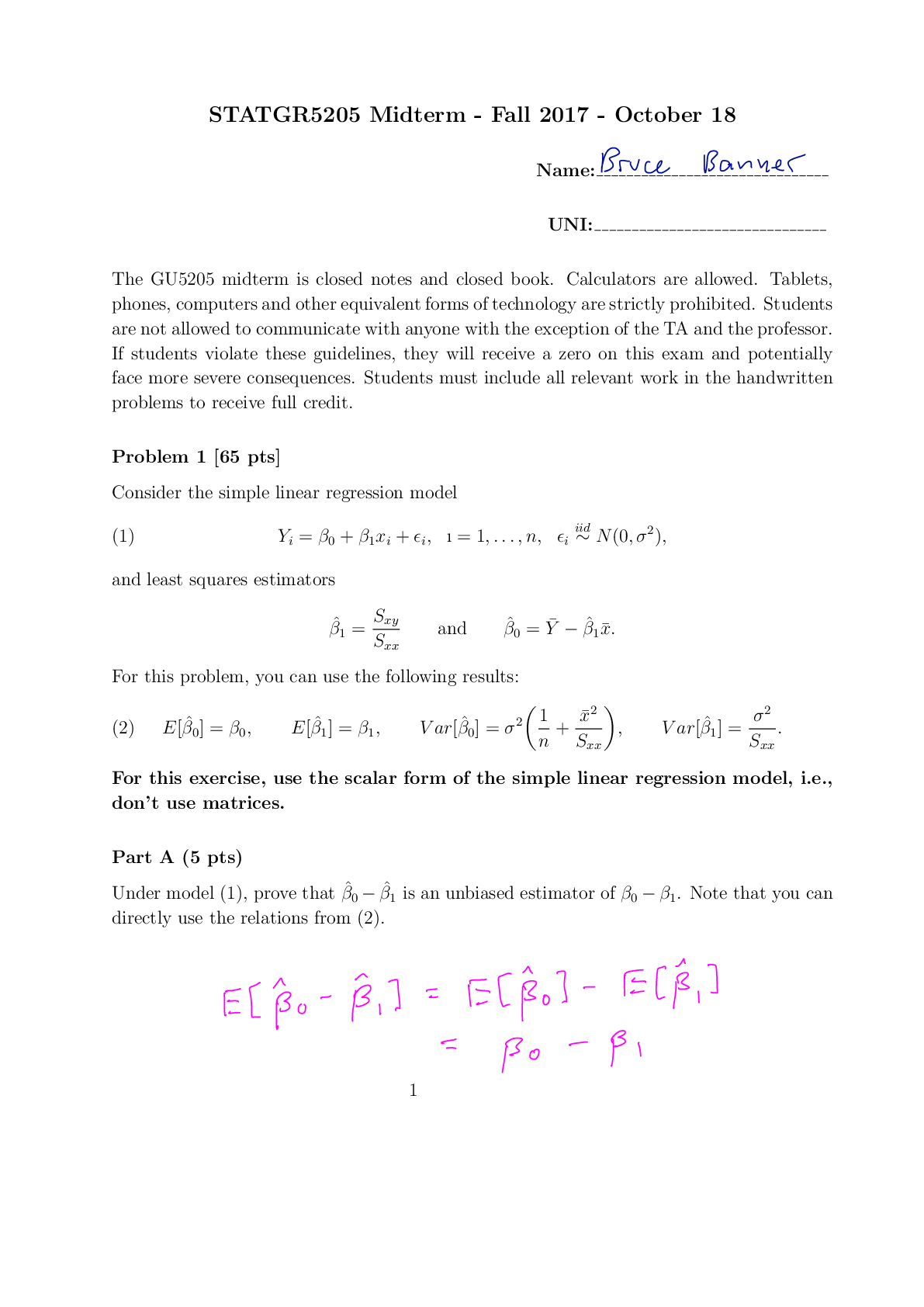
Under model (1), prove that !ˆ0 " !ˆ1 is an unbiased estimator of !0 " !1. Note that you can
directly use the relations from (2).
1
Bruce Banner
E[ fo - B , ] = E[p^o ] - ECB , ]
=
po
- PiPart B (20 pts)
Under model (1), derive an expression for Cov(!ˆ0, !ˆ1), where !ˆ0 and !ˆ1 are the least squares
estimators. Simplify the result as much as possible. Note that you can directly use the
relations from (2).
2
Note that § , = §,KiYi , Ki=×ij,÷ .
thatNote under model 11 ) ,
Cov ( Y
, } , ) = Cov ( ±¥,Yi , ?IkiYi )
= tn¥¥
,
kjcov Yj ( Yi , )
o
=
in ¥
,
Kiraly ;) + t.IS.K;Cw( Yi ,Yjl
=
02
In -2k ;
= 0
Then
Covcpo , B.) = covlt - F. I , F , )
= covet ,i3i ) - Ecov ( B , ,1& )
= 0 - Ivar ( § , )
2
- o
=
- × -
Sxx
•Part C (10 pts)
Under model (1), derive an expression for V ar[!ˆ0 " !ˆ1], where !ˆ0 and !ˆ1 are the least
squares estimators. Simplify the result as much as possible. Note that you can directly use
the relations from (2).
Note: if you cannot complete Part B, then express the solution to Part C in
terms of Cov(!ˆ0, !ˆ1)
[Show More]






.png)