Chapter 4 -- Inventory Management 2
OBJECTIVES
After studying this chapter, you should be able to:
• better understand the role that holding and ordering costs play in the determination
of the appropriate inventory o
...
Chapter 4 -- Inventory Management 2
OBJECTIVES
After studying this chapter, you should be able to:
• better understand the role that holding and ordering costs play in the determination
of the appropriate inventory order quantity.
• adjust the traditional EOQ model for quantity discounts and time value of money.
• appreciate how just-in-time concepts can be incorporated into the inventory order
decision process and the risks of being just-in-time
• assess the impact that different order quantities have on the timing and amount of
cash flows related to the inventory purchase decision.
• learn how to assess the actual behavior of inventory flows through the use of
balance fraction measures rather than inventory turnover ratios.
• learn how large retailers like Costco, Wal-Mart and Target are constantly
improving supply chain management with new technologies like RFID.
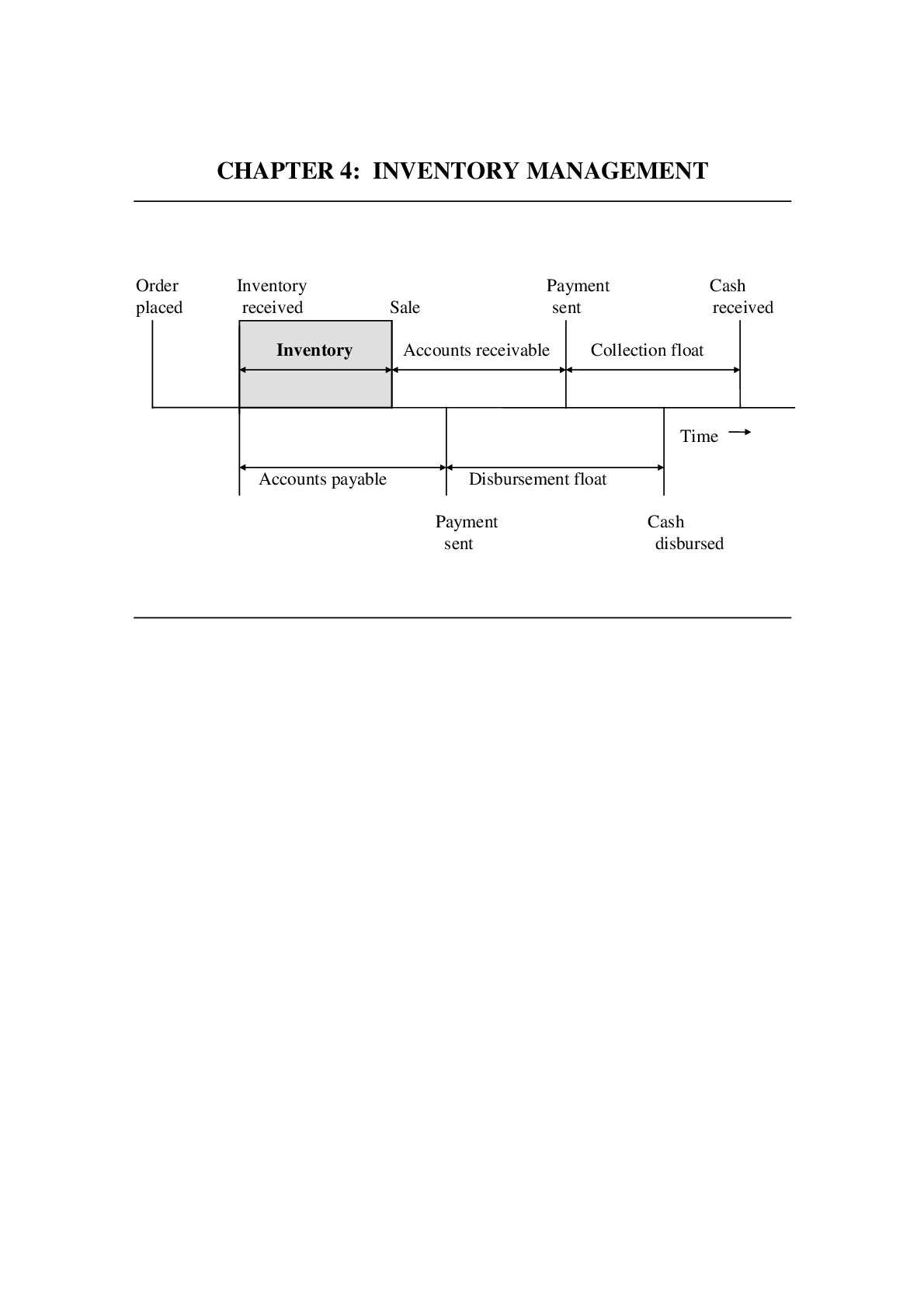
The management of inventory plays an important role in the management of the
firm's cash flow timeline. Keeping smaller inventory balances means less idle investment
but requires many more orders of inventory resulting in more disbursements of cash but
each of a relatively small amount. However, keeping minimal inventory balances
increases the likelihood of inventory shortages. As an alternative, keeping larger
inventory balances means more idle investment in inventory. Fewer orders, each of a
larger quantity, are placed resulting in larger cash balances being disbursed but over
longer intervals of time. This inventory strategy will result in a lower probability of
inventory shortages.
FINANCIAL DILEMMAChapter 4 -- Inventory Management 3
Can Placing Fewer Orders Save Money?
The treasurer of LUBE-RITE, Inc., a nationwide chain of lube centers, was just informed
by the purchasing manager that one of the firm's suppliers of petroleum products has just
initiated a quantity discount program. Although the purchasing manager was excited
about the prospects, the treasurer realized that the order quantity required to receive the
discount would greatly increase the firm's investment in inventory. Larger orders would
reduce ordering costs but the larger quantities would increase the holding costs and
opportunity costs of the inventory investment. She wondered if the trade-off in these
costs was worth the quantity discount received.
Inventory is a difficult item to manage because it crosses so many lines of
responsibility. The purchasing manager is responsible for supplies of raw material and
would like to avoid shortages and to purchase in bulk to take advantage of quantity
discounts. The production manager is responsible for uninterrupted production and
wishes to keep enough raw materials and work in process inventory on hand to avoid
disrupting the production process. The marketing manager is responsible for selling the
product and therefore wishes to minimize the chances of running out of inventory. The
[Show More]