SCIENCE 101 > STUDY GUIDE > Centennial CollegeSCIE 326Unit 2-scie326 (All)
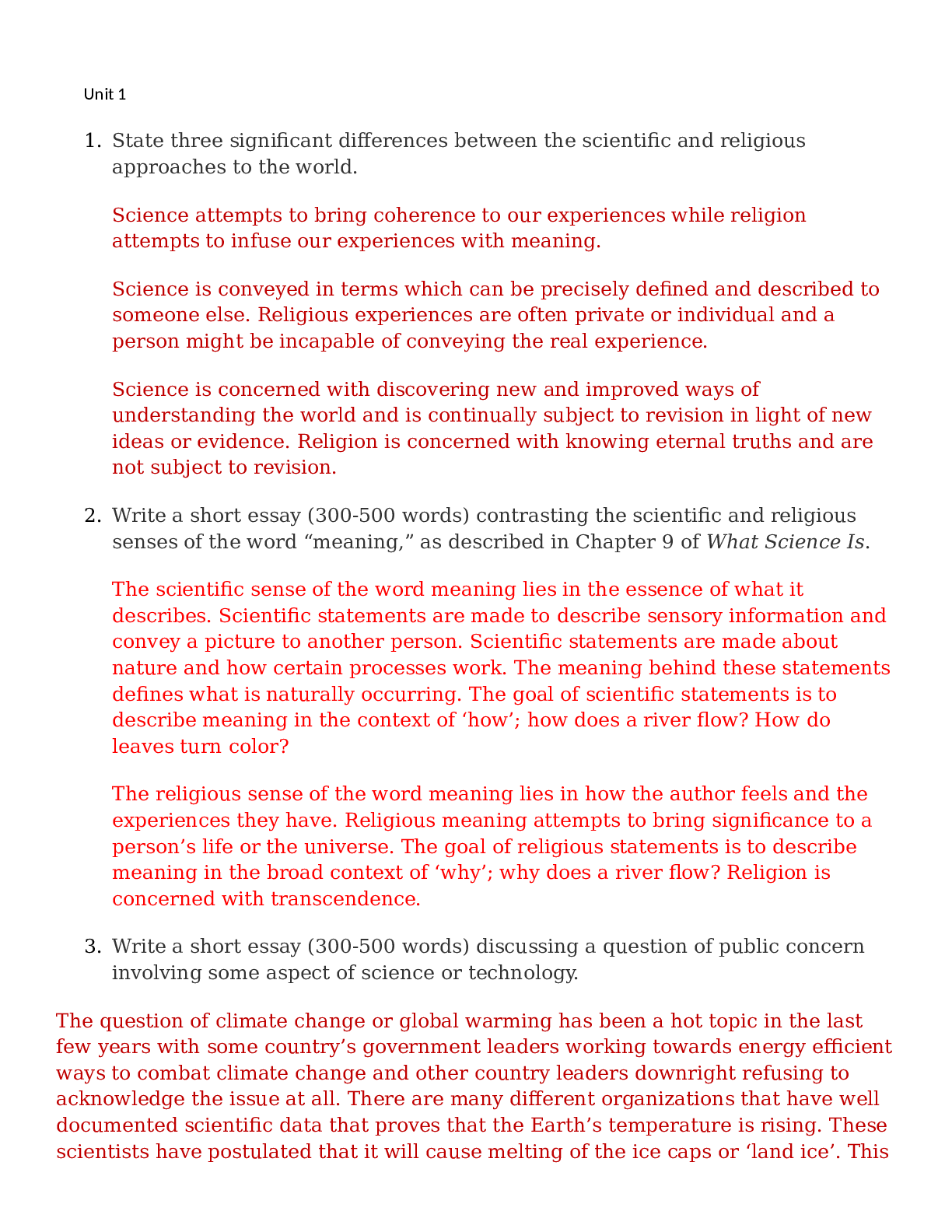
Unit 2 Can Science Be Defined? Science: the observation, identification, description, experimental investigation, and theoretical explanation of natural phenomena. ( Definition of Science) —A ... merican Heritage Dictionary of the English Language[19] The range of activities under the heading of science is tremendous. In addition to the traditional sciences—astronomy, physics, chemistry, medicine, geology and biology—we have a host of newer human sciences, such as psychology and anthropology; social sciences, such as sociology and political science; and hybrid fields, including management science, economics (called “the dismal science”) and library science. Such diverse subjects can all claim to be sciences only if they have something in common. But the unifying principle cannot be found in their subject matter. We cannot even say that all of the disciplines laying claim to the title “science” share the same methods. Each has its own version of something called “the scientific method,” but comparisons between fields such as physics, biology, sociology and anthropology show that “the” scientific method is more aptly thought of as a bundle of discipline-dependent methods sharing only basic similarities of form. What does show up in common is the goal of understanding, and the basic inductive attitude and point of view. Without these core characteristics, we do not have science. In this unit, we introduce various definitions of science, each of which is satisfactory in some ways and limited in others. We also consider whether “science” and “Western science” are the same thing, and engage in a brief hypothetical exercise on whether science is a uniquely human practice. Objectives When you have completed Unit 2, you should be able to 1. formulate a general, if incomplete, definition of science.2. describe, briefly, the history of several cases of scientific discovery: Roentgen’s discovery of X-rays, Kekulé’s discovery of the structure of benzene, the discovery of energy bands in solids, Humbolt’s biogeographical studies and Jenner’s discovery of the smallpox vaccine. (Book) 3. show how each of these cases of scientific discovery exemplifies some aspect of your definition of science.( Book) 4. list some of the reasons why the scientific revolution occurred in Europe rather than in more advanced civilizations of the world [Show More]
Last updated: 3 years ago
Preview 1 out of 15 pages
Buy this document to get the full access instantly
Instant Download Access after purchase
Buy NowInstant download
We Accept:
Can't find what you want? Try our AI powered Search
Connected school, study & course
About the document
Uploaded On
May 01, 2021
Number of pages
15
Written in
All
This document has been written for:
Uploaded
May 01, 2021
Downloads
0
Views
83
Scholarfriends.com Online Platform by Browsegrades Inc. 651N South Broad St, Middletown DE. United States.
We're available through e-mail, Twitter, Facebook, and live chat.
FAQ
Questions? Leave a message!
Copyright © Scholarfriends · High quality services·