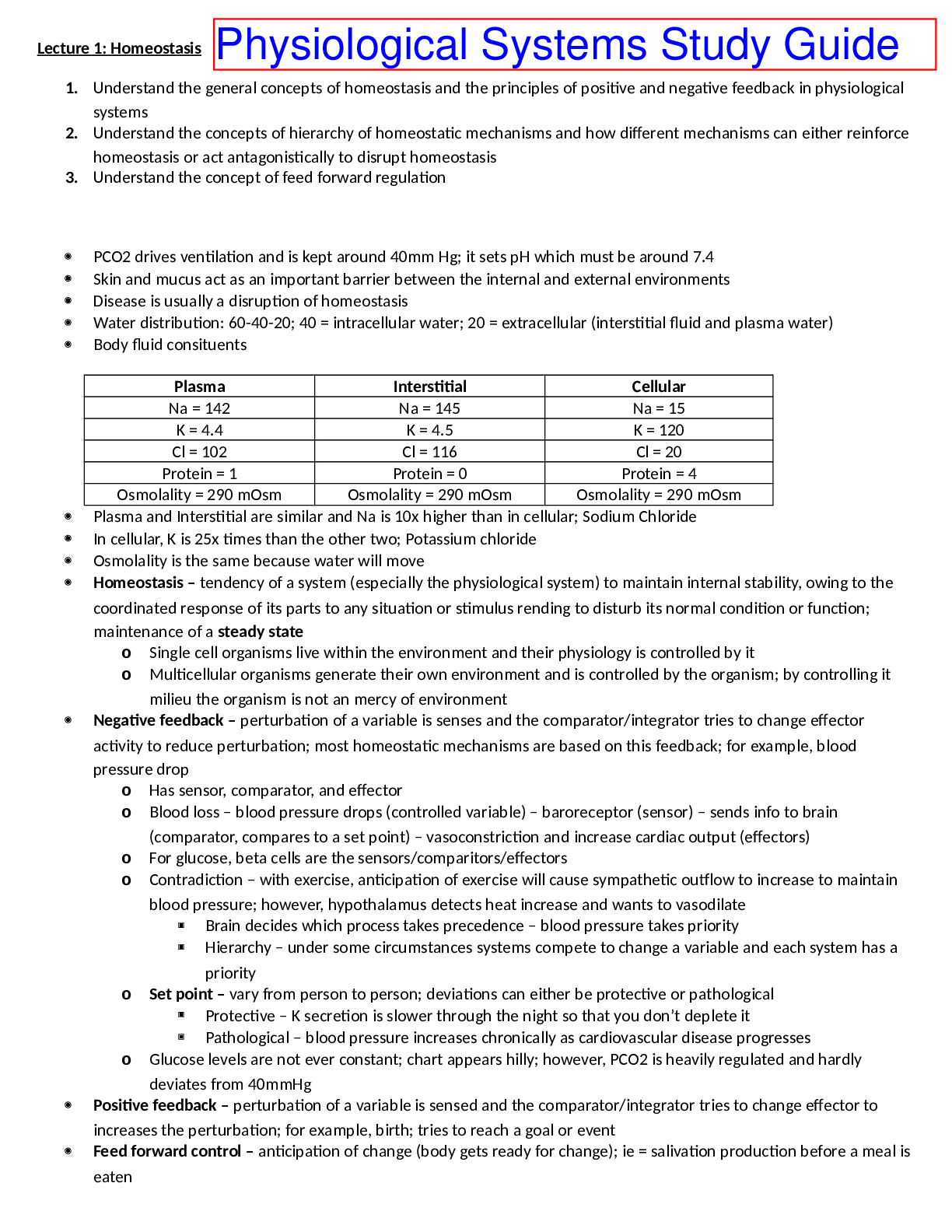
Lecture 1: Homeostasis
1. Understand the general concepts of homeostasis and the principles of positive and negative feedback in physiological
systems
2. Understand the concepts of hierarchy of homeostatic mechanisms
...
Lecture 1: Homeostasis
1. Understand the general concepts of homeostasis and the principles of positive and negative feedback in physiological
systems
2. Understand the concepts of hierarchy of homeostatic mechanisms and how different mechanisms can either reinforce
homeostasis or act antagonistically to disrupt homeostasis
3. Understand the concept of feed forward regulation
Lecture 2: Movement of substance across membranes
1. Describe the polar structure of water, and explain how the formation of hydrogen bonds permits the dissociation of
salts (such as NaCl), saccharides, and other polar molecules. Contrast the definitions of hydrophobic and hydrophilic
related to water polarity.
Lecture 3: Gas Pressures
Dalton’s law – total barometric pressure is the weight of the entire atmosphere above you;
o 3 main gasses – nitrogen, oxygen, and hydrogen
o Sum of these pressures = total barometric pressure
o Fractional concentrations never change for each gas; Oxygen will always be 21% and nitrogen will always be
78% no matter at what altitude
Lecture 4: Tonicity and Osmolarity
1. Using a cell membrane as an example, define a reflection coefficient, and explain how the relative permeability of a
cell to water and solutes will generate an osmotic pressure. Contrast the osmotic pressure generated across a cell
membrane by a solution of particles that freely cross the membrane with that of a solution with the same osmolality,
but particles that cannot cross the cell membrane. Lecture 5: Cell Membrane Potentials
Charge equality (electroneutrality) – for every positive charge, there is a negative charge
Water is a polar molecule that has a separation of charge within its structure (meaning it can interact with other
charged molecule ions) Lecture 6: Drug Receptor Interactions
Specificity of response –
o Ideally, we want a drug that only interacts with one target and has no side effects
o However, most drugs interact with a target and interacts with other receptors to cause side effects
Drug selectivity – the more selective, the better; Lecture 7 – Pharmacodynamics
Agonists – binds to receptor to give an effect
Antagonist – binds to receptor but causes no effect itself; but now receptor is bound and will prevent agonists from
bindingLecture 8: Pharmacokinetics
Pharmacokinetics –study of the factors that determine the amount of free drug that reaches the target site
o Factors include: drug absorption, drug distribution, drug metabolism, drug excretion
Pharmacodynamis is looking at how the drug effects the body; kinetics is how the body effects the drugLecture 9: Metabolism
2 ways to get rid of drugs: (Biotransformation)o Oxidation/Reduction reactions – Phase 1; polarizes molecule to give it a charge and make it more soluble
o Conjugation/hydrolysis – Phase 2Lecture 10: Autonomic Nervous System
Nervous system is made up of somatic nervous system (voluntary and reflex control of skeletal muscle) and autonomic
nervous system (reflex control of smooth and cardiac muscle, regulation of body’s internal environment)Lecture 11: ANS part 2
Parasympathetic Neurotransmitters: (cholinergic)
o Pre-ganglionic – ACh (nicotinic), enkephalin, substance P, GnRH
o Post-ganglionic – ACh (muscarinic) and VIP
Sympathetic Neurotransmitters: (adrenergic)Lecture 12: ANS part 3
ACh is synthesized from choline and Acetyl Coa (from glycolysis) in a reaction catalyzed by choline acetylase transferase
and happens in the cholinergic nerve terminals (rate limited by choline reuptake)
Choline comes into the cell with a co-transporter with Sodium
[Show More]