Francis Torralba – MCH Exam 2 Study Guide
1. Labor – contractions with cervical change
a. Stages of Labor
i. 1st stage (Labor) (dilation 1cm-1.5cm/hr) – can take any time
1. Latent phase
a. Longest and most variable
...
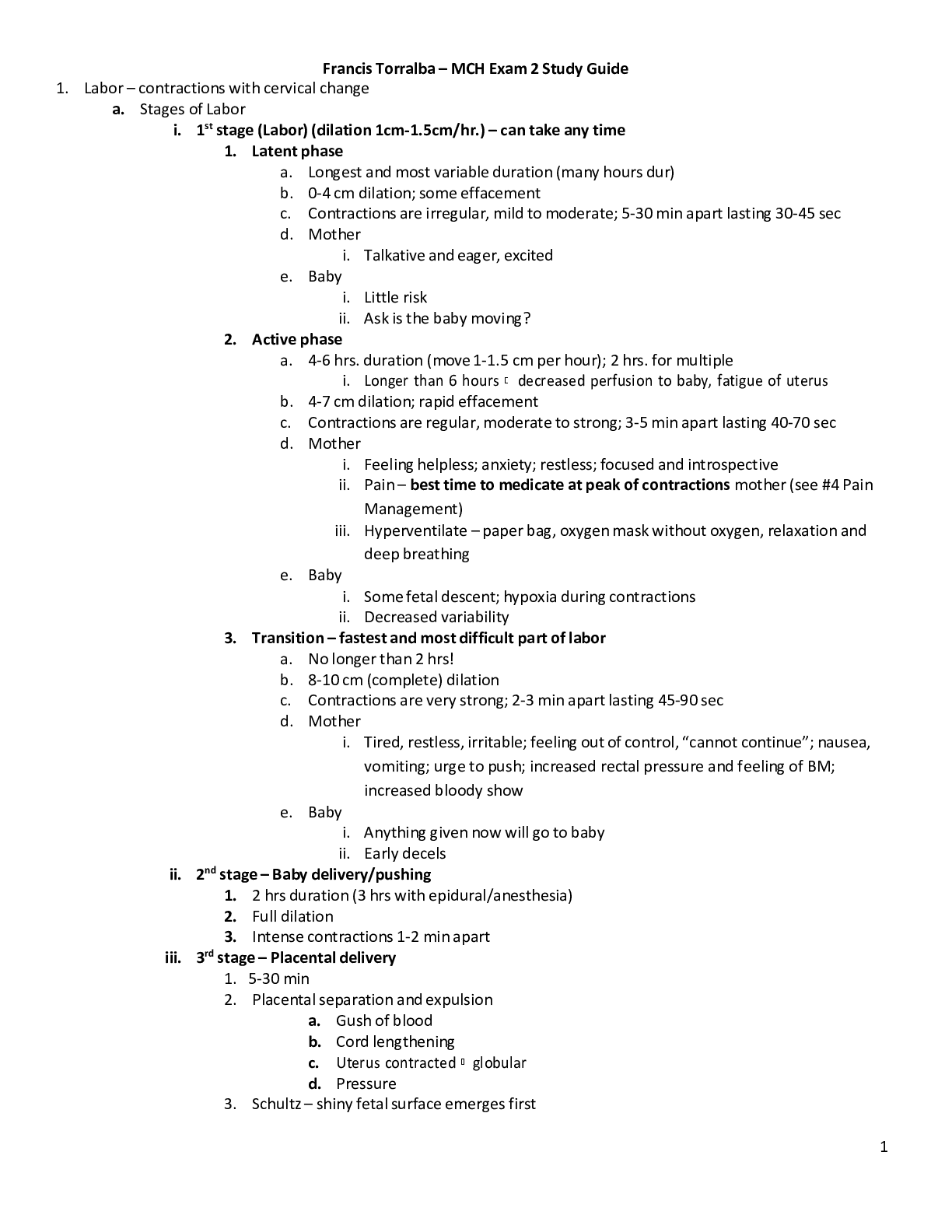
Francis Torralba – MCH Exam 2 Study Guide
1. Labor – contractions with cervical change
a. Stages of Labor
i. 1st stage (Labor) (dilation 1cm-1.5cm/hr) – can take any time
1. Latent phase
a. Longest and most variable duration (many hours dur)
b. 0-4 cm dilation; some effacement
c. Contractions are irregular, mild to moderate; 5-30 min apart lasting 30-45 sec
d. Mother
i. Talkative and eager, excited
e. Baby
i. Little risk
ii. Ask is the baby moving?
2. Active phase
a. 4-6 hrs duration ( move 1-1.5 cm per hour); 2 hrs for multip
i. Longer than 6 hours decreased perfusion to baby, fatigue of uterus
b. 4-7 cm dilation; rapid effacement
c. Contractions are regular, moderate to strong; 3-5 min apart lasting 40-70 sec
d. Mother
i. Feeling helpless; anxiety; restless; focused and introspective
ii. Pain – best time to medicate at peak of contractions mother (see #4 Pain
Management)
iii. Hyperventilate – paper bag, oxygen mask without oxygen, relaxation and
deep breathing
e. Baby
i. Some fetal descent; hypoxia during contractions
ii. Decreased variability
3. Transition – fastest and most difficult part of labor
a. No longer than 2 hrs!
b. 8-10 cm (complete) dilation
c. Contractions are very strong; 2-3 min apart lasting 45-90 sec
d. Mother
i. Tired, restless, irritable; feeling out of control, “cannot continue”; nausea,
vomiting; urge to push; increased rectal pressure and feeling of BM;
increased bloody show
e. Baby
i. Anything given now will go to baby
ii. Early decels
ii. 2nd stage – Baby delivery/pushing
1. 2 hrs duration (3 hrs with epidural/anesthesia)
2. Full dilation
3. Intense contractions 1-2 min apart
iii. 3rd stage – Placental delivery
1. 5-30 min
2. Placental separation and expulsion
a. Gush of blood
b. Cord lengthening
c. Uterus contracted globular
d. Pressure
3. Schultz – shiny fetal surface emerges first
1Francis Torralba – MCH Exam 2 Study Guide
4. Duncan – dull maternal surface of placenta emerges first
5. Watch out for PP hemorrhage!
a. Fundal height at umbilicus – hard fundal massage to prevent PP hemorrhage
iv. 4th stage – Stabilization/Recovery
1. 2 hrs duration
2. Lochia is scant to moderate rubra
3. Vital signs q15 min; fundal checks q15 for 1st hour, q30 min afterwards
b. Five factors (“Ps”) that affect and define the labor and birth process: passenger, passageway, powers,
position, and psychologic response.
i. Passenger – consists of the fetus and the placenta.
1. Presentation – the part of the fetus that is entering the pelvic inlet first. It can be the back of
the head (occiput), chin (mentum), shoulder (scapula), or breech (sacrum or feet).
2. Lie – the relationship of the maternal longitudinal axis (spine) to the fetal longitudinal axis
(spine).
a. Transverse – fetal long axis is horizontal and forms a right angle to maternal axis and
will not accommodate vaginal birth. The shoulder is the presenting part and may
require delivery by cesarean birth if the fetus does not rotate spontaneously.
b. Parallel or longitudinal – fetal long axis is parallel to maternal long axis, either a
cephalic or breech presentation.
3. Attitude – relationship of fetal body parts to one another.
a. Fetal flexion – chin flexed to chest, extremities flexed into torso.
b. Fetal extension – chin extended away from chest, extremities extended.
4. Fetopelvic or fetal position – the relationship of the presenting part of the fetus (sacrum,
mentum, or occiput), preferably the occiput, in reference to its directional position as it
relates to one of the four maternal pelvic quadrants. It is labeled with three letters.
a. The first letter references either the right (R) or left (L) side of the maternal pelvis.
b. The second letter references the presenting part of the fetus, either occiput (O),
sacrum (S), mentum (M), or scapula (Sc).
c. The third letter references either the anterior (A), posterior (P), or transverse (T) part
of the maternal pelvis.
d. Station – measurement of fetal descent in centimeters with station 0 being at the
level of an imaginary line at the level of the ischial spines, minus stations superior to
the ischial spines, and plus stations inferior to the ischial spines.
ii. Passageway – the birth canal that is composed of the bony pelvis, cervix, pelvic floor, vagina, and
introitus (vaginal opening)
[Show More]


.png)