NURSING 326 Children Adolescent
MULTIPLE CHOICES
1. Which developmental characteristic should the nurse identify as typical of a client diagnosed
with Severe Intellectual Disability?
A .
The client can perform some
...
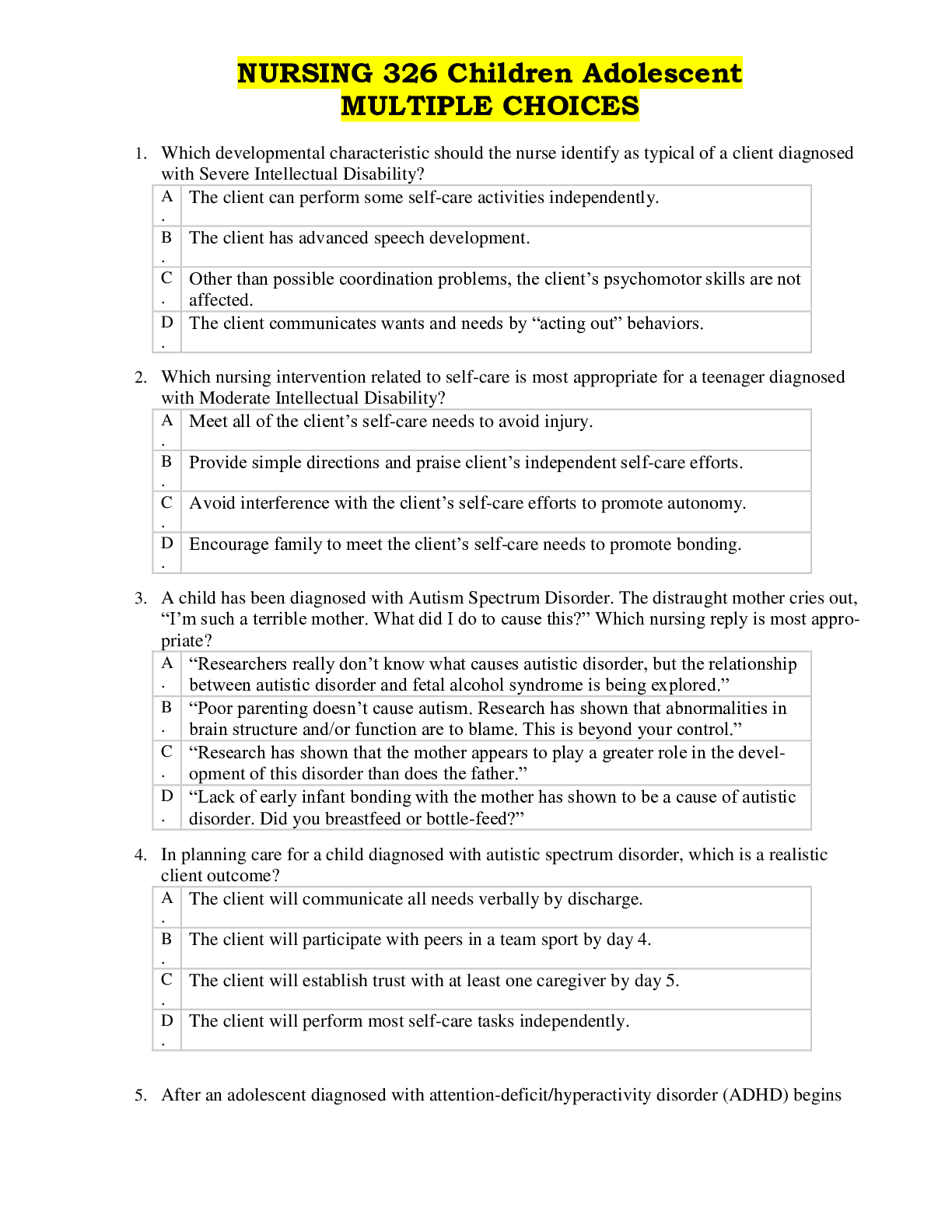
NURSING 326 Children Adolescent
MULTIPLE CHOICES
1. Which developmental characteristic should the nurse identify as typical of a client diagnosed
with Severe Intellectual Disability?
A .
The client can perform some self-care activities independently.
B .
The client has advanced speech development.
C .
Other than possible coordination problems, the client’s psychomotor skills are not
affected.
D .
The client communicates wants and needs by “acting out” behaviors.
2. Which nursing intervention related to self-care is most appropriate for a teenager diagnosed
with Moderate Intellectual Disability?
A .
Meet all of the client’s self-care needs to avoid injury.
B .
Provide simple directions and praise client’s independent self-care efforts.
C .
Avoid interference with the client’s self-care efforts to promote autonomy.
D .
Encourage family to meet the client’s self-care needs to promote bonding.
3. A child has been diagnosed with Autism Spectrum Disorder. The distraught mother cries out,
“I’m such a terrible mother. What did I do to cause this?” Which nursing reply is most appropriate?
A .
“Researchers really don’t know what causes autistic disorder, but the relationship
between autistic disorder and fetal alcohol syndrome is being explored.”
B .
“Poor parenting doesn’t cause autism. Research has shown that abnormalities in
brain structure and/or function are to blame. This is beyond your control.”
C .
“Research has shown that the mother appears to play a greater role in the development of this disorder than does the father.”
D .
“Lack of early infant bonding with the mother has shown to be a cause of autistic
disorder. Did you breastfeed or bottle-feed?”
4. In planning care for a child diagnosed with autistic spectrum disorder, which is a realistic
client outcome?
A .
The client will communicate all needs verbally by discharge.
B .
The client will participate with peers in a team sport by day 4.
C .
The client will establish trust with at least one caregiver by day 5.
D .
The client will perform most self-care tasks independently.
5. After an adolescent diagnosed with attention-deficit/hyperactivity disorder (ADHD) beginsmethylphenidate (Ritalin) therapy, the nurse notes that the adolescent loses 10 pounds in a 2-
month period. Which is the best explanation for this weight loss?
A .
The pharmacological action of Ritalin causes a decrease in appetite.
B .
Hyperactivity seen in ADHD causes increased caloric expenditure.
C .
Side effects of Ritalin cause nausea; therefore, caloric intake is decreased.
D .
Increased ability to concentrate allows the client to focus on activities rather than
food.
6. An adolescent client who was diagnosed with Conduct Disorder at the age of 8 is sentenced to
juvenile detention after bringing a gun to school. Which indicates the nurse’s understanding of
conduct disorder related to this client’s situation?
A .
Childhood-onset conduct disorder is more severe than the adolescent-onset type,
and these individuals likely develop antisocial personality disorder in adulthood.
B .
Childhood-onset conduct disorder is caused by a difficult temperament, and the
child is likely to outgrow these behaviors by adulthood.
C .
Childhood-onset conduct disorder is diagnosed only when behaviors emerge before the age of 5, and therefore improvement is likely.
D .
Childhood-onset conduct disorder has no treatment or cure, and children diagnosed with this disorder are likely to develop progressive oppositional defiant
disorder.
7. Which finding is the nurse most likely to assess in a child diagnosed with Separation Anxiety
Disorder?
A .
The child has a history of antisocial behaviors.
B .
The child’s mother is diagnosed with an anxiety disorder.
C .
The child previously had an extroverted temperament.
D .
The child’s mother and father have an inconsistent parenting style.
8. A child has been recently diagnosed with Mild Intellectual Disability (ID). Which information
about this diagnosis should the nurse include when teaching the child’s mother?
A .
Children with mild ID need constant supervision.
B .
Children with mild ID develop academic skills up to a sixth-grade level.
C .
Children with mild ID appear different from their peers.
D .
Children with mild ID have significant sensory-motor impairment.
9. A nursing instructor is teaching about the developmental characteristics of clients diagnosed
with Moderate ID. Which student statement indicates further instruction is needed?A .
“These clients can work in a sheltered workshop setting.”
B .
“These clients can perform some personal care activities.”
C .
“These clients may have difficulty relating to peers.”
D .
“These clients can successfully complete elementary school.”
10. Which nursing intervention should be prioritized when caring for a child diagnosed with ID?
A .
Encourage the parents to always prioritize the needs of the child.
B .
Modify the child’s environment to promote independence and encourage impulse
control.
C .
Delay extensive diagnostic studies until the child is developmentally mature.
D .
Provide one-on-one tutorial education in a private setting to decrease overstimulation.
11. A preschool child is admitted to a psychiatric unit with a diagnosis of Autism Spectrum
Disorder. To help the child feel more secure on the unit, which intervention should the nurse
include in this client’s plan of care?
A .
Encourage and reward peer contact.
B .
Provide consistent caregivers.
C .
Provide a variety of safe daily activities.
D .
Maintain close physical contact throughout the day.
12. A preschool child diagnosed with Autism Spectrum Disorder has been engaging in constant
head-banging behavior. Which nursing intervention is most appropriate?
A .
Place client in restraints until the aggression subsides.
B .
Sedate the client with neuroleptic medications.
C .
Hold client’s head steady and apply a helmet.
D .
Distract the client with a variety of games and puzzles.
13. When planning care for a client, which medication classification should the nurse recognize as
effective in the treatment of Tourette’s disorder?
A Antipsychotic medications. B .
Antimanic medications
C .
Tricyclic antidepressant medications
D .
Monoamine oxidase inhibitor (MAOI) medications
14. Which behavioral approach should the nurse utilize when caring for children diagnosed with a
disruptive behavior disorder?
A .
Involving parents in designing and implementing the treatment process
B .
Reinforcing positive actions to encourage repetition of desired behaviors
C .
Providing opportunities to learn appropriate peer interactions
D .
Administering psychotropic medications to improve quality of life
15. A child diagnosed with Autism Spectrum Disorder has the nursing diagnosis of disturbed
personal identity. Which outcome best addresses this client’s diagnosis?
A .
The client will name own body parts as separate from others by day 5.
B .
The client will establish a means of communicating personal needs by discharge.
C .
The client will initiate social interactions with caregivers by day 4.
D .
The client will not harm self or others by discharge.
16. A nursing instructor presents a case study in which a 3-year-old child is in constant motion
and is unable to sit still during story time. The instructor asks a student to evaluate this child’s
behavior. Which response indicates that the student has evaluated the situation appropriately?
A .
“This child’s behavior must be evaluated according to developmental norms.”
B .
“This child has symptoms of ADHD.”
C .
“This child has symptoms of the early stages of autistic disorder.”
D .
“This child’s behavior indicates possible symptoms of oppositional defiant disorder.”
17. A client has an IQ of 47. Which nursing diagnosis best addresses a client problem associated
with this degree of intellectual disability?
A .
Risk for injury R/T self-mutilation
B .
Altered social interaction R/T nonadherence to social convention
C .
Altered verbal communication R/T delusional thinking
D Social isolation R/T severely decreased gross motor skills.
18.A physician orders methylphenidate (Ritalin) for a child diagnosed with ADHD. Which
information about this medication should the nurse provide to the parents?
A .
If one dose of Ritalin is missed, double the next dose.
B .
Administer Ritalin to the child after breakfast.
C .
Administer Ritalin to the child just prior to bedtime.
D .
A side effect of Ritalin is decreased ability to learn.
19. Which should be the priority nursing intervention when caring for a child diagnosed with
Conduct Disorder?
A .
Modify the environment to decrease stimulation and provide opportunities for
quiet reflection.
B .
Convey unconditional acceptance and positive regard.
C .
Recognize escalating aggressive behaviors and intervene before violence occurs.
D .
Provide immediate positive feedback for appropriate behaviors.
20. A mother questions the decreased effectiveness of methylphenidate (Ritalin) prescribed for
her child’s ADHD. Which nursing reply best addresses the mother’s concern?
A .
“The physician will probably switch from Ritalin to a CNS stimulant.”
B .
“The physician may prescribe an antihistamine with the Ritalin to improve effectiveness.”
C .
“Your child has probably developed a tolerance to Ritalin and may need a higher
dosage.”
D .
“Your child has developed sensitivity to Ritalin and may be exhibiting an allergy.”
21. The nurse has taken report for the evening shift on an adolescent inpatient unit. Which client
should the nurse address first?
A .
A client diagnosed with Oppositional Defiant Disorder being sexually inappropriate with staff
B .
A client diagnosed with Conduct Disorder who is verbally abusing a peer in the
milieu
C .
A client diagnosed with Conduct Disorder who is demanding special attention
from staff
D .
A client diagnosed with ADHD who has a history of self-mutilation22. A 6-year-old client is prescribed methylphenidate (Ritalin) for a diagnosis of ADHD. When
teaching the parents about this medication, which nursing statement explains how Ritalin
works?
A .
“Ritalin’s sedation side effect assists children by decreasing their energy level.”
B .
“How Ritalin works is unknown. Although it is a stimulant, it does combat the
symptoms of ADHD.”
C .
“Ritalin helps the child focus by decreasing the amount of dopamine in the basal
ganglia and neuron synapse.”
D .
“Ritalin decreases hyperactivity by increasing serotonin levels.”
23. An 8-year-old client diagnosed with ADHD was admitted 5 days ago for management of
temper tantrums. Which should be a priority nursing intervention during the termination phase
of the nurse-client relationship?
A .
Set a contract with the client to limit acting-out behaviors while hospitalized.
B .
Teach the importance of taking fluoxetine (Prozac) consistently, even when feeling better.
C .
Discuss behaviors that are and are not acceptable on the unit.
D .
Ask the client to demonstrate learned coping skills without direction from the
nurse.
24. A child diagnosed with ADHD is having difficulty completing homework assignments.
Which information should the nurse include when teaching the parents about task performance improvement?
A .
The parents should isolate the child when completing homework to improve focus.
B .
The parents should withhold privileges if homework is not completed within a 2-
hour period.
C .
The parents should divide the homework task into smaller steps and provide an
activity break.
D .
The parents should administer an extra dose of methylphenidate (Ritalin) prior to
homework.
ANS: C
25. A nursing instructor is teaching about pharmacological treatments for ADHD. Which
information about atomoxetine (Strattera) should be included in the lesson plan?
A .
Atomoxetine (Strattera), unlike methylphenidate (Ritalin), is a CNS depressant.
B When taking atomoxetine (Strattera), a client should eliminate all red food color-. ing from the diet.
C .
Atomoxetine (Strattera) will be a life-long intervention for clients diagnosed with
this disorder.
D .
Atomoxetine (Strattera), unlike methylphenidate (Ritalin), is a selective norepinephrine reuptake inhibitor (SNRI).
26. A pregnant patient is being treated for uncontrolled diabetes and reports to the nurse, “I have
two other children, and my diabetes hasn’t affected them. I’m sure this baby will be fine too.”
What percentage of ID cases result in early alterations in embryonic development?
A .
5 percent
B .
10 percent
C .
20 percent
D .
30 percent
27. A care plan for the child with ID states that the child “will attempt to interact with others in
the presence of trusted caregiver.” This is an example of an outcome criterion for which nursing diagnosis?
A .
Impaired verbal communication; short-term goal
B .
Impaired verbal communication; long-term goal
C .
Impaired social interaction; short-term goal
D .
Impaired social interaction; long-term goal
28. Sophie is 11 years old, with a diagnosis of ADHD. Her parents report and provide documentation from her teachers that Sophie is distracted easily and is unable to complete classroom activities even in the presence of minimal stimulation. A nursing diagnosis of noncompliance
with task expectations has been determined, with a short-term goal that Sophie will participate
in and cooperate during therapeutic activities. What nursing intervention is most appropriate?
A .
Establish goals that allow Sophie to complete part of the task, rewarding each
step completion with a break for physical activity.
B .
Ask Sophie to repeat instructions to you.
C .
Provide assistance on a one-to-one basis, beginning with simple, concrete instructions.
D .
Provide an environment for task efforts that is as free of distractions as possible.
29. Why would a nurse establish goals for a client diagnosed with ADHD, presenting with low
frustration tolerance and short attention span that allows the client to complete part of the task,
rewarding each step-completion with a break for physical activity?
A .
Short-term goals are not so overwhelming with a short attention span.B .
Repetition of instructions helps to determine the client’s level of comprehension.
C .
This encourages the client to perform independently while providing a feeling of
security.
D .
The client lacks the ability to assimilate information that is complicated or has
abstract meaning.
MULTIPLE RESPONSE
30. Which of the following risk factors noted during a family history assessment should the nurse
associate with the potential development of ID? Select all that apply.
A .
A family history of Tay-Sachs disease
B .
Childhood meningococcal infection
C .
Deprivation of nurturance and social contact
D .
History of maternal multiple motor and verbal tics
E .
A diagnosis of maternal major depressive disorder
ANS: A, B, C
31. Which of the following interventions should the nurse anticipate implementing when planning
care for children diagnosed with ADHD? Select all that apply.
A .
Behavior modification
B .
Antianxiety medications
C .
Competitive group sports
D .
Group therapy
E .
Family therapy
32. The nurse should recognize which of the following findings contribute to a client’s development of ADHD? Select all that apply.
A .
The client’s father was a smoker.
B .
The client was born 7 weeks premature.
C .
The client is lactose intolerant.
D .
The client has a sibling diagnosed with ADHD.
E .
The client has been diagnosed with dyslexia.
[Show More]