NURSING 326 DIGESTIVE
Food undergoes which of the following types of processing in the body?
a. digestion
b. absorption
c. metabolism
d. all of the above
Which of the following processes does not occur in the diges
...
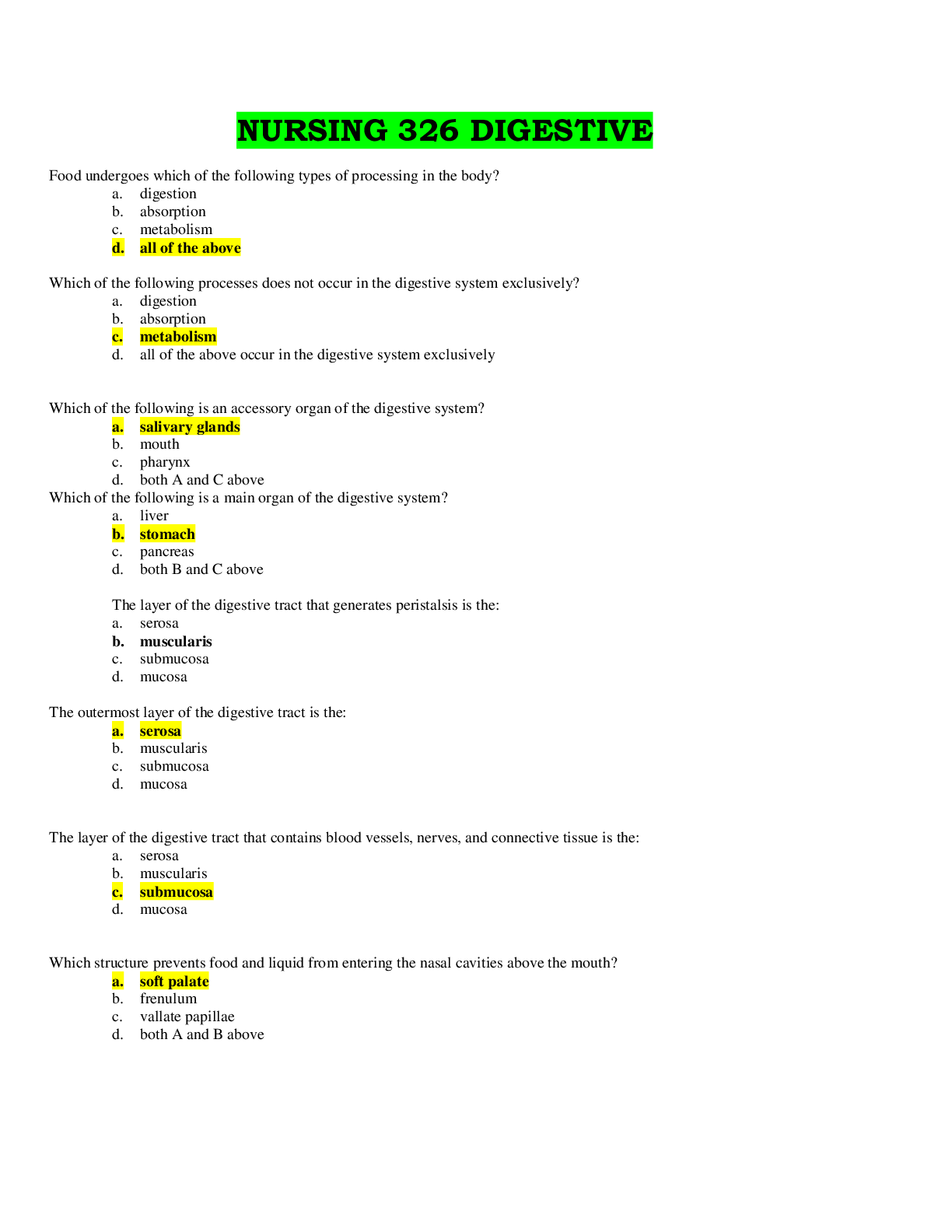
NURSING 326 DIGESTIVE
Food undergoes which of the following types of processing in the body?
a. digestion
b. absorption
c. metabolism
d. all of the above
Which of the following processes does not occur in the digestive system exclusively?
a. digestion
b. absorption
c. metabolism
d. all of the above occur in the digestive system exclusively
Which of the following is an accessory organ of the digestive system?
a. salivary glands
b. mouth
c. pharynx
d. both A and C above
Which of the following is a main organ of the digestive system?
a. liver
b. stomach
c. pancreas
d. both B and C above
The layer of the digestive tract that generates peristalsis is the:
a. serosa
b. muscularis
c. submucosa
d. mucosa
The outermost layer of the digestive tract is the:
a. serosa
b. muscularis
c. submucosa
d. mucosa
The layer of the digestive tract that contains blood vessels, nerves, and connective tissue is the:
a. serosa
b. muscularis
c. submucosa
d. mucosa
Which structure prevents food and liquid from entering the nasal cavities above the mouth?
a. soft palate
b. frenulum
c. vallate papillae
d. both A and B aboveEnamel is found in the:
a. root of the tooth
b. crown of the tooth
c. neck of the tooth
d. all of the above
Dentin is found in the:
a. root of the tooth
b. crown of the tooth
c. neck of the tooth
d. all of the above
The largest of the salivary glands is the:
a. sublingual gland
b. parotid gland
c. submaxillary gland
d. submandibular gland
Because of its location, the pharynx can be considered part of the:
a. digestive system
b. musculoskeletal system
c. respiratory system
d. both A and C above
The term “tricuspids” refers to these types of teeth:
a. incisors
b. canines
c. premolars
d. molars
The part of the stomach to the left and above the opening of the esophagus into the stomach is the:
a. pylorus
b. fundus
c. body
d. rugae
The part of the stomach that joins with the small intestine is the:
a. pylorus
b. fundus
c. body
d. rugae
The part of the stomach that joins with the small intestine is the:
a. pylorus
b. fundus
c. body
d. rugae
Which of the following structures does not help to increase the absorptive surface area of the small intestine?
a. villi
b. plicae
c. lacteald. microvilli
The sequence of sections of small intestine through which food passes would be:
a. duodenum, jejunum, ileum
b. duodenum, ileum, jejunum
c. jejunum, ileum, duodenum
d. jejunum, duodenum, ileum
In which part of the small intestine does most of the chemical digestion occur?
a. ileum
b. jejunum
c. duodenum
d. both A and C above
Which of the following statements is correct?
a. The cystic duct drains bile from the liver.
b. The cystic duct and hepatic duct join to form the common bile duct.
c. The hepatic duct connects the gallbladder and the small intestine.
d. Both A and C above
The function of bile is to:
a. chemically digest fat
b. emulsify fat
c. remove cholesterol from the body
d. both B and C above
At the hepatic flexure, the:
a. transverse colon becomes the descending colon
b. descending colon becomes the transverse colon
c. ascending colon becomes the transverse colon
d. ascending colon becomes the descending colon
At the splenic flexure, the:
a. transverse colon becomes the descending colon
b. descending colon becomes the sigmoid colon
c. ascending colon becomes the transverse colon
d. ascending colon becomes the descending colon
the vermiform appendix:
a. produces enzymes that assist in fat digestion
b. gets its name because it looks like a worm
c. is important in the reabsorption of bile
d. none of the above
Which of the following is an extension of the peritoneum?
a. mesentery
b. cecum
c. the greater omentum
d. both A and C aboveEnzymes are important in:
a. mechanical digestion
b. deglutition
c. chemical digestion
d. both A and C above
Amylase is made in the:
a. salivary glands
b. stomach
c. pancreas
d. both A and C above
The end product of amylase digestion is usually:
a. glucose
b. lactose
c. maltose
d. fructose
The most abundant end product of carbohydrate digestion is:
a. maltose
b. glucose
c. lactose
d. sucrose
Maltase and sucrase are made in the:
a. small intestine
b. pancreas
c. stomach
d. liver
Protein digestion begins in the:
a. mouth
b. stomach
c. small intestine
d. large intestine
In the stomach:
a. pepsin converts hydrochloric acid to pepsinogen
b. pepsin converts pepsinogen to hydrochloric acid
c. hydrochloric acid converts pepsinogen to pepsin
d. hydrochloric acid converts pepsin to pepsinogen
Trypsin:
a. is important in protein digestion
b. works in the stomach
c. is made in the liver
d. all of the above
Protein digestion:
a. end products are amino acids
b. uses peptidase made in the small intestines
c. uses trypsin made in the pancreas
d. all of the above
Fat digestion begins in the:a. mouth
b. stomach
c. small intestine
d. large intestine
Bile:
a. causes the emulsification of fat
b. is made in the liver
c. works in the small intestine
d. all of the above
Lipase:
a. is made in the pancreas
b. is stored in the gallbladder
c. converts fatty acid and glycerol to fats
d. all of the above
The movement of digested food from the digestive system to the circulating fluid is called:
a. digestion
b. deglutition
c. absorption
d. peristalsis
Which of the following processes is not considered an example of mechanical digestion?
a. the teeth chewing food
b. the stomach churning food
c. amylase acting on food in the mouth
d. bile acting on food in the small intestine
The layers of the digestive tract from the inside (lumen) to the outside are:
a. submucosa, mucosa, muscularis, serosa
b. mucosa, submucosa, muscularis, serosa
c. mucosa, submucosa, serosa, muscularis
d. mucosa, serosa, submucosa, muscularis
Canine teeth are sometimes called:
a. cuspids
b. incisors
c. bicuspids
d. tricuspids
The tube that drains bile from the liver is the:
a. common bile duct
b. cystic duct
c. hepatic duct
d. major duodenal papillae
The tube that drains bile from the gallbladder is the:
a. common bile duct
b. cystic duct
c. hepatic duct
d. major duodenal papillaeWhich of the following substances is absorbed by the large intestine?
a. salts
b. vitamin K
c. water
d. all of the above
Which of the following substances is absorbed into the blood capillaries of the intestinal villi?
a. amino acids
b. fatty acids
c. glycerol
d. all of the above
The length of the gastrointestinal tract in an adult is about
a. 9 feet
b. 19 feet
c. 29 feet
d. 39 feet
Which of the following is not true of the gastrointestinal tract?
a. It is about 9 feet long in adults.
b. It is also called the alimentary canal.
c. The material in the gastrointestinal tract is considered to be outside the body.
d. All of the above are true of the gastrointestinal tract.
Which of the following is not considered a main part of the tooth?
a. root
b. cuspid
c. crown
d. neck
The ducts that carry secretion from the pancreas empty into which part of the digestive tract?
a. stomach
b. duodenum
c. ileum
d. jejunum
Which of the following is not a function of the pancreas?
a. produces enzymes that digest proteins
b. produces proteins that digest fat
c. produces a substance that neutralizes hydrochloric acid produced in the stomach
d. All of the above are functions of the pancreas.Match each of the terms with its definition or description.
a. liver k. pylorus
b. gallbladder l. duodenum
c. mucosa layer m. ileum
d. mesentery n. pancreas
e. muscularis layer o. transverse colon
f. serosa layer p. peristalsis
g. ascending colon q. vermiform appendix
h. salivary glands r. villi
i. esophagus s. descending colon
j. fundus t. jejunum
._____ Part of the digestive tract wall that generates peristalsis
_____ Gland that produces lipase and trypsin
_____ Part of the small intestine that connects to the stomach; where most of the chemical digestion takes place
_____ Submandibular, sublingual, and parotid are all this type of gland
_____ Structure that concentrates and stores bile
_____ Innermost layer of the wall of the digestive tract
_____ Part of the large intestine that is between the cecum and hepatic flexure
_____ An extension of the peritoneum
_____ Part of the small intestine that joins with the large intestine
_____ Part of the stomach that joins with the small intestine
_____ Tube that leads from the pharynx to the stomach
_____ Gland that produces bile
_____ Outermost layer of the wall of the digestive tract
_____ Part of the large intestine between the splenic and hepatic flexures
_____ Part of the stomach that is to the left and above where the esophagus opens into the stomach
_____ Tiny finger-like projections that help absorb food in the small intestine
_____ A worm-like tubular structure that is attached to the cecum of the large intestines
_____ Muscle contractions that propel food through the digestive tract
_____ Part of the small intestine into which food enters when it leaves the duodenum_____ Part of the colon that lies between the splenic flexure and the sigmoid colon
Match each of the terms with its definition or description.
a. digestion i. glycerol
b. absorption j. amino acids
c. amylase k. mastication
d. bile l. lactase
e. maltase m. hydrochloric acid
f. lipase n. trypsin
g. pepsin o. deglutition
h. monosaccharides p. sucrase
_____ Causes the emulsification of fats
_____ Enzyme that reduces complex carbohydrates to maltose
_____ This and fatty acids are the end products of fat digestion
_____ Enzyme that converts maltose to simple sugars
_____ Enzyme that is responsible for the chemical digestion of fats
_____ Movement of digested food from the digestive system to the blood or lymph
_____ End product of carbohydrate digestion
_____ A protein enzyme that must be activated by hydrochloric acid in the stomach
_____ End product of protein digestion
[Show More]