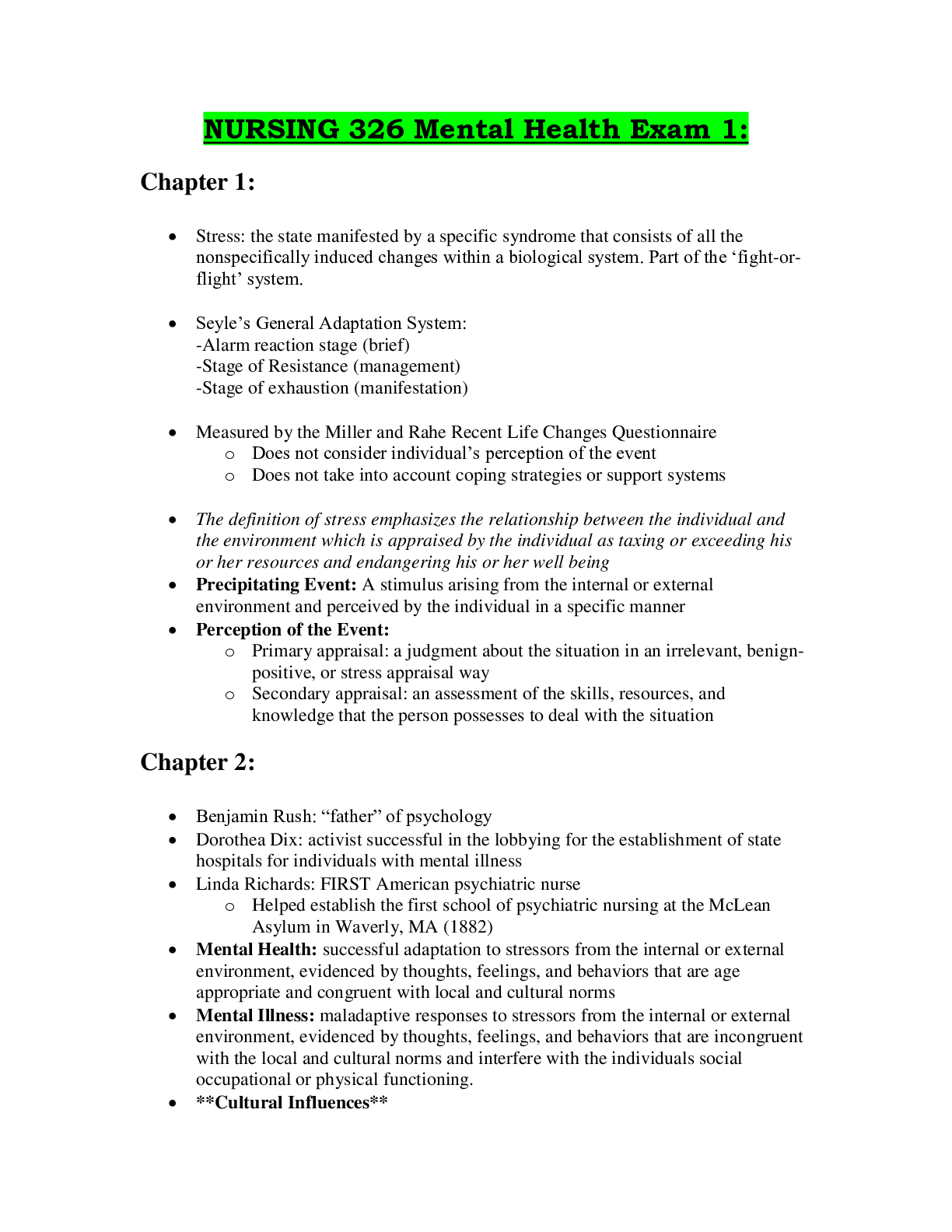
NURSING 326 Mental Health Exam 1:
Chapter 1:
Stress: the state manifested by a specific syndrome that consists of all the
nonspecifically induced changes within a biological system. Part of the „fight-orflight‟ syst
...
NURSING 326 Mental Health Exam 1:
Chapter 1:
Stress: the state manifested by a specific syndrome that consists of all the
nonspecifically induced changes within a biological system. Part of the „fight-orflight‟ system.
Seyle‟s General Adaptation System:
-Alarm reaction stage (brief)
-Stage of Resistance (management)
-Stage of exhaustion (manifestation)
Measured by the Miller and Rahe Recent Life Changes Questionnaire
o Does not consider individual‟s perception of the event
o Does not take into account coping strategies or support systems
The definition of stress emphasizes the relationship between the individual and
the environment which is appraised by the individual as taxing or exceeding his
or her resources and endangering his or her well being
Precipitating Event: A stimulus arising from the internal or external
environment and perceived by the individual in a specific manner
Perception of the Event:
o Primary appraisal: a judgment about the situation in an irrelevant, benignpositive, or stress appraisal way
o Secondary appraisal: an assessment of the skills, resources, and
knowledge that the person possesses to deal with the situation
Chapter 2:
Benjamin Rush: “father” of psychology
Dorothea Dix: activist successful in the lobbying for the establishment of state
hospitals for individuals with mental illness
Linda Richards: FIRST American psychiatric nurse
o Helped establish the first school of psychiatric nursing at the McLean
Asylum in Waverly, MA (1882)
Mental Health: successful adaptation to stressors from the internal or external
environment, evidenced by thoughts, feelings, and behaviors that are age
appropriate and congruent with local and cultural norms
Mental Illness: maladaptive responses to stressors from the internal or external
environment, evidenced by thoughts, feelings, and behaviors that are incongruent
with the local and cultural norms and interfere with the individuals social
occupational or physical functioning.
**Cultural Influences**o Incomprehensibility: the inability of the general population to understand
the motivation behind a behavior
o Cultural Relativity: the „normality‟ of a behavior is determined by the
culture
**Anxiety and grief are two major primary psychological response
patterns to stress**
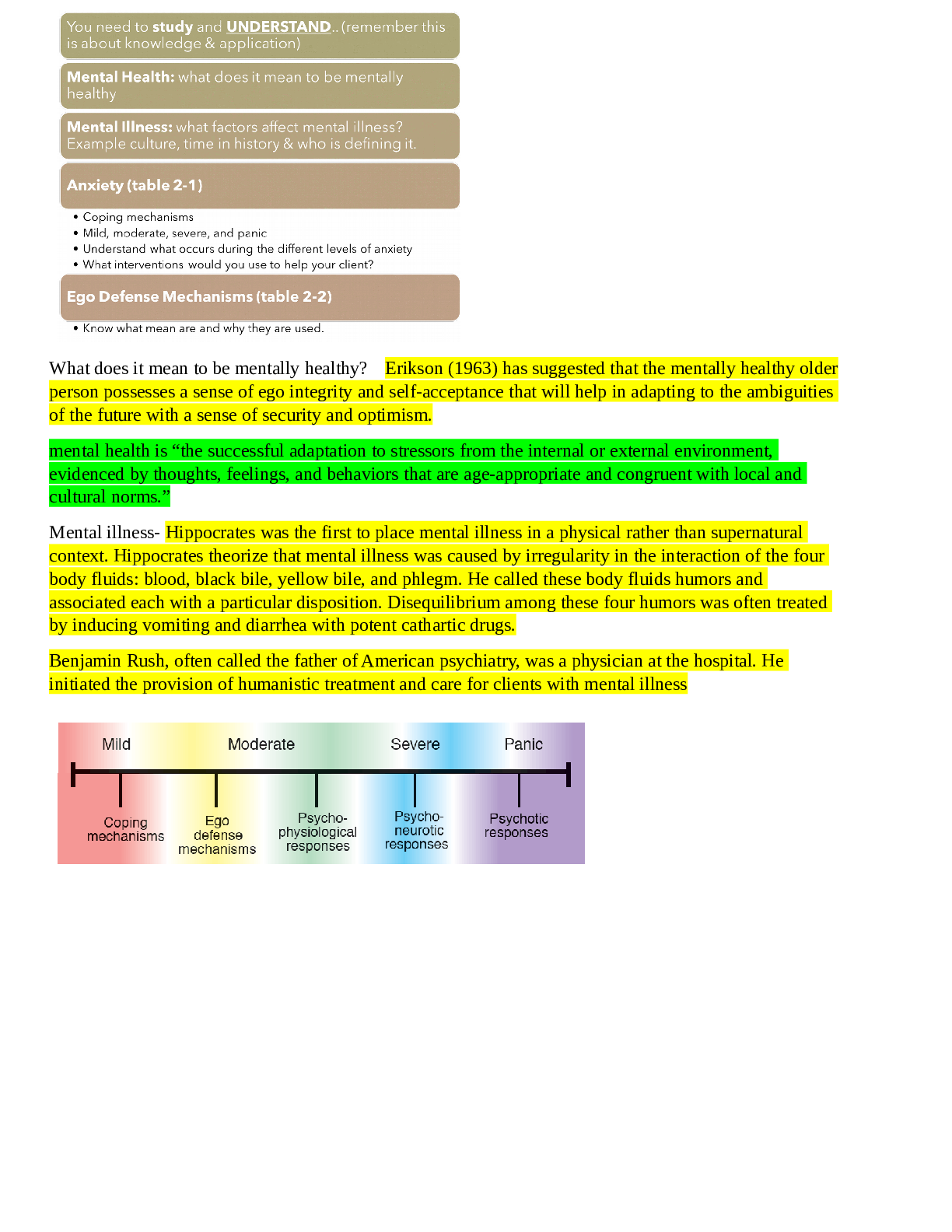
Anxiety: a diffuse apprehension that is vague in nature and is associated with
feelings of uncertainty and helplessness
Hildegard Peplau’s Four Levels of Anxiety:
o Mild: Seldom a problem
o Moderate: perceptual field diminishes
o Severe: perceptual fear is so diminished that concentration is centered
around one detail only, or many extraneous details
o Panic: most intense state
Functioning and the moderate to severe level of anxiety can cause migraines,
IBS, and cardiac arrhythmias
Repressed severe anxiety can result in anxiety disorders, somatic symptom
disorders and dissociative disorders
Extended periods of functioning at the panic level can cause psychosis and
psychotic behavior
**Kubler-Ross‟s 5 Stages of Grief”
1. Denial
2. Anger
3. Bargaining
4. Depression
5. Acceptance
Anticipatory Grief: the experience of the grieving process before the actual loss
occurs
Resolution: The length of the grief process is entirely individual. Can last from a
few weeks to years and is influenced by a number of factors
**Resolution of the grief response is thought to occur when an individual can look
back on the relationship with the lost entity and accept both the pleasures and the
disappointments of the association
Chapter 3:
Personality is defined as the characteristic way in which a person think, feels, and
behaves; the ingrained pattern of behavior that each person evolves, both consciously and
unconsciously, as his or her style of life or way of being.
Stages are identified by age but influenced by temperament
Personality disorders occur when personality traits become inflexible and
personality functioning becomes individually and interpersonally impaired Freud
o Basic character was formed by 5 years old
o 3 major components:
ID
EGO
SUPEREGO
Dynamics of Personality: Freud
o Psychic Energy
o Cathexis
o Anticathixis
Development of the Personality: Freud
o Oral Stage (birth to 18 months)
o Anal Stage (18 months to 3 years)
o Phallic Stage (3 to 6 years)
o Latency Stage (6 to 12 years)
o Genital Stage (13 to 20 years)
Interpersonal Theory: Sullivan- based on the belief that the individual behavior
and personality development are the direct result of interpersonal relationships
o Infancy (birth to 18 months)
o Childhood (18 months to 6 years)
o Juvenile (6 to 9 years)
o Preadolescence ( 9 to 12 years)
o Early Adolescence (12 to 14 years)
o Late Adolescence (14 to 21 years)
Theory of Psychosocial Development: Erikson
o Trust v Mistrust (birth to 18 months)
o Autonomy v Shame and Doubt (18 months to 3 years)
o Initiative v Guilt (3 to 6 years)
o Industry v Inferiority ( 6 to 12 years)
o Identity v Role Confusion (12 to 20 years)
o Intimacy v Isolation (20 to 30 years)
o Generativity v Stagnation (30 to 65 years)
o Ego Integrity v Despair (65 years to death)
Theory of Object Relations: Mahler- Based on the separation individual process
of the infant from the maternal figure (primary caregiver)
o Phase I: Autism (birth to 1 month)
o Phase II: Symbiosis (1 to 5 months)
o Phase III: Separation-Individuation (5 to 36 months)
Differentiation (5 to 10 months)
Practicing (10 to 16 months)
Rapprochement (16 to 24 months)
Consolidation (24 to 36 months)
** The emotional problems of many individuals can be traced to lack of fulfillment of the
tasks of separation-individuation Theory of Moral Development: Kohlberg- Stages of moral development are tied
to individual‟s motivation behind the behavior
o Preconventional Level (4-10 years)
o Conventional Level (10-13 years and into adulthood)
o Postconventional Level (from adolescence on)
Nursing Model of Interpersonal Development: Peplau
o Stranger - in the beginning nurse and patient are strangers
o Resource Person – the nurse provides information related to the client‟s
health care
o Counselor – the nurse uses interpersonal techniques to help client‟s learn
to adapt to difficulties or changes in life experiences
o Teacher – the nurse identifies learning needs and provides education to
improve the health situation
o Leader – allows the client to be an active participant in his or her care
o Technical Expert – the nurse possesses the clinical skills necessary to
perform the interventions that are in the client‟s best interest
o Surrogate – for the client, the nurse fulfills basic needs which is
associated with mothering
Four Stages of Personality Development: Peplau
o Stage 1: Learning to count on others
o Stage 2: Learning to delay gratification
o Stage 3: Identifying Oneself
o Stage 4: Developing skills in participation
Chapter 4:
The “limbic” system is the emotional brain and can help stabilize emotional
behavior
Antipsychotics are to be used as an adjunct to individual or group therapy
Most action occurs at the neuronal synapse
Antidepressants block reuptake of Serotonin and Nor epinephrine (SSRI)
Antipsychotics work by blocking specific neurotransmitter receptors
Benzodiazepines facilitate the transmission of GABA
Chapter 5:
Right: is a valid, legally recognized claim or entitlement encompassing both freedom
from government interference or discriminatory treatment and entitlement to a benefit or
service
Absolute Right: when there is no restriction whatsoever on the individual‟s entitlement
Legal Right: is a right on which the society has agreed and formalized into law
5 Ethical Principles
Autonomy
Beneficence
Nonmaleficence
Justice Fidelity/Veracity
Ethical Issues in Psych:
o The right to refuse medication
o The right to the least restrictive treatment alternative
The Nurse Practice Act: Defines the scope of practice for nurses
Chapter 7:
A therapeutic relationship is an interaction between two people (usually a
caregiver and care receiver) in which input from both participants contributes to a
climate of healing, growth promotion, and illness prevention
Peplau believe that the emphasis in psychiatric nursing should be on the
counseling subrole
Therapeutic Use of Self: The ability to use one‟s personality consciously and in
full awareness in an attempt to establish relatedness and to structure nursing
interventions
The Johari Window: representation of the self and a tool that can be used to
increase self-awareness
o The open or public self
o The unknowing self
o The unknown self
o The private self
Conditions Essential to Development of a Therapeutic Relationship:
o Rapport
o Trust
o Respect
o Genuineness
o Empathy
Phases of the Therapeutic Relationship
o Preinteraction Phase
o Orientation Phase
o Working Phase
Transference
Countertransference
o Termination Phase
Remember to keep boundaries with patient
Chapter 8:
Preexisting conditions affect communication and treatment. Things such as:
o Gender
o Social Status
o Values, attitudes, beliefs
o Culture/ Religion
o Age and Developmental Level Therapeutic Communication Techniques:
o Using silence
o Accepting
o Giving recognition
o Offering self
o Giving broad openings
o Offering general leads
o Placing the event in time or sequence
o Making observations
o Encouraging descriptions of perceptions
o Encouraging comparison
o Restating
o Reflecting
o Focusing
o Exploring
o Seeking clarification and validation
o Presenting reality
o Voicing doubt
o Verbalizing the implied
o Attempting to translate words into feelings
o Formulating a plan of action
Nontherapeutic Communication Techniques
o Giving reassurance
o Rejecting
o Giving approval or disapproval
o Agreeing/disagreeing
o Giving advice
o Probing
o Defending
o Requesting an explanation
o Indicating then existence of an external source of power
o Belittling feelings expressed
o Making stereotyped comments
o Using denial
o Interpreting
o Introducing unrelated topics
**Active Listening
Sit facing the client
Observe an open posture
Lean towards client
Establish eye contact
Relax
Chapter 9:
**The nursing process in Psychiatric Nursing: Assessment
Diagnosis
Outcomes Identification
o NOC- Nursing Outcomes Classification
Planning
o Nursing Interventions Classification
Implementation
APIE: Assessment, Problem, Intervention, Evaluation
Chapter 10:
Therapeutic Groups v. Group Therapy:
Group Therapy: has a sound theoretical base and leaders generally have advanced
degrees in psychology, social work, nursing, or medicine
Therapeutic Groups: based to a lesser extent on theory; focus is on group
relations, interactions, between group members, and the consideration of a
selected issue
Self-Help Groups: Composed of individuals with similar problems (i.e. AA, NA)
Curative Factors of Groups
o Instillation of Hope
o Universality
o Imparting of Information (education)
o Altruism- assistance and support to each other
o Corrective Recapitulation of the Primary Family Group
o Development of Socializing Techniques
o Imitative Behavior
o Interpersonal Learning
o Group Cohesiveness
o Catharsis
o Existential Factors
Chapter 12:
Milieu Therapy: therapeutic community- a scientific structuring of the environment to
effect behavioral changes and to improve the psychological health and functioning of the
individual
Every interaction is an opportunity for therapeutic interventions
The client owns his or her environment and his or her own behavior
Inappropriate behaviors are dealt with as they occur
Restrictions and punishment are to be avoided
Chapter 13:
Any stressful situation can precipitate a crisis
Crisis: any sudden event in one‟s life that disturbs homeostasis during which
usual coping mechanisms cannot resolve the problem Response to a crisis depends on three factors:
1. The individual‟s perception of the event
2. The availability of situational support
3. The availability of adequate coping mechanisms
Dispositional Crisis: an acute response to an external situational stressor
Crises of Anticipated Life Transitions: normal life-cycle transitions that may be
anticipated but over which the individual may feel a lack of control
Crisis Resulting From Traumatic Stress: crisis precipitated by an unexpected
external stressor over which the individual has little or no control and from which
he or she feels emotionally overwhelmed and defeated
Maturational/ Developmental Crisis: crisis that occurs in response to a situation
that triggers emotions related to unresolved conflicts in one‟s life
Crisis Reflecting Psychopathology: emotional crisis of which preexisting
psychopathology has been instrumental in precipitating or in which
psychopathology significantly impairs or complicates adaptive resolution
Phases of the Crisis Intervention:
o Phase 1: Assessment
o Phase 2: Planning of Therapeutic Intervention
o Phase 3: Intervention
o Phase 4: Evaluation of Crisis Resolution and Anticipatory Planning
Chapter 16:
Aggression: one way that individuals express anger, can be emotional or physical. Is a
behavior that is intended to threaten or injure the victim‟s security or self esteem
**Role modeling is one of the strongest forms of learning**
Operant Conditioning is when a specific behavior is learned by positive or
negative reinforcement
Anger and aggression can be learned through operant conditioning
Predisposing Factors to anger and aggression:
o Biochemical factors
o Socioeconomic factors
o Environmental factors
Anger can be identified with characteristics that include:
o Frowning
o Clenched Fists
o Low-pitched words forced through clenched teeth
o Yelling and shouting
o Intense or no eye contact
o Easily offended
o Defensive
o Passive-aggressive
o Emotional overcontrol and flushed face
o Intense discomfort
o Tension Aggression can be identified by:
o Pacing
o Restlessness
o Tense face and body
o Verbal or physical threats
o Threats of homicide or suicide
o Loud voice, shouting, use of obscenities
o Argumentative
o Increased agitation
o Overreaction to environmental stimuli
o Panic anxiety
o Disturbed thought process
o Suspiciousness
o Disproportionate anger
o Role model
o Help find alternative ways of relieving tension
Chapter 18:
A behavior is considered to be maladaptive when it; is age inappropriate, interferes with
adaptive functioning, is misunderstood by others in terms of cultural inappropriateness
Techniques for modifying behavior:
o Shaping
o Modeling
o Contingency Contracting
o Token Economy
o Time Out
o Flooding
o Overt sensitization (medicine that makes you when you drink)
Chapter 19:
Cognitive Therapy is aimed at modifying distorted cognitions about a situation. The goal
is for client‟s to learn to identify and alter the dysfunctional beliefs that predispose them
to distort experiences
Goal orientated and problem-focused
Emphasizes the present
Automatic thoughts: thoughts that occur rapidly in response to a situation and
without rational analysis; sometimes called cognitive errors.
o Arbitrary inference
o Overgeneralization
o Dichotomous thinking
o Selective abstraction
o Magnification
o Minimization
o Catastrophic thinkingo Personalization
Schemas: Cognitive structures that develop early in life from personal
experiences. These concepts are reinforced by further learning experiences and
influence the formation of other beliefs, values, and attitudes. Schemas can be
adaptive or maladaptive, general or specific, and positive or negative.
Clients must be prepared to become their own therapists
Assignments are done to reinforce learning
Chapter 20:
ECT is the induction of a grand mal seizure through the application of an electrical
current to the brain; stimulus applied through electrodes
The duration of the seizure should be about 15 to 25 seconds
Usually administered every other day for about 6 to 12 treatments
Effective in the treatment of severe depression, growing popularity after the 80s
o NOT considered a treatment of first choice
Also indicated in the treatment of acute manic episodes of bipolar and acute
schizophrenia
Only contraindication is increased ICP
S/E include temporary memory loss and confusion, sometimes there is retrograde
amnesia
Atropine sulfate or glycopyrrolate is administered 30 minutes before the treatment
VS q 15 minutes after procedure
Orient client to help with confusion
Chapter 29:
Somatic symptom disorders are characterized by physical symptoms suggesting medical
disease but without demonstrable organic pathophysiological mechanism to account for
them. Dissociative disorders are defined by a disruption in the usually integrated
functions of consciousness, memory, and identity.
SSD‟s have been identified as hysterical neuroses and were thought to be a
response to repressed severe anxiety
SSD‟s are more commonly found in:
o Women
o Less educated persons
o Rural areas
Dissociative Disorders (DID) are rare. They are also more prevalent in women
than in men
Drug abuse and dependence are common complications of SSD
[Show More]


.png)


.png)

.png)