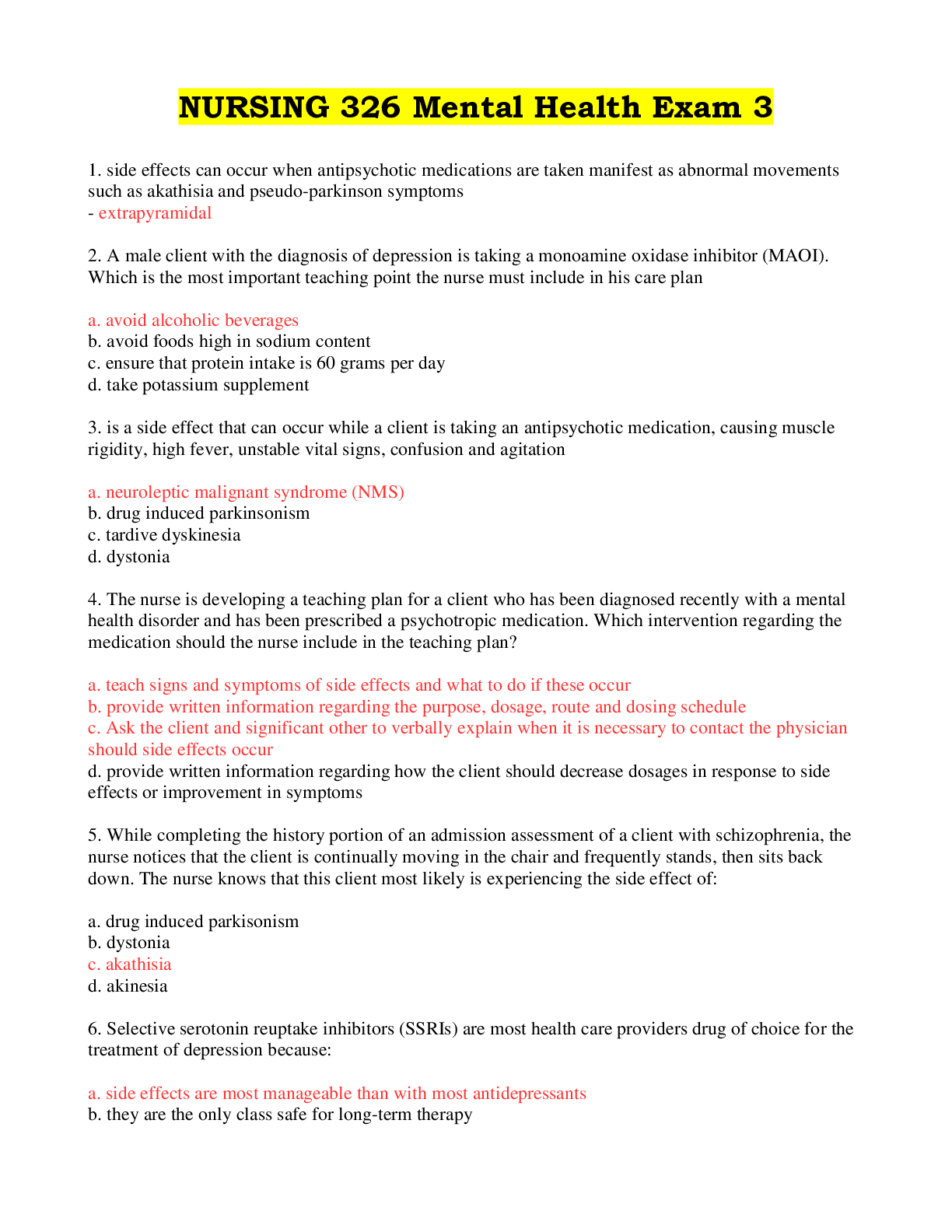
NURSING 326 Mental Health Exam 3
1. side effects can occur when antipsychotic medications are taken manifest as abnormal movements such as akathisia and pseudo-parkinson symptoms
- extrapyramidal
2. A male client
...
NURSING 326 Mental Health Exam 3
1. side effects can occur when antipsychotic medications are taken manifest as abnormal movements such as akathisia and pseudo-parkinson symptoms
- extrapyramidal
2. A male client with the diagnosis of depression is taking a monoamine oxidase inhibitor (MAOI). Which is the most important teaching point the nurse must include in his care plan
a. avoid alcoholic beverages
b. avoid foods high in sodium content
c. ensure that protein intake is 60 grams per day
d. take potassium supplement
3. is a side effect that can occur while a client is taking an antipsychotic medication, causing muscle rigidity, high fever, unstable vital signs, confusion and agitation
a. neuroleptic malignant syndrome (NMS)
b. drug induced parkinsonism
c. tardive dyskinesia
d. dystonia
4. The nurse is developing a teaching plan for a client who has been diagnosed recently with a mental health disorder and has been prescribed a psychotropic medication. Which intervention regarding the medication should the nurse include in the teaching plan?
a. teach signs and symptoms of side effects and what to do if these occur
b. provide written information regarding the purpose, dosage, route and dosing schedule
c. Ask the client and significant other to verbally explain when it is necessary to contact the physician should side effects occur
d. provide written information regarding how the client should decrease dosages in response to side effects or improvement in symptoms
5. While completing the history portion of an admission assessment of a client with schizophrenia, the nurse notices that the client is continually moving in the chair and frequently stands, then sits back down. The nurse knows that this client most likely is experiencing the side effect of:
a. drug induced parkisonism
b. dystonia
c. akathisia
d. akinesia
6. Selective serotonin reuptake inhibitors (SSRIs) are most health care providers drug of choice for the treatment of depression because:
a. side effects are most manageable than with most antidepressants
b. they are the only class safe for long-term therapy
c. this is the oldest class of antidepressants
d. they are fast-acting medications
7. An adult female client has been diagnosed recently with mild depression but opts not to take the medication prescribed by her physician after talking with the physician about the benefits, risks, possible outcomes and side effects. She decides to investigate alternative treatments. This client is making this decision based on the premise of:
a. informed consent
b. noncompliance
c. client education
d. right to privacy
8. The nurse is aware that he or she may be administering the new antianxiety medication pregabalin (Lyrica) to clients without an anxiety disorder for the purpose of treating:
a. depression
b. psychotic episodes
c. neuropathic pain
d. bipolar disorder
9. which of the following are basic responsibilities of nurses who administer psychotherapeutic drugs?
a. monitoring and evaluating the clients response to the medication
b. continually assessing the clients condition
c. adjusting medication dosages according to therapeutic levels
d. assisting in the coordination of the client's care
e. teaching clients about their medications, administering prescribed medications
f. administering prescribed medications
10. A female client who has had bipolar disorder for several years decides to stop all of her medications because she is tired of the side effects. She also cancels all appointments with her therapist, stating that it is just too difficult to plan the visits in her hectic schedule. This client is considered:
a. depressed
b. noncompliant
c. suffering from an anxiety disorder
d. possessing obsessive-compulsive tendencies
11. which one of the following is a biological cause of mood disorders?
a. anger turned inward
b. imbalance of neurotransmitters
c. reaction to external stressors
d. impaired nurturing
12. a client is experiencing an episode at the level of mania. Which behaviors are characteristic of this level?
a. outgoing, happy and worry free
b. decreased ability to concentrate e. unstable affect
c. confident f. pressured speech
d. disoriented g. poor hygiene
12. The client lives his life by rapidly bouncing from feelings of deep sadness to great joy. The client’s diagnosis is most likely:
a. bipolar disorder
b. major depression
c. anxiety disorder
d. dysthymic disorder
13. Theories that view depression as a group of learned responses are called:
a. social
b. behavioral
c. biological
d. psychoanalytical
14. which of the following statement are true regarding depression in the elderly?
a. it is a normal sequence of aging
b.the highest rates are among individuals who receive long term care
c. depression is higher in elderly women than men
d. older adults express feelings of depression in more subtle ways than younger person
e. most depressed older adults volunteer to share their feelings
15. a client asks the nurse which types of antidepressants have the fewest side effects. What is the nurse’s most accurate response?
a.“Tricyclic antidepressants”
b.“Nontricyclic antidepressants”
c.“Monoamine oxidase inhibitors (MAOIs)”
d.“Selective serotonin reuptake inhibitors (SSRIs)
16. during the continuation phase of therapy, a client with a diagnosis of depression asks, "what is the goal of therapy during this 4-to9- month period? what is the nurse's best response?
a. we are going to work together to try to reduce your symptoms
b. our goal is to determine the cause of your depression and cure it
c. we want to prevent you from ever having any depressive episodes in the future
d. our goal is to prevent you from relapsing and experiencing distressing emotional states
17. When the environment lacks security or presents dangers, the perception that life will be short or will end in violence is most compelling for:
a. Children
b. Adolescents
c. Young adults
d. Middle-aged adults
18. is a term that is used to describe a form of active suicidal behavior, such as gestures, threats, or attempts to end one's own life
- direct self-destructive behavior
19. is when a client thinks or fantasizes about death with no definite intent to commit suicide
- Suicidal ideation
20. All people who commit suicide are depressed or psychotic. This statement is a(n):
a. Fact
b. Myth
c. Opinion
d. Attitude
21. After establishing a no-harm contract with the client, the nurse should:
a. Begin to assess client risk factors.
b. Continue to maintain close observation.
c. Decrease observation activity to allow client autonomy.
d. Begin treatment with antidepressants
22. The theory that suicide rates are affected by group support, social changes, regulations, religion, legal sanctions or limitations, and philosophical beliefs is known as the ____ theory.
a. Biological
b. Sociological
c. Interpersonal
d. Psychoanalytical
23. An elderly male clients wife of 50 years recently died from cancer. He suffers from a chronic debilitating illness and has been refusing to eat, drink, or take his medications. This client is displaying behavior characteristic of:
a. Suicidal threats
b. Suicidal attempts
c. Suicidal ideation
d. Passive suicide
24. The nurse is caring for a male client with a major depressive disorder who has not responded well to various treatments in the past. The latest treatment method has resulted in slight improvement in the clients symptoms. On this particular day, the client has a very positive affect and says he feels amazingly better. The nurse should:
a. Congratulate him on his recovery.
b. Document the clients improvement.
c. Ask him what he feels has helped him feel better so suddenly.
d. Assess the client for signs and symptoms of suicidal thoughts.
25. The caregiver works with suicidal clients to establish therapeutic rapport. The focused communications and concerned actions encourage suicidal persons to:
a. Feel in control
b. Feel self-worth
c. Talk about themselves
d. Feel foolish for thinking about suicide
26. Biological studies of suicide victims show an imbalance of which neurotransmitter system?
a. Serotonin
b. Epinephrine
c. Norepinephrine
d. Dopamine
27. Suicide attempts by ____ are more successful because one out of every two attempts results in death.
a. Adolescents
b. Older adults
c. Young adults
d. Middle-aged adults
28. A terminally ill female client chooses the time and place of her own death. This is an example of:
a. Suicide
b. Self-injury
c. Rational suicide
d. Planned suicide
29. Bob drives fast everywhere he goes, especially when he is drinking. Last night, he was arrested for gambling and loud behavior. Bob is engaging in ____ behavior.
a. Adaptive
b. Suicidal
c. Direct self-destructive
d. Indirect self-destructive
30. Subsequent to a 2-week inpatient psychiatric admission, a hospitalized client with schizophrenia, who has been prescribed an antipsychotic medication for 2 months, is hallucinating and delusional and has disorganized speech. Which of the following nursing actions is appropriate?
a. Ask the physician for a liquid form of the drug
b. Ask the physician for a sustained-release form of the drug
c. Ask the physician for an enteric coated form of the drug
d. Ask the physician for a chewable form of the drug
31. Assessment of a client reveals dryness of the mouth, blurred vision, excessive sweating, and urinary retention. These findings are consistent with which type of reaction?
a. hypertensive crisis
b. anticholinergic reaction
c. serotonin syndrome
d. CNS depression
32. A client develops muscle rigidity, tremor, pacing, and incontinence. These are extrapyramidal side effects (EPSEs) of which of the following?
a. antipsychotic drugs
b. antidepressant
c. antianxiety
33. When teaching a client with an anxiety disorder about her buspirone (BuSpar) prescription, what important information should the nurse include?
a. the risk of sedation is lessened with this drug
b. the drug has numerous side effects
c. the drug has an increased risk for abuse
d. the drug takes 1-2 weeks to produce therapeutic effects.
34. The nurse should include what information for a client prescribed lithium?
a. limit fluids
b. balance fluid and sodium intake
c. restrict sodium intake
d. exercise outside in summer
35. The nurse is caring for client who has just been prescribed a benzodiazepine for treatment of anxiety. Which item in the client's history would cause the nurse to contact the health care provider before administering the medication?
a. The client has hepatitis C
b. the client took medicine approx 2 years ago
c. the client drinks 2 cups of tea
d. the client eats a diet high in sodium
36. A client who is taking an antipsychotic for schizophrenia should be advised to avoid alcohol for which reason?
a. CNS depression
b. CNS stimulation
c. accelerated hypertension
d. hypoglycemia
37. The nurse instructs the client taking an monoamine oxidase inhibitor (MAOI) to avoid foods that contain tyramine. This is an example of which client care guideline?
a. administer drug
b. teach client about the drug
c. assess client
d. monitor client
38. a clients son and daughter were killed during a fellow students murderous rampage at their high school 9 months ago. the client says to the nurse, "my wife and i just feel empty and exhausted. i cant believe that i had a vasectomy after our son and daughter were born because we wanted to give them both whatever they needed. we have college funds for both of them they'll never use now. the nurse should make which appropriate statement to the client?
a. your loss is incalculable. Perhaps you could consider some ways in which to commemorate their lives for you and in your community
b. your feelings are appropriate for the extent of your loss and how your childrens death happened
c. my parents would be devastated if they lost me too. How can I be of service to you?
d. your loss touches me so. How truly devastated you both must be. Can you share what things have you been doing to grieve?
39. a client comes to the mental health clinic after losing all of his personal belongings in a hurricane. the client tells the nurse that the loss of his possessions is his fault because he didnt prepare for the storm. the nurse determines that the client is coping ineffectively and develops goals with the client. which of the following goals is the least realistic?
a. the client will identify effective coping skills
b. the client will develop and use adaptive coping patterns
c. the client will express and share his feelings about this crisis
d. the client will stop blaming himself for the loss of his belongings
40. a client who is experiencing suicidal thoughts says to the nurse “life is just not worth it anymore” what is the appropriate initial response?
a. tell me what you mean by that
b. you have a lot to live for
c. a good nights sleep will help you feel better
d. you should feel grateful for everything you have
41. A nurse is evaluating the coping skills of a client with a diagnosis of depression. Which statement indicates to the nurse the need to help the client learn and appropriately use these skills?
a. I wont ever be depressed again
b. I have learned ways to deal with stress
c. I know that I cant do everything
d. I need to take my meds
42. A client who recently lost his hand in a workplace accident says to the nurse, "I don't know how I'm going to support my family with a plastic hand. I might as well be dead." Which nursing response would be therapeutic?
a. You're saying basically that you feel useless without your hand?"
b. perhaps you need to focus on being happy that you survived
c. dont worry about all of that at this point.
43. A single mother whose only son died 2 months ago says to the nurse, "I've been bothered at work with thoughts of my son. Suddenly I'll think of something awful I said to him years ago or some punishment I gave him because he'd been bad." Which of the following plans should the nurse include in caregiving?
a. Explaining that bereaved persons often describe intrusive thoughts of negative experiences with the deceased and then increasing the frequency of nurse-client visits.
b. scheduling the client for an appointment with psychiatrist, bec this is a patholigical manifestation
c. seeking emergency certification fro the psychiatric inpatient unit at the community hospital bec of high lethality concerns and visiting the client daily
d. calling the MD to report that the client is a high risk for suicide and increase frequency of visit
44. A 45-year-old client says to the nurse, "Since I left my wife and children, I can hardly make ends meet between child support and trying to support myself. I don't know why I bother going to work when my wife and kids take just about everything I make." Which nursing statement would be therapeutic?
a. Do you feel that child support is designed to help children, not punish spouses who leave?"
b. I wonder why you left your wife and children
c. you seem very angry about carrying out your responsibility to your childen
d. what would you expect your wife and children do? They didnt leave you
45. A client with depression says to a nurse, "Why is my family meeting with you? Are you telling them about me?" Which response by the nurse would be therapeutic?
a. Your family is learning about depression and how best to help you so that they can be supportive of you. We do not talk about you or anything confidential about you."
b. I am committed to keeping everything you say to me confidential, so it is troubling when you accuse me of talking to your family
c. you sound concerned that I would tell your family something about you eventhough you know that we talk about is confidential
d. have you talked with your family? What have they said to you about the meetings?
46. A nurse is talking to a client with depression when the client says, "I don't know why my son turned out like he did. I never thought that he would rob a bank! I don't know what I did wrong. I know that he didn't grow up with a father, but I gave him everything. I wish I could start over and do things differently." Which response by the nurse would be therapeutic?
a. you seem to be feeling regret
b. dont blame yourself.
c. all we can do is give our children love and do out best.
d. do I hear you saying that you feel that your sons behavior caused by his upbringing?
[Show More]


.png)



.png)