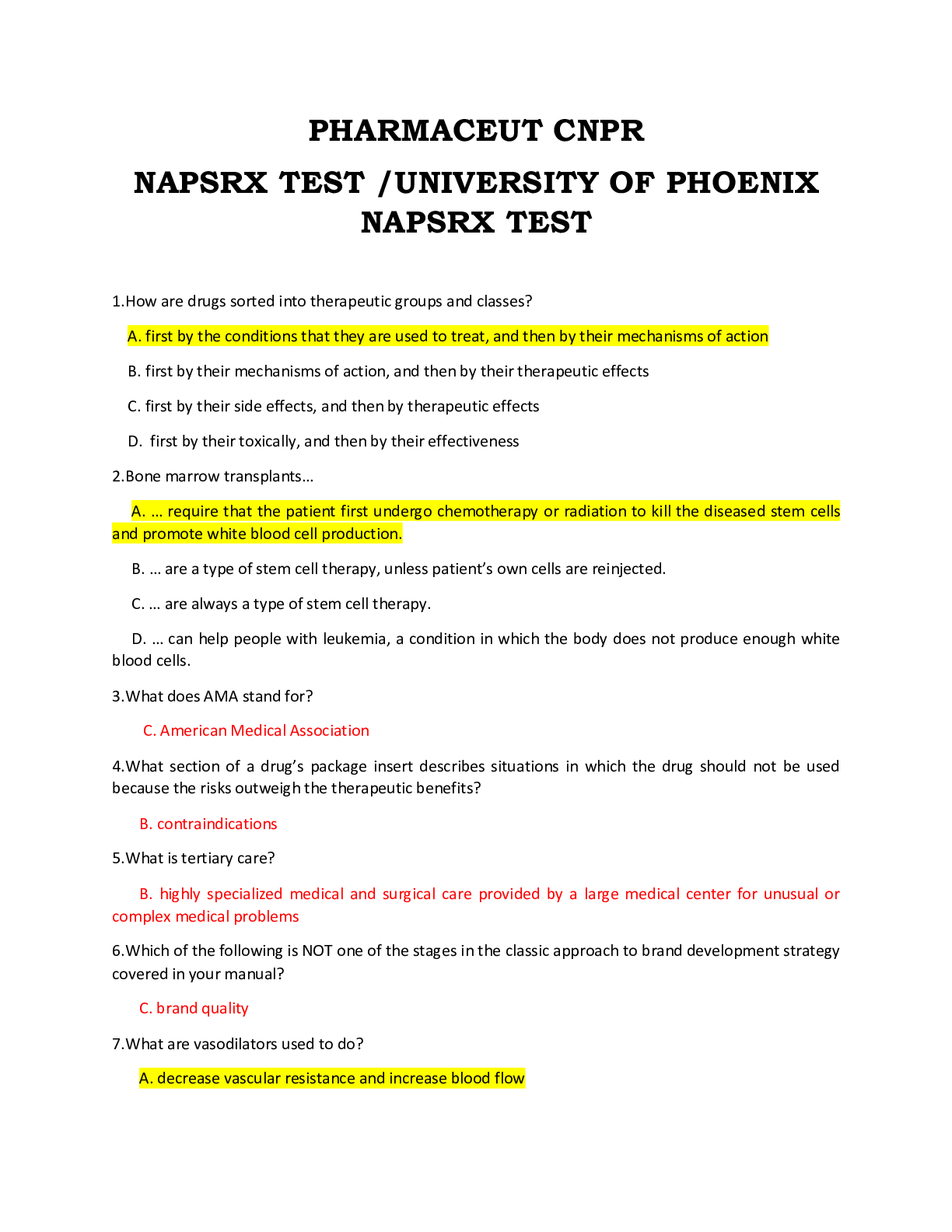
PHARMACEUT CNPR NAPSR
Quiz 1 Chapter 1
1. Pharmaceuticals are arguably the most socially important healthcare product. True
2. Pharmaceutical development is a high-risk undertaking, in which many promising leads
prov
...
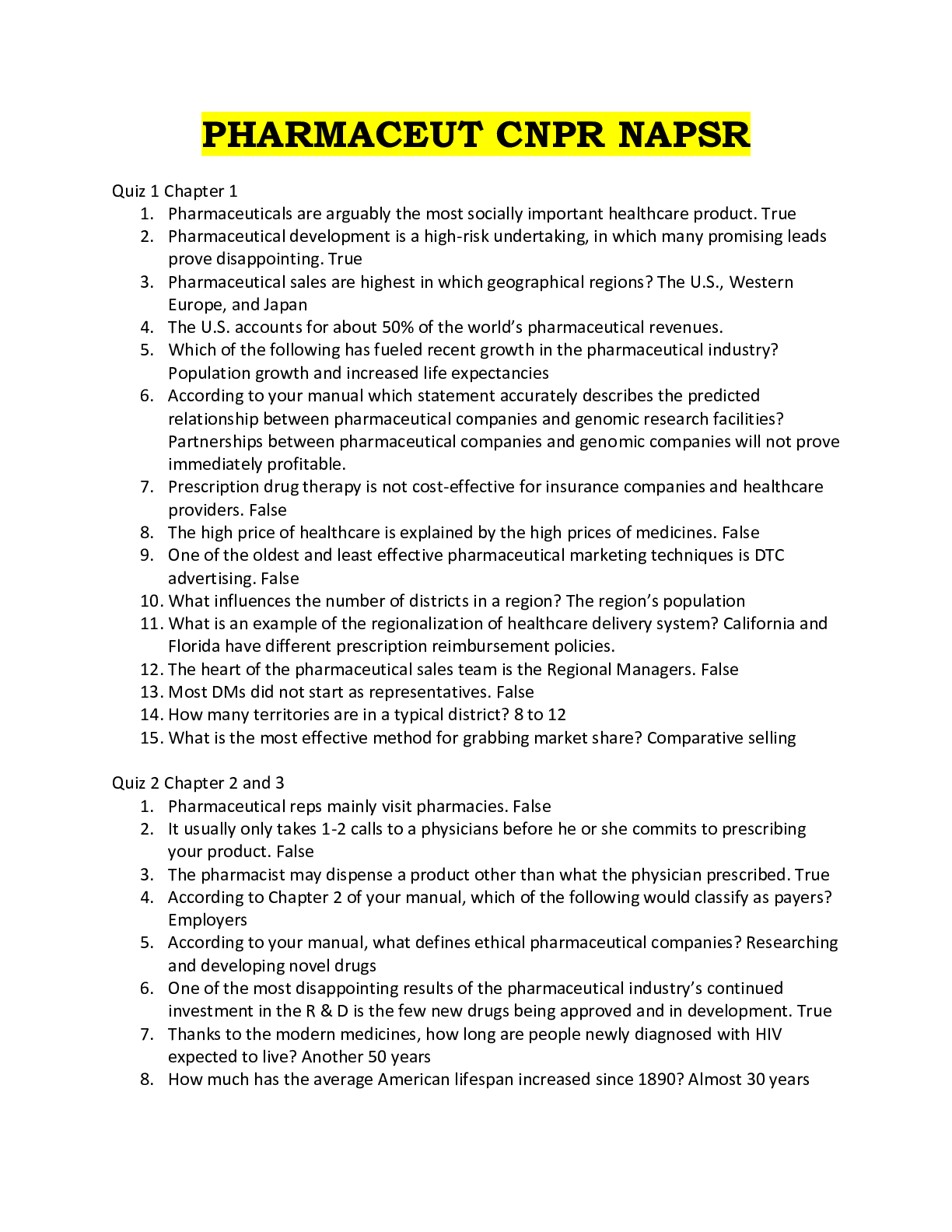
PHARMACEUT CNPR NAPSR
Quiz 1 Chapter 1
1. Pharmaceuticals are arguably the most socially important healthcare product. True
2. Pharmaceutical development is a high-risk undertaking, in which many promising leads
prove disappointing. True
3. Pharmaceutical sales are highest in which geographical regions? The U.S., Western
Europe, and Japan
4. The U.S. accounts for about 50% of the world’s pharmaceutical revenues.
5. Which of the following has fueled recent growth in the pharmaceutical industry?
Population growth and increased life expectancies
6. According to your manual which statement accurately describes the predicted
relationship between pharmaceutical companies and genomic research facilities?
Partnerships between pharmaceutical companies and genomic companies will not prove
immediately profitable.
7. Prescription drug therapy is not cost-effective for insurance companies and healthcare
providers. False
8. The high price of healthcare is explained by the high prices of medicines. False
9. One of the oldest and least effective pharmaceutical marketing techniques is DTC
advertising. False
10. What influences the number of districts in a region? The region’s population
11. What is an example of the regionalization of healthcare delivery system? California and
Florida have different prescription reimbursement policies.
12. The heart of the pharmaceutical sales team is the Regional Managers. False
13. Most DMs did not start as representatives. False
14. How many territories are in a typical district? 8 to 12
15. What is the most effective method for grabbing market share? Comparative selling
Quiz 2 Chapter 2 and 3
1. Pharmaceutical reps mainly visit pharmacies. False
2. It usually only takes 1-2 calls to a physicians before he or she commits to prescribing
your product. False
3. The pharmacist may dispense a product other than what the physician prescribed. True
4. According to Chapter 2 of your manual, which of the following would classify as payers?
Employers
5. According to your manual, what defines ethical pharmaceutical companies? Researching
and developing novel drugs
6. One of the most disappointing results of the pharmaceutical industry’s continued
investment in the R & D is the few new drugs being approved and in development. True
7. Thanks to the modern medicines, how long are people newly diagnosed with HIV
expected to live? Another 50 years
8. How much has the average American lifespan increased since 1890? Almost 30 years9. What is a treatment group? A group of patients assigned to receive a specified
treatment
10. What is the main difference between a blinded and double-blinded study? In a double
blind study, neither the study staff nor the study participants know which subjects are in
the experimental group and which in the control.
11. What does asymptomatic mean? Not exhibiting signs or symptoms
Quiz 3 Chapter 4
1. Which term denotes the study of bodily functions (as opposed to structures)?
2. In its broadest definition, a drug is any substance that produces a physical or
psychological change in the body. True
3. How does the Federal Food, Drug and Cosmetic Act (FFDCA) define a drug? Ant
substance intended for use in the diagnosis, cure, mitigation, treatment or prevention of
disease, or a substance other than food intended to affect the structure or function of
the body.
4. Which statement about vitamins is correct? Most of the body’s required vitamins must
be taken in from outside the body.
5. ADME testing measures the rate at which the body absorbs the drug, distributes it to
the organ necessary to produce the desired effect, metabolizes it into waste material
and then excretes it from the body. True
6. ADME testing is primarily used in what field? Pharmacokinetics
7. Which statement about placebos is correct? Placebo effects can lead to withdrawal
systems.
8. ON average, only about 5 of 4,000 drugs studied in the laboratory are eventually studied
in people. True
9. Which statement is true about drugs taken sublingually? Sublingual drugs are absorbed
directly and almost immediately into the bloodstream.
10. What are 3 of the 7 rights of drug administration? The right patient, the right drug, and
the right dose
11. Pro-drugs are administered in active form. Which is metabolized into an inactive form,
False
12. The kidney of an 85-year-old person excretes drugs only around 50% as efficiently as
that of a 35-year-old person.
13. The normal age-related decrease in kidney function can help doctors determine an
appropriate dosage based solely on a person’s age. True
14. What differentiates a caplet from a tablet? Caplets are shaped like capsules and have
film coatings to aid in swallowing.
15. Where will you find the legend “Caution: Federal Law prohibits dispensing without a
prescription”? on the label of all prescription drugs
16. What happen in slow acetylators? Drugs that are metabolized by N-acetyl transferase
rend to reach higher blood levels and remain in the body longer.
Quiz 4 Chapter 4
1. About 50% of the people in the U.S. are slow acetylators.2. Which of the following statements about drug-drug interactions is incorrect? Drug-drug
interactions are always harmful
3. Smoking decreases the effectiveness of some drugs. True
4. Which of the following statements about dietary supplements is incorrect? Because of
dietary supplements are not drugs, interactions with drugs are not a concern.
5. Which statement/s is/are incorrect about an ideal drug, or magic bullet as Ehrlich
phrased it? All of these statements are correct.
6. Which statement accurately differentiates resistance from tolerance? Tolerance refers
to a person’s diminished response to a drug after repeated use, while resistance applies
to microorganisms’ or cancel cells’ abilities to withstand drug effects.
7. Between 3% and 7% of hospital admissions in the United states are estimated to be for
treatment of adverse drug reactions. True
8. Which statement is true about the universal scale for quantifying the severity of an
adverse drug reaction? None of these statements are true because there is no such
scale.
9. Why is noncompliance a serious public health concern? It increases the cost of medical
care.
10. Which of the following is not eligible for patent protection under U.S. regulations?
Companies can be granted patents for all of these things.
11. Drugs’ trade names are often unrelated to their intended use. False
12. Like foods and household products, generic drugs are usually lower quality than the
brand name drugs for which they are marketed as equivalents. False
13. Legally, bioequivalence of different versions of a drug can vary by up to 10%.
14. Which of the following statements about biologics is incorrect? They do not cause
immune responses.
15. “Large molecule” products are developed and manufactured by a chemical process.
False
16. what are drugs that attract or bind to cell receptiors in order to mimic or enhance
activities by endogenous chemical messengers? Agonists
Quiz 5 Chapter 4
1. Which term denotes how an API works in the body? Mechanism of action
2. What cements the active and inert components together to maintain cohesive portions?
Binders
3. What does the medical abbreviation BID denote? Twice a day
4. What is the medical abbreviation for as needed? PRN
5. Which components might case patients’ different reactions to brand name and generic
drugs? Differences in inactive ingredients
6. All cells have a nucleus. False
7. Which of the following does not affect drug response? All of these factors influence drug
response.
8. Drug reactions are predictable because they do not occur after a person has been
previously exposed to the drug one of more times without any allergic reactions. False9. What is the typical relationship between a drug’s site of administration and site of
action? They are usually somewhat removed from each other.
10. What is CMAX? The peak plasma concentration on a measuring curve
11. Which of the following is not a main concept in clinical pharmacology?
Pharmacoprocesses
12. Which of the following is not a route of drug administration? Transfugal
13. How are intradermal drugs delivered? By injection under the skin
14. What is an example of intravenous drug delivery? An injection of anesthetic directly into
the bloodstream
15. What are the major organs of the gastrointestinal system? The mouth, esophagus,
stomach, liver, pancreas, gallbladder, small and large intestines
Quiz 6 Chapter 5 and 6
1. Who is normally responsible for selling to distributors? NAMs
2. How often do secondary drug wholesale distributors buy their drugs directly from the
manufactures? Sometimes
3. By FDA law, large chain pharmacies are not allowed to buy directly from drug
manufactures. False
4. Only 3 companies account for nearly 90% of all drug wholesale sales. True
5. What type of sale bypasses the need for intermediary distributors? Manufacturer-direct
sales
6. What is a group purchasing organization (GPO)? An entity consisting of two or more
hospitals or other health care entities that negotiates contracts on behalf of its
members
7. Prescription dispensed by mail-order pharmacies are, on average, around 3 times larger
than those dispensed by retail pharmacies.
8. Which of the following is not a type of non-stock-sale? All of these are examples of nonstock sales
9. What is another term for rebates? After-market arrangements
10. The PDMA is the Prescription Drug Manufactures Association. False
11. A company that owns and operates three or fewer pharmacies is an independent drug
store.
12. Which section of a drug’s package insert information covers the usual dosage range?
Indications and usage
13. Drug labels must include indications, usage information, and contraindications. True
14. What should be included in the description section of a drug’s package insert
information? The drug’s proprietary name and the established name.
Quiz 7 Chapter 7
1. Exclusivity gives exclusive marketing rights, is granted by the FDA, and can run
concurrently with a patent or not.
2. What differentiates exclusivity from a patent? Exclusivity is only granted upon the drug’s
FDA approval.3. What is required of an invention for it to be worthy of patent protection? It must be
novel, useful, and not obvious.
4. A generic drug is the bioequivalent to the originator brand-name drug in dosage,
strength, safety, and quality.
5. Which of the following is not required by the FDA’s Criteria for Equivalency? The drugs
contain identical amounts of the same inactive ingredients.
6. What list is generally considered the most reliable source of information on
therapeutically equivalent drug products? “Approved Drug Products with Therapeutic
Equivalence”
7. Which of the following is an orange book rating? B
8. What is the term for chemical equivalents which, when administered in the same
amounts, will provide the same biological or physiological availability as measured by
blood and urine levels? Biological equivalents
9. What term denotes a drug that is identical or bioequivalent to the originator brandname in dosage for, safety, strength, route, quality, performance, characteristics, and
intended use? Generic
10. What term denotes the dispensing of an unbranded generic product for the product
prescribed? Generic substitution
11. What is the duration of a patent challenge? 180 days
Quiz 8 Chapter 8
1. How is a drug sample closet or cabinet like a grocery store shelf? The more visibility you
can give your drug, the more likely that it will be prescribed.
2. Pharmaceutical representatives do not typically store and secure their own drug
samples. False
3. Sampling is sometimes the most important factor in a pharmaceutical rep’s success.
True
4. The FDA approves storage conditions for drug products. True
5. Pharmaceutical representatives must always record the amount of drug samples left
and obtain a signature for that amount. True
6. What is prohibited by section 503 of the federal food, drug and cosmetic act, as
amended by the prescription drug marketing act? The sale, purchase, or trade or offer
to sell, purchase, or trade prescription drug samples
7. The federal government does not regulate the drug sampling for a Pharmaceutical
representative. False
8. Which of the following is permitted by section 503 of the federal food, drug and
cosmetic act? None of these
9. Which entity issues monographs that define how drugs should be stored, and what
variance is allowed in their stated contents? United states Pharmacopoeial convention
10. Storage conditions for drug products are based on information supplied by the
manufacture. True
11. Medications are usually unaffected by changes in temperature, light, humidity, and
other environmental factors. False12. In which cases can degraded drugs sometimes still be used? When the amount of
remaining drug has not fallen lower than 85-90% of that stated on the label
13. Drug recalls are alsmost always negotiated with the FDA beforehand.
14. Which problem would not be improved by electronic prescribing systems? None of
these
15. What should you do if you receive a shipment form your employer and you notice there
are twice as many samples as what is posted on the packing slip? Call your sales
manager to inform him/her of the mistake and ask for instructions on the proper
procedure
Quiz 9 Chapter 9
1. Which area of drug R&D has seen the largest cost increases? Clinical testing
2. On average, how long does it take for a new drug to be developed? 10-15 years
3. Which of the following regulatory agencies is industry-based? Pharmaceutical research
and manufactures of America (PhRMA)
4. Which of the following factors has simplified the pharmaceutical R&D process? None of
these
5. The landmark FDA Modernization act of 1997 was a major step forward in enabling safe
and effective new drugs and biologics to be made available sooner to patients. True
6. According to your manual, which type of system is the best way to deliver healthcare? A
market-based system
7. How would increased pharmaceutical price controls affect the U.S. healthcare system?
Increased price controls would stifle innovation
8. Which of the following invests a greater percentage of sales in research than the biotech
sector? None of these
9. What was the intent of the Bayh-Dole act and the Stevenson-Wydler Technology
Innovation Act? To hasten the commercialization of technologies that otherwise might
not be used
10. According to your manual, what did the G10 Medicines Group recently report about the
pharmaceutical industry in the European Union (EU)? There is poor collaboration
between publicly- and privately-funded research centers.
Quiz 10 Chapter 10
1. The aim of preclinical pharmacological studies is to obtain data on the safety and
effectiveness of the lead compound. TRUE
2. Toxicity information in preclinical studies helps provide confidence about a drug's
safety. TRUE
3. Pharmacological studies using animals are regulated under Good Laboratory
Practice. TRUE
4. Why do drugs administered to patients only contain APIs? They don't.
5. Which of the following does NOT affect a drug's ability to permeate membranes?
the drug's vesicles6. Through which barriers can lipid-soluble drugs usually pass? cell membranes
7. How are weak acid drugs generally absorbed by the stomach? more quickly than
weak basic drugs
8. Which of the following routes of administration do NOT completely bypass the
liver? rectal administration
9. Why are intravenous drug dosages easier to control than drugs administered
transdermally? The entire dose is available in the bloodstream to be distributed
to the target site.
10. Which of the following does NOT affect a drug's distribution to its target tissues?
All of these factors affect a drug's distribution to its target tissues.
11. Which of these medical terms means “to apply the drug on the skin surface”?
transdermal
12. Carcinogenicity studies are carried out to identify the tumor-causing potential of
a drug. TRUE
Quiz 11 Chapter 11
1. According to NIH ethical guidelines, which of the following is the most important
criteria in selecting subjects for clinical studies? scientific objectives
2. Which statement about the IRB is INCORRECT? The members of the IRB/IEC must
be experts in the topic of the study
3. Which phases of clinical studies are open label and which are blinded? Phase I
and IV trials are often open label, but Phase II and III are double-blinded or at
least blinded.
4. If it is not possible to measure the direct effects of a drug, what is used instead?
surrogate markers such as blood pressure and cholesterol levels
5. Which of the following is an observational study that first identifies a group of
subjects with a certain disease and a control group without the disease, and then
looks to back in time (e.g., via chart reviews) to find exposure to risk factors?
case-control study
6. Which measure of central tendency is the sum of all observations divided by the
number of observations? mean
7. Which measurement describes the number of new events that occur during a
specified period of time in a population at risk for the event (e.g., lung infections
per year)? incidence
8. Which of the following measures is used to describe the variability of the
population mean? standard error of the mean
9. Which of the following terms denotes the extent to which a test actually
measures what it is supposed to be measuring, or what we think it is measuring?
validity
10. What are the Kaplan-Meier analysis and Cox proportional hazards analysis?methods of survival analysis
11. What section of a clinical paper describes subjects' entry and exclusion criteria?
methods
12. Which document sets out how a trial is to be conducted (i.e., the study's general
design and operating features)? protocol
13. When designing and performing clinical trials, several ethical constraints must be
considered. Which of the following is NOT one of these ethical constraints?
geographic variations
Quiz 12 Chapter 12
1. What is one way in which large molecule drugs DIFFER from small molecule
drugs? Large molecule drugs are mainly protein-based drugs that develop in
biological systems such as living cells.
2. Which of the following statements about vaccines is INCORRECT? Vaccines are
types of small molecule drugs.
3. What is an advantage of attenuated vaccines over inactivated vaccines?
Attenuated vaccines are less expensive to prepare.
4. How are toxoids derived? from the toxins secreted by a pathogen
5. What is the estimated annual death toll for malaria? 1.5 to 3.5 million people
6. There are more white blood cells than red blood cells for the same volume in the
human body. FALSE
7. How was insulin primarily obtained from the 1930s to the 1980s? porcine and
bovine extracts
8. Which of the following are NOT types of cytokines? All of these are types of
cytokines.
9. Which of the following is NOT a type of hormones? blood glucose
10. Which of the following is a basic gene therapy technique? in vitro, in which
patients' genetically faulted tissues are removed, loaded with normal genes in
vectors, and returned to the patients' bodies
11. Which statement about stem cells is CORRECT? Pluripotent stem cells can
develop into many cell types, but not a new individual.
12. Leukemia is a condition in which the stem cells in the bone marrow malfunction
and produce an excessive number of immature white blood cells. TRUE
13. Which of the following are types of vectors used in gene therapy? retroviruses
14. Which of the following is NOT a type of stem cell? pluripotent
15. Traditional vaccines are prepared in a number of ways. Which of the following is
NOT one of them? insulin
Quiz 13 Chapter 13
1 Effective drug therapy is a cost-effective and highly valuable means of controlling totalhealthcare expenditures and improving quality of life. TRUE
2 Drug utilization review (DUR) programs have traditionally been used to ensure the
appropriate, safe, and effective use of prescription drugs, but are increasingly
shifting their focus to minimizing costs.
3 DUR programs involve retrospective monitoring of physicians’ prescribing patterns.
TRUE
4 A formulary is a list of prescription drugs approved by insurance coverage. TRUE
5 The history of drug formularies in the U.S. extends back to the American Revolution.
6 Which of these is NOT a type of formulary?
a closed three-tier formulary in which generic drugs are listed on Tier 1
a five-tier formulary that is supplemented by a step therapy program
an open formulary that places few restrictions on coverage or access
All of these are types of formularies.
7 Which of the following is NOT a recent formulary trend? the repeal of Hatch-Waxman
8 What did the Hatch-Waxman Act do? make it easier for generic manufacturers to
compete with R&D companies
9 What is opportunity cost? the value of a sacrificed alternative
10 According to your manual, the three primary entities that fund pharmaceuticals
are employers, the government (Medicare and Medicaid), and individuals.
11 Which of these individuals would NOT be a member of a P&T committee? a
company's medical liaison
12 Almost 98% of employed Americans are now covered by a HMO, a preferred
provider organization, or a point-of-service plan. FALSE
Quiz 14 Chapter 14-15
1. Pharmaceutical companies are more interested in acquiring and exploiting
another’s brands than in acquiring another's R&D and sales and marketing assets.
FALSE
2. Ideally, when should brand strategy development for a new drug begin? during
Phase II clinical trials
3. Which of the following is an example of a expressive value? I own a BMW
because I want people to know that I'm a serious driving enthusiast.
4. According to your manual, which of the following is NOT an example of a
functional value? uniqueness
5. It is rare for pharmaceutical companies to explore, develop, and promote
expressive values with which patients might identify. TRUE
6. To be competitive, pharmaceutical brands must be distinctive. They must possess
defining characteristics that are perceived by customers to be unique, attractive,and relevant to their needs. TRUE
7. With the global need for new drugs, pharmaceutical brand names are not subject
to regulatory approval. FALSE
8. How has DTC advertising changed over the last few decades? DTC advertising has
become an essential marketing tactic for both large and small brands.
9. Which of the following MOST strongly influences physicians' prescribing habits?
doctors' personal experiences, and their patients' unique situations
10. Pharmaceutical companies spend more on promotional activities than on R&D.
FALSE
11. Which of the following would be MOST well-served by mass-market print and TV
ads? a brand that treats a very common chronic condition
Quiz 15 Chapter 16
1. How do companies use prescriber data? to conduct research
2. Under PhRMA Code, which of the following is acceptable? modest meals for staff
members attending educational events
3. Under the AMA Guidelines on Gifts to Physicians from Industry, which gifts are
NOT permitted? gifts that are only given to doctors with high prescribing volumes
4. Under PhRMA Code, which of the following actions by sales reps are permitted?
providing modest meals to staff members attending educational events
5. The PhRMA Code on Interactions with Healthcare Professionals is only voluntary
and not mandatory. TRUE
6. Which of the following would NOT be considered acceptable promotional items
under PhRMA Code? pens and clipboards designed to be used by patients in
doctors' offices
7. Under PhRMA Code, what is one example of an acceptable patient education
item? an anatomical model valued under $100
8. Under what circumstances does PhRMA Code permit a company to provide
entertainment or recreational activities to healthcare practitioners?
a. when the activity is intended to facilitate informational exchange
b. when the practitioner is acting as a bone fide advisory board consultant
c. when the practitioner is providing a legitimate service to the company
d. under none of these circumstances
9. Under PhRMA Code, may a company sponsor a lunch at a 3-day conference if
part of it includes an educational program for which attendees may choose to
receive CME credit? yes, but only if if the lunch is clearly separate from the CME
portion of the conference
10. Which of the following is an arm of the Department of Health and Human
Services that investigates regulatory infractions, provides compliance advice, and
brings enforcement actions? Office of Inspector GeneralQuiz 16 Chapter 17
1. It is illegal to ask receptionists for personal information about your clients such as
home phone numbers, birthdays, or hobbies. FALSE
2. Which of the following is NOT a primary goal or function of the P&T committee?
to educate sales representatives on legal and ethical guidelines for professional
behavior
3. Which of the following is a major challenge facing family medicine? managed
care policies eroding patient-doctor relationships
4. According to your manual, family physicians diagnose and treat approximately
what proportion of patients they see (as opposed to referring them to
specialists)? 95%
5. Which of the following is NOT one of the steps on the Product Adoption
Continuum?
a. adoption
b. awareness
c. evaluation
d. These are all steps on the continuum.
6. Which of the following would be classified as a type of somatic psychiatric
treatment? drug therapy
7. Why is the last 10 minutes of each hour usually the best time to make office visits
to psychiatrists? Psychiatrist often see patients on the hour for 45 minutes.
8. What is/are an advantage/s of selling to residents? Residents are often more
open-minded.
9. What is drug utilization review (DUR)? an MCO’s practice of monitoring
prescribing patterns
10. Used in the treatment of manic-depressive illness and schizoaffective disorder:
Mood stabilizers
Quiz 17 Chapter
1. What is the focus of the short call protocol?
a. asking a quick yes-or-no question so that you can move to the close
b. beginning with a specific clinical study
c. beginning with a specific patient type
d. just asking for a few more minutes so that you do not need to bother
them again
2. Who is the Medical Science Liaison (MSL)?
a. someone employed by a hospital who coordinates sales
representatives' visits
b. someone employed by a hospital who heads the P&T committee
and manages the formularyc. someone employed by a pharmaceutical company who builds
relationships with thought leaders and acts as an informational
resources
d. someone employed by a university who coordinates privately funded
clinical studies
3. What type of education do MSLs typically have?
a. bachelor's degrees
b. graduate-level science degrees
c. master's degrees
d. only a little college, because their sales experience is far more
important
4. How do companies typically judge the MSL team's contributions?
a. deciling
b. return on education
c. the individual MSL's sales records
d. the projected sales potential of the MSL's sales representatives
5. What differentiates push through programs from pull through programs?
a. Push through programs focus on individual patients.
b. Push through programs take place at the physician level.
c. Sales representatives are more involved in pull through
programs.
d. Sales representatives are more involved in push through programs.
6. Which of these is NOT a type of pull through program?
a. adherence/persistency
b. educational support
c. therapeutic intervention
d. All of these are types of pull through programs.
7. Because pharmaceutical sales reps work mostly out of their homes, it is
not important that they work well in a team environment.
a. TRUE
b. FALSE
8. What is the MOST LIKELY reason that a doctor would lack interest in one
of your clinical studies?
a. A competitor has told the doctor to ignore you.
b. The doctor does not like the way you are presenting it.
c. The doctor would prefer to feel like you are selling rather than
educating.
d. The doctor's receptionist has warned him about you.
9. Which of the following is NOT an effective method for reaching the 65+
market?
a. being a Medicare Part D information resource
b. knowing the physician-payer mix
c. taking advantage of partnership programsd. All of these are effective methods for reaching the 65+ market.
10. When a physician visits your hospital display, you should begin
conversation by asking, “Can I help you?”? FALSE
Quiz 18 Chapter 19
1. Which of the following is NOT a rule in making the most out of your sales calls?
a. counterpart coordination
b. no data dumping
c. reading the environment
d. your agenda, not theirs
2. Specialty care products are more often prescribed by generalist physicians.
a. TRUE
b. FALSE
3. Side effects that might be considered merely minor annoyances in acute
treatment can be a powerful barrier to adoption in chronic therapies.
a. TRUE
b. FALSE
4. Acute medications, such as antibiotics, are used to address short-term illnesses or
symptoms.
a. TRUE
b. FALSE
5. In some medical cases, a therapy may be initiated by a specialist and monitored
and maintained by a primary care physician.
a. TRUE
b. FALSE
6. Blockbuster drug status typically translates into sales of just under $10 million
annually.
a. TRUE
b. FALSE
7. A generic drug manufacturer's greatest challenge is often to replicate drug
formulation factors that affect the pharmacokinetic and pharmacodynamic
characteristics of the original drug.
a. TRUE
b. FALSE
8. What differentiates an orphan drug from a blockbuster drug?
a. By FDA Law, orphan drugs have been previously rejected by the FDA
b. Orphan drugs are pediatric therapies.
c. Orphan drugs typically generate far more revenue.
d. Orphan drugs typically treat rare conditions.
9. How long are most calls and visits to physicians' offices (excluding waiting and
driving time)?a. only a few minutes
b. 15-30 minutes
c. 30-45 minutes
d. about an hour
10. Which of the following is NOT a step in managing rumors?
a. confirm
b. counter attack
c. search
d. transition
11. According to the text, which of the following is considered going to the next
level?
a. becoming a micro-thinker
b. meeting the clients' every need
c. minimizing rumors
d. staying focused
12. What is one of the primary job responsibilities of a retail pharmacist?
a. dispensing pharmaceuticals
b. managing formularies
c. manufacturing pharmaceuticals
d. prescribing pharmaceuticals
13. What is NOT one of the ways in pharmaceutical companies and representatives
categorize their customers?
a. acute care vs. chronic care
b. office-based vs. hospital-based
c. primary care vs. specialty care
d. Companies and agents categorize their patients in all of these ways.
Quiz 19 Chapter 20
1. Which of the following are relatively new prescription drug benefits covered under the
Medicare Prescription Drug Improvement & Modernization Act?
a. HMO Plan 2006
b. Medicare Part A
c. Medicare Part B
d. Medicare Part D
2. Which term means “disease producer”?
a. enzyme
b. glidant
c. isomer
d. pathogen
3. Which type of blood cell plays the most prominent role in fighting infection and disease?
a. red blood cellb. stem cell
c. validated blood cell
d. white blood cell
4. Which of the following generally resides on a cell surface (or in the cytoplasm) and
causes a biological change or activity when stimulated?
a. glidant
b. leukocyte
c. receptor
d. tissue
5. Renal pertains to:
a. heart
b. kidneys
c. ovaries
d. stomach
6. What term denotes the practice of locating genes on a chromosome?
a. gene delivery
b. gene mapping
c. gene therapy
d. generics
7. What field is MOST concerned with drug effects due to slight genetic differences?
a. genomics
b. pharmacogenomics
c. pharmacokinetics
d. pharmacoprosthetics
8. Which entity or entities fund/s the National Institutes of Health (NIH)?
a. MDA
b. Pharmaceutical Companies
c. United Nations
d. United States Federal Government
9. With respect to the material in your manual, what does IDN stand for?
a. immunodeficient drug
b. independent drug network
c. integrated delivery network
d. internal doctors network
10. What is SS an abbreviation for?
a. semis
b. senior specialist
c. Stark Law I & II
d. successful sale
11. What term is used to denote drugs that are non-biological (i.e., chemical) in nature?
a. generic
b. large molecule
c. parenteral drug
d. small molecule12. When referring to medication dosage, which medical abbreviation denotes “hour”?
a. H
b. H.S.
c. M
d. M.S.
13. Which of the following terms denotes the study of drugs' beneficial and toxic effects on
living cells, tissues, and organisms?
a. biology
b. genetics
c. microgenetics
d. pharmacology
14. What are specialized cells and tissues that work together to perform a specific body
function for a common purpose?
a. membranes
b. organs
c. plasma
d. proteins
15. What is the mechanism of action?
a. a dose of medication that keeps/maintains the necessary plasma concentration
levels for therapeutic benefit
b. the method by which a medication produces its therapeutic effects
c. time period between administering a medication and noticing a therapeutic
effect
d. typically oral or parenteral
16. What is plasma?
a. the fluid portion of the blood
b. the fluid portion of the lymphatic system
c. the lining of the lungs
d. the lining of the small intestine
17. What is anaphylaxis?
a. a type of chemotherapy
b. An extreme sensitivity and reaction to a foreign substance, including
medications
c. An interaction in which one medication reduces the effects of another
medication
d. When a medication produces active metabolites
Quiz 20 Chapter 21-22
1. Which of the following is NOT a way in which CNS agents are used?
a. as analgesics
b. as anesthetics
c. as anti-convulsantsd. They are used in all these ways.
2. How do cholinergic agonists work?
a. by inhibiting the actions of acetylcholine
b. by inhibiting the actions of GABA
c. by mimicking the actions of acetylcholine
d. by mimicking the actions of GABA
3. Which of the following is considered a sympathomimetic drug that stimulates the alphaadrenergic receptors?
a. Antihistamine
b. Expectorant
c. Decongestant
d. Lung surfactant
4. Which of the following is NOT a type of gastrointestinal agents?
a. gallstone solubizing agents
b. H2 antagonists
c. laxatives
d. prolactin inhibitors
5. What is one of the main functions of a tocolytic agent?
a. to decrease urine pH
b. to increase urine pH
c. to induce labor
d. to suppress labor
6. Which of these conditions is NOT treated with antiandrogens?
a. acne
b. dyspepsia
c. masculinization in women
d. polycystic ovarian syndrome
7. which types of patients are MOST likely to receive immune globulins?
a. patients with inflammatory conditions
b. patients with weakened immune systems
c. transplant recipients
d. all of these
8. What is iron's primary function in the body?
a. carrying oxygen
b. inhibiting dopamine
c. mimicking dopamine
d. neutralizing gastric pH
9. Which of the following is NOT a type of anti-infectant?
a. amebicides
b. antimalarial agents
c. antimetabolites
d. carbapanems
10. What is one difference between entry-level and experienced résumés?
a. Entry-level résumés are more likely to begin with the education section thanthe experience section.
b. Entry-level résumés are more likely to contain a Summary of Qualifications.
c. Experienced résumés are more likely to contain an Objective.
d. Experienced résumés contain more extracurricular activities.
11. Which statement about targeted cover letters is true?
a. Targeted cover letters are always solicited.
b. Targeted cover letters are always tailored to specific companies.
c. Targeted cover letters are only written for vacant positions.
d. Targeted cover letters should be written in the third-person.
[Show More]



.png)