Final Exam GLST 220
•
1 out of 1 points
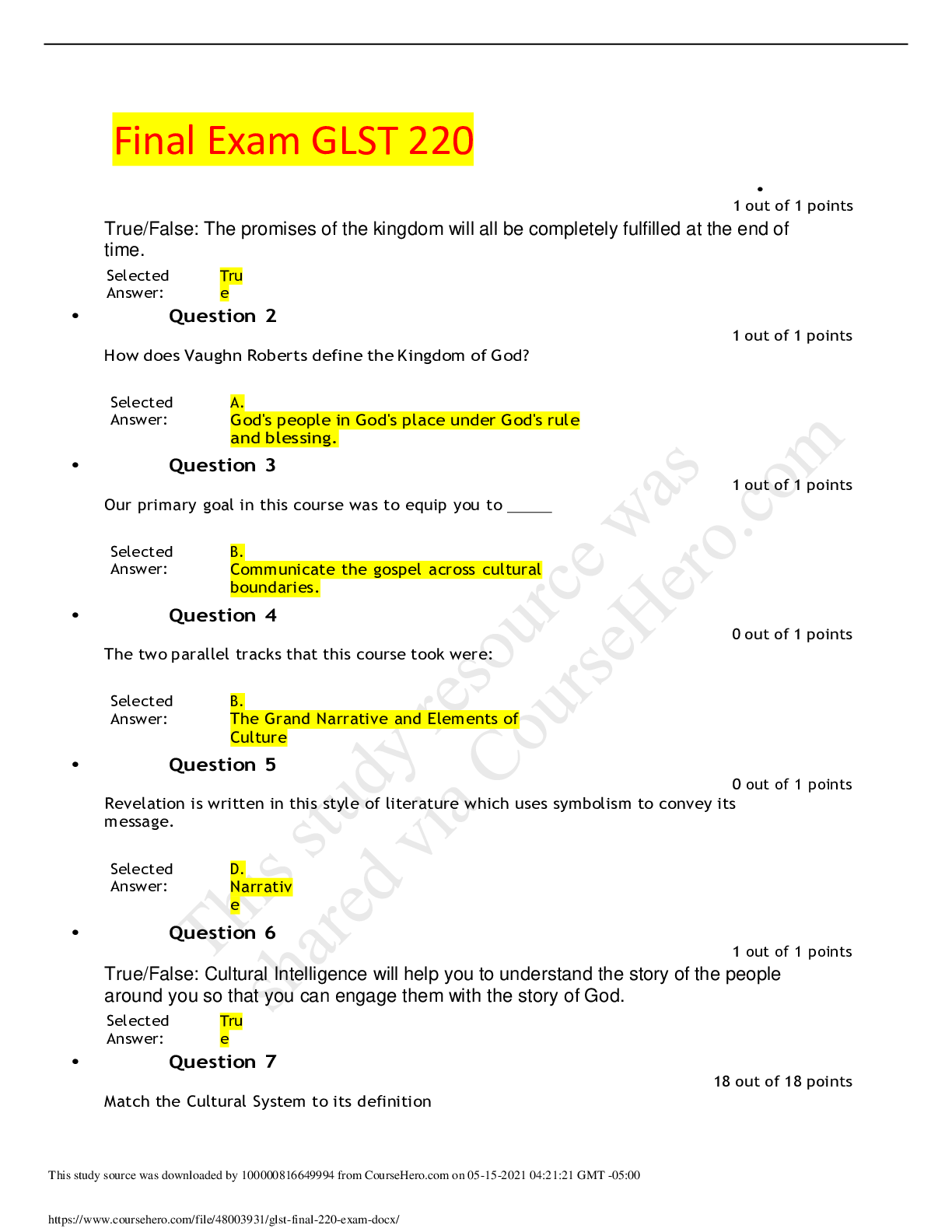
True/False: The promises of the kingdom will all be completely fulfilled at the end of time.
Selected Answer:
Tru e
• Question 2
How does Vaughn Roberts define th
...
Final Exam GLST 220
•
1 out of 1 points
True/False: The promises of the kingdom will all be completely fulfilled at the end of time.
Selected Answer:
Tru e
• Question 2
How does Vaughn Roberts define the Kingdom of God?
1 out of 1 points
Selected Answer:
A.
God's people in God's place under God's rule and blessing.
• Question 3
Our primary goal in this course was to equip you to
1 out of 1 points
Selected Answer:
B.
Communicate the gospel across cultural boundaries.
• Question 4
The two parallel tracks that this course took were:
0 out of 1 points
Selected Answer:
B.
The Grand Narrative and Elements of Culture
• Question 5
0 out of 1 points
Revelation is written in this style of literature which uses symbolism to convey its message.
Selected Answer:
D.
Narrativ e
• Question 6
1 out of 1 points
True/False: Cultural Intelligence will help you to understand the story of the people around you so that you can engage them with the story of God.
Selected Answer:
Tru e
• Question 7
Match the Cultural System to its definition
18 out of 18 points
Question Selected Match
Informal Legal System
Informal Education System
E.
Although less formalized, simple legal systems are still binding and are passed along through conventional wisdom. Citizens and visitors are presumed to understand and follow the rules.
L.
The emphasis of wisdom passed to youth from extended-family members, parents, and siblings.
Kinship Family N.
The family finds its identity in several generations of history and the household often includes three or more generations
Capitalism I.
A society created around the idea of individuals gaining resources and services based on their capacity to pay for them. Decisions are market driven.
Solid Artistic System
R.
A preference for clean, tight boundaries that emphasize precision and straight lines.
Socialism G.
A society in which the state coordinates and implements the production and distribution of basic resources through central planning and control.
Artistic Systems
A.
A society's approach to aesthetics including decorative art, music, architecture, web design, and city planning.
Legal Systems F.
The systems developed by a society to protect citizens' rights.
Formal Legal System
Family Systems
M.
A very formalized system that is chronicled in things such as a written constitution and laws.
Q.
The system a society develops for who can marry whom and the arrangements for how children and senior members are cared for.
Nuclear Family J.
The family is based on two generations whose members are related by marriage and consists primarily of parents and children.
Economic Systems
Formal Education System
O.
The basic ways a society organizes itself to meet its members' universal needs of food, water, clothing, and housing.
H.
The use of schools, books, and professionally trained teachers to educate youth.
Educational Systems
Rational Religious System
K.
The patterns for how the senior members of a culture transmit their values, beliefs, and behaviors to their offspring.
C.
The emphasis is on finding reason-based scientific answers to the supernatural with a focus on individual responsibility and work ethic.
Mystical Religious System
P.
The emphasis is on supernatural powers, both good and evil, that control day-to-day events and life.
Religious Systems
Fluid Artistic System
D.
The ways a culture explains the supernatural and what otherwise seems inexplicable.
B.
A preference for more fluid, indiscriminate lines with an emphasis on ebb and flow and flexibility.
• Question 8
Match the Cultural Value Orientation to its definition
Question Selected Match
20 out of 20 points
Low Uncertainty Avoidance
Q.
Emphasis on flexibility and adaptability
Individualism N.
Emphasis on individual goals and rights
Short Term O.
Emphasis on immediate outcomes (success now)
High Context F.
Emphasis on indirect communication (tone)
Universalism L.
Emphasis on rules; standards that apply to everyone
Particularism K.
Emphasis on specifics; unique standards based on relationships
Competitive P.
Emphasis on competition, assertiveness, and achievement to get results
Collectivism E.
Emphasis on group goals and personal relationships
Long Term T.
Emphasis on long-term outcomes (success later)
Low Power Distance C.
Emphasis on equality; shared decision making
Doing S.
Emphasis on being busy and meeting goals
Cooperative R.
Emphasis on collaboration and nurturing behavior to get results
Affective I.
Emphasis on expressive communication; sharing feelings openly
Neutral M.
Emphasis on non-emotional communication; hiding feelings
Monochronic G.
Emphasis on a linear approach to time; work and personal lives kept separate
High Power Distance B.
Emphasis on differences in status; decisions made by superiors
High Uncertainty Avoidance
H.
Emphasis on planning and predictability
Polychronic D.
Emphasis on multitasking; can combine work and personal lives
Low Context A.
Emphasis on explicit communication (words)
Being J.
Emphasis on quality of life
• Question 9
Match the definition to the CQ Dimension
4 out of 4 points
Question Selected
Match
Understanding intercultural norms and differences B.
CQ
Knowledge
Changing verbal and nonverbal actions appropriately when interacting cross-culturally
D.
CQ Action
Having the interest, confidence, and drive to adapt cross-culturally A.
CQ Drive
Making sense of culturally diverse experiences and planning accordingly C.
CQ Strategy
• Question 10
Match the part of the story with what it says about God's people
Question Selected Match
3 out of 8 points
The Pattern of the Kingdom
D.
Multi-national family of God
The Promised Kingdom B.
Abraham's descendants
The Prophesied Kingdom
The Proclaimed Kingdom
E.
Remnant of Israel; inclusion of nations
B.
Abraham's descendants
The Perished Kingdom A.
Adam and Eve
The Perfected Kingdom C.
Jesus Christ: new Adam; new Israel
The Present Kingdom G.
The Israelites
The Partial Kingdom G.
The Israelites
• Question 11
Match the part of the story with what it says about God's place
Question Selected Match
2 out of 8 points
The Proclaimed Kingdom
C.
Jesus Christ: true tabernacle; true temple
The Perfected Kingdom H.
New temple; new creation
The Promised Kingdom F.
The individual believer; the church
The Pattern of the Kingdom
A.
Canaan (and Jerusalem and temple)
The Prophesied Kingdom
F.
The individual believer; the church
The Present Kingdom C.
Jesus Christ: true tabernacle; true temple
The Perished Kingdom G.
Banished
The Partial Kingdom H.
New temple; new creation
• Question 12
Match the part of the story with what it says about God's rule and blessing
Question Selected Match
The Perished Kingdom D.
God's Word; perfect relationships
The Perfected Kingdom F.
New covenant; Holy Spirit
The Present Kingdom C.
New covenant; new king; great blessing
0 out of 8 points
The Prophesied Kingdom
H.
The law and the king
The Proclaimed Kingdom
B.
Jesus Christ: new covenant; rest
The Pattern of the Kingdom
E.
Blessing to Israel and the nations
The Promised Kingdom A.
Disobedience and curse
The Partial Kingdom G.
Throne of God and the Lamb; perfect blessing
• Question 13
Matching: Match the term with its beliefs about the millenium.
Question Selected Match
0 out of 3 points
Premillenialism C.
The millennium represents the whole of the last days; we are in it now. Satan has already been defeated and bound by the death and resurrection of Christ. He is still active, but he can do nothing to thwart God's purposes. Christians who have died already reign with Christ in heaven.
Postmillenniali sm
A.
Christ will return before the millennium. He will raise dead Christians to life again and they will reign with him on earth. Satan will have no power until the very end of this period when he will gather together all those who still resist Christ's rule. They will then be destroyed in a final battle, and the end will come.
Amillennialism B.
The millennium is the time immediately before the second coming: he will return after it. This "millennial age" will be a period of peace and righteousness in which more and more people will become Christians and the world will grow more godly.
[Show More]



.png)

.png)