NR 503 EPI MIDTERM STUDY GUIDE
- CHAPTERS 1, 2, 3, 4, 5, 6, 8, & 9
Week 1 Self Quiz (CH. 1, 2, 9)
1. How does social justice and health inequities influence population health care
provision? Why is this critical info
...
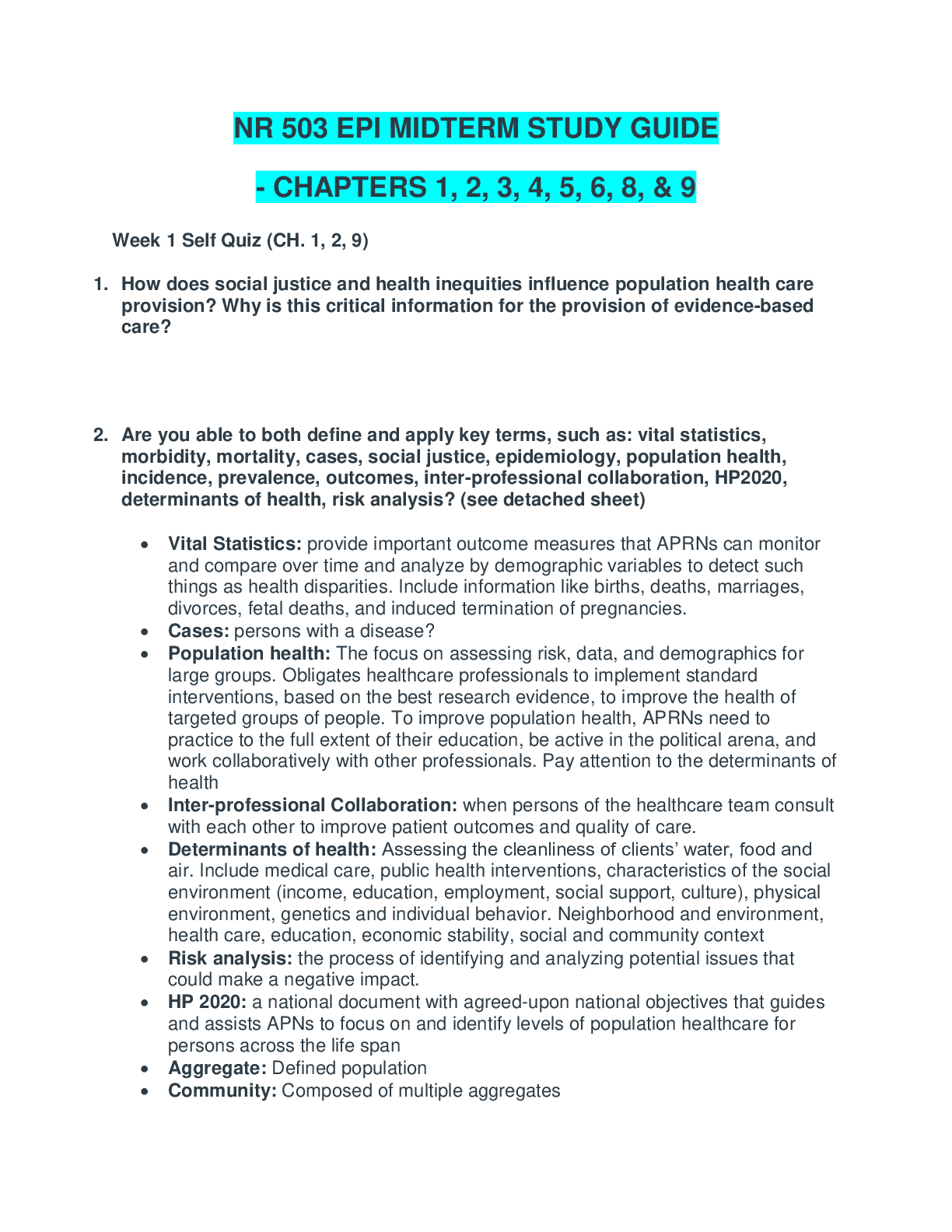
NR 503 EPI MIDTERM STUDY GUIDE
- CHAPTERS 1, 2, 3, 4, 5, 6, 8, & 9
Week 1 Self Quiz (CH. 1, 2, 9)
1. How does social justice and health inequities influence population health care
provision? Why is this critical information for the provision of evidence-based
care?
2. Are you able to both define and apply key terms, such as: vital statistics,
morbidity, mortality, cases, social justice, epidemiology, population health,
incidence, prevalence, outcomes, inter-professional collaboration, HP2020,
determinants of health, risk analysis? (see detached sheet)
Vital Statistics: provide important outcome measures that APRNs can monitor
and compare over time and analyze by demographic variables to detect such
things as health disparities. Include information like births, deaths, marriages,
divorces, fetal deaths, and induced termination of pregnancies.
Cases: persons with a disease?
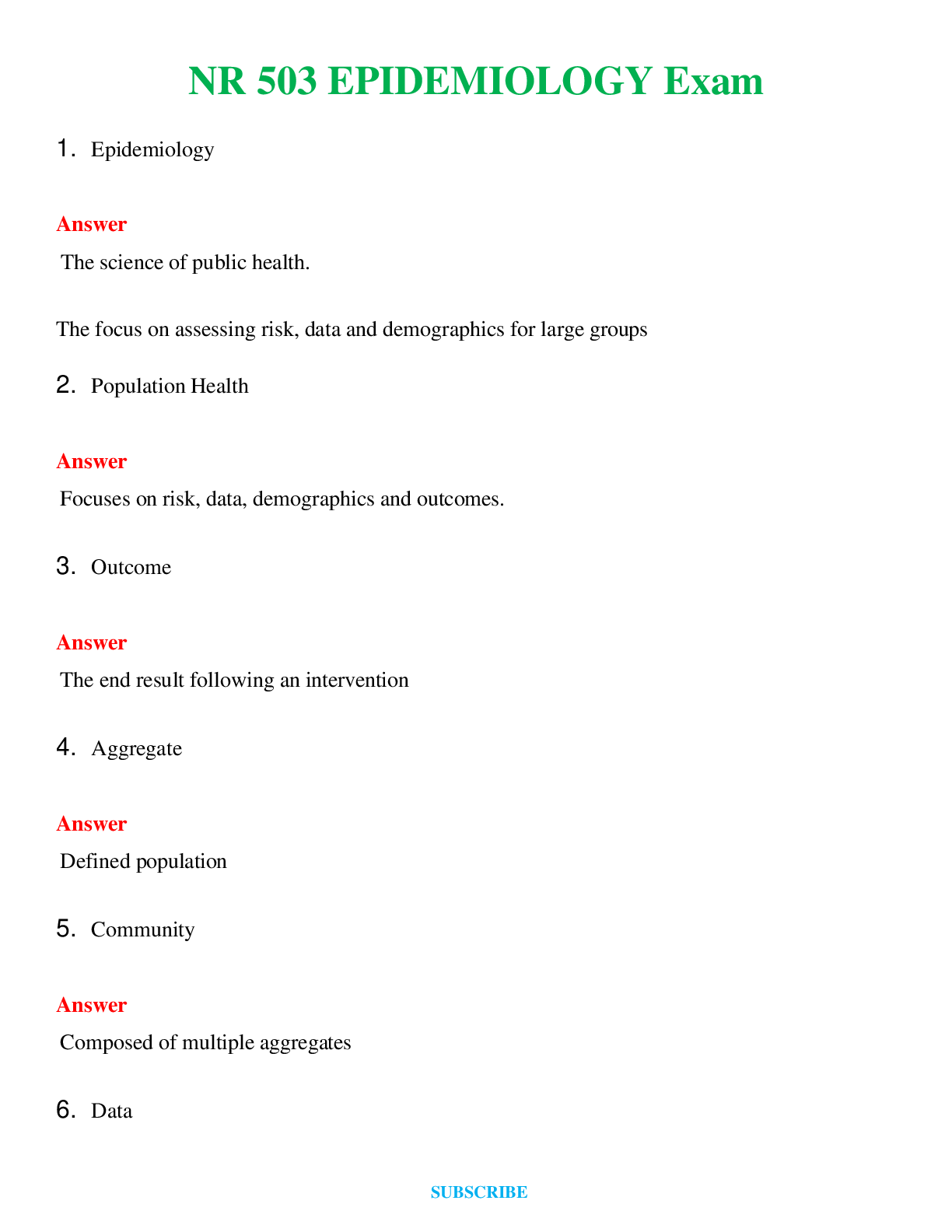
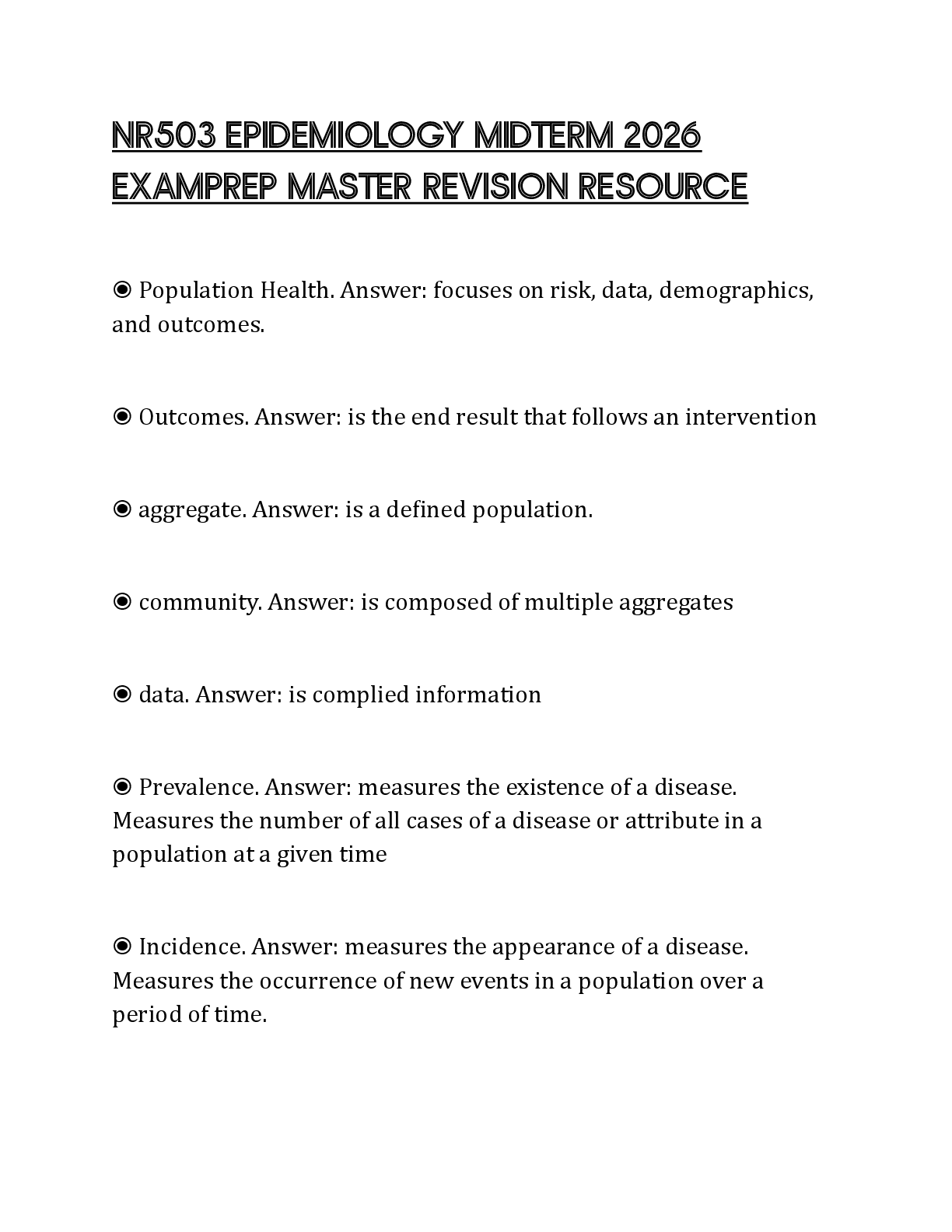
Population health: The focus on assessing risk, data, and demographics for
large groups. Obligates healthcare professionals to implement standard
interventions, based on the best research evidence, to improve the health of
targeted groups of people. To improve population health, APRNs need to
practice to the full extent of their education, be active in the political arena, and
work collaboratively with other professionals. Pay attention to the determinants of
health
Inter-professional Collaboration: when persons of the healthcare team consult
with each other to improve patient outcomes and quality of care.
Determinants of health: Assessing the cleanliness of clients’ water, food and
air. Include medical care, public health interventions, characteristics of the social
environment (income, education, employment, social support, culture), physical
environment, genetics and individual behavior. Neighborhood and environment,
health care, education, economic stability, social and community context
Risk analysis: the process of identifying and analyzing potential issues that
could make a negative impact.
HP 2020: a national document with agreed-upon national objectives that guides
and assists APNs to focus on and identify levels of population healthcare for
persons across the life span
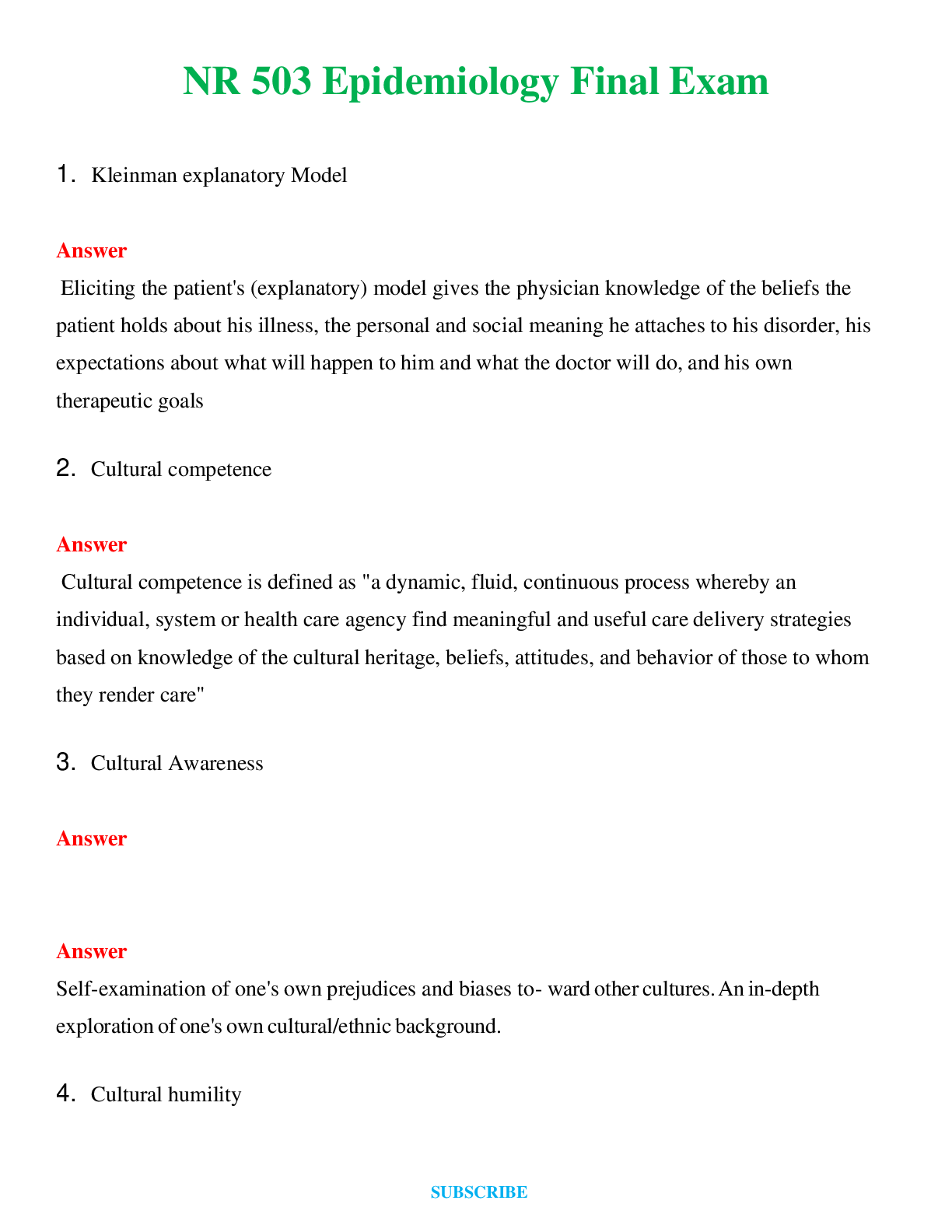
Aggregate: Defined population
Community: Composed of multiple aggregates3. What is the Campaign for Action?
The Campaign for Action works on seven major interrelated issues that together
contribute to a healthier America through nursing. They are- improving access to care,
fostering interprofessional collaboration, promoting nursing leadership, transforming
nursing education, increasing diversity in nursing, collecting workforce data, and
building healthier communities.
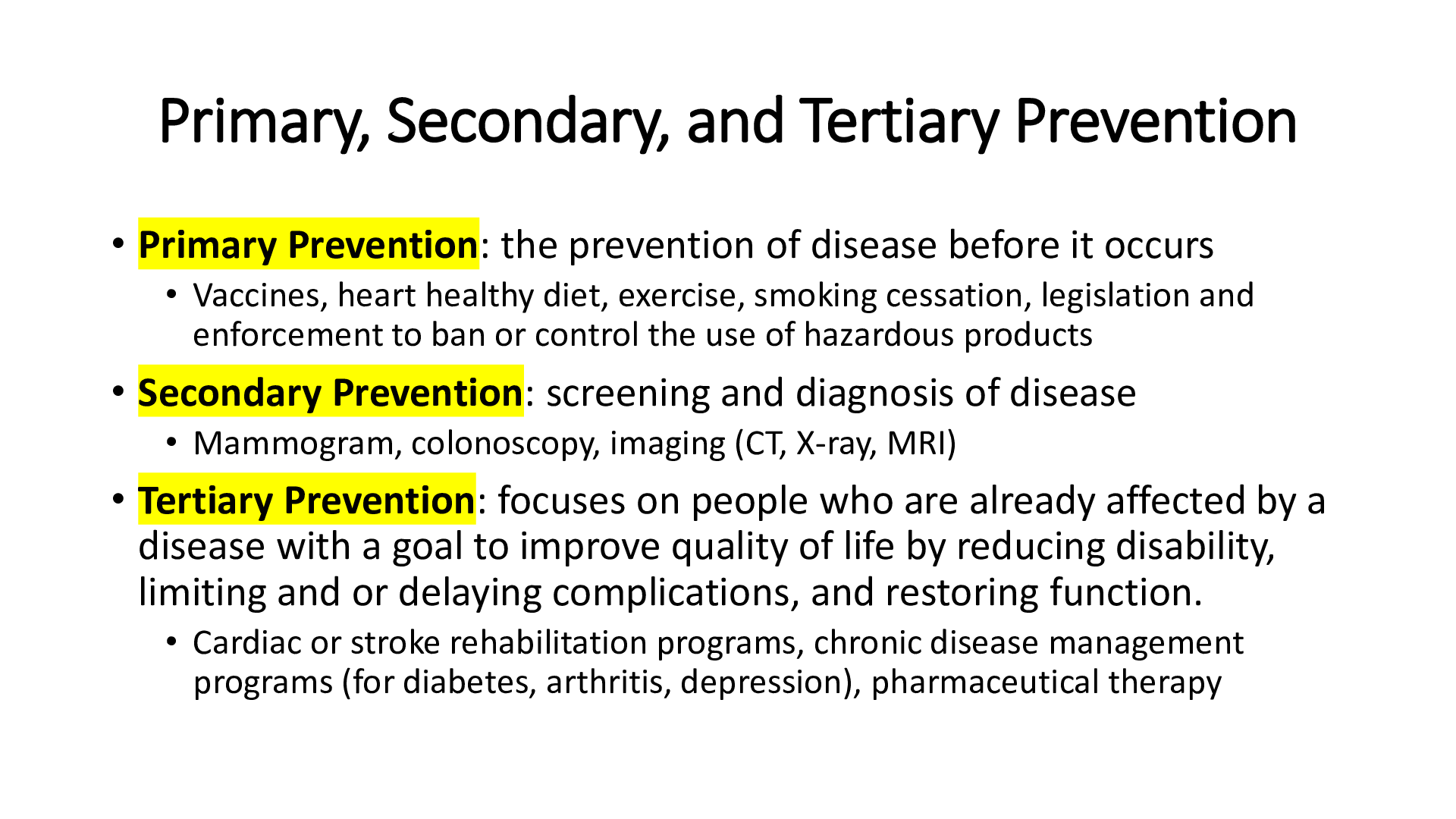
4. Explain the differences between primary, secondary, primary intervention?
Primary prevention refers to preventing disease before it occurs.
Secondary prevention consists of screening and diagnosis of disease. Detecting a
disease early in its course.
Tertiary prevention consists of interventions aimed at interventions to facilitate the
rehabilitation of the patient to the highest level of functioning while addressing the risk
factors that could further result in the deterioration of the patient’s health. Limiting the
effects of the disease once it is established.
Week 2 Self Quiz (CH. 3, 4)
1. Is screening a tertiary intervention? If yes, why, if not, what is it?
Screening is a secondary prevention intervention, not tertiary. Tertiary intervention aims
at limiting the effects of the disease once it is already established.
2. How does a provider determine the usefulness, appropriateness, of a screening
test? Where would a NP look to find a screening test? What determines if a
screening test should be used?
Screening is a tool used to detect disease in groups of asymptomatic individuals with
the goal of reducing and/or preventing morbidity and mortality. Screening is neither
available not appropriate for all diseases
The target population needs to be identifiable and accessible and the disease should
affect a sufficient number of people to make screening cost-effective. The preclinical
period should be sufficient to allow treatment before symptoms appear so that early
diagnosis and treatment make a different in terms of outcome. The screening test must
be sensitive enough to detect most cases of the disease and to be specific enough to
limit the number of false-positive tests. Validity: its ability to accurately identify those who have the disease
Sensitivity: its ability to accurately identify disease when it is present
Specificity: its ability to currently identify a person without disease with a
negative test
Reliability: the ability of test results being replicated if the test if repeated
Positive Predictive Value: a measure of the probability of a positive test result
when the disease is present
Negative Predictive Value: a measure of the probability that the disease is
absent when there is a negative test
3. Can you explain what “descriptive epidemiology” means? What is the
purpose? How is it used?
Descriptive epidemiology is the first step in any epidemiology investigation or in
analyzing any health problem from a research perspective. It is sometimes called
the natural history of a disease and begins with defining the differences,
similarities, and correlations of key areas of any health problem. Information is
gathered on any acute or chronic disease over time to track who is at riskincludes person, place, and time.
The purpose is to change the natural history of disease.
We use it by gathering information in an active surveillance on a case-by-case
basis where each specific person’s information is entered into a database.
4. How are causation and descriptive epidemiology related, how do they work
together to aid evidence-based care?
Once causation is established, healthcare providers and researches can work to
minimize new cases of the disease and treat current cases.
5. What does “causation” mean? Can you relate causation to primary, secondary
and tertiary interventions?
Causation is the action of causing something or the relationship between cause and
effect. Causative agent- factors for which presence or absence cause disease (biologic,
chemical, physical, nutritional).
Week 2 Weekly Objectives
1. Integrate concepts of descriptive epidemiology to the understanding of
disease impact.2. Discriminate among various screening tools that may be used in the
provision of care as an Advanced Practice Nurse.
Primary- APN teaching non-pregnant students about birth control and
natural family planning methods. Plans and participates in an
immunization clinic for school population. Smoking is prohibited in public
facilities. Supporting legislation that is passed which ensures that working
mothers have time to breastfeed/pump. Being active in an organization.
Secondary: The APN screens all pregnant patients for Hep B and Strep.
Examines all students for lice at the beginning of the school year.
Administers visual tests to those who do not wear contacts or glasses.
Supervises patients with smallpox who are quarantined.
Tertiary: Rehab after total hip replacement. Adopting a health heart diet to
control high cholesterol. Maintaining normal activity without pain after
diagnosis of osteoarthritis. Resuming normal activities after rehab.
3. Synthesize the concepts of causation to the understanding of interventions
for prevention.
The 5 W’s of Descriptive Epidemiology:
What= health issue of concern
Who= person
Where= place
When= time
Why/How= causes, risk factors, modes of transmission
Week 3 Self Quiz (CH. 3, 4, 6)At the end of this week, can you answer/discuss the following:
1. What is a case-control study and how does it differ (or how is it the same) as the
cohort study design?
In a case-control study, there is a group of individuals with the outcome of
interest (cases) and a second group without the outcome of interest (controls). It
is measured as an odds ratio (OR). To calculate the OR, make a 2x2 table in
which the cases and controls are the columns and the exposed and nonexposed
population are the rows.
In case-control studies, the investigator begins with cases and controls and goes
back to look for exposures. In cohort studies, the investigator begins with
exposed and nonexposed and follows those individuals over time to see who
develops or does not develop an outcome or disease.
2. Can you talk about the ways bias shows up in a study design (such as, selection
bias) etc.?
There is selection bias and information bias.
Selection bias occurs when the selected subjects in a sample are not representative of
the population of interest or of the comparison group.
Information bias deals with how information or data are collected for a study. Many
types of data are not collected for research purposes so they may be incomplete,
inaccurate, or contain misleading information.
3. What is different in a randomized control trial than, for instance, a case-control
study (or a cohort study)? What does it mean to show a causal relationship?
Randomized control trials (clinical trials) are useful for evaluating treatments (including
technology) and for assessing new ways of organizing and delivering health services.
RCT assign patients randomly to either receive the new treatment/intervention or not
receive it. Inclusion and exclusion criteria must be precise and written in advance to
eliminate any errors.
RCT and cohort studies both compare more than two groups.
Difference between cohort and case-control- case-control studies allow the APRN to
look at cases and the probability of having an exposure or risk factor. Cohort studies
allow the APRN to follow a cohort over time to determine whether being exposed to a
risk factor impacts the likelihood of developing a disease or diseases or improves
outcomes.
Difference between cohort and RCT- cohort studies are observational and not as
reliable as RCT since the two groups may differ in ways other than in the variable. RCTare carefully planned experiments that introduce a treatment or exposure to study its
effect on real patients.
Difference between case-control and cohort studies.
Case-control: Observational. Individuals with and without the disease are
compared. Compares proportions of those who have the exposure and the
disease and those who have the exposure and who do not have the disease.
Temporal relationship may be hard to establish. Can measure odds ratio and
sometimes attributable risk if additional info is available.
Cohort: Observational. Individuals exposed and not exposed are compared.
Compares incidence of the disease in exposed and not exposed individuals. In
prospective- temporal relationship between disease and exposure is easy to
establish. Can measure absolute and relative risk, odds ratio, and attributable
risk
4. What is each type of study used for, its purpose, and its outcomes? How are the
outcomes different in each study design? Measured?
Cohort Study: identify a group of patients who are already taking a particular
treatment or have an exposure, follow them over time, and then compare their
outcomes with a similar group that has not been affected by the treatment or
exposure. Are observational and not as reliable as RCT.
Randomized Control Trial: Gold standard for research. Carefully planned
experiments that introduce a treatment or exposure to study its effect on real
patients. Include methodologies that reduce bias (randomization and blinding)
and that allow for comparison between intervention groups and control (no
intervention) groups. Can provide sound evidence of cause and effect.
Case-Control Study: studies in which patients who already have a specific
condition are compared with people who do not have the condition. The
researcher looks back to identify factors or exposures that might be associated
with the illness. Often rely on medical record and patient recall for data collection.
Less reliable than RCT and cohort studies because showing a statistical
relationship does not meal that one factor caused the other.
Correlation Study: used to conduct studies of aggregate or population
characteristics. Useful for identifying long-term trends, seasonal patterns, and
event-related clusters. Data is collected on populations, not individuals. Can only
report that a correlation exists.
Cross-Sectional Study: describe the relationship between diseases and other
factors at one point in time in a defined population. Exposures and outcomes are
collected simultaneously. Provide a “snap shot” at one point in time and this
exclude people who have died or who chose not to participate. Surveys that
sample a population and its various characteristics. Fairly quick method to obtain
descriptive data and can be useful in identifying prevalence rates for specified
populations. Compare diagnostic tests.Strengths and weaknesses of study designs.
RCT: Strengths- lower likelihood of confounding variables, minimize bias in
treatment assignment, able to control intervention or treatment. Weaknesseslabor intensive, costly, lengthy, sometimes impractical or unethical
Cohort: Strengths- able to identify confounding and address in the study, able
to control exposure, able to calculate relative risk and incidence rates, can study
multiple outcomes. Weaknesses- labor intensive, costly, lengthy
Case-control: Strengths- inexpensive, shorter time to completion, able to study
variables with long latency or impact periods, provides a means to compare
groups, able to calculate odds ratios, able to study rare or fatal diseases, can
study multiple exposures. Weaknesses- risk of bias and confounding variables,
sometimes unable to measure or determine exposure, selection bias, recall bias,
cannot assess risk
Cross-sectional: Strengths- able to calculate prevalence or population studied,
assesses exposures and outcomes at one time, provides a snapshot of study
population, inexpensive. Weaknesses- risk of confounding variables, selection
bias, cannot control for or identify the significance of potentially important
variables, cannon assess risk
Types of causal relationships. What does it take to actually establish causation?
Necessary and sufficient: a factor is both necessary and efficient.
Necessary but not sufficient: more than one factor is required, usually in a
temporal sequence.
Sufficient but not necessary: a specific factor can cause a disease process,
but other factors by themselves can cause the same disease
Neither sufficient or necessary: a specific factor can be combined with other
factors to produce disease.
* Temporal relationship: the associated factor must be present before the disease.
* Strength of association: this is the odds ratio or relative risk. The higher or stronger
the relationship, the more likely it is causal.
* Dose-response relationship: as the dose increases, so does the risk of development
of the disease.
* Replication of findings: the findings can be found in repeated study.
* Biological plausibility: current knowledge on the factor or exposure and the
response of the human body on a cellular level is consistent with the findings.* Alternate explanations are considered.
5. What is an intervention group? Where is it found?
An intervention group is the group being tested with a new treatment/intervention and is
compared to the control (no treatment/intervention) group. Intervention groups are used
in randomized controlled trials.
6. Can you explain a retrospective versus a prospective study design? What are
the pros and cons of each?
Retrospective study design: exposure is ascertained from past records and
outcome is ascertained at the time the study begins. If an association exists
between the exposure and the outcome, then the incidence rate in the exposed
group will be greater than the incidence rate in the nonexposed group.
Pros: relatively inexpensive, quick results
Cons: potential bias, unmeasured confounders
Prospective study design: the investigator begins with a defined population
and then follows a group of individuals who were either exposed or nonexposed
to a factor of interest and then follows both groups to compare the incidence of
an outcome or disease.
o Pros: high quality data, strong validity
o Cons: expensive process, takes a lot of time
7. How are groups selected for each of the study designs?
Cohort: selects people who presently have a certain condition or receive a
particular treatment by the use of databases
Randomized Control Trial: randomly assigns participants to two groups.
Case-Control: researchers choose people with a particular result (the cases)
and interview the groups or check their records to ascertain what difference
experiences they had.
Cross-sectional: groups are selected based on existing differences rather than
random allocation
Correlational: randomized. No variables are manipulated.
8. What is meant by “scientific misconduct”?
Scientific misconduct includes (but is not limited to) gift authorship, data fabrication and
falsification, plagiarism, and conflict of interest. It can have an impact on researches,
patients, and populations.9. Differentiate: random error, systematic error, confounding error.
Random Error: (nondifferential error) occur as a result of the usual, everyday
variations that are expected and that can be anticipated during certain siutations.
Less serious than bias because they are less likely to distort findings. Reduce the
statistical power of a study and can occur because of unpredictable changes in
an instrument used for collected data or because of changes in the environment.
Systematic Error: (bias) occur not as a result of change but because of inherent
inaccuracies in measurement. Generally considered the more critical of the two.
It can be the result of either a weak study design or a deliberate distortion of the
truth.
Confounding: occurs when it appears that a true association exists between an
exposure and an outcome, but in reality, this association is confounded by
another variable or exposure. A confounder is a variable that is linked to both a
causative factor or an exposure and the outcome. Ex. Age, gender,
socioeconomic status. Occurs when a study is performed, and it appears from
the study results that an association exists between an exposure and an
outcome, when, in fact, the association is actually between the confounder and
the outcome.
Week 3 Weekly Objectives
1. Appraise case-control and cohort study designs for their utility in
informing the provision of care by the Advanced Practice Nurse.
2. Critique the randomized control trial when used in epidemiology to
determine prevention as well as related outcomes measures.
Week 4 Self Quiz (CH. 5, 8)
1. What is the highest level of data findings? How is evidence appraised?
The highest level of data findings is Level A. Evidence is appraised by using the
AACN’s evidence-leveling system. It can also be done by using transparency- a
reflection of both the accountability and the integrity of the investigator.
Level A: meta-analysis of multiple controlled studies or meta-analysis of
qualitative studies with results that consistently support a specific action,
intervention or treatment.
Level B: well-designed controlled studies, both randomized and nonrandomized
with results that consistently support a specific action, intervention, or treatment.
Level C: qualitative studies, descriptive or correlational studies, int4egrative
reviews, systematic reviews, or randomized controlled trials with inconsistent
results.
Level D: peer-reviewed professional organizational standards, with clinical
studies to support recommendations.
Level E: theory-based evidence from expert opinion or multiple case reports. Level M: manufacturer’s recommendation only.
2. Can you describe the various levels of studies and how they are rated in terms
of their use for integration into practice?
(see last question)
3. What factors determine quality of care?
Providing safe, effective, person-centered, equitable, and efficient care.
4. How is a website’s credibility determined?
The site has at least one author listed, there is a publication date, the sources come
from scholarly articles and books, the domain (.com, .org, and .net are not reliable. Look
for .gov or .edu), the site design is well-designed, and it has good writing style- poor
spelling and grammar indicates the site may not be credible.
5. What are key indicators when assessing a model of care?
Clinical quality, utilization of healthcare resources, core business processes, and
customer satisfaction.
6. How would you explain the Triple Aim initiative (model) to a colleague?
The goals of the Triple Aim Initiative are better health, better experience of care, and
lower cost
7. What is the rapid cycle improvement model?
IHI. Based on iterative cycles of “plan, do, study, act” (PDSA). Encourages small tests
of change, implementation of bundles- the development of a small number of evidencebased key components- hand hygiene, maximal barrier precautions, chlorhexidine skin
antisepsis, optimal catheter site selection, and daily review of line necessity.
Week 4 Weekly Objectives
1. Integrate the process of data gathering to the application of evidence.
2. Critique data sources for validity, reliability, credibility.3. Discern models of practice which facilitate implementation of an evidence-based
practice.
***Other terms:
Incidence rate: the number of new cases of a disease that occurs during a specified
time period in a population at risk for developing the disease.
Absolute risk: the incidence of a disease in a population
Attributable risk: how much of the risk (incidence) of the disease we hope to prevent if
able to eliminate exposure to the agent in question
Risk factor: a condition that may adversely affect an individual’s health
Odds ratio: the ratio of the odds of development of disease in non-exposed person
Prevalence rate: the number of affected persons present in the population at a specific
time divided by the number of persons in the population at the same time
Relative risk: the ratio of the risk of disease in exposed individuals to the risk of
disease in non-exposed individuals
[Show More]