ComprehensiveATIStudyGuide2021.
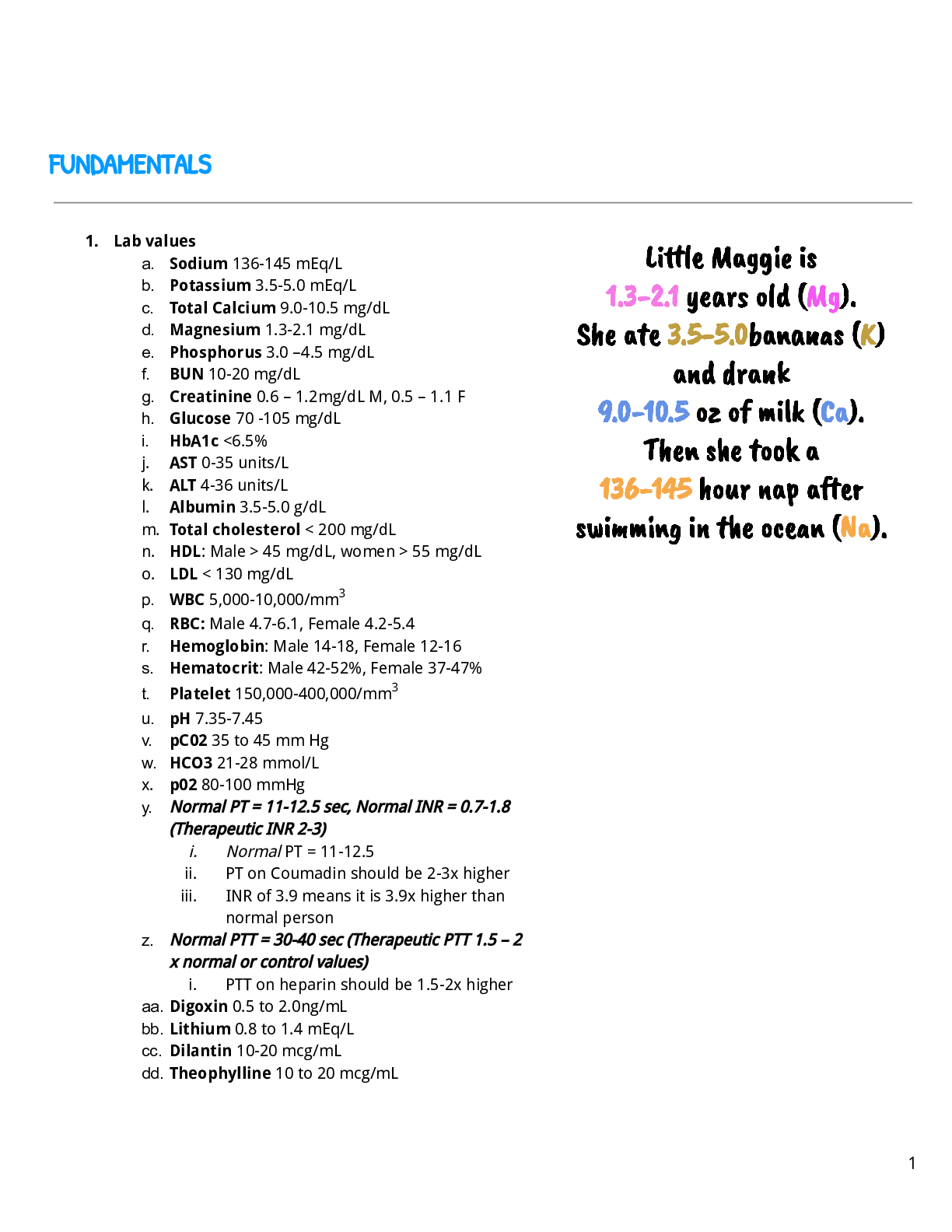
1. Lab values
a. Sodium 136-145 mEq/L
b. Potassium 3.5-5.0 mEq/L
c. Total Calcium 9.0-10.5 mg/dL
d. Magnesium 1.3-2.1 mg/dL
e. Phosphorus 3.0 –4.5 mg/dL
f. BUN 10-20 mg/dL
g
...
ComprehensiveATIStudyGuide2021.
1. Lab values
a. Sodium 136-145 mEq/L
b. Potassium 3.5-5.0 mEq/L
c. Total Calcium 9.0-10.5 mg/dL
d. Magnesium 1.3-2.1 mg/dL
e. Phosphorus 3.0 –4.5 mg/dL
f. BUN 10-20 mg/dL
g. Creatinine 0.6 – 1.2mg/dL M, 0.5 – 1.1 F
h. Glucose 70 -105 mg/dL
i. HbA1c <6.5%
j. AST 0-35 units/L
k. ALT 4-36 units/L
l. Albumin 3.5-5.0 g/dL
m. Total cholesterol < 200 mg/dL
n. HDL: Male > 45 mg/dL, women > 55 mg/dL
o. LDL < 130 mg/dL
p. WBC 5,000-10,000/mm3
q. RBC: Male 4.7-6.1, Female 4.2-5.4
r. Hemoglobin: Male 14-18, Female 12-16
s. Hematocrit: Male 42-52%, Female 37-47%
t. Platelet 150,000-400,000/mm3
u. pH 7.35-7.45
v. pC02 35 to 45 mm Hg
w. HCO3 21-28 mmol/L x. p02 80-100 mmHg
i. Normal PT = 11-12.5
ii. PT on Coumadin should be 2-3x higher
iii. INR of 3.9 means it is 3.9x higher than normal person
z.
i. PTT on heparin should be 1.5-2x higher
aa. Digoxin 0.5 to 2.0ng/mL bb. Lithium 0.8 to 1.4 mEq/L cc. Dilantin 10-20 mcg/mL
dd. Theophylline 10 to 20 mcg/mL
2. Latex allergies
a. Note that clients allergic to bananas, apricots, cherries, grapes, kiwis, passion fruit, avocados, chestnuts, tomatoes, and/or peaches may experience latex allergies as well
3. Order of assessment → Inspection, palpation, percussion, auscultation
a. Except with abdomen it is IAPP-inspect, auscultate, percuss and palpate.
4. Cane walking → COAL (Cane, Opposite, Affected, Leg)
5. Crutch walking → Remember the phase “step up” when picturing a person going up stairs with crutches. The good leg goes up first followed by the crutches and the bad leg. The opposite happens going down the stairs….OR “up to heaven…down to hell”
6. 3 point gait → Allows pt to be mobile without bearing weight on affected extremity
a. Used when pt is non-weight bearing on a leg
7. Delegation → RNs DO NOT delegate what they can EAT (Evaluate, Assess, Teach)
a. A nursing assistant can perform tasks such as taking vital signs, range of motion exercises, bathing, bed making, obtaining urine specimens, enemas and blood glucose monitoring. Nursing assistants cannot interpret results or perform any task beyond the skill level of the certification they received.
i. Performing gastrostomy feeding thru an established gastrostomy tube
b. The PN is managed under the supervision of the RN. Certain higher level skills can be delegated after competency has been established by the RN (e.g., dressing changes or suctioning).
8. Medical asepsis is “clean technique” and surgical asepsis is sterile technique
9. Isolation Precautions
a. AIRBORNE → “My chicken hez TB”
i. Measles, chicken pox, herpes zoster, TB
ii. Management → Neg pressure room, private room, mask, n95 for TB
b. DROPLET → SPIDERMAn
i. Sepsis, scarlet fever, strep, pertussis, pneumonia, parvovirus, influenza, diphtheria, epiglottitis, rubella, mumps, adenovirus
ii. Management → private room, mask
c. CONTACT → MRS WEE
i. MRSA, VRSA, RSV, skin infection (herpes zoster, cutaneous diphtheria, impetigo, pediculosis, scabies, and staphylococcus), wound infections, enteric infection (C diff), eye infections (conjunctivitis)
ii. Management → gown, gloves, goggles, private room
10. Venturi mask (4-10L/min) is most precise O2 delivery. Best for pt w/ chronic lung disease (i.e. COPD)
11. Aerosol mask/Face tent good for
[Show More]