OC 201, Oceanography
Lab 8: Understanding El Niño – Southern Oscillation
In today’s lab you will work with real archived data that has been collected by the Pacific Marine Environmental Laboratory
(PMEL) located up in
...
OC 201, Oceanography
Lab 8: Understanding El Niño – Southern Oscillation
In today’s lab you will work with real archived data that has been collected by the Pacific Marine Environmental Laboratory
(PMEL) located up in Seattle. You will be using data from the Tropical Atmosphere Ocean (TAO) project, which is a realtime observation system that collects data from a network of moored buoys in the equatorial Pacific Ocean. These
observations facilitate the detection and study of ENSO and provide an ideal opportunity to investigate interactions between
the atmosphere and ocean.
Open a web browser – Safari is preferred on Macs, Chrome on PC – and enter the URL of the TAO homepage:
http://www.pmel.noaa.gov/tao/index.shtml
[Clicking on About > Mission > TAO/TRITON from the TAO home page will provide additional information about the
TAO project and details about how the data is collected. You may also click on the About > El Niño tab for more information
on these phenomena.]
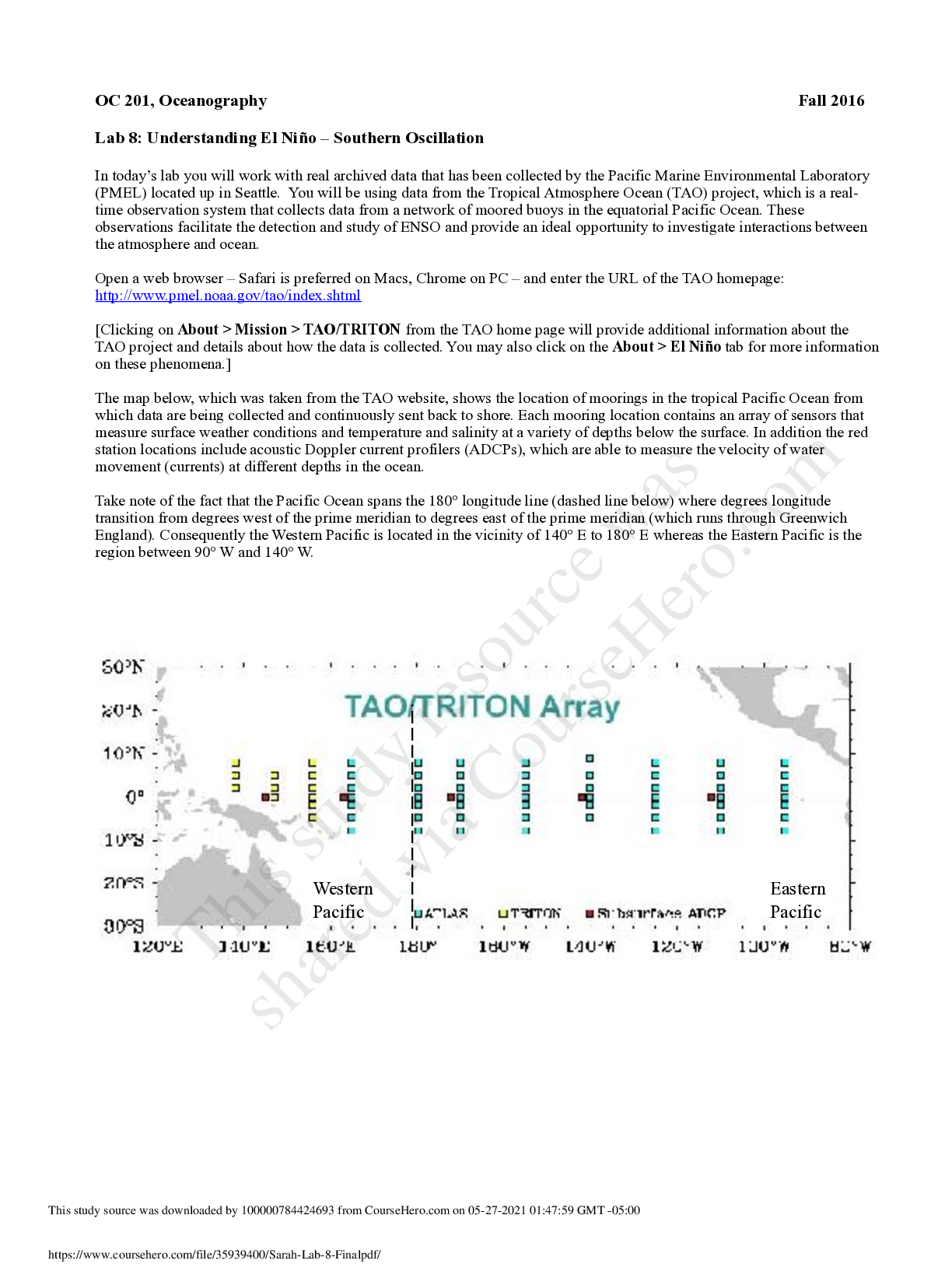
The map below, which was taken from the TAO website, shows the location of moorings in the tropical Pacific Ocean from
which data are being collected and continuously sent back to shore. Each mooring location contains an array of sensors that
measure surface weather conditions and temperature and salinity at a variety of depths below the surface. In addition the red
station locations include acoustic Doppler current profilers (ADCPs), which are able to measure the velocity of water
movement (currents) at different depths in the ocean.
Take note of the fact that the Pacific Ocean spans the 180° longitude line (dashed line below) where degrees longitude
transition from degrees west of the prime meridian to degrees east of the prime meridian (which runs through Greenwich
England). Consequently the Western Pacific is located in the vicinity of 140° E to 180° E whereas the Eastern Pacific is the
region between 90° W and 140° W
[Show More]