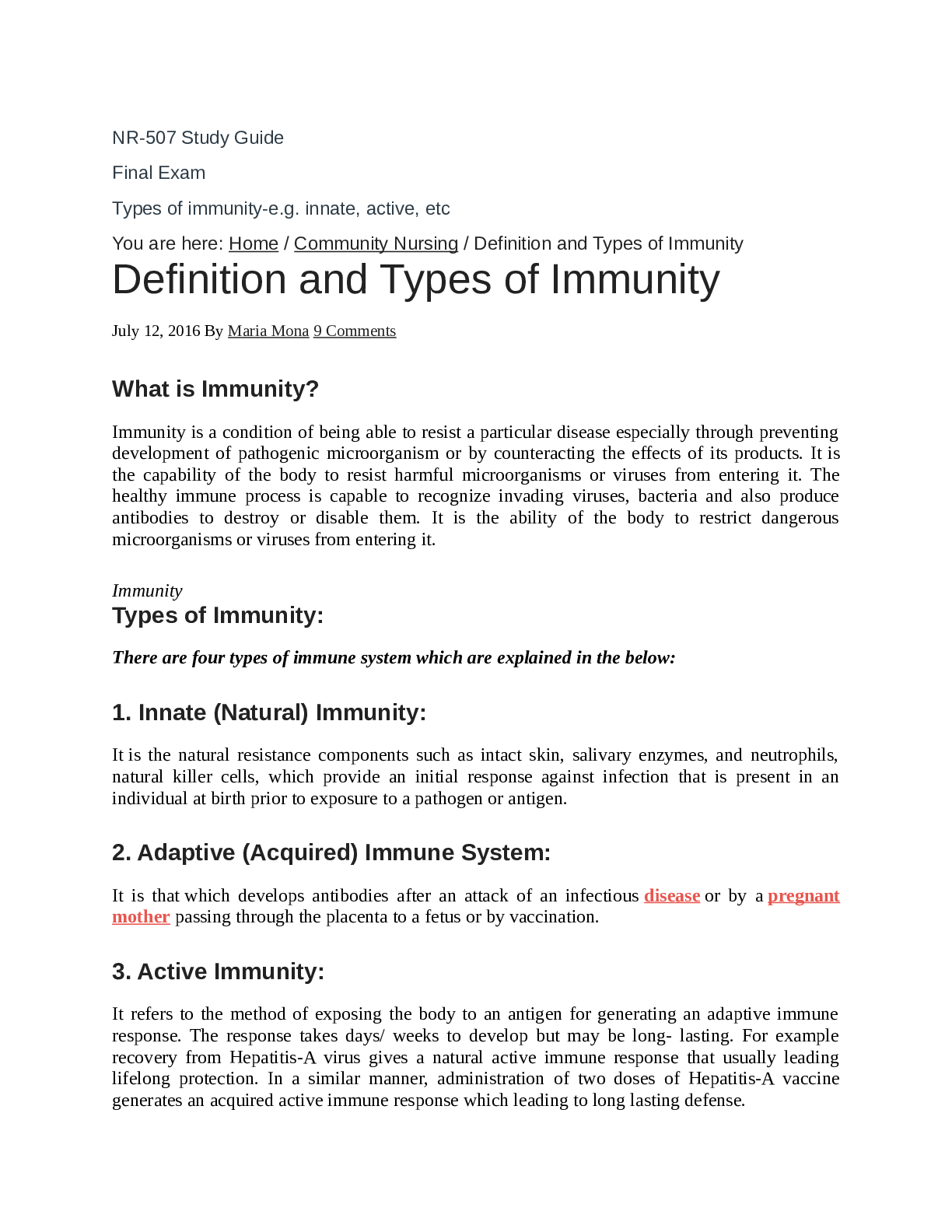
Definition and Types of Immunity
July 12, 2016 By Maria Mona 9 Comments
What is Immunity?
Immunity is a condition of being able to resist a particular disease especially through preventing
development of pathogenic m
...
Definition and Types of Immunity
July 12, 2016 By Maria Mona 9 Comments
What is Immunity?
Immunity is a condition of being able to resist a particular disease especially through preventing
development of pathogenic microorganism or by counteracting the effects of its products. It is
the capability of the body to resist harmful microorganisms or viruses from entering it. The
healthy immune process is capable to recognize invading viruses, bacteria and also produce
antibodies to destroy or disable them. It is the ability of the body to restrict dangerous
microorganisms or viruses from entering it.
Immunity
Types of Immunity:
There are four types of immune system which are explained in the below:
1. Innate (Natural) Immunity:
It is the natural resistance components such as intact skin, salivary enzymes, and neutrophils,
natural killer cells, which provide an initial response against infection that is present in an
individual at birth prior to exposure to a pathogen or antigen.
2. Adaptive (Acquired) Immune System:
It is that which develops antibodies after an attack of an infectious disease or by a pregnant
mother passing through the placenta to a fetus or by vaccination.
3. Active Immunity:
It refers to the method of exposing the body to an antigen for generating an adaptive immune
response. The response takes days/ weeks to develop but may be long- lasting. For example
recovery from Hepatitis-A virus gives a natural active immune response that usually leading
lifelong protection. In a similar manner, administration of two doses of Hepatitis-A vaccine
generates an acquired active immune response which leading to long lasting defense.
4. Passive Immunity:
It refers to the process of imparting IgG antibodies to keep safe against infection. It gives
immediate, but short- lived protection such as several weeks to 3 or 4 months at most. It is occurs
during pregnancy. The transfer of maternal tetanus antibody (mainly IgG) across the placenta
provides passive immune to newborn baby for several weeks/ months until such antibody is
degraded and lost.
Alveolar ventilation/perfusion In respiratory physiology, the ventilation/perfusion ratio
( / ratio or V/Q ratio) is a ratio used to assess the efficiency and adequacy of the V̇ Q̇
matching of two variables: or V – V̇ ventilation – the air that reaches the alveoli. or Q̇
Q – perfusion – the blood that reaches the alveoli via the capillaries.
Perfusion, the actual exchange of O2 and CO2 in the bloodstream,
occurs via the alveoli and pulmonary capillaries.
Ventilation, air movement in/out of the lung,
is critical to ensure sufficient perfusion.
3. Dermatologic conditions e.g.
The rash often begins with a single, round or oval, pink patch that is scaly with
a raised border (herald patch)
Pityriasis Rosea, Pityriasis rosea is an acute, self-limited, exanthematous skin
disease characterized by the appearance of slightly inflammatory, oval,
papulosquamous lesions on the trunk & proximal areas of the extremities.
• The eruption commonly begins with a "herald" or "mother" patch, a single round
or oval, rather sharply delimited pink or salmon-colored lesion on the chest, neck,
or back.
• 2 to 5 cm in diameter.
fig: Herald patch
• A few days later lesions similar in appearance to the
herald patch, appear in crops on the trunk & proximal
areas of the extremities.
• The eruption spreads centrifugally or from the top down
in just a few days.
• The long axes of these oval lesions tend to be oriented
along the lines of cleavage of the skin, like a christmas
tree pattern.
• Then the lesions fade without any residual scarring.
• The absence of symptoms other than pruritus
combine to make PR an easy diagnosis in most
instances.
• Treatment is usually reasurrance.
• Topical Steroids
• Antipruitic lotions (prax, pramagel)
• Phototherapy
• Erthyromycin in severe cases
• Rash usually persists for 2-3 months
Carbuncle: a severe abscess or multiple boil in the skin, typically infected with
staphylococcus bacteria.A carbuncle is a collection of multiple infected hair follicles. It is
an abscess, just like a furuncle (single boil), but a carbuncle(multiple furuncle) is a much more
serious infection. It forms into a broad, red, hot, painful nodule that often drains pus through
multiple openings of the skin. Because carbuncles usually contain a significant amount of pus,
they are often first treated with a procedure called incision and drainage (I&D).
Herpes zoster(shingles): Herpes zoster is infection that results when varicellazoster virus reactivates from its latent state in a posterior dorsal root ganglion.
Symptoms usually begin with pain along the affected dermatome, followed in 2 to 3
days by a vesicular eruption that is usually diagnostic.
• Patients frequently experience a prodrome of fever, pain, malaise and
headache which precedes the vesicular dermatomal eruption by severa
[Show More]










.png)




.png)
.png)
.png)

.png)
.png)

