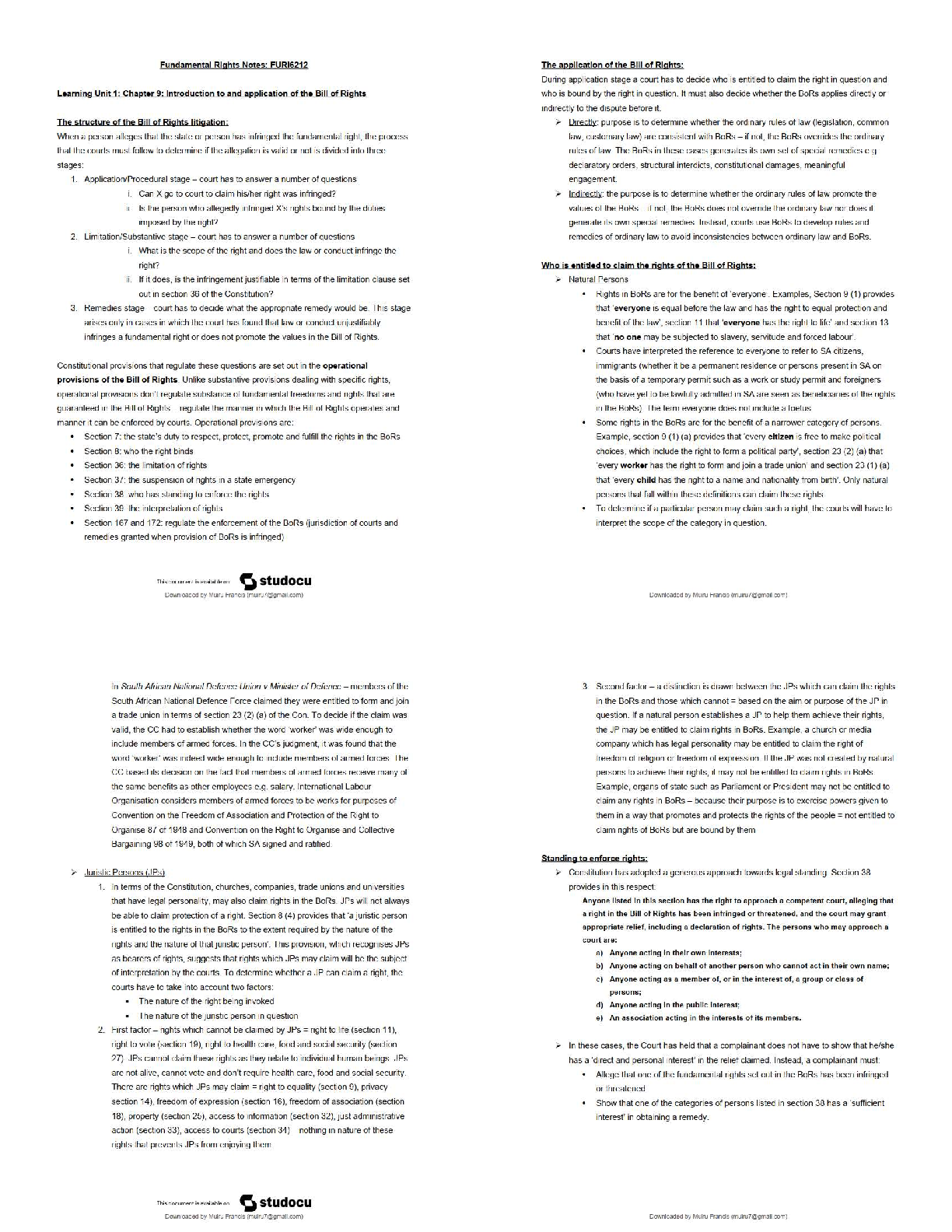
Human rights:
- aka fundamental or constitutional rights.
- According to fundamental rights, people have certain inalienable rights
which may not be encroached upon by the state except where allowed by
law.
-
...
Human rights:
- aka fundamental or constitutional rights.
- According to fundamental rights, people have certain inalienable rights
which may not be encroached upon by the state except where allowed by
law.
- Not deserved or worked for. Simply accrues to humans.
- Authority to encroach is subject to limitation.
- International concern.
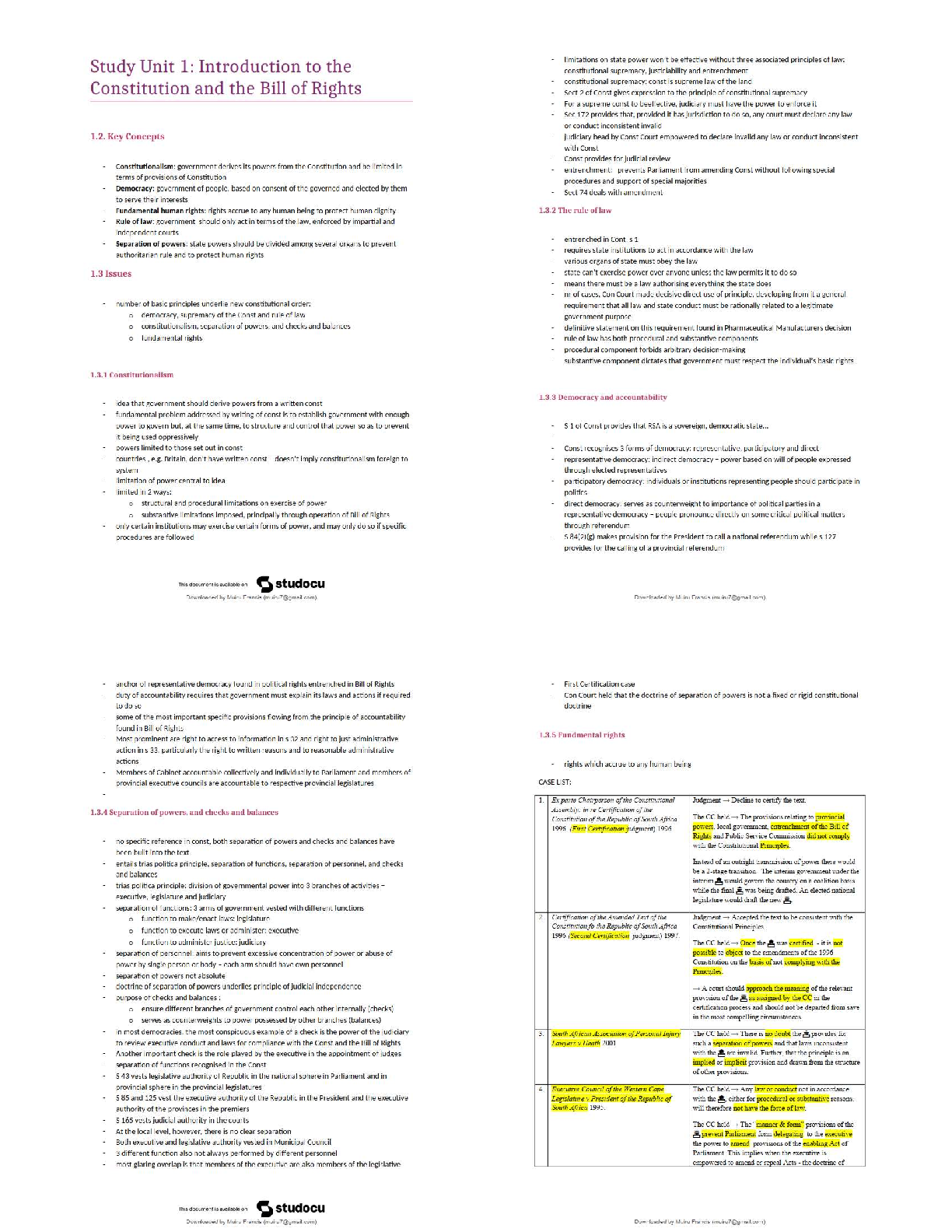
Study Unit 1: Intro to Constitution and Bill of Rights
- Interim constitution provided a Bill of Rights
- Parliamentary sovereignty replaced with constitutional supremacy.
- Process of drafting and adopting the final Constitution was governed by
the 34 Constitutional Principles in Schedule 4.
- Brief history:
o Constitutional Revolution:
§ First constitution in 1994;
§ Final constitution in 1996;
§ Meant rights were applied across board without racial
qualification;
§ Parliamentary sovereignty was replaced with constitutional
supremacy;
§ Bills of rights put in place to safeguard rights;
§ Courts given power to invalid any law inconsistent with
BoR or Constitution.
§ Central government was replaced with legislative, executive
and judiciary government.
o Negotiations process and interim constitution:
§ FW De Klerk released Mandela in 1990, and released
sanctions on political party movements for free political
movement.
§ Negotiations formally began with convening of the
Conference for a Democratic South Africa (CODESA) and
ended tow years later with an interim Constitution.
§ CODESA negotiations failed but were continued through the
ANC and resumed through the Multi-party Negotiation
Process (MPNP).
§ The government elected in the 1994 elections acted under
the interim constitution adopted.
§ Interim constitution guaranteed a united SA from the
territorial fragmentation characteristic of Apartheid. It also
declared itself supreme law of the Republic.
§ Constitutional change is only possible through special
procedures and by a special majority of legislators – the
basic constitutional frame is not subject to lawful
[Show More]