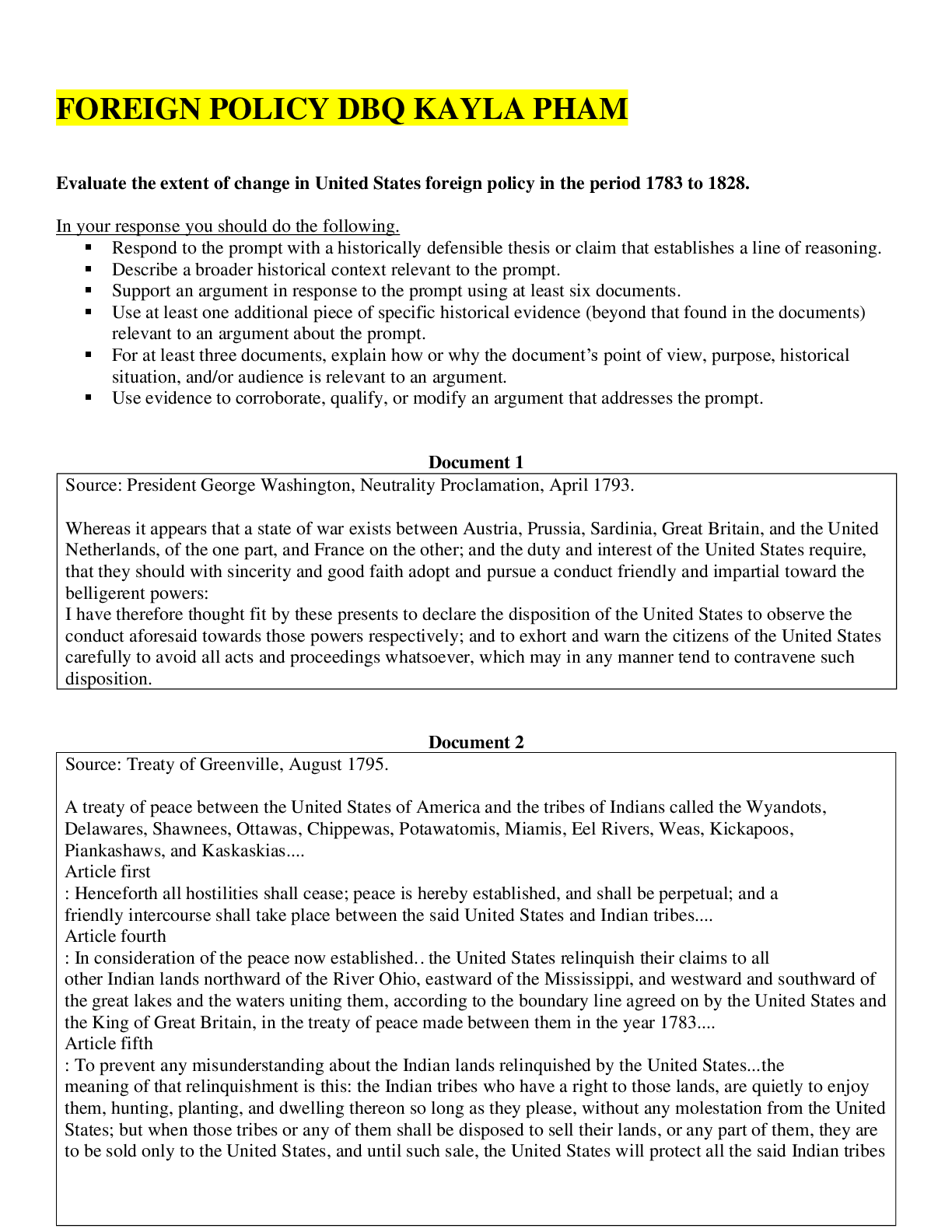
Evaluate the extent of change in United States foreign policy in the period 1783 to 1828.
In your response you should do the following.
Respond to the prompt with a historically defensible thesis or claim that esta
...
Evaluate the extent of change in United States foreign policy in the period 1783 to 1828.
In your response you should do the following.
Respond to the prompt with a historically defensible thesis or claim that establishes a line of reasoning.
Describe a broader historical context relevant to the prompt.
Support an argument in response to the prompt using at least six documents.
Use at least one additional piece of specific historical evidence (beyond that found in the documents) relevant to an argument about the prompt.
For at least three documents, explain how or why the document’s point of view, purpose, historical situation, and/or audience is relevant to an argument.
Use evidence to corroborate, qualify, or modify an argument that addresses the prompt.
Document 1
Document 2
Source: Treaty of Greenville, August 1795.
A treaty of peace between the United States of America and the tribes of Indians called the Wyandots, Delawares, Shawnees, Ottawas, Chippewas, Potawatomis, Miamis, Eel Rivers, Weas, Kickapoos, Piankashaws, and Kaskaskias....
Article first
: Henceforth all hostilities shall cease; peace is hereby established, and shall be perpetual; and a friendly intercourse shall take place between the said United States and Indian tribes....
Article fourth
: In consideration of the peace now established. the United States relinquish their claims to all
other Indian lands northward of the River Ohio, eastward of the Mississippi, and westward and southward of the great lakes and the waters uniting them, according to the boundary line agreed on by the United States and the King of Great Britain, in the treaty of peace made between them in the year 1783....
Article fifth
: To prevent any misunderstanding about the Indian lands relinquished by the United States. the
meaning of that relinquishment is this: the Indian tribes who have a right to those lands, are quietly to enjoy them, hunting, planting, and dwelling thereon so long as they please, without any molestation from the United States; but when those tribes or any of them shall be disposed to sell their lands, or any part of them, they are to be sold only to the United States, and until such sale, the United States will protect all the said Indian tribes in the quiet enjoyment of their lands against all citizens of the United States, and against all other white persons who intrude upon the same. And the said Indian tribes again acknowledge themselves and all their people to be under the protection of the said United States and no other power whatever
[Show More]